Showing posts with label difficult. Show all posts

Friday, April 8, 2016

Encouraging a Growth Mindset for your Students

       Growth Mindset is an understanding that you can learn and achieve anything if you are willing to work and practice and study and try.  A student's ability to learn is not predetermined from birth.


       This is an important concept for teachers who seem to always have some students who believe that they are not born with the skills necessary to learn.  A common saying among some students is, "I don't have a math brain.", meaning, "I don't have the ability to learn math regardless of the extent of my efforts."  We know now that this is not true.  But teachers are often faced with the prospects of needing to convince some of their students that this is not true.
       This chart is filled with suggestions for helping students to view their perceived obstacles in a different way.  Part of a teacher's job is to motivate their students to do their best everyday.  The more that we can convince students and then demonstrated to students that effort leads to (at least some level of) success, the more we are able to create a learning atmosphere in which students believe that they can learn.

       Growth Mindset is for weak and strong students alike.  We also have students who have been successful in the traditional school setting who don't have a growth mindset.  These students may have been praised for their "smarts" and they may be afraid to try something new for fear of not succeeding.  This limits their ability to grow.  Hence, encouraging a growth mindset is for all students and not just for a few.  Our best teachers have always been encouraging a growth mindset.  We have all had teachers who were able to convince us to try and to work hard in the belief that we would eventually succeed.  We need to see this occurring much more often in our classrooms.


Wednesday, December 23, 2015

Teachers That Inspire Students

       Who is your hero?

       Who do you look up to?

       This is a very common essay question for students at all levels.  The list of people who fill the pages of these essays is long: parents, athletes, friends, teachers, grandparents, historical figures, authors, poets, leaders,....  The world is full of inspiring people.  It is easy to think of such a person and maybe difficult to think of only one such person.

       These people make us believe that we can do anything.  They help us to overcome obstacles, to work harder, and to be better people.  They ask for very little in return--usually nothing.  They come to mind during the times in our lives when we think that we can't go on or we can't achieve.  They are our own, personnel superheroes.

       Most people can think of a teacher who has inspired them.  Usually a teacher who demanded high performance and worked hard to help you to achieve.  Our favorite teacher(s) were the people who believed we can do more than we believed we ourselves could do.

       Teachers that inspire students to do their best are the teachers that every parents wants their children to have.  They make learning adventurous, exciting, and thrilling.  They give their students the tools to tackle difficult problems and the self confidence to keep trying when they don't "get it" the first time.

       Be the teacher that inspires your students.


Sunday, November 8, 2015

Improving Education is Harder than Going to the Moon

       I often hear people say, "We have been able to send men to the moon.  Why can't we improve education?"  The implication, of course, is that the effort to send people to the moon is certainly more difficult than educating children.  So if we could do that, why can't we accomplish this--much easier--task?

       I would contend that improving education for all students is much more difficult than--the extremely complex of task of--sending people to the moon because (even today) educators are dealing with many more "unknowns" than NASA had in 1969.

       I doubt that anyone at Mission Control watched the Apollo capsule heading toward the moon thinking, "I'd say that we have a 20% chance of missing the moon by a hundred thousand miles."  They knew how far away the moon was; they knew the amount of force needed to break out of the earth's atmosphere; they knew how much food the astronauts needed.  It was certainly a complex task.  Mistakes were surely made and some things certainly went wrong.  But the Apollo 11 team that dealt with the physics of sending people to the moon were dealing with plenty of known quantities.

       In contrast, improving education involves our--still evolving--knowledge of how students learn.  Brain research is currently taking place and reporting new findings every year.  We have to contend with understanding the best way to motivate students and the best way to teach students.  And, of course, students aren't robots with the same abilities and the same limitations.  We have students from rich and poor families with different views of the benefits of education.  We have students from different home-life situations in which some are very supportive and some lack any sort of structure.

       It would make more sense to compare the effort to improve learning with the effort to cure cancer.  Over the years and decades, both of these fields have experienced progressed, but neither of these fields have been able to claim a complete victory.  Our understanding of cancer cells has certainly improved from 100 and 50 and even ten years ago, but we don't know enough to know how to stop their growth throughout the body.  Similarly, our understanding of how students learn has improved, but we are yet to find a school model--or even an education model--that best addresses the needs of all of our students.

       Improving education is a complex problem.  We see small improvements from time to time; and we see isolated pockets of (what appear to be) great success from time to time.  But we still have more to learn before this problem can be solved.  We have to continue to build on the successes of the past (and present) to reach the day when all students will receive the full education that they deserve and all students will reach their full potential.


Sunday, October 25, 2015

Teachers that Promote a Growth Mindset

       Every teacher has had "the phone call" with parents in which the teacher says,  Your child has the ability, she just needs to apply herself.  And then the teacher and parent (typically) talk about school rules involving turing work in on time and not talking in class.  Essentially, we are saying to the child, We're the adults.  These are the rules.  If you don't follow the rules, then you will get a bad grade.  (Of course, if the student was concerned about her grade, we wouldn't have this discussion in the first place.)

       There are a lot of "old school" problems with that phone conversation.

  1. The conversation emphasizes following rules and getting grades, and there is very little talk about actual learning.
  2. The first part of the famous teacher line is, Your child has the ability....  If the child already has the ability to do the work, then the solution to the problem should concentrate on why the child isn't doing what she is already capable of doing.
       We know that (as adults) there are lots of things that we have the ability to do and yet we don't do them--or we delay doing them for as long as possible.  Mowing the grass, doing the dishes, admitting we're wrong about something.  We have the ability to do all of these things, but we need some sort of motivation to actually take the time to do them.  Students are the same way.  The old adult (or teacher) response of "I'm the adult and I say so." may force children to do something, but it certainly doesn't motivate them to do their best.

       Growth Mindset theory tells us that when students believe that effort will lead to result, they are more likely to try new things and are less worried about making mistakes because they believe that these setbacks are just part of the process of learning new things.  I've recently been introduced to the website Mindset Kit.  This site is dedicated to helping teachers, parents, and students to understand what Growth Mindset is and how to help students to develop good, healthy Growth Mindsets.

       One simple strategy that every teacher can do is called Praise the Process.  When a student is doing some classwork, or offers an answer or an idea in class, the teacher response by praising the thinking that went into the student's effort rather responding to the correctness or the incorrectness of the student's work or response.  This simple strategy helps the student to know that their effort is important towards that eventual goal of learning the skill or concept.
  
       Mindset Kit has excellent resources for parents.  Teachers can refer parents to this site for parents who ask, "How can I help my child to do her best?"  There is a brief quiz on different statements of praise that parents can say to their children that will promote a Growth Mindset.  And there are other typical daily activities in which a parent's reaction will help their children to understand (for instance) that making mistakes is great for helping your brain to learn.

       Our best teachers already know how to encourage their students to do their best everyday--even when they don't want to.  It's the same as when a parent tries to distract their child away from something that is bothering him and towards something that he would like.  Growth Mindset strategies help teachers to do this while also helping their students to see the value in effort.

       Here's another quote I hear from parents all of the time, "I can't believe my child is doing so well in (insert course subject here) class in school.  He has never done well in that class before."  You can bet that this child has a teacher that knows how to motivate students.  Her class is interesting and students are engaged in the adventure of learning.  

       After all, they already have the ability.


Sunday, September 20, 2015

We Are a Community of Learners

       Teaching students is not like like building a model airplane.  We don't have distinct steps to follow that will lead to a completed project in the end.  Students learn differently; they come to school with different experiences and different abilities.  Good teaching requires an understanding of the learners in each classroom and daily lesson plans that are designed to help those learners.

       Good teachers understand the difficulty of reaching each individual student and they seek out the best strategies from experts in the field of education and from the teacher across the hall.  We (educators) are a community of learners.  We have to be.  We can't learn everything from experience and we can't figure out everything on our know.  We can't be experts in child psychology and special education and mathematics and English Language Learners and student engagement and formative assessment and ....  We need each other to be the best teachers we can be for our students.

       After more than 25 years in education, I am still learning and improving by listening and reading and following other educators just like me who have something great to share.  Here is my short list of excellent sources of information for educators who strive to make a difference with their students and who seek to improve their abilities every year:
  1. Annie Murphy Paul - The Brilliant Blog
    1. Her recent writings on how to using testing as a learning tool (aka - formative assessments) are informative and eye-opening to those who only see testing as an end-of-unit assessment.  She has also recently released an e-course that will show parents, teachers, and school leaders how to implement testing strategies as opportunities for student learning and growth.
  2. Robert Marzano - Marzano Research
    1. Great professional development information for teachers and for whole schools on topics ranging from Student Engagement to Assessment and Grading to Instructional Strategies to Teacher Effectiveness.  Don't let the "research" part scare you; Marzano provides effective tools and ideas that are simple to understand and to implement.
  3. Doug Lemov - Teach Like a Champion
    1. Excellent tips that any teacher can use to improve student learning and student motivation.
  4. Starr Sackstein - Changing the World, One Mind at a Time
    1. Great ideas and thoughts from a National Board Certified Teacher
    2. Lots of great recent blog posts about emphasizing learning and de-emphasizing grading

       And teachers don't have to go online to find excellent educators to collaborate with; look to your administrators, and district and state-level leaders.  Find ways to collaborate with teachers in other school buildings in your school district.  There is great value in learning from other professions.  I would say that it is a necessary element for teachers who strive to improve year after year.

     We are a community of learners.

Friday, August 21, 2015

11 Serious Questions for Teachers


       Yesterday I welcomed our 200+ secondary mathematics teachers to the 2015 - 2016 school year.  We do this every school year and it is always an exciting day.  We get to see people we haven't seen since last June; middle school teachers get to network with their high school colleagues.  The first day of school is getting closer and closer.

       This year I welcomed them with 11 serious questions about teaching.  Since this week is filled with the details of preparing those first lessons, decorating the classroom, preparing class resources, and learning about any new school policies and procedures, teachers don't usually get the chance to sit down for 30 minutes and reflect on why they do what they do.

       Here are the questions I asked them.  Read each one and take 30 seconds to reflect on your answer to the question.

  1. Why do you teach?
  2. What is your goal this year?
  3. Will you make a difference?
  4. What will you do differently this year?
  5. How do you view challenges?
  6. Where is the line between impossible and very difficult?
  7. Do your students have a Growth or Fixed Mindset?
  8. How do you know when they "get it"?
  9. Do student's term grades reflect their ability?
  10. How do you move your students from procedural to conceptual understanding?
  11. Why do you teach?
       Teachers have a job to do.  It is a difficult, complex job.  And the need to grow and to improve in the job is necessary because it isn't the sort of job in which a person knows everything they need to know when they graduate from college.  Teachers face new challenges every year and their ability to find solutions to those challenges is generally what separates good teachers from great teachers.

       Here is a movie clip I shared with the teachers in which FDR struggles to stand up straight and then boldly says, "Don't tell me, 'It can't be done.'"

       Why do you teach?


Wednesday, August 19, 2015

Open Letter to Teachers

 This is the second of a three-part series of open letters to the three most important stakeholders in our educational system: students, teachers, and parents.  All three of these groups play a vital role in the education of our children.


Dear Teachers,


       If students only knew how excited and anxious and thrilled and nervous and ... all teachers are as the first day of school approaches.  The first impression, the first lesson, the first assignment, the first words that a teacher utters on the first day of school--every second is precious.

       A teacher's role in the education of our nation's children is the most vital and influential component of our educational system. As a teacher, your abilities have more of an impact on student achievement than any other factor.  All of this importance (I know) puts a lot of pressure on you to do the best job possible everyday.


       And to add to these pressures--as you already know--teaching is a very difficult job.  Different students with different learning styles; some having good days and some having bad days ON THE SAME DAY; building positive relationships and teaching to the highest standards.  The demands on you are many.

       I want you to know how much I appreciate the work that you do.  The best of you strive to improve all of the time.  Teaching is the sort of profession that's hard to master.  There is always something more that you can do; more students that you can reach; better strategies that are more effective for more students.

       You also, at times, have to be the one who tells a student that he isn't reaching his potential--and I thank you for that too. We have to be honest with our students and we don't want them to have a false sense of accomplishment only to discover (perhaps in college) that they real do not have the abilities that they were told they had.

       I hope you will be a warm demander as a teacher this year.  That is, be the teacher with high standards who insists that students do their best everyday, and at the same time your students know that you care for them and will do everything you can to help them to achieve.  Students appreciate teachers who believe that they can be successful with difficult material.  Students don't want teachers who make everything easy and demand very little from them. This only tells the students that they aren't worth the effort to teach.  Help your students to engage in productive struggle in the classroom.


       To all of our great teachers, I hope you have the best school year ever!  We often say that our students are our future.  If this is true, than it is true that our teachers are the ones who shape our future.


Tuesday, August 18, 2015

Open Letter to Students

       This is the first of a three-part series of open letters to the three most important stakeholders in our educational system: students, teachers, and parents.  All three of these groups play a vital role in the education of our children.


Dear Students,

       As a brand new school year begins, I want to share some of my thoughts about school and education in the hopes that they will help you to have a successful year of learning.

       Note that I've used the wording "learning" and I didn't say a successful year of getting good grades.  Grades may be one indication of your learning, but grades are not the purpose of school.  Indeed the reason we adults have these rules about going to school is because we want to do our part in preparing you to be as prepared as you can be for the majority of your life as an adult.  Hence, school shouldn't be a competition for grades, but instead it should be a journey of learning.

       Some of you will learn best by sitting still and quiet in your chair and listening to your teacher and (maybe) writing some notes.  But we now know that most students don't do their best learning in this way.  Learning requires you to ask questions and to be curious about what you are taught.  You need time practice; you need time to make mistakes and fix those mistakes and make more mistakes...and so on and so on.

       Have you ever read a book that you really liked and felt that you were a fast reader?  But at other times you read a book that you weren't interested in and it seemed to take a long time to get through it.  Learning is like that.  So try to find something interesting in everything that you learn in school and you will find that learning itself can be interesting.

       I think the important thing to know about learning is that learning can be a struggle at times and that's OK.  If you learned everything the first time a teacher taught it to you, than you probably are ready to move on to a tougher class (or a tougher teacher).  Faster is Smarter.  Learning shouldn't be a competition to be the first person to finish an assignment.  Learning takes time.  So don't worry if you don't get it the first time.  True learning rarely comes fast.

       Your teacher is there to help you when you don't get it the first time.  If your teacher doesn't help you then you need to tell someone; tell your mother or father or a guidance counselor.  No teacher should make you feel bad about not learning.  No one is an expert in everything--including your teacher.  Most teachers are glad to help you--that's why they are teachers.

       So work hard at your learning this year.  Take responsibility for your learning.  Don't look for shortcuts or for "the easy way".  People who know how to learn can learn anything.  You can learn anything.  Ask for help and don't give up.  

       School is an opportunity for every student.  It, unfortunately, is not an opportunity that every child in world is given.  Appreciate this opportunity and do your best everyday.

       Have a great school year!


Thursday, July 16, 2015

Make Math Meaningful: Math Tasks

       The days of the boring worksheets in math class and the word problems about the train leaving New York are over.

       Well...actually, they're not over.  But they should be over.

       We already know that most students (and adults) do not learn new things very well just by listening to someone explaining it; after which the teacher often says something like, "Does anyone have any questions?"  This is when the students want to say, "How can we have any questions about this?  You just taught it to us one minute ago.  (And then they get a worksheet.)

       This is passive learning.  This learning promotes adherence to procedures and getting-the-right-answer over true learning and understanding.  Some students do fine and some students do not; and it is simply not acceptable to engage in teaching strategies that don't help all of our students.

       Math classes should be places where students are actively engaged in their learning.  Students are presented with a problem or a task and they work in groups to brainstorm ideas based on the objectives that they have been recently learning.  The final answer can be reached via multiple solution methods and (most importantly) the students are using and learning mathematics simultaneously.  Finally, students are able to explain what they are doing (teaching others) which is a way for students to demonstrate their understanding.

       Math Tasks are written to be activities that students can do in small groups in their math classrooms under the direction and supervision of their math teacher.  Math Tasks are meant to take the place of the old 20-problem-worksheets during class time.  Instead of students working quietly and independently, they are working together with other students: learning from each other and sharing their ideas.

       There are many online resources that have wonderful math tasks.  Some of my favorites are:

  • Illustrative Mathematics
    • Go to Content Standards, then chose a Grade, then chose a Domain, then chose a cluster, then chose a standard and you'll see a list of Math Tasks.
  • Mathematics Assessment Project (MAP)
    • Click on Tasks and see a list of middle school and high school Math Tasks.
  • Inside Mathematics
    • Click on Performance Assessment Tasks and chose a grade or course to see a list of Math Tasks
      Math Tasks model the way math is done in the real world.  That's where you are presented with a problem and you have to decide which resources to use to find a path to the answer.  There is more than one way to get the answer and sometimes there is more than one possible answer.  Math Tasks help our students to understand mathematics.


Tuesday, June 23, 2015

Why Do You Teach?

       The school year ended four days ago and I am thinking about welcoming my teachers to the next school year.  (Wow.  That was a short summer vacation.)

       Every year in our school district the teachers return to school one week before the students return.  On one of the days of that first-week-back, all of the secondary teachers in the district meet in their subject areas for a full day of professional development before the school year begins.  This is a time to learn about new resources, to network with other teachers in other schools, and to energize teachers to get excited about the new school year.

       We know that an effective teaching strategy for student understanding is to ask a lot of questions that encourage students to think about what they are learning.  If students can explain what they are doing and why they are doing it, they must understand it pretty well.  It also reinforces the idea that we want students to understand underlining concepts and not just to get-the-right-answer.

       In that vein, I am going to ask our teachers some questions in an effort to encourage them to think about what they do and why they do it.  These question will challenge the teachers to consider different possibilities.  They will be questions that defy simple answers.

       I'm in the beginning stages of preparing this presentation and I am certainly open to suggestions.  Feel free share (in the comment section below) other questions that you feel would be good questions for teachers in the beginning of the school year.

Questions:
(1) Why do you teach?
(2) What are your goals this year?
(3) What will you do differently this year?
(4) How will you make a difference?
(5) What do you want to learn this year?
(6) Why is mathematics difficult for some of your students?
(7) How will you help students who don't ask questions?
(8) How will you engage your students in their learning this year?
(9) How do you help your students to value "learning" over "getting-grades"?
(10) Why do you teach?

       We ask (or should be asking) our students difficult questions every day.  As such, we need to ask ourselves difficult questions.  Teaching students who are willing and able and ready to learn is easy.  But trying to reach the unwilling, the struggling, and the distracted student takes time and effort and expertise.

       Why do you teach?


Monday, June 8, 2015

How Much Help is the Right Amount of Help for High School Students?

       Parents and teachers want school-age children to be responsible--at least, "responsible" given their age.  But what is the right amount of responsibility for a high school student--or for a new college student?  How much "help" do 16 year olds (or 18 year olds, or 20 year olds) need to navigate the rigors of high school courses, college courses, and college life?

       Some high school students seem to breeze through high school with very little guidance from adults while others struggle--same for college.  These students make some teachers say, "See!  They can do it, so anyone of you can do it."  But is this just a "sink or swim" mentality?  Does this viewpoint help students learn responsibility, or does it prevent them from succeeding.

       On the other end of the spectrum, some say that we help student too much in high school and (so) they aren't prepared for the independence of college courses.  (Is it true that college teachers don't help their students?  I hope not.)  High schools help students to remember deadlines and they offer after-school help.  Is that "too much" help?  What is the proper balance of teaching responsibility and helping students to successfully navigate courses and school programs?

       I believe that their is value in allowing students to make mistakes and to learn from those mistakes.  I also believe that we should not be so extreme in our "caring" at the high school level that we (as teachers) do too much for students to the point that they only doing-what-they-are-told and are not learning anything.  But should we allow them to fail a course if they know the content but struggle to meet deadlines?

       Should we really expect 14 year old 9th graders to hear a long, long, long list of directions and rules on the first day of school and then penalize them for not following rule # 56 on the 23rd day of school?  Should we have to remind 11th graders of the term paper deadline everyday for three weeks?  How much help is the right amount of help?

       I think my main concern is for students who capable of learning what they need to learn at a satisfactory level (or higher), but they struggle with skills such as organization, planning ahead, learning school procedures (such as college course sequences), and meeting deadlines.  I know that these skills are important and (certainly) we want these future employees to have these skills.  But is high school and college the right place for penalizing teenagers and young adults who are still developing these skills?  I am particularly concerned about students who drop out of high school or college due to a lack of organization and not due to a lack of academic ability.

       As public schools, we should do everything we can to help our students to succeed.  But how much "help" is too much help, and how much "help" is too little help?


Wednesday, May 20, 2015

Graduation and Austin Cincotta


       A recent report from America's Promise Alliance on high school graduation rates reports that the United States High School Graduation Rate rose to 81.4% in 2013.  This represents a steady increase over the two prior years--a promising trend toward the (albeit, lofty) goal of a 90% high school graduation rate by 2020.  Ninety percent?? Maybe.   By 2020??  Not likely.

       About 3.3 million students are expected to graduate from high school this year according to the National Center for Educational Statistics. When we talk about millions of high school graduates and their collective prospects in the working world and the college world, it's easy to look at broad trends and predict likely outcomes.  But when we look at individuals, we move to the realm of real people with real concerns, real emotions, and real dreams for the their future.

       One of this year's high school graduates is my son, Austin Cincotta.  He was born in the waning years of the 20th century and grew up in the early years of the digital age.  He never used a rotary phone and he never changed a TV channel by turning a dial on the television.  He's loves his family, is a good friend, has been a boy scout since first grade, plays multiple instruments, and is interested in robotics and motion pictures.  He is excited about graduating from high school and moving on to the next phase of life.

       As for me, I am very excited for him and for the types of experiences that he will have over the next few years.  He will experience the freedoms and responsibilities of college while he thinks about his future endeavors.  He will be frustrated by meeting requirements that don't seem to have a direct link to his interests, and he will thrive in the areas that do.  He will have support from family and friends and (hopefully) from his school and his teachers.

     Our P-12 system along with family and community has done its best to prepare my son for his life after high school.  There will be ups and downs.  Ultimately his ability to make decisions, to meet goals, and achieve are up to him.  Still, I have the following hopes:


  • I hope he is willing to ask questions when he doesn't understand something and he needs to understand it
  • I hope he chooses right over wrong, even when right isn't comfortable
  • I hope he understands the value of hard work and sees (or "imagines" if he can't see it) the benefits on the other side of hard work
  • I hope he takes some chances that may be based on good criteria, but who's endpoint cannot always be known at the beginning.
  • I hope he loves what he does
       When he was little, people always told me that I couldn't protect him from all of life's dangers.  I still can't.  I can try, but I can't do it all of the time.  It is his time to face the joys and dangers of life.

       Ladies and gentleman of the world, I present my son, Austin Cincotta--quite possibly the most precious and special high school graduate this year!

       Be nice to him.  He's still learning.


Monday, May 4, 2015

Attitude Trumps Ability

       Remember when you left for school as a child and your mother said, "Do your best"?  It turns out, that was pretty good advice.


       Most students who don't succeed in their school subjects have plenty of ability but instead lack the desire to do their best.  Maybe they believe that they don't have the natural, genetic, brainpower to succeed (read Mindsets by Carol Dweck).  Maybe they have problems at home that make their schoolwork seem very unimportant.  Maybe they have a fear of failure.  I contend that most of the time, it isn't ability that is holding them back.

     Here is the most common teacher phone call to parents:

Teacher: Hello Ms. Thompson.
Parent: Hello Ms. Salero.  Is there a problem with my son, Donald, in your class?
Teacher: Donald has lots of ability; he just needs to put in the effort.

       Every teacher knows that their job is two-fold:

       (1) Teach
       (2) Encourage students to learn  


If learning isn't taking place, the best teachers with the best lesson plans won't make any difference in the lives of their students.  Hence, teachers spend a lot of time thinking and experimenting with the best ways to motivate students to do their best.

       When parents ask, "What can I do at home to help my child?", the best answer is to encourage your child to do their best everyday.

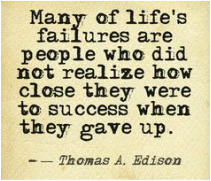
       Students need to understand that learning takes time and learning is hard and learning requires struggle.  But a lack of understanding after the first try does not mean that you are unable to learn.  In fact, it's the struggle that helps your brain to make more connections and to retain what you are learning.  Stanford educator, Jo Boaler, talks about this all of the time (see video).  Students need to understand the value in making mistakes--it isn't an excuse to give up.  In fact, mistakes are excellent learning opportunities.


       Some students are anxious to learn and don't mind making mistakes.  But others are so focused on "getting-the-right-answer" and "winning" that they are quick to give up when they don't understand something the first time.  We need students to understand the value of productive struggle.

       Keep trying; keep struggling; keep making mistakes; and keep learning.


Saturday, April 18, 2015

The Challenge of Educating Poor Students - Part 2

       American Public Schools face many and varied challenges.  Funding, equity, and public support to name a few.  On the top of this list of challenges, I would include: The Achievement of Poor Students.

       It is easy to understand the underpinnings of this problem, and yet it is extremely complex to succeed in overcoming this problem.  The problem stems from two indisputable facts:

  1. Poor students consistently demonstrate lower achievement than their non-poor peers.
  2. The proportion of poor students in our nation's public schools is over 50% and is growing.


       I will examine this challenge from three perspectives:

  1. Poor students who have succeeded in our schools
  2. Understanding the special and different needs of poor students 
  3. Expert advice on successfully educating poor students
--------------------------------------------------------------------------------------------------

The Challenge of Educating Poor Students - Part 2

Understanding the Special and Different Needs of Poor Students


       People who grow up in a middle class (or higher) home environment may take for granted simple life experiences that poor students and their families never experience.  Well-meaning teachers may have never experienced living in a poor environment and working with poor people until their first year in the classroom.  Particularly since school teachers must have a college degree and it is rare for poor people to earn a college degree, teachers are generally from a middle class (or higher) background.  

       Here is a short list of challenges for most poor students:

1) Regular, quality medical care
       
       Middle class families generally have a regular doctor for their children.  When children are sick, they go to the doctor and they get better in a couple of days.  When poor students get sick, they don't have access to a doctor or to medicine; this makes them sicker.  When they are too sick to come to school, they generally miss more school days because it takes them longer to get better.  And if they come to school when they are sick, it is harder for them to concentrate on their school work.       

      A lack of medical care leads to other issues that are more prevalent among the poor such as untreated ear infections and hearing loss issues, greater exposure to lead, and a higher incidence of asthma (source).  All of these health issue contribute to higher absenteeism and lower engagement with class lessons at school.

2) Small vocabulary when they start school

       Students from poor households hear and use considerably less words than students from middle class households.  This puts poor students at an academic disadvantage from their first day of kindergarten.  Students who are less able to use words to express their feelings and to explain their thinking because frustrated and soon shy away from activities that involve reading because they don't want to appear less able than their peers.


      Opportunities to increase each students' personal vocabulary must be of primary importance for poor students.  We know from multiple studies that students who are not reading on grade level (or above) by third grade have a reduced chance of graduating from high school. (source)  This is a significant risk factor for poor students.  In 2013, the overall national high school graduation rate was 81.4%  but the rate for poor students was only 73.3%.

3) Fixed vs. Growth Mindset

       Stanford psychologist, Carol Dweck, and her book Mindset has taken the education world by storm over the past few years.  And so it should.  She has proved that students who believe that they are not smart will refuse to try to succeed.  This is the belief of the "Fixed" mindset; the one that says, "I have a fixed capacity for learning and no matter how hard I try I won't get any smarter."  In fact, nobody has a brain that isn't capable of learning more.

       But poor students are more likely to believe in the Fixed Mindset because they are less likely to see the many opportunities that will be offered to them in the future beyond high school and college graduation.  Poor students need to be praised for their effort and teachers need to point out when their thinking has led to a great solution to a problem.  Students with Fixed Mindsets believe that they just got lucky whenever they get a good test grade.  They need to understand that it is their effort and their learning that led to that good test grade.


       Teachers at every level (elementary, middle, and high school) can help poor students to succeed.  But we have to understand the deficiencies that they bring to school and we cannot label every lack of effort as "laziness".  Some poor students do succeed; they are the lucky ones.  They probably had great teachers and caring parents or caring authority figures at home.  Overcoming these deficiencies is a very difficult job for our public schools; but understanding the problem is certainly the first step.

       All teachers should receive some training in the education of poor students.


Wednesday, April 15, 2015

The Challenge of Educating Poor Students - Part 1

       American Public Schools face many and varied challenges.  Funding, equity, and public support to name a few.  On the top of this list of challenges, I would include: The Achievement of Poor Students.

       It is easy to understand the underpinnings of this problem, and yet it is extremely complex to succeed in overcoming this problem.  The problem stems from two indisputable facts:

  1. Poor students consistently demonstrate lower achievement than their non-poor peers.
  2. The proportion of poor students in our nation's public schools is over 50% and is growing.


       I will examine this challenge from three perspectives:

  1. Poor students who have succeeded in our schools
  2. Understanding the special and different needs of poor students 
  3. Expert advice on successfully educating poor students
--------------------------------------------------------------------------------------------------

The Challenge of Educating Poor Students - Part 1

Poor students who have succeeded in our schools

       Every public school can point to a student who comes from a poor family and (yet) defies the odds and does well in school academically.   Or...Can they?  Unless you know the student's background, it might be hard to find these students in your school.

       The outward signs of poverty are relatively easy to see:  dirty clothes or the same clothes day after day; same, single pair of shoes everyday; no extra school supplies.  And then there is the attitude--opposition behavior, attention disorders, excessive absenteeism.  Taken alone, these are not necessarily signs of students from poor homes, but taken together there can be assumptions of the student's home lives based on these visible factors.

       Unfortunately, it is so common for poor students to have low academic achievement that when we have a poor student who succeeds in the academics of school we (often) don't see that child as being from a poor background.  So what is it that propels a poor student to achieve where his/her peers don't?  And what can we learn from poor students that succeed that can help us to raise the achievement of other poor students?

Vocabulary Acquisition


       According to a study from 1995, from the age of 7 months to the age of 3 years, 90% of the words used by children were words used by the children's parent (or primary caregivers).  Parents with higher educations used more words than parents with less education AND higher educated parents talked to their babies and toddlers more than less educated parents.  This creates an "Achievement Gap" among very young children before they even begin Pre-kindergarten.

       But poor students who succeed in school often come to school with a good vocabulary because they were blessed with parents and/or caregivers that shared with them the (totally free) gift of words when they were very young.  Babies and toddlers can learn words from parents reading books to them; but they also learn from simple talking and singing.  So families that cannot provide a lot of children's books to their children can still provide the precious gift of words by simply talking to their children every day.

Grit

       The story of Karvel Anderson is the best definition of grit that you will ever find.  Karvel's story is one of a child who grew up with many challenges but never anything that made him give up on life.  He says that adversity was good for him because he always wanted to prove that he can do anything.

       Most students from poor backgrounds succumb to the narrative that they will never succeed because it seems like the world is against them.  Every where they turn, some one is taking away an opportunity or refusing them something.  Grit is a personality trait in which a person strives to achieve goals regardless of the obstacles that may stand in the way.

A Supportive Adult

       Poor student who succeed usually have an adult in their life that is there to encourage them when times are tough.  It might be a parent, but it also might be a teacher, a grandmother, a school counselor, or a coach.  While some students seems to have the ability to overcome just about any situation, most poor students need someone to guide and help them through the toughest times.


       As schools and teachers look to increase the achievement of poor students, I believe that we have to understand that the world they live in can seem very different than our world.  We need to understand how their lack of resources and supports is a great hindrance to their academic success.  And we have to find a way to fill in the supports that they are lacking so that we can help them to value education and to be successful in school.


Friday, April 3, 2015

No More Worksheets!

       Here is a very simple test to determine the effectiveness of your child's mathematics teacher...

Question 1: Does you your child's mathematics teacher assign a lot of worksheets for homework and classwork?

If the answer is YES - Not a very effective teacher.
If the answer is NO - Likely to be a more effective teachers.


       This idea is a major shift in thinking for a lot of people--both for teachers and for non-teacher-parents alike.  Some would say, "How can you say worksheets are bad?"  Or, "I used worksheets when I was in school and I turned out fine."  And the internet is certainly full of sites with pre-made worksheets that are frequently downloaded and used by teachers.  So (I guess) the next argument is, "If so many teachers are still using worksheets, then why are they so bad?"  Here's why:

#1: We want students to understand the mathematics that they are learning.  Worksheets tend to encourage students to blindly follow procedures without knowing why they are doing what they are doing.  Students might get the answers correct, but if the problems were changed slightly they wouldn't know what to do because they never learned the "Why" of the procedures that they were using.

#2: If students know how to do something, then why do they have to do it 20 times?  It seems to me that if they can do it two or three times, that would be a sufficient amount of proof that they have learned the skill.  If a students does not know how to do something, then why are we forcing them to do something 20 times that they cannot do?  Have you ever completed a worksheet only to find that you made the same mistake on all 20 problems--and got everything wrong?

#3:  Worksheets are not engaging.  In Robert Marzano's book The Highly Engaged Classroom, we learn that students are more able to learn new concepts when they are engaged in the lesson.  He offers many strategies for increasing student engagement.  Worksheets tend to be boring and repetitive and very discouraging in terms of engaging students.

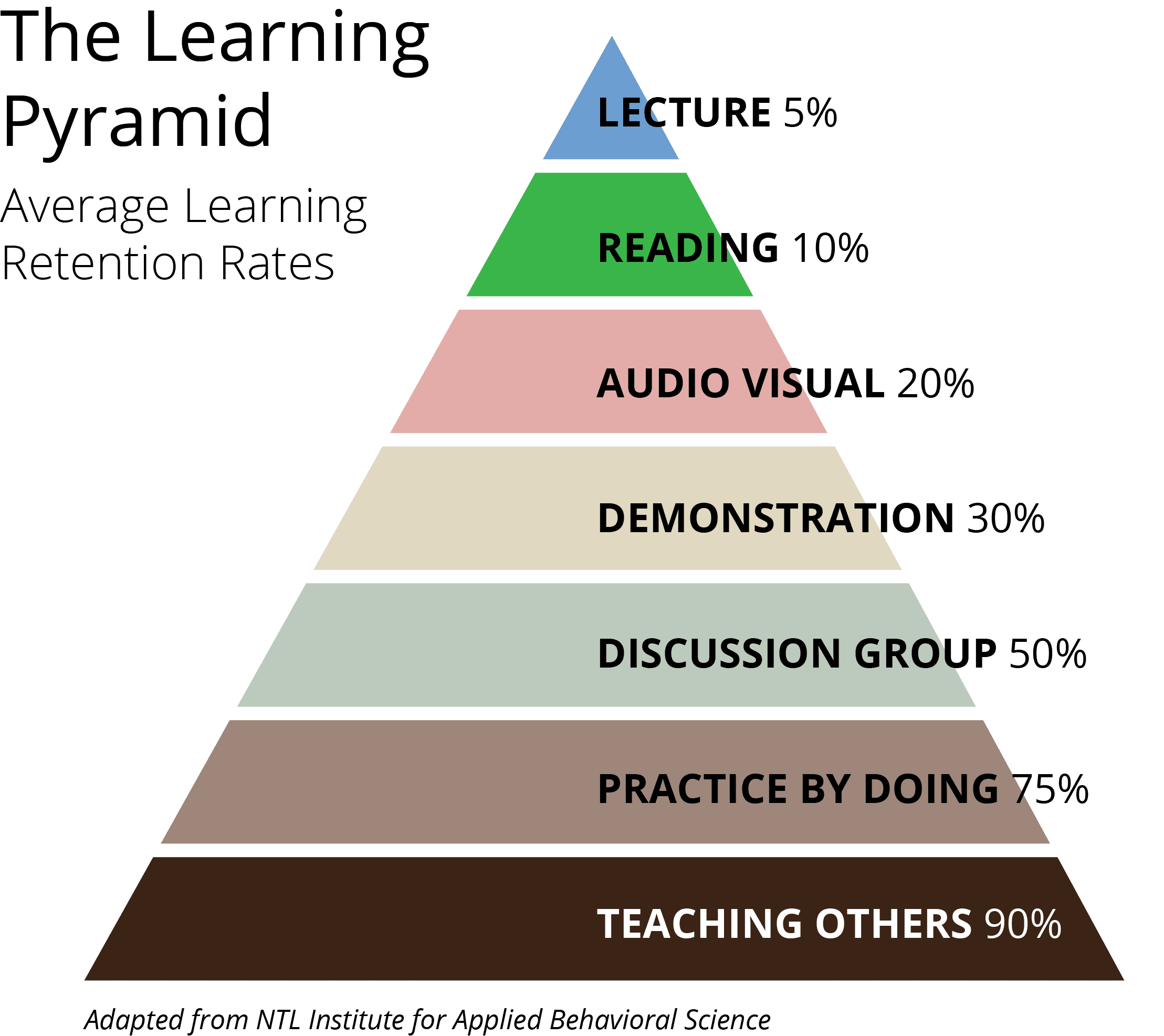
#4: We want students to communicate and collaborate with their peers during the learning process.  As students struggle with a new topic, it is valuable for them to know to ask questions and to try different approaches to solving a problem.  We call this Productive Struggle (also see here and here and here).  When students do worksheets, they are often working in isolation.  They are discouraged from talking at all with other students.  This creates a classroom in which students are expected to listen to the teacher lecturing and only to the teacher and then to learn the new content based on what they heard.  We know that this is not an effective method for learning (see The Learning Pyramid graphic).

       One reason that teachers like worksheets is that they are used to help control student discipline in the classroom.  Some teachers are not comfortable with students talking to each other and asking each other questions because they are concerned about losing control of their classes.  But we know that when students are engaged in an activity, they are focused on the activity and not distracted by anything else.  There is a benefit to allowing students to talk with each other.  And there are many strategies that can be used to do this in a productive and organized manner in the classroom.

     
       One of these strategies is the use of Math Tasks.  Math Tasks encourage critical thinking, student discussion, and questioning from students that lead to better understanding of mathematics concepts.  Many sources offer great Math Tasks for teachers to use.  Here are just a couple of them: Inside Mathematics and Mathematics Assessment Project.

       The goal of our public schools is learning.  We must use the best thinking we have to encourage thinking and learning among our students.  We don't want students to merely "complete" courses, we want them to learn, to understand, to retain knowledge, and to build upon their learned knowledge.


Wednesday, April 1, 2015

Learning, Smoking, and The Long Arc of Change

       When I think about the huge job of improving education outcomes among our students (especially our poor students) in America, I think about the amazing turn-around in behavior about smoking over my lifetime.

       It is nothing short of a modern-day miracle that smoking has declined so dramatically in the United States over the past 50 years.  In 1965, 42.4% of U.S. adults were smokers.  By 2003, that number was cut in half and in 2013 we were down to 17.8%.  And, of course, our population has risen quite a bit over this timeframe from 194 million people in 1965 to over 320 million people today.

       No one in the United States in 1965 would have ever believed that Americans would give up their love for smoking so dramatically.  Even with today's relatively low rates of smoking, nearly 70% of current smokers want to stop smoking.  It is nothing short of amazing the way this addictive behavior has changed in the United States in just a couple of generations.

       I believe that our public schools can look at this incredible event, this long arc of changed behavior, and that we can use it as a lesson for tackling the equally difficult task of improving the educational outcomes of our students.  We can examine the efforts that took place (and continue to take place) that convinced people that smoking is bad for you; and (perhaps) we can undertake similar efforts in our public schools.

       First of all, there was a national effort to inform the public of the dangers of smoking.  This began with the first surgeon general's report that provided proof that smoking was bad for your health.  Of course, there were lots of people of that didn't believe the contents of this report.  I'm sure there were people who pointed to relatives and friends who lived well into old age and smoked their whole life--and, therefore, refused to believe that smoking was bad for your health.  But more and more information came out from public and private sources about the dangerous health risks of smoking and eventually it became very hard for people to believe that smoking wouldn't harm their health.  As smokers died from lung cancer and other diseases, people began to link these deaths to their habit of smoking.  This gave people a personal connection to the ill effects of smoking and it convinced them to never smoke or to quit smoking.  As they grew up and had children of their own, this knowledge of the evils of smoking was passed on to the next generation.  And so, what started as a national effort from government sources, slowly became a combined effort of government and private resources that worked together to bring down the rates of smoking in America.


       I believe that a similar combined effort is underway in our public schools today.  We have a government that believes in the value of education and is dedicated in improving the education of our citizens.  We also have many private efforts underway that are striving to do the same.  We also have segments of our population that don't believe that education is important.  As with the smoking example, they point to friends and relatives that quit school in eighth grade and grew up perfectly fine.  But (as with the smoking example), we also have generations of parents that have regrets of not doing better and trying harder when they were in high school.  They look at their peers who went on to college or some sort of vocational training and now have higher-paying jobs.

       I believe that we can change the behavior of Americans toward the value of education--and all of the hard work that this entails--over the next generation.  I believe that we can see a country with higher high school graduation rates and higher college graduation rates.  And when this happens, we will reap the benefits of a more educated society.  We will see less crime, less people on welfare, less obesity, and a strong economy.  And I believe that this will happen within the lifetimes of our current high school students.

       We can do it.  We have done it in other areas of our society and we can do in education too.  We must do better and we will.


Friday, March 27, 2015

Good Teachers Demand High Quality Performance from Their Students

       When you think about your favorite teacher, was he/she also your easiest teacher?  Was it the teacher that let you do whatever you wanted to do?  Was it the teacher that handed out grades like candy, but didn't care much about how much or how well you learned the course content?

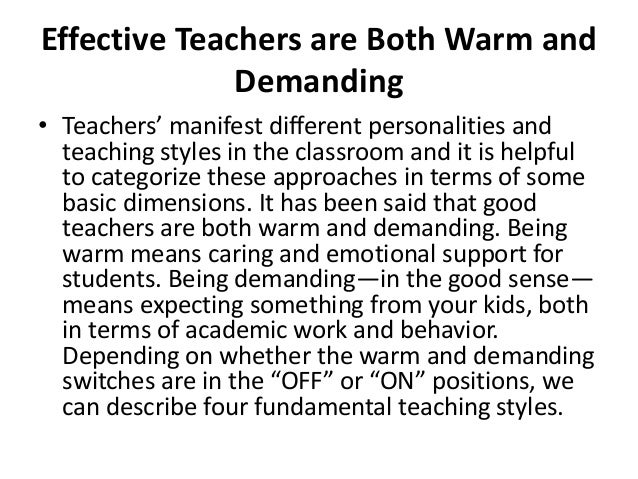
       The pedagogical term "a warm demander" has existed within the teaching profession for quite a few years at this point (see Ed. Leadership article from 2008).  The term was coined by J. Kleinfeld in 1975.  It refers to a teaching personality that makes an emotional connection with students, but also expects high academic and behavioral results from students.  This teaching technique has been praised as being particularly effective for poor and minority students; students who have historically achieved at much lower rates than their middle-class, white peers.  (see Becoming Warm Demanders, Caring Teachers, and Warm Demander Pedagogy)

       A famous example of the warm-demander teacher is Jaime Escalante.  He taught Calculus in Los Angeles.  Many of his students were poor and struggled with mathematics.  His caring yet demanding personality helped his students to achieve great results.

       Some teachers would argue that their job is only to teach and not to develop caring relationships with their students.  But I would counter-argue that only a part of a teacher's job is to teach.  The more important part is to ensure that students are learning.  This, indeed, is the hard part of teaching.  There is no single teaching strategy that is effective for all students when it comes to ensuring that learning is taking place.  Instead, we have to look to our colleagues and look to research and look to best practices to find these most effective teaching strategies.

       We know that students respond better to those teachers that show a genuine interest in them.  Students want to make their teachers proud of them--especially the teachers that really care.  Teachers that that understand their content and do not understand the need to connect with their students, often see lower academic results from their students.  And teachers that are very caring and friendly with their students but demand only low-level skills (similarly) see low academic results.

       It takes both: Warm and Demanding.

Saturday, March 7, 2015

Blood Donors and Students: Doing the Right Thing

       I've been a blood donor since I was 18 years old.

       Over the years, I've grown more and more impressed with the blood donation system in the United States and Canada via the America's Blood Centers and the American Red Cross.  They have a difficult and (yet) very important job.

       Here is the difficult part:

       Imagine if you had the job of trying to convince people to volentarily have a needle stuck in their arm?  They would also have to answer a lot of personal questions about their past travels--especially if it included travel to certain countries--and questions about their possible drug use and even their sex lives and sex partners.  As compensation for going through this ordeal, donors would receive a hearty "Thank You", a bottle of water, a snack, and occasionally a free T-shirt.  No money; no raise; no notoriety.  In fact, friends and neighbors would probably question your reasons for doing such a thing if you were a blood donor.  And if all of this wasn't tough enough, only 38% of the U.S. population is eligible to give blood (source) because of various health and risk factors.

       Here is the important part:

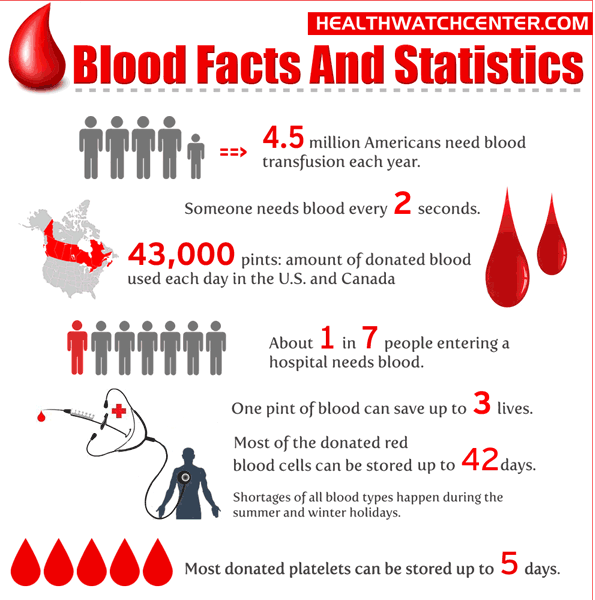
       Blood can not be manufactured.  The only way hospitals and medical centers can get blood is from people donating blood.  Blood is needed everyday for accident victims, people with Sickle cell disease, and people with cancer (source).  Over 15 million blood units are needed in the U.S. and Canada every year.  To make matters even more dire, blood can only be stored for up to 42 days (see chart).

       Hence, maintaining an adequate blood supply is difficult to do, and very important to be done.  It is so important that is worth the effort of many people throughout the country to continually seek to find more and better methods of encouraging people to donate blood and to improve the blood donation process.

       When I look at our public schools and their mission, I see many parallels to the efforts for encouraging more blood donors.  Our public schools (also) have a difficult and important job to do.  We accept students into our schools with many and varied backgrounds.  Some are poor and ill-equipped to find success in the academics of traditional schooling; some are new to our country and are trying to learn English while also trying to learn math, science, and social studies.  Some schools have few needed supplies and some classrooms have large numbers of students.  Some teachers are very well prepared to educate their students and some are not as well prepared to do this job.


       Yet, few would argue that the need for an educated public is important.  It is important for the individual and it is important for the society at large.  Hence, it is worth the struggle and the effort to continually search for ways to successfully educate all of our students.

       This belief in the importance of education is certainly shared by educators; but we often find it difficult to convince some students and their parents.  Like blood donors, we don't offer our students money or prizes for obtaining a good education.  Instead, we offer them hope for a better future.  We do our best to help our students to see the value in learning.


       Education is (indeed) the art of selling students (and parents and communities) the future value of learning.  It isn't the grades or the GPA or the credits earned.  It isn't "doing what you're told because, 'I say so'".  Learning is it's own reward.  Learning is the right thing to do because it helps you and everyone around you to be an educated person.

Public Schools and Choice

       Is it true that public school kids and their public school parents don't have choices?  I'm sure that I will expose my igno...

Teach100 blog