Showing posts with label yet. Show all posts

Sunday, August 14, 2016

Parent's Role in Improving Student Achievement

       If you have a child in elementary, middle, or high school, then your main concern is helping your child to do well in school.  You have a person or persons in your household that is a member of the most important cliental in the educational community--the students.  And as a parent, you have influence over your children.  Your attitudes and actions toward school matter.

       We need your help!

       So here is my short list of the three top things that parents can do to help their children to do well in school.


  1. Healthy relationships all around.  
Help your child to make friends with classmates and to get to know the teacher or teachers.  You (the parent) should try to get to know your child's teacher(s) too.  Communication is the key to all healthy relationships.  So try to discover the best way to contact the teacher.  Make sure that your child knows that you have a relationship with the teacher and a way to make contact on an as-needed basis.  This shows that you care about your child's education.  

   2.  Emphasize "learning" over "getting-a-good-grade".

The point of school is learning, not getting a good grade.  There are lots of ways to get good grades without learning much.  We want students to learn how to learn; to read; to study; to try and fail and try again; and ask for help.  Your child's grade should reflect his or her ability; but sometimes it just reflects his or her ability to do what they're told.  Remember that the goal of school is learning.  It's the "Do you best." philosophy (that your parents probably said to you).

    3. Don't help your children too much.

Let's face it...nobody likes to see their children struggling.  But if everything is easy and can be obtained without effort then you have to ask, "Is my child really learning anything?"  Real learning comes from a little struggle from time to time.  Just because your child doesn't "get it" the first time doesn't mean they will never get it.  They just haven't gotten it yet.  If you tell them the answer or do the work for them, they will get the right answer, but they haven't learned anything.  Remember, the goal of school is learning.  Instead of telling them the answer, ask questions.  "What do you know?"  "What don't you know?"  "What do you need to know?"  "What questions should you ask the teacher?"  We want students to learn how to deal with struggle; we want them to problem solve when the problem is difficult.
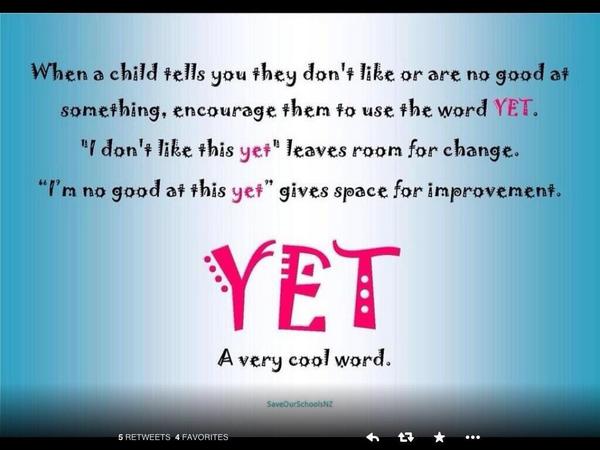
       School means a lot of things to a lot of people.  Clubs, sports, friends, activities, requirements, homework, pens, paper, teachers,....  It can be hard to remember that it is all about learning.  As the parent, you can help your child to focus on the important parts of school.

       Have a great school year!

Friday, September 11, 2015

Growth Mindset Teachers

       Have you heard about Mindsets?  In my school district, I am hard-pressed to meet a supervisor or a principal or a teacher who hasn't heard about it.  Here's a quick video that defines Growth and Fixed mindsets:


       Teachers who understand the Growth Mindset are able to help their students to understand that effort yields results and mistakes are the building blocks of true learning.  These teachers don't encourage their students to get good grades, they encourage questioning and curiousity.

       Students with a growth mindset believe that their is nothing that they can't do.  They don't mind making mistakes because they don't view them as mistakes.  Instead they view mistakes as an important part of the journey toward learning and true understanding.

       Teachers can help students to develop a growth mindset by praising their thinking and their effort, rather than praising that they simply got the right answer.  In fact, if students are constantly told that they are smart, research tells us that they tend to avoid making mistakes and they will hide the things that they can't do because they fear that they will lose the label of "being smart".

       This is (yet) another reason why we have to end this school culture of over-valuing grades.  School is supposed to be about learning and we want our students to understand that learning requires effort.  Effort requires trying new things and taking chances and not getting it right the first time.  This is not only "OK", it is necessary for true learning to take place.

       We love our growth mindset teachers that produce our growth mindset students.  Learning can be hard work.  We want our students to value this hard work and to recognize that there is always a prize waiting to reward them for this hard work.

Saturday, June 27, 2015

Somebody Has To Tell Them

       Nobody likes to hear bad news.  And nobody wants to be the person to give the bad news.


       In our public schools, we (sometimes) have the following problem...a student is not achieving at an acceptable level.  He tries to do well; he does some things well; but overall his achievement is too low for his grade or age level.  Public schools have lots of ways of helping students to raise their level of achievement and (indeed) it is our job and moral responsibility to do so.

       The problem is that someone has to tell the student and his parents that he is achieving below grade level.  That is a hard conversation to have.  No teacher wants to tell their students' parents this news.  No parent wants to hear this news.  But someone has to do it because we don't want to allow students to go through school thinking that they are doing fine (academically) when, in fact, they are below grade level.

       Sometimes we try to give this news through grades on report cards or via standardized testing grades, but the message doesn't always get through.  Sometimes students get a few good grades on minor assignments and parents "hang on" to those grades and seem to ignore the poor grades on the more major assignments.

       And so, sometimes students go through elementary and middle school thinking that they are doing fine and then they get to high school and struggle with their academic course work.  Even worse, sometimes these struggling students even go through high school with no one in authority ever telling them that they are below grade level.  These are the students that go on to college and (only) then are finally told that they do not have the ability that they thought they had--no one ever told them.

       Our job is to help students to learn.  Part of that job is telling students how well they are learning.  We don't help our students by letting them think that all is fine when it isn't.  Someone will tell them at some point, so it might as well be sooner rather than later.  It doesn't have to be an argumentative conversation.  Teachers and schools will help students to do better--that's our job.

       One way to communicate this message is to have a grading policy that rewards high academic achievement and discourages mere compliance with school and classroom rules.  While we certainly want students to behave in school, what we really want is for students to learn in school.  Teachers who have high expectations for their students and are very clear about those expectations tend to have students who reach those expectations.

       It's OK to tell students that they have not achieved the goal yet.  It doesn't mean that they will never get there, but it does tell them that where they are (academically) is not acceptable and they have to do more, try more, and achieve more.

       Somebody has to tell them.  Be brave and be the one who cares the most about your students.  Be clear about your expectations and tell students when they have and haven't met these expectations.


Public Schools and Choice

       Is it true that public school kids and their public school parents don't have choices?  I'm sure that I will expose my igno...

Teach100 blog