Showing posts with label traditional. Show all posts

Tuesday, March 7, 2017

What is Blended Learning?

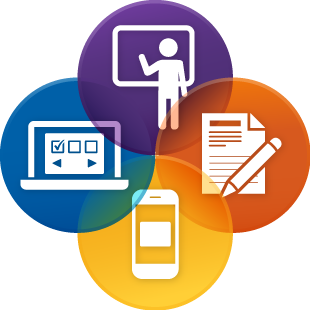
              Blended learning is an education program (formal or informal) that combines online digital media with traditional classroom methods. It requires the physical presence of both teacher and student, with some element of student control over time, place, path, or pace.

       My school district has begun the journey into Blended Learning over the past couple of years.  As an educator approaching his 30th year in the business, I view Blended Learning as an effort to bridge all of the positive and effective teaching and learning strategies that the educational and research communities have learned over the past few decades.

       Like any new initiative, Blended Learning will take some time for teachers and students and parents to learn and understand.  We will have to discover new and better ways to implement it in a way that is most beneficial to our students.  This effort will be well worth it.  Blended Learning--as I see it--addresses the following educational beliefs:


  1. Learning at your own pace.  In a traditional classroom, 30 students learn the same thing at the same time.  If you pick up on the topic quickly, you have to wait for your classmates to catch up.  If you struggle to understand the topic, you have to move to something else before you fully understand.  Blended Learning allows students to move at their pace.  Everyone is learning the same topic, but fast learners are given more challenging work and struggling learners are given more assistance.
  2. Multiple ways to show what you know.  In the traditional class, students can only demonstrate their understanding through classwork and homework and tests.  While this isn't a terrible method for measuring student knowledge, we certainly know that this method can lead to the appearance of learning when (in reality) little learning occurred.  Classwork can be graded on completion instead of quality.  Homework completion can come from lots of parental help for some and no parental help for others.  And tests can earn high grades due to cramming and memorizing rather than due to actual learning.  In the Blended classroom, students work with each other and help each other; teachers can spend more time one-on-one with their students (or in small groups).  Students can demonstrate their understanding through informal assessments and assignments in addition to more formal and traditional testing.
  3. Multiple attempts to learn.  We know that learning is a process.  Few students can sit in six or seven classes a day and learn six or seven different things strictly from listening and taking notes.  Learning requires listening and thinking and doing and sometimes failing the first couple of attempts.  Blended Learning recognizes the learning process and students understand that it is OK if they don't get it right away.  Blended Learning also provides different modalities for student learning.  These include: small group work, individual work, using online resources, using paper and pencil resources, and allowing students to verbalize their understanding.
       Blended Learning recognizes that students learn in different ways and at different rates--and this is not only OK, it is expected that all students learn in different ways.  The goal is learning.  Blended Learning permits students to be students and to learn in a way that works for them.  Learning isn't a competition.  Learning faster isn't better than learning slower.  Everyone that reaches the finish line is a winner.  Blended Learning helps students to see the value of learning.

Saturday, January 7, 2017

Teachers Seeking Innovative Learning Strategies

       If students aren't learning, then the teacher isn't succeeding.

       This is a harsh statement.  Clearly there are lots of reasons that prevent students from learning.  Some of these reasons can be due to teacher actions in the classroom and some are outside the control of the teacher.  But the main goal of school is learning.  If the student isn't learning, than we haven't met this main goal.

       Of course, not all students learn in the same way.  When a teachers presents a lesson--be it via lecture, or a game, or discovery learning, or through the use of a task, or some combination of these methods--some students will "get it" and some will not.  And so our best teachers are constantly looking for different ways (different teaching strategies) to help students to learn.  This (indeed) is the part of teaching that very, very complex.  Trying to understand the best way to help students to learn--every student in every class--is the struggle of every teacher.

       Alas, the world of education is full of ideas to help us.  Some of these ideas fall into the category good suggestions that any teacher should use, such as:

  • Scaffolding - breaking up the learning into smaller chucks and allowing students the time to learn one-piece-at-a-time in the effort to get them to learn the whole idea or standard.
  • Graphic Organizers - providing students with different ways to organize information so that "many ideas or facts" are easier to see and to understand.
  • Multisensory - presenting new information in multiple ways that help the students brain to store the information in multiple ways.  For instance, verbally explaining something while also writing the information on a whiteboard or computer screen, while also (perhaps) providing a manipulative or foldable for the student to hold and work with tactilely.  
Other ideas are more specific as to the sort of instructional style that may take place in a classroom.  A typical example of this would Direct Instruction or Lecture.  This is very typical in classrooms in the United States; particularly in our high schools.  Adults in their 70's and 80's probably received instruction in this manner when they were in high school and their grandchildren and great-grandchildren likely receive their high school instruction in this same mode.  Some people refer to this sort of instruction as Traditional classroom instruction--and it clearly is not effective for all students.

       More teachers are using a Discovery Learning approach to classroom instruction at least some of the time in their classes.  This approach allows students to build on past learnings by completing tasks and problems that require them to do so.  Students may work individually or in small groups of three or four while the teacher responds to students' questions and encourages students to think about other solutions.  This approach is common in some countries but is much less used in the United States.   

       I am part of a couple of math groups on Facebook and I posed the question, "Is Direct Instruction Necessary?"  I went on to ask if Discovery Learning could be the sole or major teaching strategy in a high school math class.  Of course the responses that I received were various and wide ranging, but I did learn a lot more about individuals and groups of teachers who use this approach with some success.  

       When teachers are continuously searching for more and better ways to reach their students, everyone wins: students, teachers, schools, society.


Wednesday, August 24, 2016

A Tale of Two Classrooms


       I saw this great graphic on Twitter today.


       Classroom A is the old, traditional classroom; and Classroom B is the way we (educators) want classrooms to be today.

       Of course, what I call "old" and "traditional", a lot of people would call "normal" and "expected".  It is the way school was when they were kids and it is perfectly OK with them now.  But today we know that that old system just didn't work for a lot of students--and it's not working for even more students today.

       If our goal is Learning, than we simply must conduct our classrooms in a way that facilitates learning.  We can't expect students to just sit and listen and learn everything.  We know now that that is not effective for most students.  I could write a blog post on everyone line in the Classroom B...maybe I will!


Public Schools and Choice

       Is it true that public school kids and their public school parents don't have choices?  I'm sure that I will expose my igno...

Teach100 blog