Showing posts with label different. Show all posts

Wednesday, January 25, 2017

Why Is Teaching Mathematics So Different Than Teaching Other Subjects?

       My entire professional career has been in Secondary Mathematics.  As a middle school teacher, high school teachers, department chair, and supervisor; I have been immersed in the field of teaching and learning mathematics.  Whenever conversations arise about the instruction for very weak students or for very advanced students, there seems to always be special considerations for students when it comes to mathematics.  Principals, school counselors, and special educator alike all agree that the teaching and learning of mathematics seem to require very different skills compared to the teaching and learning of reading and history and (perhaps) other subjects.

       Keith Devlin has a relatively simple answer to this question which he explains in his paper written for the Mathematical Association of America titled, In Math You Have to Remember, In Other Subjects You Can Think About It.  Devlin explains that mathematics is often taught as a series of rules that you just have to memorize.  Whereas other subjects such as history and science are taught within a context that help the learner to make sense of the content.  Mathematics could be taught within a context (and, I would say SHOULD be taught within a context), but it usually isn't.  This makes mathematics seem like a secret language with tricks and complicated rules that sometimes work in some situations and don't work in other situations.  When mathematics is taught as merely a bunch of skills without any understanding of how and when to use these skills, many students struggle to be successful.


       In her book Mathematical Mindsets, Stanford professor Jo Boaler explains that all students can learn mathematics if teachers are equipped to help students to build understanding.  While it is relatively easy for trained secondary mathematics teachers to learn these techniques, most teachers have not received this training when they were in college.  Furthermore, most adults today (parents, school principals, school counselors, etc) grew up learning mathematics through a strictly procedural approach.  Because of this experience, most adults believe that mathematics should be taught as a bunch of skills.


       Fortunately, more and more teachers are mixing more and more conceptual understanding in their mathematics classrooms along with learning the skills.  There are places in which math is taught somewhat differently than it was taught in past generations, and this is a good thing in my opinion even if it makes some parents feel uncomfortable.  Math should not be taught as 100% skills without any connection to the real world.  For most students, this sort of instruction is just too abstract for them to understand.


       Mathematics is also a subject that builds on itself from school year to school year.  Students need to have a good understanding of the concepts so that they can build on previously learned content to understand the new content.  This idea of building from year to year is more prevalent in mathematics than it is in other subject areas.


Sunday, November 8, 2015

Improving Education is Harder than Going to the Moon

       I often hear people say, "We have been able to send men to the moon.  Why can't we improve education?"  The implication, of course, is that the effort to send people to the moon is certainly more difficult than educating children.  So if we could do that, why can't we accomplish this--much easier--task?

       I would contend that improving education for all students is much more difficult than--the extremely complex of task of--sending people to the moon because (even today) educators are dealing with many more "unknowns" than NASA had in 1969.

       I doubt that anyone at Mission Control watched the Apollo capsule heading toward the moon thinking, "I'd say that we have a 20% chance of missing the moon by a hundred thousand miles."  They knew how far away the moon was; they knew the amount of force needed to break out of the earth's atmosphere; they knew how much food the astronauts needed.  It was certainly a complex task.  Mistakes were surely made and some things certainly went wrong.  But the Apollo 11 team that dealt with the physics of sending people to the moon were dealing with plenty of known quantities.

       In contrast, improving education involves our--still evolving--knowledge of how students learn.  Brain research is currently taking place and reporting new findings every year.  We have to contend with understanding the best way to motivate students and the best way to teach students.  And, of course, students aren't robots with the same abilities and the same limitations.  We have students from rich and poor families with different views of the benefits of education.  We have students from different home-life situations in which some are very supportive and some lack any sort of structure.

       It would make more sense to compare the effort to improve learning with the effort to cure cancer.  Over the years and decades, both of these fields have experienced progressed, but neither of these fields have been able to claim a complete victory.  Our understanding of cancer cells has certainly improved from 100 and 50 and even ten years ago, but we don't know enough to know how to stop their growth throughout the body.  Similarly, our understanding of how students learn has improved, but we are yet to find a school model--or even an education model--that best addresses the needs of all of our students.

       Improving education is a complex problem.  We see small improvements from time to time; and we see isolated pockets of (what appear to be) great success from time to time.  But we still have more to learn before this problem can be solved.  We have to continue to build on the successes of the past (and present) to reach the day when all students will receive the full education that they deserve and all students will reach their full potential.


Friday, August 21, 2015

11 Serious Questions for Teachers


       Yesterday I welcomed our 200+ secondary mathematics teachers to the 2015 - 2016 school year.  We do this every school year and it is always an exciting day.  We get to see people we haven't seen since last June; middle school teachers get to network with their high school colleagues.  The first day of school is getting closer and closer.

       This year I welcomed them with 11 serious questions about teaching.  Since this week is filled with the details of preparing those first lessons, decorating the classroom, preparing class resources, and learning about any new school policies and procedures, teachers don't usually get the chance to sit down for 30 minutes and reflect on why they do what they do.

       Here are the questions I asked them.  Read each one and take 30 seconds to reflect on your answer to the question.

  1. Why do you teach?
  2. What is your goal this year?
  3. Will you make a difference?
  4. What will you do differently this year?
  5. How do you view challenges?
  6. Where is the line between impossible and very difficult?
  7. Do your students have a Growth or Fixed Mindset?
  8. How do you know when they "get it"?
  9. Do student's term grades reflect their ability?
  10. How do you move your students from procedural to conceptual understanding?
  11. Why do you teach?
       Teachers have a job to do.  It is a difficult, complex job.  And the need to grow and to improve in the job is necessary because it isn't the sort of job in which a person knows everything they need to know when they graduate from college.  Teachers face new challenges every year and their ability to find solutions to those challenges is generally what separates good teachers from great teachers.

       Here is a movie clip I shared with the teachers in which FDR struggles to stand up straight and then boldly says, "Don't tell me, 'It can't be done.'"

       Why do you teach?


Tuesday, June 23, 2015

Why Do You Teach?

       The school year ended four days ago and I am thinking about welcoming my teachers to the next school year.  (Wow.  That was a short summer vacation.)

       Every year in our school district the teachers return to school one week before the students return.  On one of the days of that first-week-back, all of the secondary teachers in the district meet in their subject areas for a full day of professional development before the school year begins.  This is a time to learn about new resources, to network with other teachers in other schools, and to energize teachers to get excited about the new school year.

       We know that an effective teaching strategy for student understanding is to ask a lot of questions that encourage students to think about what they are learning.  If students can explain what they are doing and why they are doing it, they must understand it pretty well.  It also reinforces the idea that we want students to understand underlining concepts and not just to get-the-right-answer.

       In that vein, I am going to ask our teachers some questions in an effort to encourage them to think about what they do and why they do it.  These question will challenge the teachers to consider different possibilities.  They will be questions that defy simple answers.

       I'm in the beginning stages of preparing this presentation and I am certainly open to suggestions.  Feel free share (in the comment section below) other questions that you feel would be good questions for teachers in the beginning of the school year.

Questions:
(1) Why do you teach?
(2) What are your goals this year?
(3) What will you do differently this year?
(4) How will you make a difference?
(5) What do you want to learn this year?
(6) Why is mathematics difficult for some of your students?
(7) How will you help students who don't ask questions?
(8) How will you engage your students in their learning this year?
(9) How do you help your students to value "learning" over "getting-grades"?
(10) Why do you teach?

       We ask (or should be asking) our students difficult questions every day.  As such, we need to ask ourselves difficult questions.  Teaching students who are willing and able and ready to learn is easy.  But trying to reach the unwilling, the struggling, and the distracted student takes time and effort and expertise.

       Why do you teach?


Saturday, April 18, 2015

The Challenge of Educating Poor Students - Part 2

       American Public Schools face many and varied challenges.  Funding, equity, and public support to name a few.  On the top of this list of challenges, I would include: The Achievement of Poor Students.

       It is easy to understand the underpinnings of this problem, and yet it is extremely complex to succeed in overcoming this problem.  The problem stems from two indisputable facts:

  1. Poor students consistently demonstrate lower achievement than their non-poor peers.
  2. The proportion of poor students in our nation's public schools is over 50% and is growing.


       I will examine this challenge from three perspectives:

  1. Poor students who have succeeded in our schools
  2. Understanding the special and different needs of poor students 
  3. Expert advice on successfully educating poor students
--------------------------------------------------------------------------------------------------

The Challenge of Educating Poor Students - Part 2

Understanding the Special and Different Needs of Poor Students


       People who grow up in a middle class (or higher) home environment may take for granted simple life experiences that poor students and their families never experience.  Well-meaning teachers may have never experienced living in a poor environment and working with poor people until their first year in the classroom.  Particularly since school teachers must have a college degree and it is rare for poor people to earn a college degree, teachers are generally from a middle class (or higher) background.  

       Here is a short list of challenges for most poor students:

1) Regular, quality medical care
       
       Middle class families generally have a regular doctor for their children.  When children are sick, they go to the doctor and they get better in a couple of days.  When poor students get sick, they don't have access to a doctor or to medicine; this makes them sicker.  When they are too sick to come to school, they generally miss more school days because it takes them longer to get better.  And if they come to school when they are sick, it is harder for them to concentrate on their school work.       

      A lack of medical care leads to other issues that are more prevalent among the poor such as untreated ear infections and hearing loss issues, greater exposure to lead, and a higher incidence of asthma (source).  All of these health issue contribute to higher absenteeism and lower engagement with class lessons at school.

2) Small vocabulary when they start school

       Students from poor households hear and use considerably less words than students from middle class households.  This puts poor students at an academic disadvantage from their first day of kindergarten.  Students who are less able to use words to express their feelings and to explain their thinking because frustrated and soon shy away from activities that involve reading because they don't want to appear less able than their peers.


      Opportunities to increase each students' personal vocabulary must be of primary importance for poor students.  We know from multiple studies that students who are not reading on grade level (or above) by third grade have a reduced chance of graduating from high school. (source)  This is a significant risk factor for poor students.  In 2013, the overall national high school graduation rate was 81.4%  but the rate for poor students was only 73.3%.

3) Fixed vs. Growth Mindset

       Stanford psychologist, Carol Dweck, and her book Mindset has taken the education world by storm over the past few years.  And so it should.  She has proved that students who believe that they are not smart will refuse to try to succeed.  This is the belief of the "Fixed" mindset; the one that says, "I have a fixed capacity for learning and no matter how hard I try I won't get any smarter."  In fact, nobody has a brain that isn't capable of learning more.

       But poor students are more likely to believe in the Fixed Mindset because they are less likely to see the many opportunities that will be offered to them in the future beyond high school and college graduation.  Poor students need to be praised for their effort and teachers need to point out when their thinking has led to a great solution to a problem.  Students with Fixed Mindsets believe that they just got lucky whenever they get a good test grade.  They need to understand that it is their effort and their learning that led to that good test grade.


       Teachers at every level (elementary, middle, and high school) can help poor students to succeed.  But we have to understand the deficiencies that they bring to school and we cannot label every lack of effort as "laziness".  Some poor students do succeed; they are the lucky ones.  They probably had great teachers and caring parents or caring authority figures at home.  Overcoming these deficiencies is a very difficult job for our public schools; but understanding the problem is certainly the first step.

       All teachers should receive some training in the education of poor students.


Wednesday, April 15, 2015

The Challenge of Educating Poor Students - Part 1

       American Public Schools face many and varied challenges.  Funding, equity, and public support to name a few.  On the top of this list of challenges, I would include: The Achievement of Poor Students.

       It is easy to understand the underpinnings of this problem, and yet it is extremely complex to succeed in overcoming this problem.  The problem stems from two indisputable facts:

  1. Poor students consistently demonstrate lower achievement than their non-poor peers.
  2. The proportion of poor students in our nation's public schools is over 50% and is growing.


       I will examine this challenge from three perspectives:

  1. Poor students who have succeeded in our schools
  2. Understanding the special and different needs of poor students 
  3. Expert advice on successfully educating poor students
--------------------------------------------------------------------------------------------------

The Challenge of Educating Poor Students - Part 1

Poor students who have succeeded in our schools

       Every public school can point to a student who comes from a poor family and (yet) defies the odds and does well in school academically.   Or...Can they?  Unless you know the student's background, it might be hard to find these students in your school.

       The outward signs of poverty are relatively easy to see:  dirty clothes or the same clothes day after day; same, single pair of shoes everyday; no extra school supplies.  And then there is the attitude--opposition behavior, attention disorders, excessive absenteeism.  Taken alone, these are not necessarily signs of students from poor homes, but taken together there can be assumptions of the student's home lives based on these visible factors.

       Unfortunately, it is so common for poor students to have low academic achievement that when we have a poor student who succeeds in the academics of school we (often) don't see that child as being from a poor background.  So what is it that propels a poor student to achieve where his/her peers don't?  And what can we learn from poor students that succeed that can help us to raise the achievement of other poor students?

Vocabulary Acquisition


       According to a study from 1995, from the age of 7 months to the age of 3 years, 90% of the words used by children were words used by the children's parent (or primary caregivers).  Parents with higher educations used more words than parents with less education AND higher educated parents talked to their babies and toddlers more than less educated parents.  This creates an "Achievement Gap" among very young children before they even begin Pre-kindergarten.

       But poor students who succeed in school often come to school with a good vocabulary because they were blessed with parents and/or caregivers that shared with them the (totally free) gift of words when they were very young.  Babies and toddlers can learn words from parents reading books to them; but they also learn from simple talking and singing.  So families that cannot provide a lot of children's books to their children can still provide the precious gift of words by simply talking to their children every day.

Grit

       The story of Karvel Anderson is the best definition of grit that you will ever find.  Karvel's story is one of a child who grew up with many challenges but never anything that made him give up on life.  He says that adversity was good for him because he always wanted to prove that he can do anything.

       Most students from poor backgrounds succumb to the narrative that they will never succeed because it seems like the world is against them.  Every where they turn, some one is taking away an opportunity or refusing them something.  Grit is a personality trait in which a person strives to achieve goals regardless of the obstacles that may stand in the way.

A Supportive Adult

       Poor student who succeed usually have an adult in their life that is there to encourage them when times are tough.  It might be a parent, but it also might be a teacher, a grandmother, a school counselor, or a coach.  While some students seems to have the ability to overcome just about any situation, most poor students need someone to guide and help them through the toughest times.


       As schools and teachers look to increase the achievement of poor students, I believe that we have to understand that the world they live in can seem very different than our world.  We need to understand how their lack of resources and supports is a great hindrance to their academic success.  And we have to find a way to fill in the supports that they are lacking so that we can help them to value education and to be successful in school.


Saturday, March 7, 2015

Blood Donors and Students: Doing the Right Thing

       I've been a blood donor since I was 18 years old.

       Over the years, I've grown more and more impressed with the blood donation system in the United States and Canada via the America's Blood Centers and the American Red Cross.  They have a difficult and (yet) very important job.

       Here is the difficult part:

       Imagine if you had the job of trying to convince people to volentarily have a needle stuck in their arm?  They would also have to answer a lot of personal questions about their past travels--especially if it included travel to certain countries--and questions about their possible drug use and even their sex lives and sex partners.  As compensation for going through this ordeal, donors would receive a hearty "Thank You", a bottle of water, a snack, and occasionally a free T-shirt.  No money; no raise; no notoriety.  In fact, friends and neighbors would probably question your reasons for doing such a thing if you were a blood donor.  And if all of this wasn't tough enough, only 38% of the U.S. population is eligible to give blood (source) because of various health and risk factors.

       Here is the important part:

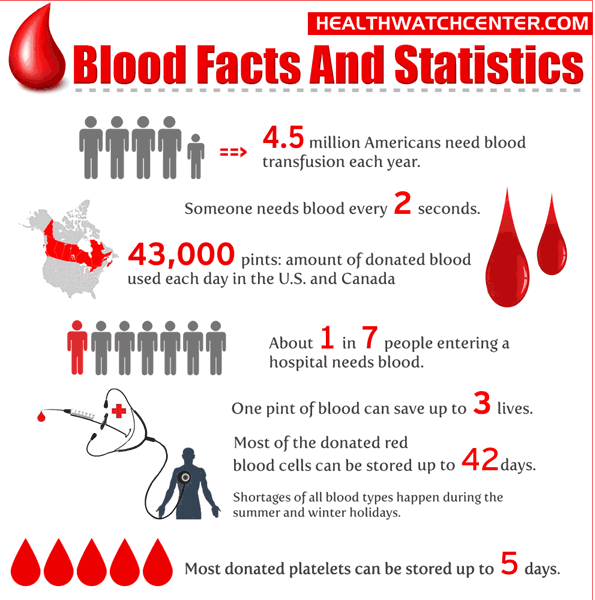
       Blood can not be manufactured.  The only way hospitals and medical centers can get blood is from people donating blood.  Blood is needed everyday for accident victims, people with Sickle cell disease, and people with cancer (source).  Over 15 million blood units are needed in the U.S. and Canada every year.  To make matters even more dire, blood can only be stored for up to 42 days (see chart).

       Hence, maintaining an adequate blood supply is difficult to do, and very important to be done.  It is so important that is worth the effort of many people throughout the country to continually seek to find more and better methods of encouraging people to donate blood and to improve the blood donation process.

       When I look at our public schools and their mission, I see many parallels to the efforts for encouraging more blood donors.  Our public schools (also) have a difficult and important job to do.  We accept students into our schools with many and varied backgrounds.  Some are poor and ill-equipped to find success in the academics of traditional schooling; some are new to our country and are trying to learn English while also trying to learn math, science, and social studies.  Some schools have few needed supplies and some classrooms have large numbers of students.  Some teachers are very well prepared to educate their students and some are not as well prepared to do this job.


       Yet, few would argue that the need for an educated public is important.  It is important for the individual and it is important for the society at large.  Hence, it is worth the struggle and the effort to continually search for ways to successfully educate all of our students.

       This belief in the importance of education is certainly shared by educators; but we often find it difficult to convince some students and their parents.  Like blood donors, we don't offer our students money or prizes for obtaining a good education.  Instead, we offer them hope for a better future.  We do our best to help our students to see the value in learning.


       Education is (indeed) the art of selling students (and parents and communities) the future value of learning.  It isn't the grades or the GPA or the credits earned.  It isn't "doing what you're told because, 'I say so'".  Learning is it's own reward.  Learning is the right thing to do because it helps you and everyone around you to be an educated person.

Tuesday, February 24, 2015

Good Teachers are Great Learners

       I think everyone has had the experience of teaching something to someone.

       Parents teach their children to walk or to ride a bike or to drive.  Friends teach their friends about cool stuff they find online or cool stuff they read about.  Colleagues teach their co-workers trade skills on the job.

       Sometimes, as a teacher, we are very attentive to the way our learner is "catching on" to what we are trying to show them.  Sometimes, as a teacher, we just go through the steps and explanations with no regard whatsoever as to whether or not the learner is following us.  And sometimes, as the teacher, we get very upset when the learner does "learn" what we just taught them.

       "I just said that."  "Weren't you listening?"  How is possible for them to not understand when I did such a good job of explaining it?

       Teacher know that "teaching" is only half of their job--maybe even less than half.  Their main job is to ensure that students are learning.  Lots of people are very knowledgeable about something; but that doesn't mean that they are good teachers.

       Teachers excel at understanding their students and (to the best of their ability) at understanding how their students are thinking and what it is that is keeping their students from fully understanding the objectives of the lesson.  Good teachers are great learners.  They discover common errors that their students make and use that understanding to help their students to understand.

       Good teachers learn about their students through questioning, discussions in class, notes on classwork, email messages or other electronic resources, meetings with parents, and sometimes facial expressions.  Teachers who care about student learning do whatever they need to do to help their students to learn.

       This is one reason why experienced teachers tend to have more success with student achievement than less experienced teachers.  This sort of learning and understanding of students comes almost exclusively from experience.  It is hard to gain this professional ability strictly from a teacher preparatory program.  Teachers that continually strive to get to know their students and to learn how they think build an ability to anticipate problems in learning and to act on these anticipated problems as part of their lesson planning.

       Teaching is a difficult job.  Students are different and student backgrounds are different; and student abilities are different.  Good teachers strive to understand these differences and to find ways to overcome these differences to help all of their students to learn.

Saturday, August 2, 2014

Hot Dogs and High Jump

     Take a look at this data from the Famous Nathan's Hot Dog Eating Contest:


Year               Winning Amount
1990                           16
1991                          21.5
1992                           19
1993                           17
1994                           20
1995                          19.5
1996                           22
1997                          24.5
1998                           19
1999                           20
2000                           25
2001                           50
2002                          50.5
2003                           44
2004                          53.5
2005                           49
2006                           54
2007                           66
2008                           59
2009                           68

     Look at the amount of hot dogs eaten by the winners in the 1990's.  Now look at the winning data from the 2000's.  Specifically, look at the difference in the winning numbers from 2000 to 2001.  Yipes!  What happened???  Is this data correct???  The number of hot dogs eaten jumped (tremendously) from 25 in 2000 to 50 in 2001.  How is that possible?

     The answer is Takeru Kobayashi from Japan.  He "changed the game" when it came to hot dog eating contests.  Not being from the United States, Kobayashi didn't have any preconceived notions about the way to eat a hot dog.  He knew that this contest was all about eating as fast as you can.  So he devised a new way to eat a hot dog in this contest.

     Kobayashi took the hot dog out of the bun, broke it in half, and ate the two halves together.  He just put both of the halves in his mouth at the same time.  Then he took the bun, squished it into a ball (with one hand), dunked it in water, and shoved it in his mouth--in one bite.  All together, it took him about ten seconds to eat one hot dog and bun.

     Kobayashi found a different way to eat hot dogs that no one had ever thought of before.  Up until his first appearance at the hot dog eating contest, everyone ate their hot dogs the same way and the winning amount only grew very slowly from year to year.

     The same thing happened in the world of high jumping.  For decades high jump competitors used a high jumping style called the Western Roll (or Straddle).  But in the 1968 Olympics, an American High Jumper named Dick Fosbury used a different technique.  He jumped with his back to the crossbar and went over the bar with his head first and his feet last.

     Once again, no one had ever seen this before and few people had ever tried this technique.  Within a short amount of years however, all world-class high jumper would use this technique (known as the Fosbury Flop).  It is considered far superior to the Western Roll.  Our current high jump world records would never have been achieved using the old technique.

     Dick Fosbury realized that the human limits of high jumping were quickly being reached with the Western Roll technique and he decided to look at high jumping in a completely different way.

Public Schools and Choice

       Is it true that public school kids and their public school parents don't have choices?  I'm sure that I will expose my igno...

Teach100 blog