Showing posts with label learners. Show all posts

Thursday, July 14, 2016

Learning About Learning

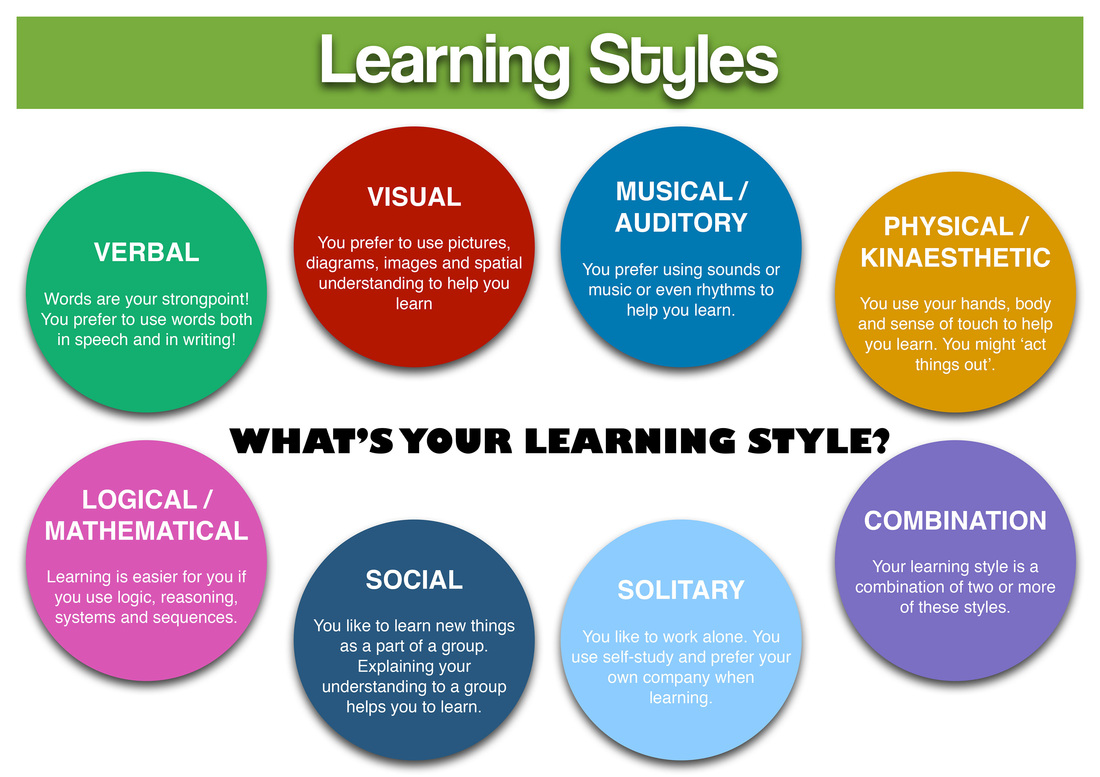
       The goal of school is learning.  The challenge for our schools is to help all students to learn when students are so different.  Some prefer to work by themselves.  Others need to bounce ideas off of their peers.  Some need only to hear the information while others need to actively "do" something to help them to learn.

       The mystery of how students learn has baffled educators for a long time.  The puzzle of "some-kids-get-it" and "some-kids-don't-get-it" has been difficult to understand.  I think that--for a long time--teachers referred to their own ability to learn (and perhaps that of their peers) and felt that all students probably learned the same way they did.  In fact, I wonder sometimes if some present day teachers use the same technique.  And while there are still many unknowns in the field of learning, it is fair to say that we know more today about how students learn than at any time in our history.

       For starters, brain research has provided a wealth of information about how we learn.  Here's a short list of things to know about how the brain learns:

  1. We receive information better when it's visual.
  2. We remember the big picture better than the details.
  3. Sleep affects learning and memory.
  4. Less sleep reduces your ability to learn new information.
  5. We learn best by teaching others.
       Next, we have a lot of help in the field of learning from experts and practitioners.  After a while, we begin to see common themes in the area of helping students to learn:

  • Engagement - Students who actively participate in their learning find it enjoyable and are better able to retain the information.
  • Movement - Learning can certainly take place while sitting, but less so if you're forced to stay seated for a long time.  (see The Power of Movement in Teaching and Learning)
  • Challenge - We learn best when we are forced to think and try and fail and try again.  Also, when we are forced to recall past learning and use that information to understand the current learning.
  • Growth Mindset - If we believe that effort yields results then we are more likely to do our best to preserve in the face of any struggles that may occur as we learn new material.

       Still, teaching is certainly a combination of Art and Science.  Teaching requires building positive relationships so that we can understand our students and construct our lessons in a way that meets their learning needs.  Teaching requires the ability to motivate students and to spark their interest in learning.  Teachers need to challenge students enough to keep it interesting, but not too much so that it becomes too overwhelming.

       The challenge of teaching is the challenge of learning how students learn.  We're getting better at this, but we still have a lot to learn [!].


Saturday, November 7, 2015

Group work is a Necessity for Students

       Our school district recently had an essay contest in which students were asked to describe their Ideal Math Class.  Submissions came in from students in grades 4 to 12.  Nearly every student said that they wanted to work in groups for at least a portion of the class time.  Students want to have the opportunity to ask each other questions and to share their ideas with a small group of peers.


       In fact, the benefits of group work in the classroom are well known.  The Center for Innovation in the Research and Teaching has compiled the following list of benefits of group work:


  • Students able to take ownership of the subject matter.
  • Students develop communication and teamwork skills.
  • Content is reinforced as students work together and "teach" each other.  This improves understanding through additional discussion and explanation.
  • Content may be broken down into parts.  This allows students to tackle larger and more complex problems and assignments than they would be able to do individually.
  • Students can work together to pool their expertise, knowledge and skills.
  • Students hold one another responsible and accountable.
  • Teaches students to plan more effectively and manage their time.
  • Instructors benefit by seeing students approach problems in novel and unique ways. This can improve the instructor's perspective and make their future teaching more effective.

  • Instructors are able to have the content reinforced by giving the students ways to apply what they have learned in a collaborative setting.


       As teachers, we want students to have different learning experiences.  We know that all students do not learn best by merely listening to the teacher and taking notes.  We want students to learn how to learn and one way to do that is to give them these opportunities in the controlled atmosphere of the classroom.

       "Group work" is a general term that can be implemented in many ways in the classroom.  The Cornell University Center for Teaching Excellence has suggested many ways for teachers to incorporate group work into their lessons.  Marzano lists cooperative learning as one of his Nine High Yield Instructional Strategies.  

       Group work breaks the mold of the traditional teaching model that keeps the teacher in the front of the room all the time and the students in neat rows of desks and (usually) not talking very much.  Group work requires planning and preparation on the teacher's part.  It also requires teachers to allow some productive, learning noise to be part of their typical class on a regular basis.

       As we prepare our students for the world of work, we need to give them opportunities to work and to learn with their peers as this will (very likely) be a part of their own professional experiences as adults.


Wednesday, October 28, 2015

PARCC Results are all about Learning

       2010 - Common Core Standards go public
       2010 to 2014 - School systems throughout the country align courses to these updated standards
       2014 - PARCC Field Test takes place in all "PARCC" states
       2015 - First full administration of the PARCC assessments
       Fall 2015 - We get to see the results of the PARCC assessments


       I feel like I'm the only person who is happy to see the results from these new tests.  Once again, the press is constantly talking about bad results, bad tests, bad schools.  To me, these results are all about learning.  They tell us how well our students are learning based on the world-class standards that are being taught in our classrooms.  Isn't this what we really want???

       It doesn't help to compare our students to each other in their school or to the students in the school on the other side of town.  The comparison that matters is the comparison to the standards.  This comparison will help us to know if our children are ready for the academic demands of college level work and for the societal demands of a career.

       School is supposed to be about learning.  The PARCC results give us a measure of this learning.  This is a good thing.  Up until today, we've had far too many students graduating from high school and believing that they were ready for college only to face a harsh reality that their high school did not prepare them as well as they thought.  Too many students begin college and don't finish college.

       Today, thanks to PARCC results (and other data points), our students and their parents will get a true measure of their ability--as early as in third grade.  And there will be time while our children are still in P-12 school for them to get help and for them to raise their abilities.

       PARCC results are a good thing.  Learning is a good thing.

       Don't you want to know if your child's true level of learning?


Wednesday, September 23, 2015

Are Your Students Obsessed with Grades?

       Here's a quick checklist to see if your students are obsessed with grades:


  1. They are constantly asking, "Is this going to be graded?"
  2. They refuse to do anything if it is not being graded.
  3. They ask for "extra credit" or make-up work at the end of the marking term to raise their grade to the next letter grade.
  4. They only see the grade at the top of their returned work and ignore the helpful comments that the teacher has written.
  5. They try to memorize the information they need to know for tests.
  6. They follow procedures in mathematics for unknown reasons just to get the right answer.
       In short, students who are obsessed with grades are just "going through the motions" at school; they do what they're told, but they learn very little.  And when they take a test that can't be beat by memorizing (like a final exam) they show their true ability or lack thereof.  The challenge for these students is to do as little as possible to earn the grade they want.

THIS IS NOT THE WAY SCHOOL IS SUPPOSED TO WORK.

       School is supposed to be all about learning.  If students aren't learning, than we are wasting their time.  And if we are (somehow) justifying how these grades-obsessed students are getting A's and B's, then we are giving them (and their parents) a false sense of accomplishment.  Eventually someone will tell these students the truth about their academic abilities, and it would be a shame if they are in college (and paying for college) when they are hit with this truth-bomb.

       Teachers can help their students to de-emphasize grades by praising them for their thinking and reasoning.  They can emphasize learning by asking students to explain how they got the right answer instead of just accepting the right answer and moving on.  Formative assessments that require thinking and reasoning and justifying instead of just repeating information tell students that memorizing isn't good enough.

       We have to help students to be less obsessed about grades.


Sunday, September 20, 2015

We Are a Community of Learners

       Teaching students is not like like building a model airplane.  We don't have distinct steps to follow that will lead to a completed project in the end.  Students learn differently; they come to school with different experiences and different abilities.  Good teaching requires an understanding of the learners in each classroom and daily lesson plans that are designed to help those learners.

       Good teachers understand the difficulty of reaching each individual student and they seek out the best strategies from experts in the field of education and from the teacher across the hall.  We (educators) are a community of learners.  We have to be.  We can't learn everything from experience and we can't figure out everything on our know.  We can't be experts in child psychology and special education and mathematics and English Language Learners and student engagement and formative assessment and ....  We need each other to be the best teachers we can be for our students.

       After more than 25 years in education, I am still learning and improving by listening and reading and following other educators just like me who have something great to share.  Here is my short list of excellent sources of information for educators who strive to make a difference with their students and who seek to improve their abilities every year:
  1. Annie Murphy Paul - The Brilliant Blog
    1. Her recent writings on how to using testing as a learning tool (aka - formative assessments) are informative and eye-opening to those who only see testing as an end-of-unit assessment.  She has also recently released an e-course that will show parents, teachers, and school leaders how to implement testing strategies as opportunities for student learning and growth.
  2. Robert Marzano - Marzano Research
    1. Great professional development information for teachers and for whole schools on topics ranging from Student Engagement to Assessment and Grading to Instructional Strategies to Teacher Effectiveness.  Don't let the "research" part scare you; Marzano provides effective tools and ideas that are simple to understand and to implement.
  3. Doug Lemov - Teach Like a Champion
    1. Excellent tips that any teacher can use to improve student learning and student motivation.
  4. Starr Sackstein - Changing the World, One Mind at a Time
    1. Great ideas and thoughts from a National Board Certified Teacher
    2. Lots of great recent blog posts about emphasizing learning and de-emphasizing grading

       And teachers don't have to go online to find excellent educators to collaborate with; look to your administrators, and district and state-level leaders.  Find ways to collaborate with teachers in other school buildings in your school district.  There is great value in learning from other professions.  I would say that it is a necessary element for teachers who strive to improve year after year.

     We are a community of learners.

Public Schools and Choice

       Is it true that public school kids and their public school parents don't have choices?  I'm sure that I will expose my igno...

Teach100 blog