Showing posts with label we must do better. Show all posts

Friday, December 16, 2016

Do Our Brightest Students Get What They Need?

       Public schools are good at educating the average student.  We are good in the education of above average students.  We spend a lot of time, money, and energy on the education of below average students; and while this is a difficult population in terms of bringing them up to grade-level standards, we've made numerous improvements over the years to help these students.

       This leaves the most limited students and the very brightest students.  For the purposes of this post, I'm defining the very limited as the academically weakest two to three percent of our student population and the very brightest as our top 1% in terms of academic ability.  We have laws and programs and policies to help the most limited of our students.  They may not receive a high school diploma, but we help them to learn as much as possible during their school years so that they can have a full, happy, and satisfying life.  We help them to go as far as they can in terms of skills and abilities.  But when it comes to our very brightest students, I'm not sure that we can say the same.


        Once again, I'm not talking about the typical advanced students in our public schools.  We have programs and/or courses for them that are different from the typical "on-grade-level" programs.  And we do a good job with these typical above-average students.  I'm talking about our most advanced students.  These are the students who don't just stand out in their class, they stand out in their school.  They represent the 1 out of 100 (or more) that excel far beyond the typical advanced students.

       I am a mathematics supervisor.  Mathematics is the one subject that often gets the most attention when the topic of our very brightest students arises.  Parents and policy-makers alike strive to identify these students and endeavor to find a way that best meets their needs.  However all too often our attempts to do this lead to an inadequate solution known as "Acceleration".  Acceleration (in this arena) usually means that these very bright students get the same mathematics content and the same mathematics instruction as everyone else; they just get it at an earlier age and/or they just go through this same content at a faster pace than other students.

       The problem with this solution is that it does not recognize the true abilities of these students, and it does not encourage these students to think harder or reason more.  It doesn't challenge these students to grow and to further develop their strong academic skills.  Instead, this solution only pushes these students to go faster.  Sadly, this solution is often praised by parents and policymakers because our society views "faster" as "better".  We see everything as a competition and those that go faster and jump higher and earn more credits and produce higher grade-point-averages are viewed as the "winners".

       The real danger of inappropriate acceleration for our brightest students is that we place this "speed" over our prime objective of education; which is to actually learn.  Students lose the chance to develop a deep understanding of the content that they master.  They lose the chance to do what they are most able to do which is to question conclusions, discover new solutions, and to create and develop new ideas.  Strategic acceleration could accomplish these goals if the instruction is appropriately geared toward the needs of our brightest students.


       In practice, our public schools struggle with the top 1% because there are so few of them.   We don't have enough of them to make a "class"; sometimes there may not even be one in every grade.  They are spread out throughout a school district.  So we have to figure out a way to provide instruction that meets their needs while still attending to all of our other students.  This is a challenge--and (perhaps) is part of the reason that mere acceleration is so often employed as the "solution".  We also struggle to understand the best way to help teachers to provide this ideal instruction for these students.  So much of public education is geared toward helping our average and weak students; and less attention is geared toward our brightest students.

       The National Association of Gifted Children is a respected organization that addresses the needs of our brightest students and provides resources to help school districts to tackle this problem of providing for these students.  We need to do more and we need to do it in a smarter and more responsible way.


Wednesday, July 6, 2016

Creating a Better High School - Part 2

       This is the second in a three-part series that will look at the structures in place in our current high schools that don't make sense or are not needed anymore.  I want to think about the best way that students learn and create a high school that will serve these learners.  I also want to think about the true purpose of high schools in our time.  My goal isn't to imagine a "High School of the Future", but instead to consider what can realistically be done today.  As always, I encourage my readers to add their thoughts and ideas.  Together we can create the high school that our students want and need today.

Create a Better High School

Part 1 - Current school structures that aren't necessary anymore.
Part 2 - How students learn and how schools can react to these learners.
Part 3 - The purpose of high school

-----------------------------------------------------------------------------------------------------------------

How students learn and how schools can react to these learners

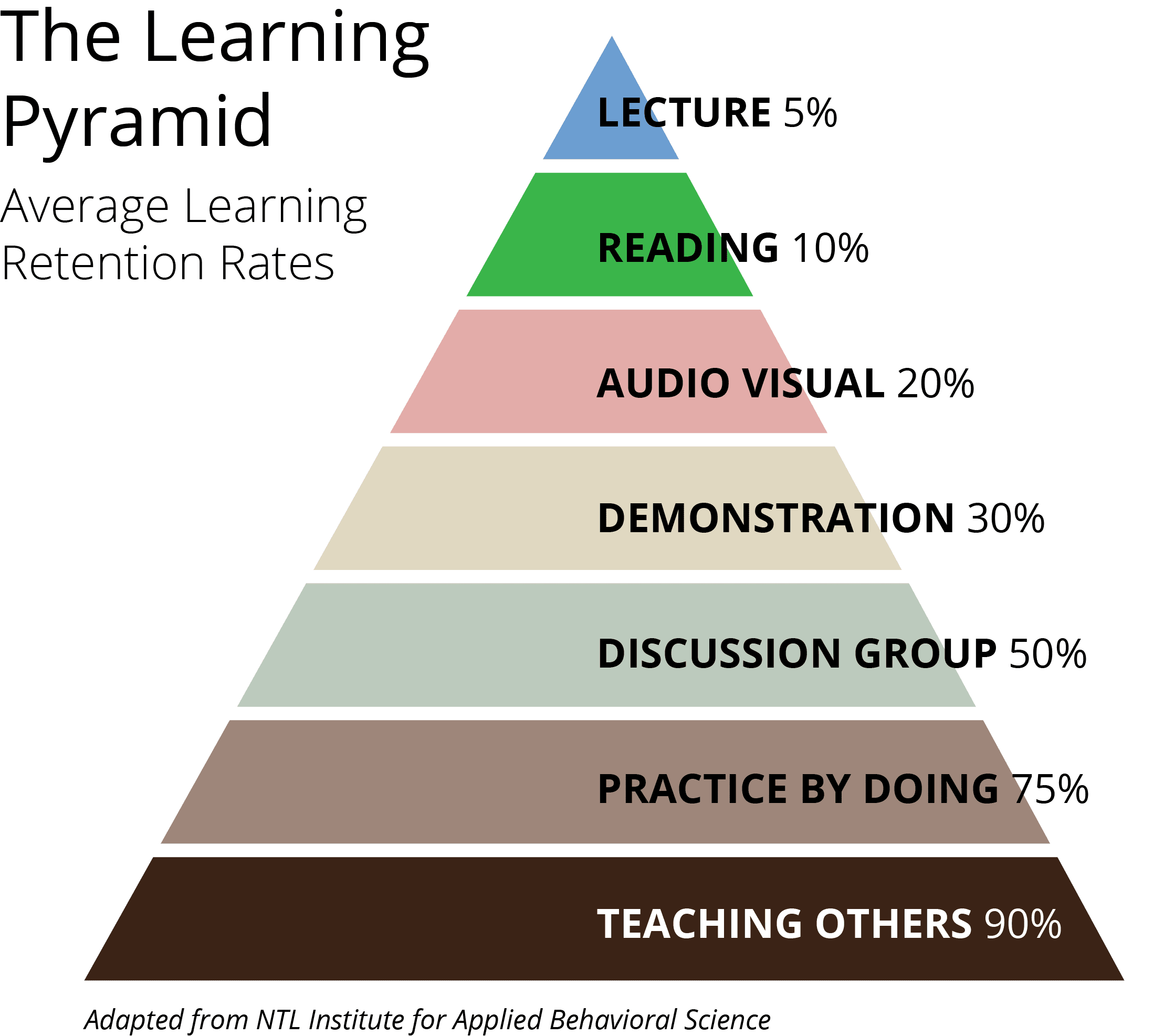
        When I think about creating a new high school, I'm really thinking about all of the traditional structures of our current high schools that don't respond to the way students learn.  The typical high school class still consists of a teacher in the front of the room who does most of the talking while students sit in rows facing the front of the room and take notes.  Students generally only talk to answer a question; to which the teacher confirms or denies its correctness.  This sort of learning (generally) falls in the "Lecture" category which is the least effective strategy for helping students to learn.

       The organization Jobs for the Future has recently published a series of papers titled Students at the Center.  In this series, they list four principles of student-centered learning.  These are:
  • Learning is personalized
  • Learning is competency based
  • Learning takes place anytime, anywhere
  • Students exert ownership over their learning
These four principals lead to deeper learning which is the sort of learning that gets students exited about what they are learning and encourages retention of their learning.  Deeper learning prepares students for both college and careers because it teaches them how to solve problems, how to work with other people, and how to think critically.

       The "changes" needed in our current high schools are changes that respond to these four principles and respond to the best ways that students learn.  This will require changes for teachers as well as changes in the expectations for schools from our parents.  Part of the struggle of changing high schools is that every adult has had the same basic schooling experience.  We are comfortable with it.  Teachers teach the way they were taught--they didn't devise these structures, they just mimic from their high school teachers and the only changes are additions of what they thought their teachers should have done and subtractions of what they thought their teachers did wrong.

       We need our high schools to be the places in which students are still learning to write and read and do math and understand history and make and appreciate art and learn about physical fitness.  But all of this has to be done in a way that encourages learning as opposed to encouraging "getting-a-good-grade" and encouraging competition with other students.  Students need to actually solve problems, to work with each other, to talk and learn how to argue their point.  The college-bound students should be able to master the beginnings of Physics and Calculus; but should also be to experience the work of the field they aspire to enter.  They should be able to more than just what they are told to do.  They should be thinkers and reasoners and creators and doers.  The career-bound students should master the art of expressing themselves in written and oral forms; they (too) should experience the workplace before leaving high school.  They should know how to build on the basic skills of any job and seek ways to make it better.

       We want students to learn; we want them to learn how to learn; and we want them to learn in abundance.  Because learning doesn't stop when you receive your high school diploma.


Sunday, July 3, 2016

Creating a Better High School - Part 1

       This is the first in a three-part series that will look at the structures in place in our current high schools that don't make sense or are not needed anymore.  I want to think about the best way that students learn and create a high school that will serve these learners.  I also want to think about the true purpose of high schools in our time.  My goal isn't to imagine a "High School of the Future", but instead to consider what can realistically be done today.  As always, I encourage my readers to add their thoughts and ideas.  Together we can create the high school that our students want and need today.

Create a Better High School

Part 1 - Current school structures that aren't necessary anymore.
Part 2 - How students learn and how schools can react to these learners.
Part 3 - The purpose of high school

-----------------------------------------------------------------------------------------------------------------

Current School Structures that Aren't Necessary Anymore

       There's this "joke" about schools that educators don't find funny at all.  The joke says that Rip Van Winkle sleeps for 100 years.  When he wakes up, he walks around town and notices everything is different.  The grocery store, the cars, the roads, the clothes people wear,...everything.  Then he comes to a school and walks in and sees a classroom and he smiles and says, "Finally, something that looks familiar to me."  (Don't laugh.  Not funny.)

       People like "familiar".  People tend to resist change.  But do you really want a doctor who only uses medical knowledge from 1920?  Do you want an ice box instead of a refrigerator?  Do you want a rotary phone instead of a smart phone?  Why do we welcome these changes and resist changes to our schools?  

       Mr. Van Winkle recognized the student desks in neat rows and the teacher's desk in the front of the room.  He recognized the chalkboard on the front wall.  If he happened to visit while school was in session, he would see all students arrive at school at the same time and leave at the same time.  He might have recognized the students moving from class to class every 45 minutes; carrying textbooks and pencils and notebooks.  During classes, he might have recognized the teacher verbally teaching--doing most or all of the talking--while the students took notes and listened to the teacher.  If he stayed for a few days or a few weeks, he might see the teacher giving written tests and returning assignments with grades on them.  He would see report cards.

       I want to think about basic school structures and think about if they are still the best way to conduct a high school in the 21st century.  Here's my short list:

  • Why does high school have to start at 7:30am?
  • Why do all classrooms have a "front"?
  • Why do teachers do most of the talking?
  • Why are desks in rows and pointing in the same direction?
  • Why do we use individual students desks?
  • Why do we use grades to measure knowledge?
  • Why do all students learn the same thing at the same time?
  • Why do textbooks constitute the "primary source" of content?
  • Why four years?
       Do these structures produce the results we want?  Do these structures "work" for most of our students?  It's not that I don't like structure.  We have a lot of students and a lot of instruction in a lot of content areas to provide to them.  Structure of some sort is probably necessary.  But does it have to be these structures--the same basic structures that we've had in high schools for a hundred years?  Is there a better way to use the tools of education that we have today to help our students of today to prepare for their futures of tomorrow?

       Most or all of the items on my list are not part of SOME high schools (or some classes in some high schools) today.  So this isn't a futuristic view of what high schools could be--these things are happening today in some small way in many of our high schools.  But should these structures change for all of our high schools?  And what will be the new structures for high schools?


Friday, October 9, 2015

Five Steps to Effective Schools


       I should have titled this post, Five Humongous Mountains to Traverse that Lead to Effective Schools.  But anyone who has ever worked within our public school system already knows that the best results only ever come from hard work and massive efforts.

       As I think about what is necessary for any school or school system to be truly effective, I keep coming down to these five propositions:

  1. The purpose of school is learning.
  2. Teachers facilitate learning.
  3. #2 (above) requires a great understanding of how students learn.
  4. Teachers plan lessons that include strategies that are effective in helping students to learn based on the students' learning styles.  (That is, based on #3 above.)
  5. Students learn.

The Purpose of School is Learning

       Some people might have trouble accepting this first proposition.  The time and effort we put into sports and activities (and worrying about grades) may certainly lead some to believe that schools have other purposes or (at least) competing purposes.  

       These other purposes are wonderful and they help to make "school" a welcoming place.  They give our students a sense of being part of the community and they teach our students that the world is full of opportunities.  Still, I believe that the true purpose of school is learning.  It's not grades, it's not sports, it's not standing-in-lines and doing-what-you're-told and putting-your-name-in-the-upper-right-hand-corner-of-the-page.  The purpose of school is learning.

Teachers Facilitate Learning

       Some teachers feel that their job is to teach and their students' jobs are to learn.  I believe that teachers' main job is to facilitate learning.  If students aren't learning, then what's the point--what are we doing day in and day out?  Teaching is (of course) a big part of the job, but if we believe that the purpose of school is learning (see #1 above), then we must believe that student learning is a crucial part of every teacher's responsibility.

       The difficulty in traversing this mountain is nestled in the fact that we can't force anybody to do anything.  If we have a student (or many students) who  refuse to accept the opportunity for learning we (as teachers) are limited in our ability to make this happen.  Yet, I would ask, What does a good parent do when her child refuses to go to sleep at bedtime?  Does she give up?  Does she allow the child to do that which she knows is not in his best interests?  No.  She reads on to my next proposition [!] .

Understanding How Students Learn

       Let's face it...the first two mountains were molehills relative to mountain #3.  In fact, I would guess that 90% of teachers are in full agreement with the first two propositions.  It is this third proposition in which our journey across toward effective schools really begins to get difficult.  Indeed, we have some great teachers who have been teaching for over ten and 20 years who still struggle with this question: How Do Students Learn?

       From my point of view, I believe that a full understanding of how students learn requires formal training (or professional development) and experience.  No new teacher is fully prepared for the job of teaching, because a new teacher cannot fully understand how students learn without having the experience of interacting with students and making instructional decisions based on those interactions.

       Resources on the science of learning are plentiful.  An excellent list of fairly recent breakthroughs in our understanding of learning can be found here.  Edutopia compiled an excellent list of brain-based learning resources recently.  Here is an excellent blog on the Science of Learning.  If you want to dive deep into this subject, the National Academies Press put out a full volume on How People Learn.  Teachers can take courses about how students learn and learning theory, and teachers can seek out information from these and other sources to build their knowledge about how students learn.  

       If teachers are to succeed in facilitating learning, they must have a working knowledge of how students learn.  Hence, my third proposition is likely to be the biggest barrier to effective schools.  It is hard for individual teachers to gain the volume of knowledge needed to be very successful on this front; and it takes to time and experience for teachers to use and to fine tune this knowledge.  I believe that most of our good teachers are perpetually improving their skills at understanding how students learn.  Teacher that do not view this skill as necessary will forever be only marginally effective and will prevent our public schools from achieving their primary objective: Learning.

Use Knowledge of How Students Learn to Plan Effective Lessons with Effective Strategies

       This step goes hand-in-hand with #3 (above).  In practice, teachers gain an understanding of their students, search for strategies and activities that they feel would be engaging for their students, and then plan their lessons to incorporate their strategies and activities.  After teaching the lesson, the teacher evaluates its effectiveness and (perhaps) makes some adjustments for the next time that this lesson is taught.

       Matching effective strategies to the learning abilities of the students is difficult, complex work.  Indeed, this is the hard part of teaching and a major stumbling block in our efforts to be as effective as we can be.  This is where the "science" of teaching appears to become much more of an "art".  It is where individual teachers interact with individual students.  This complex work (in my opinion) requires teachers to work in groups and in Professional Learning Communities (PLCs) to gain the knowledge and experiences from many professionals in order to build on each teacher's knowledge and experience.

Students Learn

       The end result successfully completing steps 1 through 4 is student learning.  For some schools, this finish line far from view and much work is needed to begin to see this end result.  For others, this goal is well within view and is getting closer each school year.

       The first step to any problem is identifying the problem and then to identify a path to solving the problem.  These five steps will definitely lead to effective schools.  Achieving these five steps requires significant effort.  We have to be a team of teachers and administrators and researchers and parents and community.  All of our schools can be effective schools.

       Our students deserve nothing less than our collective best.


Tuesday, October 6, 2015

Teaching Mathematics For Understanding

       There has been a lot of debate in the U.S. about our student's ability in mathematics for the past decades--certainly for my entire career (which started in the 1980's). How do we compare with students in other countries? (see PISA results - 36th out of 70 for mathematics in 2012)  How do we compare with each other state-by-state?  (see NAEP results from 2013)

       What are the causes for these discrepancies?  What do other countries do differently compared to what we do in the U.S.?

       Ask a hundred people and (it seems) you would get a hundred answers.  Everything from "nothing's wrong" to "the system is broken".  Everyone has their point of view; there are experts on both sides of the every argument.

       Recently, I've read two sources on this issue that make a lot of sense to me.  The first is from Phil Daro.  He makes the point that many mathematics teachers in America have the goal of teaching students how to get the right answer.  In other countries the mathematics teachers have the goal of teaching students how to understand particular mathematical concepts.

       This makes sense to me because I've been that mathematics teacher and I've seen that mathematics teacher among my colleagues.  While I believe that our teachers want their students to understand and to gain a conceptual understanding, they are often fighting a battle against an accountability system that seems to reward "correct answers" more than awarding "correct understanding".  (Although the new PARCC and Smarter Balance assessments may have found a balance between these two competing forces.)  We are also fighting a culture of students who avoid the struggles needed understand these concepts and (instead) seek shortcuts for getting the right answer.

       The second source is an article by the education writer Amanda Ripley.  She took the PISA math test in an effort to understand the sort of thinking that it requires of students.  She also interviewed exchange students who spent time in schools in other countries.  From these interviews, she repeatedly heard these students remark about the following three differences between schools in the United States and schools in higher achieving countries.  These are:

  1. School is harder. There's less homework but the material is more rigorous. People take education more seriously, from selecting the content to selecting the teachers.
  2. Sports are just a hobby. In the U.S., sports are a huge distraction from the business of school, but that's not the case in other countries.
  3. Kids believe there's something in it for them. The students in other countries deeply believe that what they are doing in school affects how interesting their lives were going to be. Even if they don't like a class, they see their education as a stepping stone to their future.

       I believe that we have to take a honest look at ourselves here in the U.S. and be open to these differences if we are ever to see a significant rise in the achievement of our students.  Our current climate of new standards and new assessments provide to us an opportunity to make this huge adjustment in our teaching and in our understanding of the true purpose of our mathematics class rooms.

       We can do this.  We must do this.  We must do better.


Tuesday, April 21, 2015

The Challenge of Educating Poor Students - Part 3

       American Public Schools face many and varied challenges.  Funding, equity, and public support to name a few.  On the top of this list of challenges, I would include: The Achievement of Poor Students.

       It is easy to understand the underpinnings of this problem, and yet it is extremely complex to succeed in overcoming this problem.  The problem stems from two indisputable facts:

  1. Poor students consistently demonstrate lower achievement than their non-poor peers.
  2. The proportion of poor students in our nation's public schools is over 50% and is growing.


       I will examine this challenge from three perspectives:

  1. Poor students who have succeeded in our schools
  2. Understanding the special and different needs of poor students 
  3. Expert advice on successfully educating poor students
--------------------------------------------------------------------------------------------------

The Challenge of Educating Poor Students - Part 2

Expert Advise on Successfully Educating Poor Students

       Despite the great difficulties that our public schools have had in turning the tide of student achievement among our poor students, we actually have a lot of knowledge about best practices and effective strategies for achieving this goal.  People like Paul Gorski, Eric Jensen, and others have done extensive research on this subject.

       However, a mere listing of effective strategies severely undermines the great difficulty that is faced by teachers to engage in these strategies on a daily basis.  As with any long-term problem, we need a long-term solution--and that requires effective and ongoing training.  We mustn't assume that this is somehow "common knowledge" for all teachers.  It isn't.

       The first step is recognizing that we have this problem.  Our accountability measures over the past 15 years (in the United States) has helped in this respect.  Where, in the past, the low achievement of our poor students was often "hidden" in the aggregate data of the "whole school"; since about 2003, our public schools have been required to report the achievement of poor students separately.  This practice has shone a light on the serious under-achievement of our poor students.  While I am not convinced that the general public is aware of this problem, it is fair to say that more people know about it today than was the case in the recent past.

       So until we develop a national strategy for increasing the achievement of poor students in America, here are strategies that every teacher can do:

  1. Good Relationships:  As with any students, when teachers and students get to know each other and enjoy a positive relationship with each other, achievement generally is pretty good.  For poor students it is important that they feel welcome in school and in each classroom.  Even if the student may have a negative attitude toward the subject of the class, he/she does not have to have a negative attitude toward the teacher of the class.  Get to know your students; ask them about their day; talk about things other than the subject matter before and after class time.  Students want to make their teachers proud.  Students will try harder to do their best if they know that their teachers cares about them as a person.

2.  Basic Materials: Paper, pencils, pens, rulers, textbooks, etc. should be available to all students all the time.  While we want students to be responsible to have these items with them at all times, it is not necessary to stop the flow of the classroom just to give a lecture about bringing a pencil to school everyday.  Most teachers have a system of allowing students to borrow pencils.  It's not a big deal.  But when a student is scolded for such minor things, it adds to their negative attitude toward school.

3.  High Expectations: We want all of our students to succeed and we want all of our students to do their best.  However, sometimes in our (well-meaning) efforts to achieve these goals, we set tiny, minor expectations for our students and then we guide them every step of the way and then we (unnecessarily) praise them for basically doing what they were told to do.  I think teachers do this because they either do not think that their students can achieve at high levels, or they don't know how to help them to get to those high levels.  This, indeed, is the hard part of teaching and (indeed) is the very root of our difficulty in raising the achievement of poor students.  Teachers need to identify those best practices--within their subject area or grade level--that is the most effective with poor students.  We have to raise expectations and allow students to struggle sometimes in their journey toward learning.  Merely doing the minimum is not going to help our poor students.


       The education of our nation's poor students can no longer be pushed aside as a difficult problem that effects a few.  It is now a major problem that effects a majority of our students.  And it has long-term ramifications for them and our society as a whole.  We must do better.

       We must do better.


Wednesday, April 1, 2015

Learning, Smoking, and The Long Arc of Change

       When I think about the huge job of improving education outcomes among our students (especially our poor students) in America, I think about the amazing turn-around in behavior about smoking over my lifetime.

       It is nothing short of a modern-day miracle that smoking has declined so dramatically in the United States over the past 50 years.  In 1965, 42.4% of U.S. adults were smokers.  By 2003, that number was cut in half and in 2013 we were down to 17.8%.  And, of course, our population has risen quite a bit over this timeframe from 194 million people in 1965 to over 320 million people today.

       No one in the United States in 1965 would have ever believed that Americans would give up their love for smoking so dramatically.  Even with today's relatively low rates of smoking, nearly 70% of current smokers want to stop smoking.  It is nothing short of amazing the way this addictive behavior has changed in the United States in just a couple of generations.

       I believe that our public schools can look at this incredible event, this long arc of changed behavior, and that we can use it as a lesson for tackling the equally difficult task of improving the educational outcomes of our students.  We can examine the efforts that took place (and continue to take place) that convinced people that smoking is bad for you; and (perhaps) we can undertake similar efforts in our public schools.

       First of all, there was a national effort to inform the public of the dangers of smoking.  This began with the first surgeon general's report that provided proof that smoking was bad for your health.  Of course, there were lots of people of that didn't believe the contents of this report.  I'm sure there were people who pointed to relatives and friends who lived well into old age and smoked their whole life--and, therefore, refused to believe that smoking was bad for your health.  But more and more information came out from public and private sources about the dangerous health risks of smoking and eventually it became very hard for people to believe that smoking wouldn't harm their health.  As smokers died from lung cancer and other diseases, people began to link these deaths to their habit of smoking.  This gave people a personal connection to the ill effects of smoking and it convinced them to never smoke or to quit smoking.  As they grew up and had children of their own, this knowledge of the evils of smoking was passed on to the next generation.  And so, what started as a national effort from government sources, slowly became a combined effort of government and private resources that worked together to bring down the rates of smoking in America.


       I believe that a similar combined effort is underway in our public schools today.  We have a government that believes in the value of education and is dedicated in improving the education of our citizens.  We also have many private efforts underway that are striving to do the same.  We also have segments of our population that don't believe that education is important.  As with the smoking example, they point to friends and relatives that quit school in eighth grade and grew up perfectly fine.  But (as with the smoking example), we also have generations of parents that have regrets of not doing better and trying harder when they were in high school.  They look at their peers who went on to college or some sort of vocational training and now have higher-paying jobs.

       I believe that we can change the behavior of Americans toward the value of education--and all of the hard work that this entails--over the next generation.  I believe that we can see a country with higher high school graduation rates and higher college graduation rates.  And when this happens, we will reap the benefits of a more educated society.  We will see less crime, less people on welfareless obesity, and a strong economy.  And I believe that this will happen within the lifetimes of our current high school students.

       We can do it.  We have done it in other areas of our society and we can do in education too.  We must do better and we will.


Friday, December 26, 2014

Top Five Posts of 2014

       As I complete my first full year of blogging, here is a look at the top five posts of 2014.


       This was published on November 21st.  This post recalled the Apollo 13 moving scene when the Ed Harris character said, "This is our finest hour".  I compared this to educators today that view the exciting things happening in the world of education today.  I said that today's educators do amazing things in (sometimes) difficult situations.

       I do believe that is our finest hour and we are fortunate to be teaching in this exciting time!


       I was inspired to write this post after seeing a middle school student in my district give a speech titled, "Everyone has value."  She told a story of a one-hundred dollar bill.  She said, if she asked anyone of they would like to have a one-hundred dollar bill, people would say, "Yes" because everyone recognizes its value.  And if she were to take that one-hundred dollar bill and crumple it up and step on it and then ask people if they wanted it, people would still take it because we still understand and appreciate its value.

       Then she said that everyone has value and we should appreciate ourselves for who we are.  It doesn't matter how we look or the clothes we wear because all of us have value.  

       What a joy it was to listen to this middle school student talking to other middle school students about self worth.  This post really touched a soft spot in many of my readers.  She is a beautiful example of the many great things that take place in our public schools everyday.


       This post was a reprinting of an essay written by my daughter's middle school principal in the school newsletter.  In it, he talked about looking back at his life and wishing he spent more time telling his children how special they are to him.  The essay talked about appreciating every day and all of the people around you.  It talked about something we all want--no regrets in our later life.

       He said that we shouldn't take ourselves too seriously.  He said that we should do our best everyday and not worry if we make mistakes sometimes.  It was a bit of a tear-jerker essay and my readers real enjoyed reading his words.  I first published this post in May, but republished it recently and (once again) it got a good response.

       Principals are the most visible leaders in our public school system.  They have a huge responsibility.  This is the principal that everyone wants because he cares so much about his students. 


       This was the first of a three part series that I wrote in November of this year.  And it was the most popular of the three parts.  The series talked about the three things (in my opinion) that public schools must improve upon if we are to move forward with higher student achievement in the future.

       This part talked about the achievement of poor students in our public schools.  We know that poor students often have lower achievement than middle class and upper class students.  This has been the case for most of the history of public schooling in America, and we continue to struggle to improve this situation.  Still, we must do better by our poor students if we truly wish to see student achievement (overall) to rise.  Also, we have a moral obligation to help these most vulnerable of our student populations.


       After a successful Google Hangout session in front our our Mid-Maryland Mathematics Specialist Group back in March, I wrote this post about professional learning among educators today. No longer do we need to see people face-to-face to learn and to improve professionally.  Today we have so many options from journals to books to online courses to social media to learn from others.

       This was the most popular blog post in 2014 for my blog.  My readers really responded to this idea of using the tools available to us today to learn from educators and others from all over the world--especially via online tools such as Google Hangout.


       It has been a great learning year for me and a great year to talk about the great things that are happening in our public schools.  Thank you for the feedback from my readers and I look forward to more learning and more positive stories about our schools and our educational system in 2015!


Friday, December 12, 2014

We're Never Satisfied

       I was going to title this post, "We're Never Happy", but I didn't think that that would be a good title for a post about a blog that is supposed to talk about the good things about education.  (I guess I haven't caught on to the idea of catching-the-reader's-interest-with-a-provocative-title.  Slow learner [!].)

                ----------------------------------------------

       A few years ago public schools had a rating system called Adequate Yearly Progress.  The idea was that we would measure the progress of schools by the percentage of students who were learning at or above grade level.  Each year the target (called the Annual Measurable Objective) for what was to be considered "Good" or "Making good progress" was raised a little bit.  The idea was that after 12 years, everyone would have a target of 100%--that is, 100% of the students in your school would be learning at or above grade level.

       People would say, "100% is unrealistic"; and the response would be, "OK. Let's make it 95% or 90%.  Just, tell me which students in your school will be the ones whom we will say 'It's OK with us if you don't learn at or above grade level.' "  Do you want to be the person who says this to a student?  Do you want to be the person who says this to their parents?

  Hence, we (as educators) are never satisfied.  We are the football coach that is always pushing his players to work harder.  We are the sales manager that is always pushing her salesman to sell more.  We are the artist that is always pushing ourselves to paint better.  We are the President of the United States who wakes up everyday unsatisfied because someone in the country is unemployed and wants a job.

       We have lots of successes around us all of the time.  But we never have 100% success.  And we care about everyone of our students; and we want all of them to succeed.  It's not that we aren't happy or aren't proud of our students who have succeeded.  We just want all of them to succeed.

       And that is What's So Good About Public Education in America...We are never satisfied until we figure out a way to help all of our students to succeed.  I believe we are doing better than ever before.  Through professional learning communities and strong leadership at all levels, we are seeing successes that we didn't see many years ago.  Through research about learning and research about how the brain works, we are working smarter than ever before.

       But we're never satisfied until we truly reach all students.


Wednesday, November 19, 2014

We Must Do Better - Part 3

       This post is part three of a three-part series titled We Must Do Better.

       I love public schools; and there is a lot to cheer about when it comes to the ability of public schools to prepare students for their futures.  But there are three major areas in which public schools must improve if we want to see ourselves as providing a world-class education to our nation's children.

       1) We must raise the achievement of poor children.

       2) We must increase graduation rates.

       3) We must provide continuous, high-quality professional development to our teachers.

       It isn't that there aren't other areas that can and should improve in our public schools.  But improvement in these three areas are absolutely critical if we truly want our school system to be exceptional and of the highest quality for all of our students.

----------------------------------------------------------------------------------------------------------------

We Must Do Better

Part 3 - Continuous, high-quality professional development for teachers

       The subjects of the first two parts of this series--the achievement of poor children and the need to increase high school graduation rates--dealt with issues of which many people are aware.  They are discussed in journals and newspapers often.  The subject of this part is considerably less well discussed in the mainstream press and much less well known among the general public.

       When discussing elements of the education that influence student achievement, researchers agree that the ability of the teacher is among the most important factors.  The Center for Public Education has stated:
A growing body of research shows that student achievement is more heavily influenced by teacher quality than by students’ race, class, prior academic record, or school a student attends. This effect is particularly strong among students from low-income families and African American students.
Of course, just about any person who has ever had the experience of being a student can tell you that good teachers have helped them to learn much better than poor teachers that they have had.  Hence, there is very little debate that high-quality teachers in the classroom will lead to higher student achievement.  And so the next logical question is, How do we ensure that every teacher will be highly-able and highly-effective in every classroom?


       A good place to start is the National Board of Professional Teaching Standards.  In January of 2013, the NBPTS celebrated its 100,000th National Board Certified Teacher.  After 25 years of looking at the teaching profession and looking at research on developing high-ability teachers, the NBPTS has established five core propositions that represent what "all accomplished teachers share in their expertise and dedication to advance student achievement."

       We know that the best teachers are constantly learning and constantly improving.  They build on past successes and even learn from past mistakes.  They constantly search for better ways to reach every student.

       Teachers need regular opportunities to meet with other teachers to talk about what they do with other teachers.  This professional learning community helps to build teacher ability--which, in turn, leads to higher student achievement.  Its hard work to constantly improve.  You can't merely give a teacher a book or article to read.  They have to think about students; think about classroom strategies; think about questions to ask students; anticipate answers and areas where students will struggle.  They have to try new things and make mistakes and try again and make new mistakes...and try again.

       As a nation, we need to help to provide all teachers with high-quality professional development.  And it needs to occur on a regular and ongoing basis.  It can't be one or two days a year.  It must be ongoing if we really intend to see improvement over time.  Its hard.  It costs money.  It can look different for different teachers or for schools that teach to different student communities.  As with so many things in life, professional development is understood to be necessary, but delivering it in a meaningful way is a challenge.


Thursday, November 13, 2014

We Must Do Better - Part 2

       This post is part two of a three-part series titled We Must Do Better.

       I love public schools; and there is a lot to cheer about when it comes to the ability of public schools to prepare students for their futures.  But there are three major areas in which public schools must improve if we want to see ourselves as providing a world-class education to our nation's children.

       1) We must raise the achievement of poor children.

       2) We must increase graduation rates.

       3) We must provide continuous, high-quality professional development to our teachers.

       It isn't that there aren't other areas that can and should improve in our public schools.  But improvement in these three areas are absolutely critical if we truly want our school system to be exceptional and of the highest quality for all of our students.

----------------------------------------------------------------------------------------------------------------

We Must Do Better

Part 2 - Increasing Graduation Rates

       Part 1 of this series was about the need to increase achievement among poor students.  I am going to begin this part by looking at the differences in high school graduation rates between poor students and non-poor students.  Take a look at this graphic from the organization America's Promise Alliance:


       This graphic shows that (in 2012) low-income students had a graduation rate below 80 percent in 41 states while non-low income students had a graduation rate below 80 percent in only 7 states.  As a nation, our graduation rate in 2012 was 81 percent.  (source: National Center for Education Statistics - The Condition of Education)  

       Our national graduation rate has been rising since the 1995 - 1996 school year when it was 71%. We are moving in the right direction as a nation, but we still have a long way to go.  Allowing 1 of every 5 students to leave school without a diploma has real and serious consequences.  These include:
  • Higher unemployment rates
  • Lower pay compared to people with high school diplomas
  • Greater need for public assistance
  • Greater chance of incarceration
  • Less effective parenting skills
(sources: here and here and here)

       Public schools clearly have many responsibilities.  We must do everything we possibly can to get more students to graduate from high school--especially poor students.  In decades past, completing high school was arguably less important than it is today.  However, in today's world and in the world that our students will inherit, people without a high school diploma have a greatly enhanced risk of lifelong struggles to avoid poverty and to experience a middle-class lifestyle.

     As a graduate student, I questioned the difference between students who dropout of high school and students who graduate in the bottom 10% of their class.  I hypothesized that such students who barely graduate were no better off than students who didn't graduate.  Using data from the National Center for Education Statistics, I discovered that weak high school graduates were still better off than high school dropouts.  That's right; even students who struggle to pass all of their courses in high school and eventually graduate are better off than people who never earn a high school diploma.  Why?  I think it is because there is something within these weak students that says, "This (schoolwork) is hard, and everyday I come to school I know that I am going to struggle.  But I am going to continue to come and to work and to finish high school."  I believe that students who (perhaps) hate school and always struggle academically AND still graduate have had a life experience that they carry with them in their futures struggles.

       This message of the importance of graduating from high school is logical and sensible to everyone working in education and probably to just about everyone outside of education.  But despite our best efforts, this message is not getting through to 19% of our youth.  And it is hitting particular groups of students worse than others.  Once again, according to the National Center for Education Statistics (see top of page 13):

Group                  Graduation Rate (2012)
Amer. Indian/
Alaskan Native                68%

Hispanic                           76%

Black                                68%

Poor students              well below the national average (see America's Promise)

     These focus areas will help to improve graduation rates among our most vulnerable groups of students:

  1. Adress chronic absenteeism
  2. Improve middle schools
  3. Re-engage youth who have left school
  4. Provide more and better adult and peer supports
       We must do better at raising the high school graduation rates of our students.  It is important to our nation; it is important to every young man and woman in our high schools.


Monday, November 10, 2014

We Must Do Better - Part 1

       This post starts a three-part series titled We Must Do Better.  I love public schools; and there is a lot to cheer about when it comes to the ability of public schools to prepare students for their futures.  But there are three major areas in which public schools must improve if we want to see ourselves as providing a world-class education to our nation's children.

       1) We must raise the achievement of poor children.

       2) We must increase graduation rates.

       3) We must provide continuous, high-quality professional development to our teachers.

       It isn't that there aren't other areas that can and should improve in our public schools.  But improvement in these three areas are absolutely critical if we truly want our school system to be exceptional and of the highest quality for all of our students.

--------------------------------------------------------------------------------------------------------------------------

We Must Do Better

Part 1 - Achievement of Poor Children

       It's easy to find data and information on the topic of Low Achievement Among Poor Students.  (see JensenHoneydosomething.org)  Few professional educators and very few education researchers disagree about the effects of poverty on a child's education.  And children living in poverty in the U.S. will soon become the majority of our public school students.

       The list of obstacles for children living in poverty is long and difficult to overcome.  (Which is why school system continue to struggle to solve this problem.)  Here's the short list:
  • higher absenteeism
    • when poor kids get sick, they tend not to go to the doctor; then they get sicker and it takes longer for them to get well
  • higher dropout rates
    • poor kids need to work to make money for the family
    • poor kids see school as "not for them"
  • academically behind from the start
    • poor kids tend to have parents that didn't go to college or didn't finish high school
    • poor kids have less books in their home and parents read to them less than their non-poor peers
    • poor kids also tend to actually hear less words prior to entering school which adds to their academic shortcomings
  • less than 30% of students in the bottom quarter of incomes enroll in college and less than 50% of them graduate.
(source for all of these bullet points is here)

       In the past decade, public schools have shone a light on the academic achievement of poor students--which is a good start.  We cannot address a problem unless we recognize it as a problem.  But the next step--improving the achievement of poor students--is still a struggle for most schools and school systems.

       The Educational Testing Service (ETS) Center for Research on Human Capital and Education put out a report in July 2013 that laid out seven strategies that education policymakers can address that would have an effect on the problem of increasing achievement among poor children.  There strategies are:

  1. Increasing awareness of the incidence of poverty and its consequences 
  2. Equitably and adequately funding our schools
  3. Broadening access to high-quality preschool education
  4. Reducing segregation and isolation
  5. Adopting effective school practices
  6. Recognizing the importance of a high-quality teacher workforce
  7. Improving the measurement of poverty

       These strategies require a national response. This is something that can happen in America.  I know this because it has happened before.  Civil Rights for African Americans; Women's Right to Vote; Reduction of the Prevalence of Smokers; wearing seat belts.  All of these things were (at one time in America) considered impossible dreams.  Yet a national effort that lasted decades led to each of them becoming a reality.

       We can do the same thing with the education of children living in poverty.  We can and we must.  We have a moral responsibility to help our most vulnerable citizens.  We must do better than we are doing now.  For us as a country; and for every individual citizen.  We can begin to see the reduction of this problem in our lifetime; and the elimination of this problem in our children's lifetimes.  

       This is a huge problem that can be fixed.

       We must do better.


Public Schools and Choice

       Is it true that public school kids and their public school parents don't have choices?  I'm sure that I will expose my igno...

Teach100 blog