Showing posts with label achievement. Show all posts

Monday, March 27, 2017

Achievement of Poor Students is the Educational Challenge of Our Time

       The data is overwhelming:

  • 10.7 million school-aged children living in poverty (source)
  • Over 50% of school-aged children are eligible for Free and Reduce Price Meals (source)
and the results are terrible:
  • Children living in poverty miss more days of schools than children who do not live in poverty.
  • Dropout rates are higher among student from low-income families.
  • 40% of children living in poverty are not prepared for primary schooling.
  • Less than 30% of students from the bottom quarter of income go to college; and less than half of them finish college. (source)
       The academic achievement of poor students has been a challenge that our nation has seen for decades.  Back in the time when earning a high school diploma was less necessary for acquiring a good job, our failure to adequately help poor students was less of an issue.  The penalty for not succeeding in school, while present, was not so severe.  Low-skilled jobs, manufacturing jobs, and service jobs were relatively plentiful and attaining a middle class life-style, while still somewhat difficult, was more possible.  

       Today, high school graduation (and the hard and soft skills that we want our students to gain in high school) is much more of a necessity than ever before.  Technology has lowered the number of low-skilled jobs and "Career and College Readiness" has become so much more than a slogan.


       The statistics are well known.  Student from families in which the parents have college degrees usually do well in school.  Students from families in which the parents didn't finish high school usually do poorly in school.  We are faced with the daunting challenge of overcoming this generational force that seems to keep pulling our most vulnerable students down.  Since "learning" is not something that can be forced on a person, our schools need to find a way to convince poor students (and their families) that schooling and education are important.  Knowledge is power.  Academics leads to more opportunities.  

       This is especially true as students move to middle and high school.  The subject content is more difficult; the reading level is higher; and the consequences of better achievement that are recorded and stored in student records are asked for from colleges and universities later on.  It's hard to do hard things--even for bright students.  The issue isn't the level of intelligence.  The issue is the level of motivation that encourages students to carry on even when the work gets harder.

       No one wants to fail.  Poor students are burdened with many hardships that come with a lack of money: less books at home; less technology at home; poor or no healthcare that leads to sick students getting sicker rather than getting better; less food and/or less healthy food.  We need to understand these challenges that are part of the daily experience of our poor students.

       This has been a problem in education for a long time.  There are pockets of success around the country, but we are far from declaring victory over this problem.  Of all the issues facing education, the issue of educating our poor students looms high above the rest in my opinion.  When this issue is properly addressed and we begin to see improved results, we can truly say that we have given our best to our students and to our society.



Sunday, March 5, 2017

How much Parental Involvement is 'Just Right'?

       Parents are an important part of the educational process.  But some parental involvement is too little and some is too much.  What is the "sweet spot" of parental involvement; What would you consider to be (as Goldilocks would say) "just right" when it comes to parental involvement?

       No one would dispute the value of a strong connection between the home and the school when it comes to better outcomes for education.  We (educators) want parents to be involved.  We want parents to celebrate with us the academic successes of their children, and we want parents to support and to assist us when struggles and obstacles occur along the way.  As teachers, what do you consider to the right amount of parental support?  Is it possible to have too much involvement from the home? What do you consider to be too little support?  As a parent, how do you approach your involvement in your child's education?  Do you leave it all to the schools and the teachers?  Do you check on homework and that's it?  Are you comfortable talking to your child's teacher?

       How much parental involvement falls into the "Just Right" category?  This question may have a different answer for elementary teachers than for high school teachers.  Parents with more education may feel different than parents with less education.  Parents of younger children may answer this question differently than parents of older children.

       As a high school teacher, whenever we had parent-teacher conferences, the parents of students with high grades often came and the parents of students with low grades usually didn't come.  I also saw many parents who (themselves) had a college education and few parents who never went to college.  As a school we would often discuss the issue of finding ways to involve parents and finding ways to invite parents to different school events.  Whenever I reached out to a parent (due to both positive and negative events that occurred with their child in my classroom), I always found a parent who was willing to help and who was appreciative of the contact.

       On the other hand, I've also experienced parents who wanted weekly updates (phone calls or emails); parents who would constantly contact me and other teachers about the smallest issues that occurred in the school relative to their child.  Sometimes these folks were very anti-public-school and they were anxious to share their alternate opinion about what was happening and what (instead) should be the job of the schools.  But most of the time these parents were supportive of the school and certainly supportive of their child--but I worried that the child (in high school) was not given the opportunity to make even the smallest decision on his own about his education.  Still, I felt that more parental involvement was better than no parental involvement and it wasn't my place as a teacher to tell a parent how to help their child.


       What does your school do to encourage more parental involvement?  What can a school do to encourage overly involved parents to allow their children to take more ownership of their education? How much parental involvement is 'just right'?  Is too much involvement a nice problem to have?  

Wednesday, February 1, 2017

Evaluating Teachers

       Learning is highly dependent on the skills and abilities of the teacher.  According to Hattie, the following influences rank very high in their ability to raise student achievement:
  • teacher estimates of achievement
  • collective teacher efficacy
  • teacher credibility
  • classroom discussion
  • teacher clarity
  • improved classroom instruction
       Since we know that teachers influence student outcomes, we want to be sure that our teachers are the best that they can be.  Hence, teachers are evaluated on a regular basis to be sure the they are effective and (hopefully) are improving.

       A common tool that some school use to evaluate teachers is the Charlotte Danielson Framework for Teaching.  This tool, updated in 2013, looks at the job of teachers in four different domains:
  1. Planning and Preparation
  2. The Classroom Environment
  3. Instruction
  4. Professional Responsibilities
Each of these four domains are further divided into five or six components that zero in on specific factors that influence effective teaching.  When this Framework is used to evaluate teachers, each component of each domain is considered and teachers are provided with a plethora of useful feedback.  It is this feedback, along with conversations between the teacher and the evaluator, that lead to continuous improvement among our teachers.

       Different school systems use different processes for evaluating teachers.  However, all school systems recognize the value of teacher evaluations.  Schools change.  New materials, new technology, new information about how students learn; all combine together and require teachers to change what they do from time to time.  No one wants a teacher who has used the same materials for 20 years; or who hasn't changed their teaching strategies (or improved their teaching strategies) for 20 years.  We want teachers that recognize the needs of their students and adjust their teaching accordingly.

       Teacher evaluations are an important part of the teaching profession.  The improvement that we seek in our students, we also seek in our teachers.


Wednesday, June 15, 2016

Is Your Child Advanced in Mathematics?

       It seems that, more than in other subjects, the placement of students in advanced mathematics is often a contentious issue. Elementary schools have different policies about placing students in classes that teach math at grade levels that are above the student's current grade.  Middle schools often offer high school mathematics classes, but some stop at Algebra 1 and some go beyond Algebra 1.

       The ability of a school or school system to determine a student's math ability (or "advanced" math ability) can be hard to do with great accuracy--especially when we are trying to make this determination with eight and nine year old children.  It's not enough that they are getting good grades in their math work; math is more than mere calculation.  And higher-level math is all about reasoning and thinking and understanding.  The kid that is good at memorizing, isn't always good at (say) the abstraction that comes with manipulating variables and graphing a line.


      Yet, I think that (too often) we get a false impression of a student's math abilities from merely looking at their elementary grades on the report card.  Sometime students are placed in advanced classes and at some point in middle school they start to struggle because they were pushed to learn higher and higher levels of math too fast.  On the other hand, there are certainly students who are highly able in mathematics and they should be encouraged to take more challenging classes that are commensurate with their abilities. So goes the dilemma of trying to identify the truly highly-able students from those that only appear to be highly-able.

       One method that helps is using multiple data points.  When students breeze through their multiplication tables and get "A's" on their report cards, but do poorly on standardize tests or on unit tests, this should be a cause for concern.  Maybe this student is good at memorizing facts and procedures and not good at understanding concepts.  This student is successful at procedural assignments (such as long division with whole numbers), but may struggle with more abstract assignments (such as a math task with multiple answers).

       Of course, we know that it is OK for students to struggle as they learn new concepts (see previous blog post), but many students view this struggle as a sign that they aren't good at math; or a sign that the teacher is doing something wrong.  We don't want students to struggle because they have been inappropriately placed.  Truly able students (and Growth Mindset students) don't mind the struggle because they enjoy the journey toward learning.  Also they understand that it is OK if they don't get it the first time.  Continual effort will eventually pay off.  Students who never tried hard to do well in math and then are placed in an advanced math class and then are upset when they don't get it the first time...these may be the students that we are pushing too quickly.

       Is your child advanced in mathematics?  How do you know?

Tuesday, May 17, 2016

High School Graduation and Beyond

       May and June is the time in the school year when we think and hear a lot of graduation.  High school and college students are graduating; completing one important life event and moving on to the next.  It's exciting, it's a happy time, it's a time to celebrate!

       As a nation, we have a lot to celebrate because we have seen a rise in the high school graduation rates over the past few years and that's a very good thing for our nation.  In the 2013 - 2014 school year, the high school graduation rate was 82.3%--an increase of over three percentage points from the 2010 - 2011 school year.

       Our society demands a workforce that is willing and able to continually learn and to use the knowledge of past learnings.  Students who succeed beyond high school are the people who understand that their ability to do a job is not dependent on the grades they earned in high school as much as it is on their desire to continually learn and to do their best.  We need thinkers and doers and believers.  While high school graduation is a big step (and an important step), it is still only one step.  Those students who were only successful in "playing school" and earning grades without any concern for learning will find it difficult to succeed in college or the workforce in places where thinking and problem solving is necessary.

       Sometimes it seems like we put too much on our schools.  We teach courses, but we also teach how to work together, how to get along with others, how to learn, how to struggle, how to accept responsibility.  No one gets a grade for these things; no one is denied a diploma for not attaining these traits.  But those that lack the ability to do these things often struggle to live in a society that doesn't always give you second chances; a place where breaking the rules have real consequences and no one is there to remind you what to do and when to do it.

       We all get one chance to make the most of our 13 years of K-12 education.  After that, the number of opportunities rise with the number of decisions.  It's not enough to do what you're told; just ask those that barely graduated high school.


Sunday, May 8, 2016

EdCamp

       EdCamp is sweeping the nation!  Have you heard about EdCamp? Check out this quick (1 minute) video:


       EdCamp is like a huge faculty room with teachers from all over your school district (or state) coming to one place to talk about whatever education topic they want to talk about; and to do so with other teachers who are interested in sharing ideas and hearing from others on the same topic.

       I often tell our new teachers that an important way to grow and to improve professionally is to talk with and hear from other teachers.  Everyone has ideas; everyone has something to contribute.  Different teachers have different experiences; different teachers hear about and use different resources.  One teacher uses Desmos (for example) to demonstrate attributes of graphs and equations; another teacher uses PearDeck to gather quick formative information from students (and to enhance student engagement); a third teachers uses TenMarks to determine the level of understanding her Algebra 1 have of a particular standard.  (And so on.)  The teachers using these resources may feel like they don't have anything special to share, but these resources that they use everyday might be completing new to someone else.  Everyone gets better at what they do when they hear from other teachers.

       EdCamp brings together teachers to talk about teaching.  And the teachers that come to EdCamp are the teachers that want to share their knowledge and want to hear from others.  Contact your state education office or your district's Office of Professional Learning.  See if there is an EdCamp being planned near you.  Or host your own EdCamp.

       Better teachers make better students; and EdCamp makes teachers better.


Monday, May 2, 2016

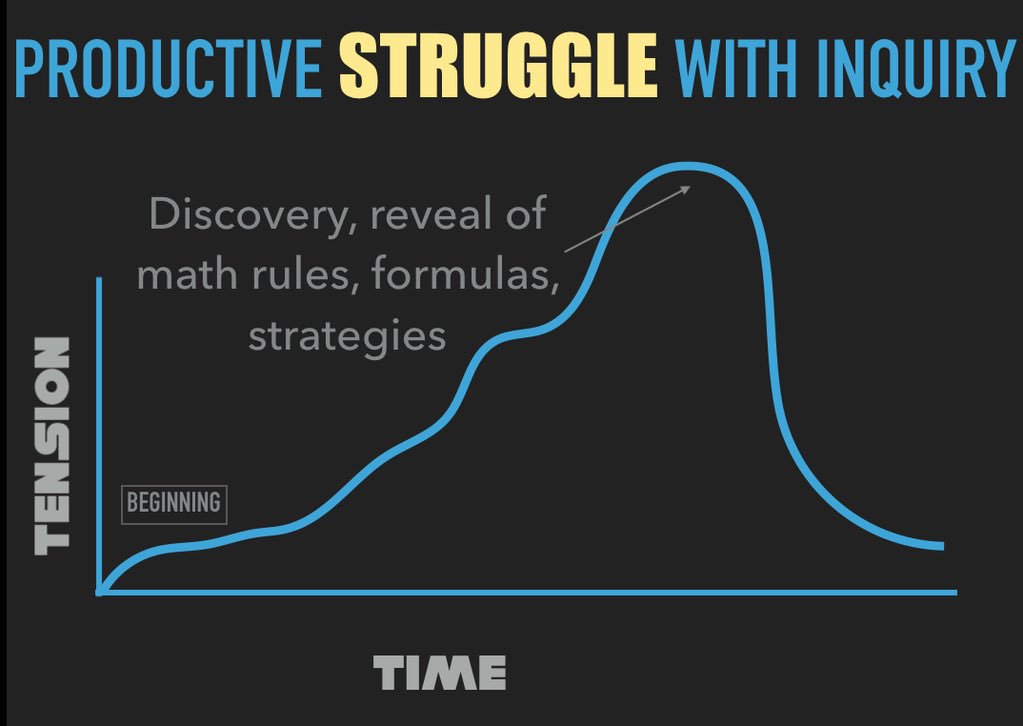
It's OK To Struggle When You're Learning Something New

       Years ago I knew of a little boy whom I never heard speak a word until he was nearly ten years old.  It wasn't that he couldn't talk; his disability was more serious than that...he was born with two older siblings and a mother who wanted the world to view her son as "Always Correct".  To ensure this perception, whenever anyone asked him a question, she would answer the question.  The older siblings did the same thing--but not for the same reason.  They just thought of him as a child that didn't talk much.  Clearly my nephew got the message (at a very early age) that other people would do things for him--even speak for him.  There was no reason to speak or even to think very much.  Of course, his mother loved him and she wanted the best for her son.  She didn't like to see him struggle to learn how to do things and didn't like to see him cry, so she did just about everything for him.

       Sometimes teachers are like this mother.  We want the best for our students and we want them to succeed.  So, sometimes we give them hints to nudge them toward the right answer; we compliment them for minor things (like repeating what we say); and we never want to suggest that they might be wrong about something.  Teachers are caring people and it makes sense that we want the best for our students.  But allowing students to have a false sense of achievement is not a caring thing to do.  And if this sort of (false) encouragement continues for a whole school year, and then the next year, and then the next year, we end up teaching students that learning is just memorizing stuff and repeating what the teacher says, and following directions.  That's not learning.

       Learning anything that is worth learning requires a certain amount of struggle.  No one expects you to learn something complex the first time you hear it.  You have to think about it, and practice with it, and make some mistakes, and learn from the mistakes, and make more mistakes, and then (maybe) you can claim success at learning.  It's OK to struggle and it's OK to allow your children to struggle.  We want students to know that learning is full of challenges and effort is required to overcome these challenges.  We want students to believe that they can do anything if they have the will to work at it until it is done.

       This is a difficult message for most parents to hear.  A lot of people have a fixed mindset about their children's abilities.  This means that they believe that their children are capable of doing some things and incapable of doing other things--and no amount of effort will change that.  This mindset leads to statements such as, "It's OK if you're not good at math because I was never good at math and some people just can't do math."  (Feel free to substitute other words in place of the word "math".)  This is a terrible message for students.  Instead, the message should be that hard work pays off and struggle leads to learning.


Thursday, April 14, 2016

Education that REALLY Prepares Our Students

 
       This week I've had the great fortune of attending the National Council of Teachers of Mathematics (NCTM) Annual Meeting.  Many subject areas hold these types of large, national conferences to help teachers and supervisors and school board members and principals to grow professionally and help students to achieve.

       I attended one particular session that discussed the need for our schools to examine the needs of the world that we live in and to make appropriate changes to the education that we provide to our students--the adults and workforce of the next generation.  The speaker was Diane Briars; President of NCTM.  She referenced the book Education for Life and Work (2012) that discussed the sort of competencies that will increase in the near future.  These include:


  • non-routine analytic skills
  • non-routine interactive skills
  • thinking
  • reasoning
  • expressing information to others
  • interpreting information and responding appropriately

       Math teachers know that we teach reasoning and problem solving and analytic thinking.  But we currently teach these skills under the guise of Algebra and Geometry courses.  Is there a better way?  Would it be better to teach these skills within a context rather than strictly in the abstract?  And what about the actual teaching strategies that are employed when presenting such content to students?  Ms. Briars cited a study from 2014 that stated students learn better in active learning classrooms than they do in the traditional lecture-type classrooms.  Active-learning classrooms would use strategies such as: (i) Occasional group problem solving, (ii) Tutorials completed during class, (iii) Use of personal response systems, and (iv) Increased emphasis on student discourse including student-to-student discourse and teacher-to-student discourse.

       Finally, in the report titled, A Common Vision , the Mathematical Association of America (MAA) states that the status quo of teaching mathematics to our undergraduate students is no longer acceptable given that so many students struggle to complete the first one or two mathematics classes offered to them.  We need to see cooperation between the P-12 system and the collegiate system to create courses and course pathways that help students to learn the skills they need to learn to be successful in the world they will inherit.  One possible solution is to offer math courses that are not based on Algebra or Calculus--considering that the content learned in these classes is not necessary for the majors that some of our students seek.  For instance, Journalism may not need to know Calculus, but they will need to know statistics and how to interpret data.  

       From time to time, great institutions need to examine their work in light of the goals that they seek to achieve.  Education is one of those great institutions.  Such change should not be rare but (indeed) should be ongoing.  We no longer live in the 1920s or the 1960s or even in the 2000s.  We have an obligation to prepare our students for their world.  


Friday, April 8, 2016

Encouraging a Growth Mindset for your Students

       Growth Mindset is an understanding that you can learn and achieve anything if you are willing to work and practice and study and try.  A student's ability to learn is not predetermined from birth.


       This is an important concept for teachers who seem to always have some students who believe that they are not born with the skills necessary to learn.  A common saying among some students is, "I don't have a math brain.", meaning, "I don't have the ability to learn math regardless of the extent of my efforts."  We know now that this is not true.  But teachers are often faced with the prospects of needing to convince some of their students that this is not true.
       This chart is filled with suggestions for helping students to view their perceived obstacles in a different way.  Part of a teacher's job is to motivate their students to do their best everyday.  The more that we can convince students and then demonstrated to students that effort leads to (at least some level of) success, the more we are able to create a learning atmosphere in which students believe that they can learn.

       Growth Mindset is for weak and strong students alike.  We also have students who have been successful in the traditional school setting who don't have a growth mindset.  These students may have been praised for their "smarts" and they may be afraid to try something new for fear of not succeeding.  This limits their ability to grow.  Hence, encouraging a growth mindset is for all students and not just for a few.  Our best teachers have always been encouraging a growth mindset.  We have all had teachers who were able to convince us to try and to work hard in the belief that we would eventually succeed.  We need to see this occurring much more often in our classrooms.


Thursday, March 31, 2016

We Do Something Important Every Day

       Education is important business.

       Once in a while, a student needs to be somewhere else in the school during the time that she should be in my classroom.  Club meetings, picture day, sporting events, ... lots of activity going on in a typical high school.  So this mature and responsible student comes to me a day or two before and asks, "Are we doing anything important tomorrow?"

       My answer is always the same:  We do something important Every Day.  Bell-to-bell learning; every minute, every day; valuable instructional time....  Call it what you will, the stuff that goes on in the classroom--in every classroom--is valuable and important.

       Sometimes it is hard to see the importance of something we do everyday.  It becomes commonplace; and without an engaging teacher it can become boring.  The best learning occurs when the teacher understands the importance of every minute and communicates this to the students via thoughtful, engaging lessons.

       Education is important; everyday, every minute.

Wednesday, January 20, 2016

Higher Rates of Women in Engineering


       Are we doing enough to encourage girls to pursue careers in Engineering?

       It isn't enough (anymore) to say that there are more women in Engineering today then there were 10 and 20 and 30 years ago.  The numbers of women in Engineering in these past years was so low that (one would hope) those numbers have gone up.  But recently, the percentage of females earning bachelor degrees in engineering has stubbornly remained only steady.

       Lots of data suggest that the number of female engineers should be increasing.  More high school women are taking Statistics, Calculus, and Physics.  More women than men have been enrolled in college since 1978.  Women have been earning more college degrees than men since 1981.  And the prospects for jobs in engineering is growing.  
       Opportunities abound; so if you're a middle or high school teacher or principal, or you're a parent of girl, be sure they get the message that they can do anything.  Don't feed the stereotype that says men are engineers.  Help them to be proud of their abilities and to pursue their dreams.  

       We need more women to be engineers.


Friday, November 27, 2015

Tinkering Around the Edges Isn't Sufficient for Significant Improvement in Our Schools

       There's a joke among some educators that says if a child doesn't understand the lesson, then we will just say it again slower and louder.

       It's not a funny joke.  In fact its really sort of a put down to teachers who struggle to help students to learn.  If the teacher presented the lesson in the best way she knows how, then she may not know of another way to present the lesson and (so) when a students doesn't get it, she just repeats the same thing (sometimes slower and louder).  This usually doesn't help the student to learn any better than the first time, but it does lead to frustration for both the student and the teacher.

       These situations are far too common in our nation's classrooms today.  Improving these situations is haphazard at best.  Sometimes some students try harder; sometimes some teachers try different strategies.  But most of the time, instructional change is small (or absent) and academic results remain the same.

       Still, this doesn't happen from a lack of trying.  Plenty of teachers (most teachers) try very hard to learn more and to improve every year.  They read books; they attend conferences; they take classes; they join Professional Learning Communities (PLCs) within their school or school system or online.

       Change is hard, and improving academic results for student groups that have historically struggled in the traditional school system is a complex problem.  It isn't the sort of problem that can be solved by tinkering around the edges; and by not causing some level of discomfort for people who insist that everything is fine the way it is now.

       I believe that we have the knowledge and the research to know what must be done to improve education outcomes for the students that we aren't reaching today.  These strategies and policies are available for everyone to see.  A short list of books from a variety of sources provides the answers we seek.  Here are some of them:

  1.  The Results Fieldbook: Practical Strategies from Dramatically Improved Schools, by Mike Schmoker
  2.  Whatever It Takes: How Professional Learning Communities Respond When Kids Don't Learn, by Richard DuFour
  3.  School Leadership that Works: From Research to Results, by Robert Marzano
  4.  Teacher Leadership that Strengthens Professional Practice, by Charlotte Danielson
  5.  Failure is Not an Option: Six Principles that Guide Student Achievement in High-Performing Schools, by Alan Blankstein

       However, I also believe that the change we need involves the hard work of constant improvement.  It requires schools to dig deep into the standards and objectives that are taught everyday and to ask questions such as, 
  • What is the best way to teach this objective to students?
  • What strategies should we use?
  • What activities are best?
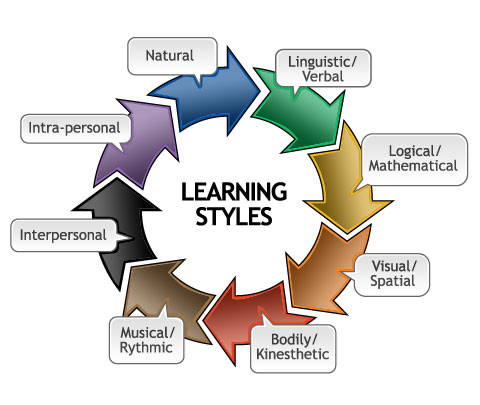
  • How do we reach a classful of students with different learning styles?
  • How do we assess student understanding?
  • How do we assess the success of the decisions we made for this lesson?
       This is complex work and it requires effective collaboration among teachers--no one should have to do this on their own.  If we are successful, it will take a generation to complete this transformation of our schools.  During that time, we will have to contend with a lot of resistance from educators and non-educators alike.  However, this is an effort that is worth the years of hard work.  This is an effort that today's teachers can look back on and be proud to say, "I was there when the hard work was done."

       Tinkering around the edges isn't enough anymore.  It's time to do what we tell our students to do--Work hard and you will see the rewards in your future.

Tuesday, November 3, 2015

Crack the Code of Learning

       How does a teacher enable students to learn?  How do students learn?  How do people learn?  Teachers who seek to reach their students struggle with these questions all of the time.  Experience (and research) tell us that students learn differently.  When we teach a lesson to 30 students; some get it right away, some get part of it, some don't get it at all.  How is that possible?  All of the students heard the same lesson; yet not all of the students had the same level of "Learning".

       This can lead to a difficult and awkward situation in which the teacher feels offended that the his or her efforts went to naught; and the student feels embarrassed that he or she wasn't able to learn as well as other students.  Our best teachers understand that all students don't learn in the same way and (so) they try to find different ways to present information.  They present is verbally; they present it visibly on a whiteboard on a screen; they use videos; they have students read some information; they have other students explain their thinking; and so on.  We use these different strategies to keep the class interesting and to increase student engagement.  But we also do this because we know that all students won't learn the same way and we need to find a way to present the content in different ways so that we reach all of our students.

       Einstein has been associated with the quote, "I never teach my pupils, I only provide the conditions in which they can learn."  I don't know if he really said this, but the statement may be correct.  It may be that no teacher can actually MAKE students learn.  It may be that the best we can do is to encourage students to learn.  We do this by getting to know our students very well and using this knowledge to include into our lessons those aspects that our students will find interesting.  If the students are interested than they are more apt to try their best even if the learning is difficult.

       Still, even when we understand about different learning styles and the value of good relationships with students, teachers are still faced with some topics that seem to be difficult for many students.  Once again we struggle to crack this code of learning.  How do teachers help students to understand complex topics?  Indeed, this is the art of teaching.  Some teachers are better at this than other teachers.  In my experience, the teachers who are able to reach the most students are the teachers who learn from their own experiences (including their own failures) and who seek input from other teachers via conversations with colleagues, reading journals and research, and taking courses about learning.

       Learning isn't a complete mystery--but it isn't a completely solved mystery either.  Current research about how the brain works will help to answer some of our questions.  Collaboration with professional teachers helps too.  Teaching is rewarding and (at times) frustrating.  As we learn more about the process of learning we will have more teachers with greater abilities to address the needs of more and more of our students.


Sunday, October 25, 2015

Teachers that Promote a Growth Mindset

       Every teacher has had "the phone call" with parents in which the teacher says,  Your child has the ability, she just needs to apply herself.  And then the teacher and parent (typically) talk about school rules involving turing work in on time and not talking in class.  Essentially, we are saying to the child, We're the adults.  These are the rules.  If you don't follow the rules, then you will get a bad grade.  (Of course, if the student was concerned about her grade, we wouldn't have this discussion in the first place.)

       There are a lot of "old school" problems with that phone conversation.

  1. The conversation emphasizes following rules and getting grades, and there is very little talk about actual learning.
  2. The first part of the famous teacher line is, Your child has the ability....  If the child already has the ability to do the work, then the solution to the problem should concentrate on why the child isn't doing what she is already capable of doing.
       We know that (as adults) there are lots of things that we have the ability to do and yet we don't do them--or we delay doing them for as long as possible.  Mowing the grass, doing the dishes, admitting we're wrong about something.  We have the ability to do all of these things, but we need some sort of motivation to actually take the time to do them.  Students are the same way.  The old adult (or teacher) response of "I'm the adult and I say so." may force children to do something, but it certainly doesn't motivate them to do their best.

       Growth Mindset theory tells us that when students believe that effort will lead to result, they are more likely to try new things and are less worried about making mistakes because they believe that these setbacks are just part of the process of learning new things.  I've recently been introduced to the website Mindset Kit.  This site is dedicated to helping teachers, parents, and students to understand what Growth Mindset is and how to help students to develop good, healthy Growth Mindsets.

       One simple strategy that every teacher can do is called Praise the Process.  When a student is doing some classwork, or offers an answer or an idea in class, the teacher response by praising the thinking that went into the student's effort rather responding to the correctness or the incorrectness of the student's work or response.  This simple strategy helps the student to know that their effort is important towards that eventual goal of learning the skill or concept.
  
       Mindset Kit has excellent resources for parents.  Teachers can refer parents to this site for parents who ask, "How can I help my child to do her best?"  There is a brief quiz on different statements of praise that parents can say to their children that will promote a Growth Mindset.  And there are other typical daily activities in which a parent's reaction will help their children to understand (for instance) that making mistakes is great for helping your brain to learn.

       Our best teachers already know how to encourage their students to do their best everyday--even when they don't want to.  It's the same as when a parent tries to distract their child away from something that is bothering him and towards something that he would like.  Growth Mindset strategies help teachers to do this while also helping their students to see the value in effort.

       Here's another quote I hear from parents all of the time, "I can't believe my child is doing so well in (insert course subject here) class in school.  He has never done well in that class before."  You can bet that this child has a teacher that knows how to motivate students.  Her class is interesting and students are engaged in the adventure of learning.  

       After all, they already have the ability.


Friday, October 2, 2015

Motivated to Learn

       I often say to new teachers that it may not be your job to entertain your students, but it is certainly part of your job to motivate your students.
       We know that actual "teaching" is only a part of a teachers job.  The most major part of the job is ensuring that students are learning.  Our best teachers know that most students don't learn strictly by listening.  Learning requires doing, talking, asking questions, making mistakes, and doing some more.  Teachers plan lessons that keep their students engaged.

       Strategies to keep students motivated include lots of basic things such as:

  1. Calling on students every class (preferably at least three times each class),
  2. Allowing opportunities for students to get out of their seats during every class,
  3. Playing games that require students to understand the objective for the day to do well in the game, 
  4. Asking a lot of "Why" questions that require students to think and to explain their thinking,
  5. Allowing students choices to demonstrate their learning.
       Students can't learn if they are not motivated to learn.  Requiring students to sit still and listen to the teacher for 45 minutes or 50 minutes or 90 minutes is not an effective way to instill true learning.

       What do you do to motivate your students to do their best everyday?


Wednesday, September 23, 2015

Are Your Students Obsessed with Grades?

       Here's a quick checklist to see if your students are obsessed with grades:


  1. They are constantly asking, "Is this going to be graded?"
  2. They refuse to do anything if it is not being graded.
  3. They ask for "extra credit" or make-up work at the end of the marking term to raise their grade to the next letter grade.
  4. They only see the grade at the top of their returned work and ignore the helpful comments that the teacher has written.
  5. They try to memorize the information they need to know for tests.
  6. They follow procedures in mathematics for unknown reasons just to get the right answer.
       In short, students who are obsessed with grades are just "going through the motions" at school; they do what they're told, but they learn very little.  And when they take a test that can't be beat by memorizing (like a final exam) they show their true ability or lack thereof.  The challenge for these students is to do as little as possible to earn the grade they want.

THIS IS NOT THE WAY SCHOOL IS SUPPOSED TO WORK.

       School is supposed to be all about learning.  If students aren't learning, than we are wasting their time.  And if we are (somehow) justifying how these grades-obsessed students are getting A's and B's, then we are giving them (and their parents) a false sense of accomplishment.  Eventually someone will tell these students the truth about their academic abilities, and it would be a shame if they are in college (and paying for college) when they are hit with this truth-bomb.

       Teachers can help their students to de-emphasize grades by praising them for their thinking and reasoning.  They can emphasize learning by asking students to explain how they got the right answer instead of just accepting the right answer and moving on.  Formative assessments that require thinking and reasoning and justifying instead of just repeating information tell students that memorizing isn't good enough.

       We have to help students to be less obsessed about grades.


Saturday, September 5, 2015

The Pros and Cons of Standardized Testing

Warning:  If you are 100% against standardized testing or 100% in favor of standardized testing, you shouldn't read this blog post.  I'm going to some things that you will agree with, but you will be so blinded in anger over the things I say that you disagree with that you will never see the agreement parts.  Besides, you have already determined your thinking on this matter so there is no point for you to hear the opinions of others.

------------------------------------------------------------------------------------------------------------------

       Alright, maybe that warning was a little harsh.  I apologize.  In truth, I'd like to believe that the people who are on the extreme sides of this issue are a very small minority.  Most people have their views regarding standardized testing, and I would guess that most people fall somewhere in the middle of the issue.  I'm one of those people.

       In an ideal world, the students will come to school and do their best everyday to learn--and testing wouldn't be necessary.  The reason it wouldn't be necessary (in this ideal world) is because teachers would constantly gain an understanding of each student's level of learning through formative assessment practices; and students would ask questions about the things they didn't understand and keep working on these things until they got it.  The motivation would be the attainment of knowledge.

       To be fair, some students and teachers and whole schools work hard to (at least) approach this ideal world of education; but for the rest of us, we are still somewhere on our journey toward this world.  We are striving to emphasize learning over "getting-a-grade"; but we still need effective ways to measure learning--and testing is part of this process; and standardized testing is part of this process.

Some Pros of Standardized Testing

       In my view the "standardized" part of standardized testing is a pro.  Every student takes the same test regardless of the factors that influenced their learning (such as their teacher, the curriculum, the standards, the state they live in, etc.).  Think about the SAT test: colleges know that every student is taking the same test, so SAT scores can be compared to each other regardless of where in the country the test was taken.

       Also, the next generation of standardized tests (think PARCC and Smarter Balanced tests) are written to determine a measure of learning based on understanding content more than based on memorizing formulas and procedures.   This means that it will be harder for students to guess the right answers on these tests.  It also means that results will be based on true learning and understanding rather than on a student's ability to take a test.

Some Cons of Standardized Testing

       It may be a challenge to teach all of the content that is covered in a standardized test prior to the administration of the test.  Standardized tests typically have specific testing windows or a specific testing date on which to give the test.  Since different school districts start and end on different dates during the year and have different days off due to holidays and other reasons, it might be hard to structure a course outline that completely covers all of the material that will be assessed on a standardized test.  This occurs (sometimes) for Advanced Placement tests.  These AP tests usually have a particular May date for their administration and many school districts finish their school years in June.

       Some might argue that a "con" to standardized testing is that it might assess something that we don't teach or don't want to teach in the course.    I believe that there is general agreement of what needs to be taught in each grade and that this is less of an issue than some would have you believe.

       To me the biggest down side to standardize testing is that it gives the message to students (and parents) that the goal of school is getting a good grade on a (standardized) test rather than having the goal of learning.  Sometimes standardized test results are treated with great importance with newspaper articles and school-wide celebrations.  And sometimes these results are given too much importance when making course selection decisions for the next couple of school years.  As I said before, schools should emphasize learning and should de-emphasize "getting a grade".  A standardized test score should be just one piece of data that is used in conjunction with many other data points to make big decisions about a student's ability.


Tuesday, August 18, 2015

Open Letter to Students

       This is the first of a three-part series of open letters to the three most important stakeholders in our educational system: students, teachers, and parents.  All three of these groups play a vital role in the education of our children.


Dear Students,

       As a brand new school year begins, I want to share some of my thoughts about school and education in the hopes that they will help you to have a successful year of learning.

       Note that I've used the wording "learning" and I didn't say a successful year of getting good grades.  Grades may be one indication of your learning, but grades are not the purpose of school.  Indeed the reason we adults have these rules about going to school is because we want to do our part in preparing you to be as prepared as you can be for the majority of your life as an adult.  Hence, school shouldn't be a competition for grades, but instead it should be a journey of learning.

       Some of you will learn best by sitting still and quiet in your chair and listening to your teacher and (maybe) writing some notes.  But we now know that most students don't do their best learning in this way.  Learning requires you to ask questions and to be curious about what you are taught.  You need time practice; you need time to make mistakes and fix those mistakes and make more mistakes...and so on and so on.

       Have you ever read a book that you really liked and felt that you were a fast reader?  But at other times you read a book that you weren't interested in and it seemed to take a long time to get through it.  Learning is like that.  So try to find something interesting in everything that you learn in school and you will find that learning itself can be interesting.

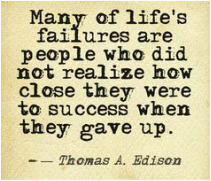
       I think the important thing to know about learning is that learning can be a struggle at times and that's OK.  If you learned everything the first time a teacher taught it to you, than you probably are ready to move on to a tougher class (or a tougher teacher).  Faster is Smarter.  Learning shouldn't be a competition to be the first person to finish an assignment.  Learning takes time.  So don't worry if you don't get it the first time.  True learning rarely comes fast.

       Your teacher is there to help you when you don't get it the first time.  If your teacher doesn't help you then you need to tell someone; tell your mother or father or a guidance counselor.  No teacher should make you feel bad about not learning.  No one is an expert in everything--including your teacher.  Most teachers are glad to help you--that's why they are teachers.

       So work hard at your learning this year.  Take responsibility for your learning.  Don't look for shortcuts or for "the easy way".  People who know how to learn can learn anything.  You can learn anything.  Ask for help and don't give up.  

       School is an opportunity for every student.  It, unfortunately, is not an opportunity that every child in world is given.  Appreciate this opportunity and do your best everyday.

       Have a great school year!


Wednesday, July 29, 2015

The Grading Monster

       This is a story of a idea that grew up and got bigger and eventually took over a population.  The idea was to use grades to classify a student's ability.  This idea has grown into the the current Grading Monster that we have today.

       The origins of this idea, attributed to William Farish, seemed innocent enough--find a way for teachers to teach more students.  But what it did, instead, was to separate the important student-teacher relationship that had symbolized teaching for most of the 10,000 years prior.

     It would be fair to say that grades have overtaken the main purpose of schooling--which is to learn.  Of course this is not true for all students, but when students complain about academic performance, their complaint is much more commonly about their grade than about the learning that did or did not take place.

       Parents tell their children to get good grades rather than to learn a lot.  And when grades are low, discussions about how grades are determined and how these grades will affect course placement and/or college acceptance are the paramount concern over and above the concern that students are learning well enough.  More often than then not, the concern over learning is never brought up when grades are low.


       Dr. Justin Tarte talks about grades a lot in his blog Life of an Educator by Dr. Justin Tarte.  He points out many pitfalls that our educational system has fallen into when it comes to grades and grading.  Starr Sackstein is another blogging star of mine who has discussed grades and grading recently.  Clearly the effects of The Grading Monster are well known by educators and maybe, just maybe, we will begin to see this monster lose her strangle hold on our educational system.

       My thoughts on defeating this monster include the more common use of true formative assessments in our classrooms.  My definition of "formative assessments" is assessments and activities that provide to students and parents (and teachers) information on how well the students are learning.  Notice that I included the "activities" in this definition--as formative assessments don't have to be tests and quizzes.  In fact, I would advocate that most of the time formative assessments are not tests or quizzes.

       If we can emphasize the idea of learning and of measuring learning and de-emphasize the idea of getting-good-grades, we can defeat The Grading Monster and win back our schools for their true purpose--learning.


Saturday, June 27, 2015

Somebody Has To Tell Them

       Nobody likes to hear bad news.  And nobody wants to be the person to give the bad news.


       In our public schools, we (sometimes) have the following problem...a student is not achieving at an acceptable level.  He tries to do well; he does some things well; but overall his achievement is too low for his grade or age level.  Public schools have lots of ways of helping students to raise their level of achievement and (indeed) it is our job and moral responsibility to do so.

       The problem is that someone has to tell the student and his parents that he is achieving below grade level.  That is a hard conversation to have.  No teacher wants to tell their students' parents this news.  No parent wants to hear this news.  But someone has to do it because we don't want to allow students to go through school thinking that they are doing fine (academically) when, in fact, they are below grade level.

       Sometimes we try to give this news through grades on report cards or via standardized testing grades, but the message doesn't always get through.  Sometimes students get a few good grades on minor assignments and parents "hang on" to those grades and seem to ignore the poor grades on the more major assignments.

       And so, sometimes students go through elementary and middle school thinking that they are doing fine and then they get to high school and struggle with their academic course work.  Even worse, sometimes these struggling students even go through high school with no one in authority ever telling them that they are below grade level.  These are the students that go on to college and (only) then are finally told that they do not have the ability that they thought they had--no one ever told them.

       Our job is to help students to learn.  Part of that job is telling students how well they are learning.  We don't help our students by letting them think that all is fine when it isn't.  Someone will tell them at some point, so it might as well be sooner rather than later.  It doesn't have to be an argumentative conversation.  Teachers and schools will help students to do better--that's our job.

       One way to communicate this message is to have a grading policy that rewards high academic achievement and discourages mere compliance with school and classroom rules.  While we certainly want students to behave in school, what we really want is for students to learn in school.  Teachers who have high expectations for their students and are very clear about those expectations tend to have students who reach those expectations.

       It's OK to tell students that they have not achieved the goal yet.  It doesn't mean that they will never get there, but it does tell them that where they are (academically) is not acceptable and they have to do more, try more, and achieve more.

       Somebody has to tell them.  Be brave and be the one who cares the most about your students.  Be clear about your expectations and tell students when they have and haven't met these expectations.


Public Schools and Choice

       Is it true that public school kids and their public school parents don't have choices?  I'm sure that I will expose my igno...

Teach100 blog