Showing posts with label a nation at risk. Show all posts

Wednesday, April 8, 2015

Poverty Should Not be a Barrier to Education


       The Statue of Liberty quote (written by Emma Lazarus) says it well:

Give me your tired, your poor, 
Your huddled masses yearning to breathe free, 
The wretched refuse of your teeming shore. 
Send these, the homeless, tempest-tossed, to me: 
I lift my lamp beside the golden door.

       At the turn of the 20th century, the golden door was the gateway to America for many people from Europe and other far-off lands.  Today, (I contend) this golden door is our nation's public schools.  We accept all students and we teach all students.  But when we look at the achievement of our students, we see two distinct groups:  poor students (who now make up a majority of our public school students) and non-poor students.

       I just read a great article in the April 2015 issue of District Administration (by Tim Goral) that talks about confronting the crisis of educating low-income students in our public schools.  I'm calling it a "crisis" because of the following two facts:

  1. Low-income students make up half of the population of public school students in the United States.
  2. Low-income students struggle to maintain acceptable academic results.
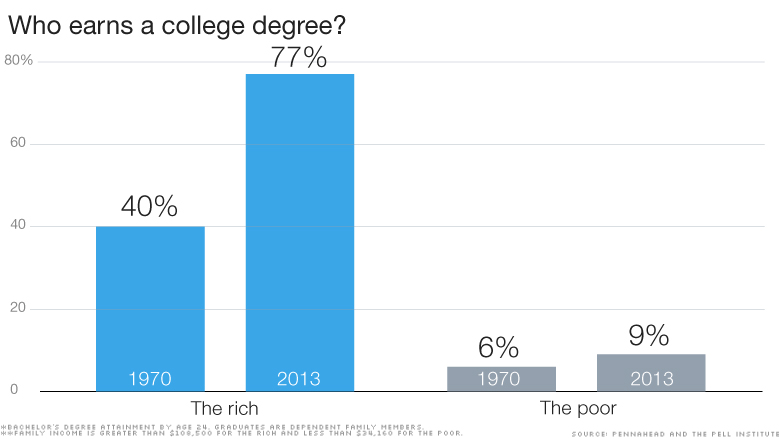
These two facts are largely undisputed among educators and education researchers.  Taken together they express the most major issue facing our public schools today and (perhaps) our society in the future.  While our students from middle and upper-income families tend to show good achievement throughout their  P-12 schooling experience, the growing numbers of students from poor families continue to demonstrate bleak achievement results.  This is evident on the NAEP results as well as just about any state-level results (and local results).

       I believe that this is the "Sputnik" event of our time.  However, I fear that while this is a well-known problem among educators, it is not a well-know problem for people outside of education--particularly middle and upper-income people outside of education.  We need change on a national level; a national effort.  We need advocates throughout the country to make the general public aware of this problem.


       I believe that our nation's schools have the people and the tools to turn around this "rising tide of mediocrity that threatens our very future as a nation and a people."  (quoted from A Nation at Risk)  This is a difficult and complicated problem that we must solve.

       And I am certain that we will solve this problem.


Thursday, January 16, 2014

Common Core and Our Desire to Give the Best to Our Students

     During my 25 years in education, I've seen ideas come and go; I've seen programs come and go; and I've seen movements come and go.  I used to think that the education system was constantly dreaming up ideas that were initiated with great fanfare and then were let go as failures.  But I've come to realize that education is not a static thing; certainly National Education is not a static thing.

     A lot of thought and research and debate goes into new initiatives and I think that it is fair to say that educators are constantly thinking about students and the best way to help students.  Education is also constrained by limited funds and (sometimes) limited research.  Also, big problems that require big solutions are often very complicated.  But it is not an excuse to "do nothing" just because the task at hand is difficult.


  After the landmark report "A Nation at Risk" came out in 1983, our education system did their best to respond to the issues that were raised in this report.  Some problems have been addressed and some remain.

     We have to remember that time does not stand still.  The world is changing and that means that our schools have to change also.  The form of that change can be numerous and diverse; but change it must.

     I am living and working through the transition to the Common Core standards.  Once again, this is a big change that is responding to a big problem in a big way.  Change can be scary at times, but this change is very, very necessary.  I am confident that I will look back at this second decade of the century and say that I was part of the beginning of something big.  And I am proud to be involved in this change.

     This isn't the end of change.  Programs and ideas will continue to come and go.  Each one will do its part to help our students and to improve on the last change that occurred.  I've come to believe that change is good and it should be embraced.


Public Schools and Choice

       Is it true that public school kids and their public school parents don't have choices?  I'm sure that I will expose my igno...

Teach100 blog