Showing posts with label digital natives. Show all posts

Tuesday, November 17, 2015

It's Time for Our Schools to Leave the 20th Century

       You know the old joke about Rip Van Winkle and schools?  He falls asleep for a hundred years and upon waking up he sees everything he used to know has changed dramatically.  The houses look so different.  The clothes that people wear are very different.  And the cars...wow.  Then he finds a school and walks inside.  He goes into a classroom and he is comforted to see that schools and classrooms haven't changed a bit.

       We educators don't think this is very funny.

       In fact, it is embarrassing for us carry out the important work of education today in the same way that we did this work 50 or 30 or even 20 years ago.  Doing so ignores the research about learning that has been done over the past few decades.  It ignores the research about how the brain reacts to the stimuli that occurs in classrooms.

       For instance, we know that most students can't learn to the best of their ability strictly by sitting in class for a whole class period and listening to the teacher talking (and taking notes).  We know that students are more engaged when they have the opportunity to participate verbally and when they have a chance to get up out of their seat and participate physically in some way.  We have technology that we didn't have (even 20) years ago that can be tapped to help our students to prepare for the information world that they will enter after high school.

        We are not preparing our students by merely teaching them to read, write, and do arithmetic.  These things are important, but they are not enough.  Memorizing facts long enough to get a good test grade will not prepare our children for the world that they will inherit.  Our schools have the responsibility to mirror the society that our students will experience.

       Twentieth Century schooling is not what our students need.  Most of them have never even lived in the 20th century.  I believe that our current education leaders understand this need for our schools to change.  Part of the responsibility of our public schools is to explain this need for change to our parents and to our communities.  Staying the same is easy; change is hard.  Schools often face opposition from communities who tend to say that "The old way was good enough for me and it's good enough for our kids."  We need to make the case against this sort of thinking.

       Someone needs to speak for our students and for their futures.


Friday, October 2, 2015

Motivated to Learn

       I often say to new teachers that it may not be your job to entertain your students, but it is certainly part of your job to motivate your students.
       We know that actual "teaching" is only a part of a teachers job.  The most major part of the job is ensuring that students are learning.  Our best teachers know that most students don't learn strictly by listening.  Learning requires doing, talking, asking questions, making mistakes, and doing some more.  Teachers plan lessons that keep their students engaged.

       Strategies to keep students motivated include lots of basic things such as:

  1. Calling on students every class (preferably at least three times each class),
  2. Allowing opportunities for students to get out of their seats during every class,
  3. Playing games that require students to understand the objective for the day to do well in the game, 
  4. Asking a lot of "Why" questions that require students to think and to explain their thinking,
  5. Allowing students choices to demonstrate their learning.
       Students can't learn if they are not motivated to learn.  Requiring students to sit still and listen to the teacher for 45 minutes or 50 minutes or 90 minutes is not an effective way to instill true learning.

       What do you do to motivate your students to do their best everyday?


Tuesday, December 9, 2014

Digital Learning

       This is an exciting time to be in education!

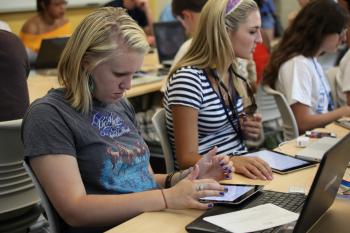
       Educators today grew up before the computer age (or as the computer age was beginning) and we  are witnessing the transformation to the digital learning environment in our schools.  We will forever be able to say, "We were there when...
  • ...when our schools first got wireless internet
  • ...when our students were allowed to use digital devices for the first time
  • ...when we stopped using paper textbooks
  • ...when we first used "blended" resources and then went totally online
  • ...when we first allowed students to use cell phone as their "device" in school

       As with most major transitions, we are struggling with developing new rules and preparing for new unknowns.  Some of us are kicking and screaming our way to this new world of education; as other's of us can't run fast enough away from the past.

       And (I think) the public is struggling with what they expect from us (the public schools) as well.  Parents want their children to be prepared for the world that they will inherit.  But, at the same time, many parents are more comfortable with the old paper textbook coming home every night; "ten math problems"; "read a section from the Social Studies textbook and answer the questions at the end of the section."  They'll say, "That's what I did when I was in school...and I turned out just fine."  While other parents are calling their child's principal and asking what device is permissible under BYOD (Bring Your Own Device)--so they can get it for their child for Christmas or for their birthday.

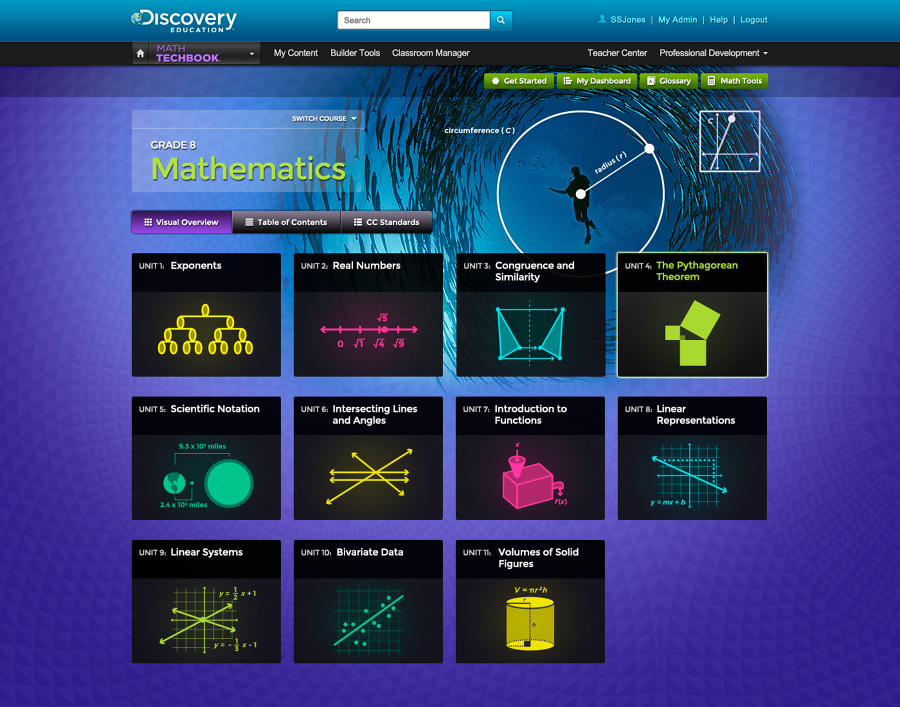
       Yes, this is an exciting time to be in education.  Our schools are getting Chromebooks for students to use.  I met with a group of secondary mathematics teachers yesterday to talk about the new Techbook from Discovery Education.  Teachers use their school websites to communicate with parents.  And Google Apps For Education (GAFE) is all we ever talk about.

       The transition is happening now.  It's exciting!  It's great!  It's the right thing to do for our students.  It is the way our students live--now.  And it is the way they should be learning--now.


Monday, March 17, 2014

Education Adjusting to Change

     So, the story goes like this...

     Rip Van Winkle sleeps for 100 years.  Then he wakes up.  He walks around town and sees a supermarket and says, "Wow, this is very different from what I remember before I slept for 100 years." Then he walks a little further and sees a neighborhood of houses and (again) remarks about how different everything is.  Then he walks a little further and sees a school.

    Rip Van Winkle walks into the school.  He walks down the halls; he walks into classrooms.  He sees the rows of desks; the teacher's desk in the front of the classroom; the board in the front of the classroom.  He smiles and breathes a sign a relief.  "This", he says, "looks familiar to me."

    Of course, this story is not a compliment to our public schools.

     This story illustrates how difficult it has been for our public schools to change over the years.  While some people find  comfort in this "sameness", many public educators are greatly bothered by the fact that public schools has difficulty keeping up with the world around us--the world (by the way) that our students will enter when they leave formal schooling.  And the world that our students currently live in!

     But this IS changing in some places and (sometimes) the change is one class at a time.  Our younger teachers are all-too-ready to use technology in the classroom and to engage students in their learning with fun activities that require them to get out of their seats and to interact with other students.  And it isn't just our newest teachers that are leading this change; our veteran teachers that strive to improve every year are also anxious to embrace educational technology and Student Engagement strategies.

     This change is taking place right now.  But we accept that public education will constantly change to mirror society.  This isn't a one-time-thing.  Change is constant in public education from now on.  And isn't this what we want from our public schools?


Friday, February 7, 2014

e-books, e-learning, e-education

     It used to be that you could count on school looking the same generation after generation.
- Rows of desks
- Teacher in the front
- Teacher talks
- Students listen
- Take out your books and read and answer the questions.

     But I envision a transformation in our nations public schools.  It is a transformation that will take place over a period of (perhaps) three to six years; a transformation that has already begun in some places.  I am talking about seeing less paper textbooks and much, much more electronic devices--both in the classroom and at home.

     These will be the tools of knowledge for our students.  The goal will be finding information, understanding information, using information, and creating things with this knowledge.  Students will learn about people in other countries and will communicate with these people while sitting in the classroom.  Students will learn about Physics and will create virtual simulations to test a theory.

     Education will be so much more than memorizing facts.  It will be exploring and learning and questioning and failing and trying again.  Students will learn by doings as well as by questioning.  We are past mere "e-books", we are talking about e-learning.  It is a transformation that will improve with every passing year.  As older teachers retire and newer teachers (digital natives) take their place, e-education will grow and mature.

     This is an exciting time to be in education!  This is a change that we want for our students; to prepare our students for their future.


Public Schools and Choice

       Is it true that public school kids and their public school parents don't have choices?  I'm sure that I will expose my igno...

Teach100 blog