Showing posts with label mistakes. Show all posts

Monday, March 20, 2017

New Teachers Don't Have to Know Everything

       Starting a new job is exciting...and scary.  And when that new job involves a classroom full of students who are depending on you; and they all have parents who are depending on you; and you're expected to use technology that you've never used before; and some student don't try to do their best every day; and ... and ... and ....  Well, you get the idea.  New teachers and veteran teachers have pretty much the same job and the same responsibilities.  But I've got good news for new teachers:  You don't have to know everything.

       Today's teachers are better trained and better prepared for that first day on the job than ever before.  Policies and laws and general "good practice" have prepared our college graduates well.  Student teaching requirements and excellent mentors during teacher training programs help our future teachers to understand curriculum, experiment with teaching strategies, and learn to interact with students.  But teaching is not the sort of job that can be fully learned in a college classroom.  Teaching requires practice and a fair amount of trial and error.  Every student is different and every group of students are different.  You can't be fully prepared for every situation when you begin teaching.

       For this reason, I tell new teachers that they are not expected to know everything when they begin their career.  I encourage them to ask a lot of questions and to seek advice from fellow teachers and from their principal and assistant principal.  It isn't that new teachers aren't prepared to accept the responsibilities of the job--they certainly are.  But teaching is much more of an art than some sort of mechanical process.  Anyone can explain some idea or concept to a bunch of students.  But a teacher wants every student to understand the idea so well that they can discuss it with other students, ask questions about it, and even build on this new knowledge and find connections to other ideas and knowledge that they already have.

       New teachers who strive to improve and to learn from others are usually viewed in a good light, even if they make a few mistakes along the way.  Furthermore, I feel that it is the responsibility of the school and the school district to continually provide supports that will help new teachers to become better teachers.  We know that our best teachers are the ones who continually look for new and better ways to reach their students.  The world changes and we need teachers who are willing to change as well.  This is true for experienced teachers as well as for new teachers.

       We understand that it is stressful to accept a new job with new surroundings, new people, and new responsibilities.  We want new teachers to be comfortable and confident.  With adequate supports, new teachers can approach everyday knowing that nobody is perfect and mistakes are part of the learning process.  This is what we tell our students and it applies to the teachers too.  Teaching is an awesome responsibility, and understanding that teaching is a learning process helps new teachers to get through that first year eager to begin their second year.




Saturday, September 24, 2016

I Don't Have a Reading Brain

       I don't have a reading brain.  


       I'm 52 years old and I've never been good at reading.  In fact, I'm constantly telling my children that I was never a good reader so that they don't feel so bad about being bad at reading themselves.  They are always saying, "Why do we have to learn to read anyway?" and even though I basically agree with them, I try to think of times when reading is important such as when they get a text from their friends.

       I really don't feel too bad about being a bad reader because just about everyone I know is bad at reading.  In fact, we are always joking about being bad at reading.  My sister-in-law is a middle school English teacher and every time we go to a restaurant we always make her read the menu to us.  We just tell the waitress to hand the menus over to her and most of the time the waitress sort of laughs in agreement and says something like, "I get it.  I'm a terrible reader too."  And we all have a big laugh.

       People who can read must be really smart.  Everyone knows this.  In school, we always knew who the smartest kids were because they were able to read.  When teachers told me to read, I just tried to memorize the facts that I needed to know to answer the questions at the end of the chapter.  That's what I tell my own children to do because I really can't help them with their reading and they know that I can't really read very well anyway.

       High school reading was the worst.  Seriously, how are normal people supposed to memorize all of those words AND their meanings.  It really isn't humanly possible, except for people that have reading brains--I guess.  

----------------------------------------------------------------

       Does this sound familiar to you?  Are you constantly telling your kids and your friends that you're terrible at reading?  Do you get tense when have to read something?  Do you have reading anxiety?


Who would brag about not being able to read?  Who would ever suggest to their very own children that reading isn't important?  It's absurd.  No adult or parent would openly laugh about not being able to read.

       But, sadly, adults and parents often say these things about mathematics.  Some people actually believe that there is such a thing as a "math brain".  Many people view people who are good at math as being "smart".  And I have often been in a restaurant when my friends and relatives have passed the check to me to figure out the tip--all the while laughing and being very open about their inability to do math.

       What sort of message are we sending to our children when so many adults joke about not being able to do math?  Too many children feel that they are given a "pass" from the adults in their lives to be poor at math.  This leads to a lack of effort in the classroom which leads to a lack of understanding.  Every math teacher has (at some point in their career) said to a parent, "Your child could do so much better in mathematics if he/she put in the effort."

       This is something that we can fix.  This is something that every parent can do to help their child to do better in math.  Stop saying that you were never good at math.  Make sure that your children understand that they can do anything and they can learn anything; but they have to try.  Learning isn't always easy.  No one expects you to "get it" the first time.  It takes effort and mistakes and try, try again.

       Learning reading and mathematics isn't all that different.  The difference is our attitudes toward them.

Friday, August 26, 2016

A Tale of Two Classrooms -- Mistakes = Learning

 This is the third in a ten-part series based on the poster: A Tale of Two Classrooms.


---------------------------------------------------------------

Mistakes = Learning

       So here's a situation that happens everyday.  A teacher is teaching something new.  He or she asks a question and nobody responds.  Or maybe you're an adult and you go to a meeting of some sort and the presenter asks a question and nobody responds.  Why does this happen?  Why is this so common?

       Just like adults, students don't want to give the wrong the answer.  They don't want to offer a suggestion or an idea or a possible answer for fear that they may be wrong.  Wrong answers are viewed in a very negative way.  Wrong answers are bad.  Wrong answers are frowned upon.  So rather than risk embarrassment and possibly a scolding of some sort from the teacher, students (and adults) prefer to stay silent.

       Now imagine being in a class in which mistakes are viewed as great opportunities for learning.  When a students asks a question or offers a solution or an idea, it doesn't matter if he/she is right or wrong.  Instead, the comment is considered part of the classroom discourse.  It enables others students to hear different ideas and they can respond to these ideas.  In fact, we now know that mistakes help our brains to grow and help all of us to learn (no matter our age).

       When you are learning something new, you're not expected to know it right away.  Most new learning takes time and effort and mistakes and correcting mistakes and then more mistakes before you really understand it well--perhaps especially when learning math and science concepts.  It's not only "OK" to make mistakes, it should be expected (and respected) to make mistakes when you are learning something new.

       We want our students to be in classes in which mistakes are viewed as a nature part of the learning process.


Tuesday, November 3, 2015

Crack the Code of Learning

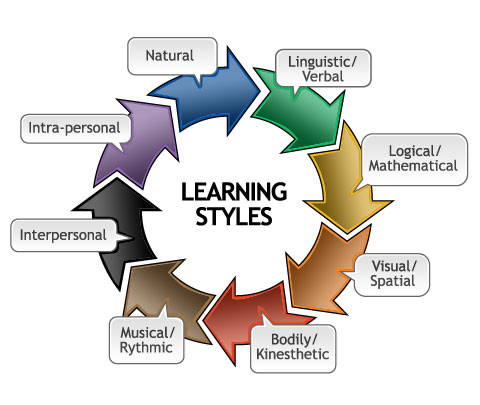
       How does a teacher enable students to learn?  How do students learn?  How do people learn?  Teachers who seek to reach their students struggle with these questions all of the time.  Experience (and research) tell us that students learn differently.  When we teach a lesson to 30 students; some get it right away, some get part of it, some don't get it at all.  How is that possible?  All of the students heard the same lesson; yet not all of the students had the same level of "Learning".

       This can lead to a difficult and awkward situation in which the teacher feels offended that the his or her efforts went to naught; and the student feels embarrassed that he or she wasn't able to learn as well as other students.  Our best teachers understand that all students don't learn in the same way and (so) they try to find different ways to present information.  They present is verbally; they present it visibly on a whiteboard on a screen; they use videos; they have students read some information; they have other students explain their thinking; and so on.  We use these different strategies to keep the class interesting and to increase student engagement.  But we also do this because we know that all students won't learn the same way and we need to find a way to present the content in different ways so that we reach all of our students.

       Einstein has been associated with the quote, "I never teach my pupils, I only provide the conditions in which they can learn."  I don't know if he really said this, but the statement may be correct.  It may be that no teacher can actually MAKE students learn.  It may be that the best we can do is to encourage students to learn.  We do this by getting to know our students very well and using this knowledge to include into our lessons those aspects that our students will find interesting.  If the students are interested than they are more apt to try their best even if the learning is difficult.

       Still, even when we understand about different learning styles and the value of good relationships with students, teachers are still faced with some topics that seem to be difficult for many students.  Once again we struggle to crack this code of learning.  How do teachers help students to understand complex topics?  Indeed, this is the art of teaching.  Some teachers are better at this than other teachers.  In my experience, the teachers who are able to reach the most students are the teachers who learn from their own experiences (including their own failures) and who seek input from other teachers via conversations with colleagues, reading journals and research, and taking courses about learning.

       Learning isn't a complete mystery--but it isn't a completely solved mystery either.  Current research about how the brain works will help to answer some of our questions.  Collaboration with professional teachers helps too.  Teaching is rewarding and (at times) frustrating.  As we learn more about the process of learning we will have more teachers with greater abilities to address the needs of more and more of our students.


Saturday, October 17, 2015

Learning is a Social Activity

       Learning is a social activity.

       A quick search of respected sources such as General Psychology, Psychology Today (article by Dr. Matthew J. Edlund, and one of my favorite education writers Annie Murphy Paul will help all of us to understand that the best learning requires active participation by the learner.  (View an excellent talk by Dr. Paul here.) The old days of "sit and get", don't-talk-in-class, teacher-in-the-front-of-the-room-doing-all-of-the-talking have been shown to be effective for an incredibly small percentage of our students.


     The problem is that most of our current teachers grew up in a school setting in which less student talk was the norm.  The teacher was the sole source of knowledge in the classroom and the students were discouraged from sharing their thoughts and ideas with each other.  Hence, many current classrooms engage in this same classroom structure that existed 20 and 40 and 60 years ago.  "It was good enough for me, and so it will be good enough for my students" as the thinking goes.

       This is a problem because the old model of presenting information to students and basically asking them to memorize it isn't enough for the workforce of today--and it isn't completely necessary in the age of the internet.  We are able to obtain facts very easily now.  The challenge to our teachers is to help our students to use that information to make connections to other information; to build things; to create things; and to solve problems.

       This requires our teachers to have a knowledge of how students learn and to use that knowledge to create lessons that incorporate the strategies that are most effective in helping our students to learn.
       This also requires teachers to be comfortable with students talking to each other in class; students getting out of their seats to share information and ideas with other students; and students making mistakes (and learning from these mistakes) during class time.  Some teachers struggle with this "active learning" approach because of the fear that such a classroom atmosphere would be difficult to manage.  Such an environment in the classroom requires planning and structure and good communication between the teacher and the students.  Students need to understand the objectives of the activities and they need to be accountable for doing their part.  Yet, this is the classroom that most students will tell you that they want.  And they want it because they struggle with learning through a strict sit-and-listen-and-take-notes sort of classroom.

       Learning is a social activity no matter where the learning takes place.  Adults who learn via asking questions and reading information and watching others and making mistakes and asking more questions, etc.; should not expect students to learn any differently.

       And if students aren't learning, then what's the point of school?


Sunday, September 13, 2015

Growth Mindset Parents

       I'm not sure if the idea of mindsets has broken out of the field of education and into the general public.  I hope it has.  Imagine if the parents of all of your students had a Growth Mindset and imagine if they helped their children (your students) to have a growth mindset.  That would be truly excellent scenario for any teacher!

       If you are not currently living this this ideal world, what can a teacher do to help her students' parents to understand the value of Growth Mindsets?

       Parents often ask teachers what they can do at home to help their children.  In the middle and high school years, sometimes the parents feel that they are not capable of helping their children because the content is beyond their ability.  This is an opportunity to talk about Growth Mindset with parents.  Here are some Growth Mindset suggestions that any parent can do:


  1. Help your child to understand that effort yields results.  Read, study, practice, quiz yourself.  
  2. Tell your child that true learning takes time.  You might not "get it" the first time.
  3. Make sure your child understands that it is OK to make mistakes.  We all learn from our mistakes.
  4. Praise your child for effort; don't praise your child for "being smart".  This seems counterproductive, but kids who are rewarded for "being smart" tend to take less chances for fear of losing the "smart" label.
  5. Never, never, never, never tell your child that you were bad at math or science or anything else.  This gives children an excuse for not doing well, and it makes them believe that they have some sort of genetic deformity that predestines them to be bad at these subjects.
       So much of these suggestions go against the idea of "playing school"--looking smart, pretending to learn, memorizing stuff for the test, only caring about grades, and not caring about learning.  We want students to understand the value of hard work.  Learning faster isn't learning better.  It's OK to make mistakes.  When students hear this from their teachers and then hear it again at home, they will believe it.

       Learning isn't a competition.  Students with a fixed mindset toward any particular subject can change to a growth mindset if they have supportive teachers and parents that encourage a growth mindset.

       Learning real does take a village--a Growth Mindset village would be a pretty good place to live!


Friday, September 11, 2015

Growth Mindset Teachers

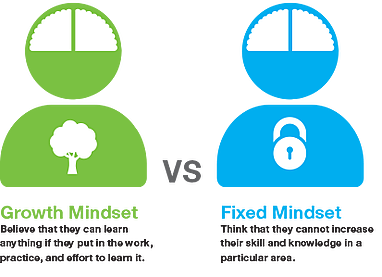
       Have you heard about Mindsets?  In my school district, I am hard-pressed to meet a supervisor or a principal or a teacher who hasn't heard about it.  Here's a quick video that defines Growth and Fixed mindsets:


       Teachers who understand the Growth Mindset are able to help their students to understand that effort yields results and mistakes are the building blocks of true learning.  These teachers don't encourage their students to get good grades, they encourage questioning and curiousity.

       Students with a growth mindset believe that their is nothing that they can't do.  They don't mind making mistakes because they don't view them as mistakes.  Instead they view mistakes as an important part of the journey toward learning and true understanding.

       Teachers can help students to develop a growth mindset by praising their thinking and their effort, rather than praising that they simply got the right answer.  In fact, if students are constantly told that they are smart, research tells us that they tend to avoid making mistakes and they will hide the things that they can't do because they fear that they will lose the label of "being smart".

       This is (yet) another reason why we have to end this school culture of over-valuing grades.  School is supposed to be about learning and we want our students to understand that learning requires effort.  Effort requires trying new things and taking chances and not getting it right the first time.  This is not only "OK", it is necessary for true learning to take place.

       We love our growth mindset teachers that produce our growth mindset students.  Learning can be hard work.  We want our students to value this hard work and to recognize that there is always a prize waiting to reward them for this hard work.

Sunday, August 30, 2015

Formative Assessment Is Not a Buzz Word

       Formative Assessments are the keys to identifying the actual learning that takes place within every student.  I'll admit that "formative assessment" is certainly an educational term that one wouldn't typically hear on a regular basis outside of education circles.  But it isn't a meaningless "buzz term" that we use to confuse people.

       Formative Assessment is something that good teachers do on a daily basis to gain information on how well the students are learning the daily objective or standard that is taught in class everyday.  If teachers didn't use some sort of formative assessment, they would only be delivering information instead of actually teaching.

       I think that people outside of education hear the word "assessment" and immediately think of "a test"; and then they think of a grade; and then they think about its impact on the course grade; and so on and so on--only thinking about grades.  Teachers on the other hand are much more interested in learning than they are in grades.  Formative assessments can be traditional quizzes or tests, but most of the time they are activities, questions, discussions, games, projects, exit tickets, pre-assessments--lots of strategies that teachers use to identify the level of learning that is occurring within each of their students.

       Formative Assessment emphasizes learning and de-emphasizes "the grade".  Formative assessment helps students to see the learning target (the goal) and it helps them to be successful in reaching that goal.

       So don't think of "tests" when you hear the term "Formative Assessment".  Instead think, "I'm glad my child's teacher is concerned about helping my child to learn well."

       Another phrase we use a lot is "Assessment for Learning".  Using Formative Assessments effectively helps students to learn and to learn well.  It isn't a "final exam" that (instead) tests what the student knows after the teaching and learning has already taken place.  Formative Assessment is what happens while the learning is taking place.  It recognizes that students aren't going to understand everything the first time they hear it.  They have to hear it and try it and make mistakes and try again and make more mistakes and learn from these mistakes and try it again...and eventually they get it.

       Mistakes are expected, respected, and inspected.  This is what Formative Assessments do.


Thursday, August 20, 2015

Open Letter to Parents

 This is the third of a three-part series of open letters to the three most important stakeholders in our educational system: students, teachers, and parents.  All three of these groups play a vital role in the education of our children.


Dear Parents,


       The school year is about to begin.  This is an exciting time for your children; but I know that it is an exciting time for you too.  And well it should.  As parents, you are an important part of the educational process of your children.  You encourage your children to do their best and you help them as much as you can.  Your children need you as they navigate their way through the P-12 system.  Thank you for supporting your children.

       I'd like to offer a few suggestions on this topic that you might not have ever heard before.  I say this because these suggestions tend to go against popular thought on the best way for parents to help their children.  Here goes:

1) It's OK to let your children struggle a little bit while they are learning new things.  It's OK if they don't "get it" the first time.  It doesn't mean that they are slow or below average or any other negative buzz word you might want to call a person who doesn't learn new things quickly.  True learning takes time; it takes a little trial and error.  Be sure to let your children know this. 

2) Education is not a competition.  I know that this sounds like a funny thing to say--especially to people who believe that everything in life is a competition.  But education should not be a race for your children to win.  Who cares if your child is a better speller than other kids in the class?  Who cares if your child gets a better grade than other kids on the geography test.  

       Teach your children to do the best they can all of the time.  If they feel that they have to surpass everyone all of the time in everything that they do, then the first time this doesn't happen (and it will; often) they will feel like a failure.

3) Instead of saying "Get good grades!", you should say "Learn well today!"  School is about learning; it's not about getting good grades.  Especially in elementary and middle school; grades should absolutely be secondary to learning.  Students who strive for high grades tend to learn how to "play school".  They do what their told and they turn things in on time.  But they only do things because of "the grade".  They don't care about learning; they only care about following the rules to get a good grade.  Don't be impressed by your children's good grade.  Stress the importance of learning.  What is the point of getting through school with good grades if you haven't learned anything more than following rules and doing what your told?

4) Lastly, make sure your children understand that hard work and studying and practice lead to success in everything that they do.  Making mistakes is OK; in fact, making mistakes and learning from mistakes helps children to learn.  Let your children know that it always OK to make mistakes.  


       Learning is a pursuit for perfection, it is a lifelong journey of wonder.


Public Schools and Choice

       Is it true that public school kids and their public school parents don't have choices?  I'm sure that I will expose my igno...

Teach100 blog