Showing posts with label graduation. Show all posts

Sunday, January 29, 2017

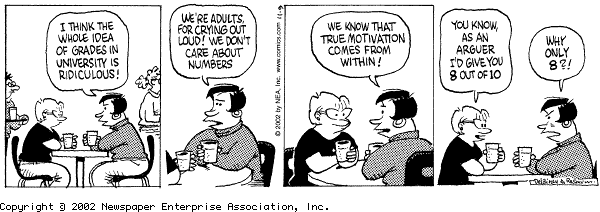
Flaws in the Letter Grade System

       What does it mean when you get an A in a class?  I'm not asking, "What is it supposed to mean?"  I'm asking, "What does it actually mean?"  Does the "A" in Chemistry mean the same as the "A" in History?  Does the "A" in Physical Education mean the same as the "A" in English?  What does a "B" mean; what does a "D" mean?  Did you ever get an "A" in a class--middle school, high school, or college--and then brag to your friends that you didn't learn a thing?  Did you ever get an "A" or a "B" in a class and fail the final exam?  Did you know someone who consistently earned "A's" and "B's" in math classes and couldn't score over 500 on the math portion of the SATs?

       Howard Pitler list four major problems with our current system of using letter grades:
  1. There is no consistency from teacher to teacher or from school to school.  Schools and school districts may have different policies about grading; and these policies aren't necessarily the same from school to school or from school district to school district.
  2. Teachers decide the factors that go into a course grade and they decide the weighting for each of these factors.  So called "hard teachers" and "easy teachers" is actually a real thing when it comes to grading in the letter grading system.  Some teachers are more demanding than others; some teachers award "points" for non-academic behaviors such as showing up to class on time or not using all of your allotted bathroom passes. Merely completing homework can be part of the grade regardless of the quality or the "learning" that may have occurred while completing the homework.
  3. Grades discourage students from learning.  Pitler quotes Alfie Kohn who says, 

 “Kids who are graded—and have been encouraged to try to improve their grades—tend to lose interest in the learning itself, avoid challenging tasks whenever possible (in order to maximize the chance of getting an A), and think less deeply than kids who aren’t graded.” The target becomes the grade rather than the learning. Students take less challenging classes because they want to “protect” their GPAs.

 4.  Lastly, true learning often requires multiple attempts in which ultimate success doesn't happen until the end of the process.  When students are more concerned about "getting grades", they tend to try less, they are less willing to go through the necessary struggle needed to achieve the ultimate level of true learning.

       There is another way to measure student learning and that is to compare their learning against standards (or proficiencies or competencies) that everyone can agree on.  Proficiency-based Learning is not new.  In fact it is growing in popularity among educators who want students and parents to have a better understanding of the actual learning that is taking place in our schools.  One of the hallmarks of proficiency-based learning is the idea that students need time to re-visit topics and ideas in their journey toward true learning and true understanding.  Hence, assessments are used to help students and parents to "see" the learning that occurred and to recognize the learning that still needs to happen.  When students are re-assessed, grades aren't averaged.  Instead, higher grades at a later time in the learning process are recognized as the actual level of learning that occurred.  Therefore, students are encouraged to try harder.

       Proficiency-based Learning should also allow students to work at their own pace.  Ideally, they should not move on to something new until they have a good understanding of the current lesson or idea or standard.  Also, students may have opportunities to demonstrate their understanding in multiple ways; not always via a summative test--however these tests can be still be used.

       Schools are for learning, not for "getting grades".  And we need to have a better system for identifying the learning that takes place.  Too many students are graduating from high school without the skills to hold a job or complete college or make good decisions for themselves.  We need to do better for our students so that they will have better options for their futures.


Tuesday, December 27, 2016

College Not For All

       I'm going to start by saying that I went to college, my wife went to college, my siblings went to college, I want my children to go to college, and everyone I work with went to college.  I'm a big fan of "going to college".  College provides specialized knowledge in a specific field of study; often by people who are experts in that field.  There is a benefit to going to college, but since this post is about "not going to college", I'll just say that the benefits of college are well documented.


       So why am I (a lifelong educator) writing about not going to college?  Because public school desire to teach ALL students.  All students are welcome in our public schools.  We take all students.  We don't have some sort of litmus test that permits some students to enter our public schools and denies others t enter; we take everyone.  And in doing so, we have an obligation to teach all students.  This means that we teach the students who are college-bound as well as those that are not.  This leads to the dilemma of all public schools: Are we preparing students for college?  Are we preparing them for the world of work?  Or, Are we doing both?  (And if the answer is the latter, then How do we do that?)

       We know that all students won't go to college.  (source)  We also know that some will go to college and won't finish college. (sourceHere is a slideshow of 25 jobs that don't require a college degree--although nearly all (or actually all) of these jobs require some sort of education and/or training beyond high school.  So the question remains, How do prepare the college-bound students and the non-college-bound students at the same time?

       The simple answer is that this is a complex problem.  It is a problem that (in my opinion) requires multiple options and pathways for high school students.  It is a problem that does not lend itself to one-size-fits-all solutions.

       It is fair to say that all public schools recognize this need to prepare students for their lives beyond high school--whatever they may be.  But it is also fair to say that some requirements are aimed (more) at the college-bound students than at the non-college-bound students.

       My solution views these two subgroups of students as much more alike then different in terms of the skills and knowledge that they need for both college and work.  Clearly, reading and basic mathematics understanding is needed.  By "reading", I include understanding the context of what is being read; and I include reading and understanding non-fiction and technical manuals.  Our civilized world requires reading.  Medical reports, insurance papers, legal documents such as wills and mortgages all require a level of reading in which people can read and understand.  By "basic mathematics", I include understanding and calculating things such as sales tax and interest income.  People should be able to gain information from a chart, graph, or table of numbers.  People need to know what a percent means and what fractions mean.  Calculators can do the calculations, but people need to do the "understanding".  Beyond reading and mathematics, I believe that a good understanding of other typical high school subjects is needed to help people gain an understanding of the world and the people around them.  These include science, history, art, some computer skills, health, and knowing a foreign language--which is extremely common outside of the United States.

       Beyond these academics, I believe that the rules and regulations that take place in a high school and in the classroom should instill in our students a sense of right and wrong as well as a sense of how to exist as an adult in society.  When my daughter was in kindergarten, her teacher told us that everything they do has a purpose.  What may look like "fun" or "downtime" to the non-kindergarten-teacher observer, has a purpose.  Similarly, everything in high school should have a purpose.  Whether you are going to college or work, you need to be on time, you need to be polite, you need to listen.  You need to learn from others and you need to be able to work with others.  You need to know that sometimes you'll get some help to do things and sometimes you have to do things on your own.  You need to be responsible and you need to take on responsibilities.

       It seems to me that when employers complain about young people in the workplace, it isn't so much that they lack reading and mathematics skills--although I hear this as well.  It is more that they lack the ability to accept responsibilities, to understand written and verbal directions, and to follow through on important tasks.  These skills are needed for the college students also.

       College isn't for everyone.  But public schools and their graduation requirements and daily rules and regulations are for everyone.  Learning is a lifelong skill.  It doesn't stop on graduation day.  We want all students to succeed regardless of the path they take after college.


Monday, October 24, 2016

The Time Has Come to Question Everything We Do in Education

Why is the school day six-and-a-half hours?

Why is the school year from September to June?

Why do have to use Carnegie Units in high school?

Why are grades so important?

Why does every class have to have a textbook?

Why do I have to use a pencil in math class?

Why does high school start so early in the day?

Why do schools compare themselves to each other?

Why do I have to memorize things that are easily found online?

Why does the teacher do most of the talking in class?

Why do we rank students in high school?

Why do we brag about high grades and not about high learning?

Why do have student desks and chairs?

Why do all of the chairs face in the same direction?

Why is there 14 years of schooling from Pre-K to high school graduation?

Why?


       Cars change; buildings change; clothes change; planes change: people change; the world changes.  Why don't schools change?  

       Why?

Wednesday, July 6, 2016

Creating a Better High School - Part 2

       This is the second in a three-part series that will look at the structures in place in our current high schools that don't make sense or are not needed anymore.  I want to think about the best way that students learn and create a high school that will serve these learners.  I also want to think about the true purpose of high schools in our time.  My goal isn't to imagine a "High School of the Future", but instead to consider what can realistically be done today.  As always, I encourage my readers to add their thoughts and ideas.  Together we can create the high school that our students want and need today.

Create a Better High School

Part 1 - Current school structures that aren't necessary anymore.
Part 2 - How students learn and how schools can react to these learners.
Part 3 - The purpose of high school

-----------------------------------------------------------------------------------------------------------------

How students learn and how schools can react to these learners

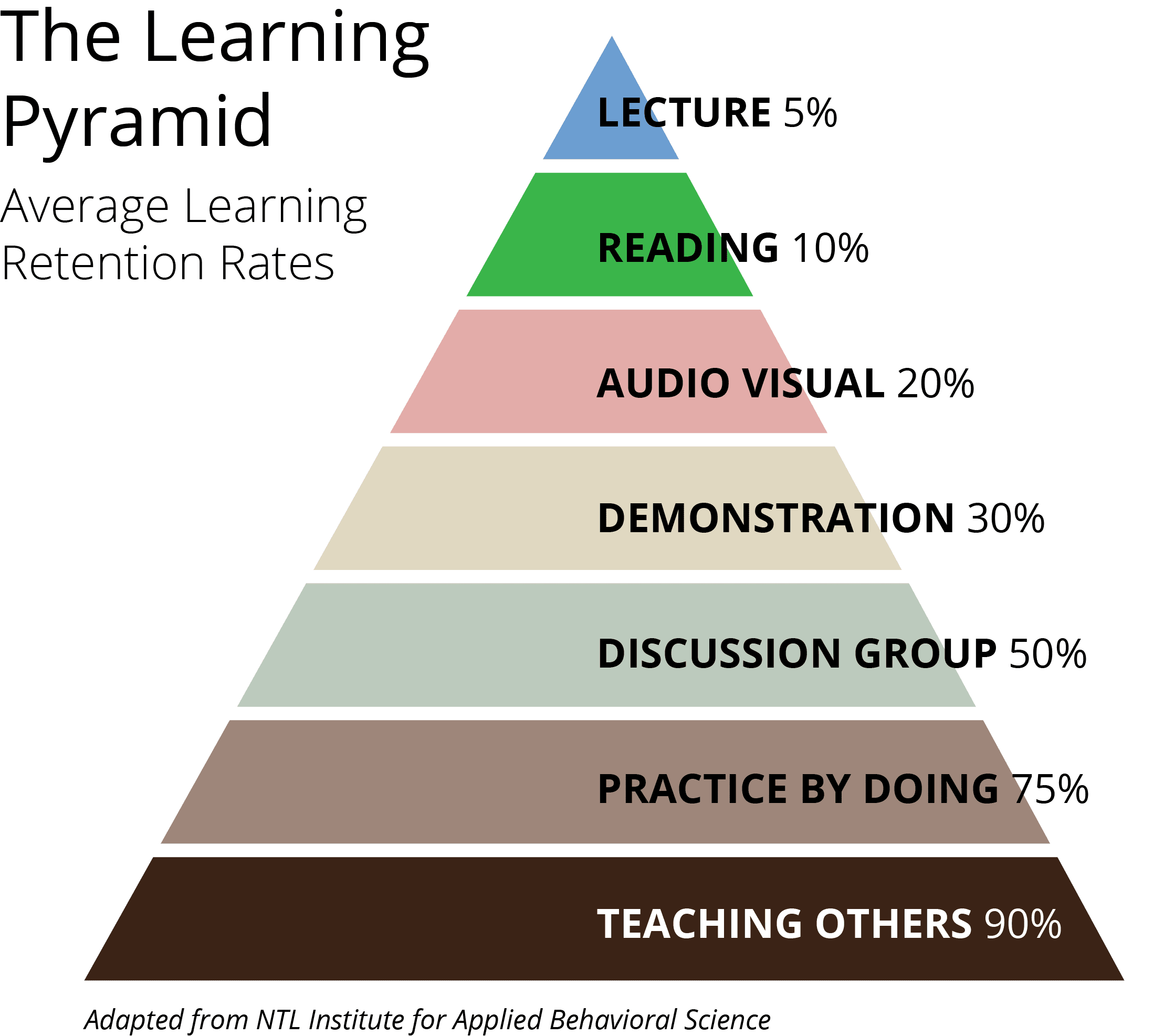
        When I think about creating a new high school, I'm really thinking about all of the traditional structures of our current high schools that don't respond to the way students learn.  The typical high school class still consists of a teacher in the front of the room who does most of the talking while students sit in rows facing the front of the room and take notes.  Students generally only talk to answer a question; to which the teacher confirms or denies its correctness.  This sort of learning (generally) falls in the "Lecture" category which is the least effective strategy for helping students to learn.

       The organization Jobs for the Future has recently published a series of papers titled Students at the Center.  In this series, they list four principles of student-centered learning.  These are:
  • Learning is personalized
  • Learning is competency based
  • Learning takes place anytime, anywhere
  • Students exert ownership over their learning
These four principals lead to deeper learning which is the sort of learning that gets students exited about what they are learning and encourages retention of their learning.  Deeper learning prepares students for both college and careers because it teaches them how to solve problems, how to work with other people, and how to think critically.

       The "changes" needed in our current high schools are changes that respond to these four principles and respond to the best ways that students learn.  This will require changes for teachers as well as changes in the expectations for schools from our parents.  Part of the struggle of changing high schools is that every adult has had the same basic schooling experience.  We are comfortable with it.  Teachers teach the way they were taught--they didn't devise these structures, they just mimic from their high school teachers and the only changes are additions of what they thought their teachers should have done and subtractions of what they thought their teachers did wrong.

       We need our high schools to be the places in which students are still learning to write and read and do math and understand history and make and appreciate art and learn about physical fitness.  But all of this has to be done in a way that encourages learning as opposed to encouraging "getting-a-good-grade" and encouraging competition with other students.  Students need to actually solve problems, to work with each other, to talk and learn how to argue their point.  The college-bound students should be able to master the beginnings of Physics and Calculus; but should also be to experience the work of the field they aspire to enter.  They should be able to more than just what they are told to do.  They should be thinkers and reasoners and creators and doers.  The career-bound students should master the art of expressing themselves in written and oral forms; they (too) should experience the workplace before leaving high school.  They should know how to build on the basic skills of any job and seek ways to make it better.

       We want students to learn; we want them to learn how to learn; and we want them to learn in abundance.  Because learning doesn't stop when you receive your high school diploma.


Friday, May 20, 2016

Is There Too Much Testing?

       Testing.  


       The very word conjures up emotions in students and parents and school officials alike.  Within the educational community, this word conjures up other words like: measuring, accountability, fairness, purpose, practice, instructional time, online, paper/pencil, formative, and summative.  Your connection to these feelings and issues probably shapes your views about testing in our public schools.  Part of what makes this such a big issue is that there are no simple "right" and "wrong" solutions.  It is a complex problem that requires thought and discussion among many stakeholders.


       The goal of schooling is learning.  There may be other benefits such as socializing, joining a club or team, earning a diploma; but the goal is learning.  Our ability to measure learning has grown significantly over the past twenty years as educators come to understand the value of frequent formative assessments in combination with teaching strategies that engage students.  In the past, the school classroom was a very dictatorial place:  Teacher in the front doing most of the talking; students sitting in rows listening to the teacher and taking notes; test or quiz every Friday.  This system worked fine for the student who was able to learn by listening, but if you needed to ask questions, or clear up any confusion with the content prior to the test you probably struggled to learn in this environment.  And if you weren't able to concentrate on the teacher's words for two or three hours, you might have missed your first and only chance to get that precious information from the teacher.


       Today we know that learning requires doing and talking and questioning in addition to listening (and note taking).  We also know that we want to get a sense of the learning that is taking place on a daily basis and not just once a week or whenever the "Big Test" occurs.  This "measuring of daily learning" is what we call Formative Assessment.  It could be a game, a series of verbal questions from the teacher, an activity during class, a exit ticket (or exit pass),  Anything that gives the teacher and the student information as to their level of understanding the content or the objective for the day.  Usually when we argue about "Testing", this isn't the sort of testing that we are arguing about.

       The discussion over testing usually centers around what educators call summative tests.  These are chapter or unit tests, final exams, end-of-course tests, and major state tests.  These tests might be required to graduate from high school; or they may command a large portion of a final grade in a course; or they may be used to determine if you are ready for college (or if you will be accepted to college).  These are the tests whose results have some sort of consequence.

       A common issue that arises is a student who appears to be learning very well based on class grades and report card grades, but then this same student demonstrates a lower level of learning on one of these big tests.  I think that I worry when there is a public outcry over testing because of this scenario.  I feel that rather than arguing against giving the test, we should question why the discrepancy happened in the first place.  Clearly a student who fails an end-of-course test and earns an "A" or a "B" as a course grade cannot (both) be very knowledgeable about this content AND be very weak with this material.  Something is going on.  Perhaps both the course grade and the test are not true reflections of the student's ability.  Perhaps it is somewhere in the middle of these two extremes.

       Since the goal of school is learning, there should be accurate and valid methods for determining the extent of this learning.  It isn't enough for a student to come to school everyday and do what he's told to do and then walk out of school without some measure his learning.  Getting grades isn't enough.  What does it benefit a child to get good grades in school and not be able to read or do math at an acceptable level when he leaves school?  This is one of the reasons for instituting summative and state testing in the first place.  Also far too many students begin college but never finish college.  If more people took the results of these big tests seriously, they might be less in a rush to go to college until their abilities were more in-line with college-level expectations.


       Is there too much testing?  Why are you asking this question?  If it is because you don't like to see your child getting poor results on this test, than you should question the discrepancy between the course grades and the big test.  If it is because the results are not used for any useful purpose, then you should discuss this with you child's teacher or school.  Everything done in public schools should have a purpose; this includes testing.


Tuesday, May 17, 2016

High School Graduation and Beyond

       May and June is the time in the school year when we think and hear a lot of graduation.  High school and college students are graduating; completing one important life event and moving on to the next.  It's exciting, it's a happy time, it's a time to celebrate!

       As a nation, we have a lot to celebrate because we have seen a rise in the high school graduation rates over the past few years and that's a very good thing for our nation.  In the 2013 - 2014 school year, the high school graduation rate was 82.3%--an increase of over three percentage points from the 2010 - 2011 school year.

       Our society demands a workforce that is willing and able to continually learn and to use the knowledge of past learnings.  Students who succeed beyond high school are the people who understand that their ability to do a job is not dependent on the grades they earned in high school as much as it is on their desire to continually learn and to do their best.  We need thinkers and doers and believers.  While high school graduation is a big step (and an important step), it is still only one step.  Those students who were only successful in "playing school" and earning grades without any concern for learning will find it difficult to succeed in college or the workforce in places where thinking and problem solving is necessary.

       Sometimes it seems like we put too much on our schools.  We teach courses, but we also teach how to work together, how to get along with others, how to learn, how to struggle, how to accept responsibility.  No one gets a grade for these things; no one is denied a diploma for not attaining these traits.  But those that lack the ability to do these things often struggle to live in a society that doesn't always give you second chances; a place where breaking the rules have real consequences and no one is there to remind you what to do and when to do it.

       We all get one chance to make the most of our 13 years of K-12 education.  After that, the number of opportunities rise with the number of decisions.  It's not enough to do what you're told; just ask those that barely graduated high school.


Wednesday, April 27, 2016

Future Schools: It's All About the Learning

       In the future, our middle and high schools won't use grades and grading--at least not the way we think of grades and grading today.  Parents will brag about what their children are learning.  As the school year ends, students will reflect on what they learned--rather than on the grades they got.  Colleges will identify qualified applicants based on what they have learned in their P-12 schools.


      Students will move at their own pace; some will finish high school when they are 16 and some finish when they are 21--and both are perfectly acceptable.  There will be an appreciation for the value of education throughout our society; and all students will feel valued in their schools.  Teachers will teach classes and help individuals; sometimes face-to-face and sometimes online.  "Sit-and-get" lecture will be replaced with active learning that includes students working and learning together--actually talking with each other during school.  Questions will be asked and problems will be solved everyday.  Students will view effort and struggle as value and necessary elements of the learning process.

       Computers and tablets will be viewed as tools for learning and for gaining information.  Students will find the data and facts that they need to make conclusions and to discover new things; to prove theorems and to create stories and art; to publish, to communicate with their learning team, and to keep lists of further areas of inquiry.

       Some students are already enjoying this school experience; for others it probably sounds like a fantasy.  I believe that current elementary school students will see pieces of this future school before they graduate and their children will see this school system as normal.  Our society can not accept an outdated system to prepare our students for their futures.  Change is not a luxury; it is a necessity.  It's not about being #1 in the world; it's about doing what's right for the next generation.


Monday, April 18, 2016

Why Do You Remember Your SAT Score?

       What's your social security number?  What is your phone number?  How tall are you?  When were you born?  What did you get on your SATs?  Huh??  Why is your SAT score is a number that you memorize every bit as much as your phone number?  I can't find any survey data that says the percentage of adults who recall their SAT score (from among adults who have taken the SAT), but my own anecdotal evidence suggests that it is very high.  I dare say that a far majority--maybe more than 75%--of adults who have taken the SAT more than 20 years ago can still recall their score today.

       Why?

        Why is this number, this score--which has no power whatsoever in lives of people in their 30s and 40s--so ingrained in our memories?  It's just a number that (years ago) described our ability to do high school mathematics and our knowledge of grammar, vocabulary, and reading comprehension.  It won't get us a raise or a promotion twenty-plus years later.  There's no college admission counselor to impress when you're in your late 30s.   We're certainly not going to get any reward or trophy or recognition of any kind.

       So why is your SAT score so important to you that you remember it for your whole life?  Why?  I have a theory....  At the time we took the SAT, everyone around us made a big deal about it.  It was billed as the most important test we will ever take.  They said, "Your life depends on it."  (Or something to that effect.)  It was like training for the Olympics.  The test date was on our mind for weeks before.  We thought and thought and thought about it.  We worried about it.  It was a sort of a milestone in our young lives; like getting our driver's license.  We might have taken it more than once because someone said that that was a good idea.  It was an accomplishment akin to graduating from high school or running a mile in six minutes or going out on your first date.

       I think that taking the SATs was billed as such a huge event in our lives, that most of us figured it was important enough to remember our scores.  But, I fear, that it also produced a generation of people that valued test scores over actual learning.  Today in education, we are trying to change this thinking.

       Today educators value frequent formative assessment over the results of unit tests and final exams.  We value multiple data points over the "one big test".  We value a combination of conceptual understanding and procedural knowledge over the mere regurgitation of facts.  Learning and the measurement of learning has come a long way.  Some colleges don't even use the SAT as a consideration for admission.  Others use it as one of many factors for making the admission decision.

       Aside from the college admission process, your SAT score really isn't very important in your life.  Americans are competitive people.  We like to win.  We don't want people to pass us on the highway; we don't want to lose a promotion to someone else; we don't want our lawn to look worse than our neighbor's lawn.  We have to stop competing for everything.  Your SAT score does not define who you are.  You won't "win" or "lose" anything because of your SAT score; especially twenty-plus years after you take the SAT.

       There are lots of experiences that most adults would gladly like to forget about their high school experiences.  Your SAT score should be one of them.


Monday, July 20, 2015

Building the Academic Strength of Our Weakest Students

       School is about learning.  And most students do fine when it comes to learning what they need to learn in school.  For most students, its not a matter of passing or failing; its more a matter of learning very well or not learning so well.  But for some of our students, keeping up-to-speed in their reading, writing, and mathematics skills as they go through their middle and high school years is difficult.  As a public school system, a lot of effort is focused on helping these students to improve their skills.  This is an important mandate in every public school.

       We know from research that students who are below grade level in reading by the end of third grade often struggle with their reading skills throughout the rest of their P-12 schooling experience.  (link to study)  They are also more likely to leave school without a high school diploma.  Difficulties in learning mathematics have been similarly well documented.  Students with weak math skills also struggle in high school mathematics and are less likely to graduate from college (see here; go to chapter 3 on page 45).  It is because of these known consequences that schools make every effort to raise the skills, abilities, and understandings of students who are weak in reading, writing, and mathematics.

       At the heart of this effort is the struggle of understanding how these students think and how they learn.  Clearly, the "usual way" of teaching and learning is not working; and so schools look to other resources and teaching strategies to reach these students.  Understanding the best ways to motivate students to do their best in school (especially when they have experienced only failure in the past) is an important task for schools and teachers.  One excellent resource is the book Mindsets by Carol Dweck.  In it Dr. Dweck explains the psychology of how people perceive their abilities to learn.

       There is no shortage of intervention programs that are available to schools (at a cost) for the purpose of helping students to regain "grade-level" status.  Schools invest in these programs and train their teachers.  Some students show excellent improvement while others do not.  It is a constant challenge to find the best way to help our weakest students.  But it is a challenge that our public schools eagerly accept every day.

       Learning is for everyone and everyone can learn.  Building the skills of our weakest students is an important responsibility of our public schools--one that we take very seriously.

Saturday, April 4, 2015

We Want Students To FINISH College

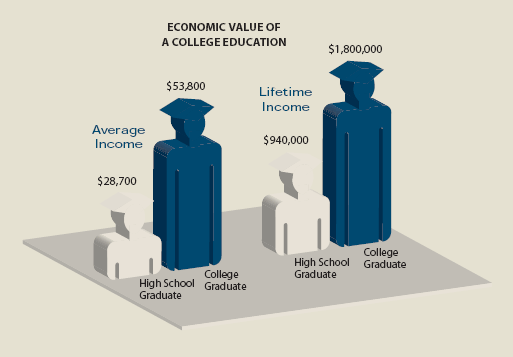
       The importance of a college education is well established.  People understand that a college education will increase the likelihood of entering into a satisfying profession and earning a higher income.  Indeed, college enrollment has risen significantly over the past 15 years.  In 2011, 21 million people attended U.S. colleges compared to only 15.9 million in 2001.

       We have won the battle of convincing students of the value of going to college.  But our goal isn't really for more students to "go" to college; our goal should really be for more students to "graduate" from college.  On that metric we are still far from claiming victory.


       Rates vary depending on the source of the information, but overall it is fair to say that merely getting accepted to college is absolutely not a guarantee of graduating from college.  In fact, many colleges have such a terrible graduation rate among students that have been attending for four years that they prefer to publicize their SIX YEAR graduation rate rather than their four year graduation rate.  According to the Chronicle of Higher Education, the six-year graduation rate means the percentage of students who are able to complete a four-year program within six years [!] .  Even this extra time only raises the overall college graduation rate to around 50%.


       Can you imagine the outcry from the public, from our government, and from our students if the high school graduation rate was only 50%???  Yet, this fact is not widely known by the public.  Little more than half of our students that begin college actually finish college.  And if you look at the data by race, the news is even worse.

       Of course there are many reasons for why students drop out of college.  A Harvard Study cites the following reasons:
- not being prepared for the rigors of academic work
- inability to cope with the competing demands of study, family, and work
- cost


       Our public schools are in a constant battle with students (and sometimes with parents) over the dueling pressures of Learning versus Getting Good Grades.  Some students care little about actual learning and only want to do what is necessary to earn a good grade.  While their teachers are pushing them to learn, to understand, and to use the learning they've acquired to learn more.  I believe that a major reason for the low college graduation rate is students who do enough in high school to get accepted to college, but don't enough (in high school) to gain the knowledge and the discipline they need to succeed in college.

       We must do better on this front.  We must continue to stress the importance of true learning and true understanding of P-12 content.  We have to lessen the importance of grades and increase the importance of real learning.  In the end, it's not that we want students to attend college; what we really want is for students to graduate from college.


Wednesday, April 1, 2015

Learning, Smoking, and The Long Arc of Change

       When I think about the huge job of improving education outcomes among our students (especially our poor students) in America, I think about the amazing turn-around in behavior about smoking over my lifetime.

       It is nothing short of a modern-day miracle that smoking has declined so dramatically in the United States over the past 50 years.  In 1965, 42.4% of U.S. adults were smokers.  By 2003, that number was cut in half and in 2013 we were down to 17.8%.  And, of course, our population has risen quite a bit over this timeframe from 194 million people in 1965 to over 320 million people today.

       No one in the United States in 1965 would have ever believed that Americans would give up their love for smoking so dramatically.  Even with today's relatively low rates of smoking, nearly 70% of current smokers want to stop smoking.  It is nothing short of amazing the way this addictive behavior has changed in the United States in just a couple of generations.

       I believe that our public schools can look at this incredible event, this long arc of changed behavior, and that we can use it as a lesson for tackling the equally difficult task of improving the educational outcomes of our students.  We can examine the efforts that took place (and continue to take place) that convinced people that smoking is bad for you; and (perhaps) we can undertake similar efforts in our public schools.

       First of all, there was a national effort to inform the public of the dangers of smoking.  This began with the first surgeon general's report that provided proof that smoking was bad for your health.  Of course, there were lots of people of that didn't believe the contents of this report.  I'm sure there were people who pointed to relatives and friends who lived well into old age and smoked their whole life--and, therefore, refused to believe that smoking was bad for your health.  But more and more information came out from public and private sources about the dangerous health risks of smoking and eventually it became very hard for people to believe that smoking wouldn't harm their health.  As smokers died from lung cancer and other diseases, people began to link these deaths to their habit of smoking.  This gave people a personal connection to the ill effects of smoking and it convinced them to never smoke or to quit smoking.  As they grew up and had children of their own, this knowledge of the evils of smoking was passed on to the next generation.  And so, what started as a national effort from government sources, slowly became a combined effort of government and private resources that worked together to bring down the rates of smoking in America.


       I believe that a similar combined effort is underway in our public schools today.  We have a government that believes in the value of education and is dedicated in improving the education of our citizens.  We also have many private efforts underway that are striving to do the same.  We also have segments of our population that don't believe that education is important.  As with the smoking example, they point to friends and relatives that quit school in eighth grade and grew up perfectly fine.  But (as with the smoking example), we also have generations of parents that have regrets of not doing better and trying harder when they were in high school.  They look at their peers who went on to college or some sort of vocational training and now have higher-paying jobs.

       I believe that we can change the behavior of Americans toward the value of education--and all of the hard work that this entails--over the next generation.  I believe that we can see a country with higher high school graduation rates and higher college graduation rates.  And when this happens, we will reap the benefits of a more educated society.  We will see less crime, less people on welfareless obesity, and a strong economy.  And I believe that this will happen within the lifetimes of our current high school students.

       We can do it.  We have done it in other areas of our society and we can do in education too.  We must do better and we will.


Monday, March 23, 2015

We Offer Opportunity


       We have all heard the expression, "Opportunity Knocks".  It conjures up images of something good coming your way.  It could be a new friend, a promising new relationship, a new job, or a chance to get some thing that you've always wanted.

       
       "Opportunity Knocks" also implies that this good thing is offered to you, but it is not thrust upon you.  You can take it or you can leave it.  As adults, we sometimes lament the opportunities that were offered to us that we did not accept.  We also (in hindsight) sometimes realize opportunities that we were offered and didn't recognize them as opportunities at the time.

       Our public schools offer opportunity to our students.  The opportunity to learn, to grow, to be responsible citizens, to be successful...  The process of educating children is long; it is divided into different school levels and different subjects.  It is offered by different people at different times.  It probably doesn't look like an opportunity some of the time.  But it is.

       We owe it to our students to help them to see the opportunity that is being offered to them.  We don't want them to have regrets of denying this opportunity later in their life.  We are the adults, we have the wisdom of years; the long view.  We have the moral authority to understand (as best as we can) how students think and how they learn.  We need to know how we can talk with them to make them understand the opportunity that is being offered to them today and everyday that they are in school.

       Public schools have many responsibilities to our students and to our society.  Teaching is only part of our job.  Ensuring that the learning is taking place is the (much more) important part of the job.

       Opportunities that come from our public schools should not be in disguise.  They should be made apparent and obvious to all of our students.  We want them to take advantage of these educational opportunities and we want them to grow and improve because of these opportunities.


Saturday, February 21, 2015

What is the Best Way to Measure Academic Ability?

       One student is smart.  Another gets good grades.  Another is in the 90th percentile.  A fourth student gets a good SAT score.  Yet another graduated in the top 25% of her class.  And a different student scored a 4 on her AP test.

       What does all of this mean?  What is the best way to measure how well students are actually learning?  How do we know which are the students that are really learning and understanding and able to use the knowledge in different situations; and which students are dutifully doing what they are told to do and completing assignments and earning good grades not learning a thing?

       I think our educational system struggles with this question very often.  We want to learn--it is the main focus of schools to teach students and to help them to learn.  When I say "learn", I mean "real, actual learning".  Not memorizing and forgetting.  Not memorizing long enough to pass the test.  I mean learning; understanding; able to teach it to others; able to use the knowledge at a later time; able to build on the knowledge learned to learn more, higher-level material.  How do we measure a student's ability to actually learn?  How do we know who is really getting it and who only appears to be really getting it?

       Parents see their children's grades.  And (I think) parents make a determination of their children's abilities based on the grades that they get in school.  That is certainly understandable.  We don't expect all parents to be experts in education and we certainly don't expect all parents to be experts in measuring academic ability.  And if the grades (the test grades and homework grades and classwork grades and course grades) accurately reflect their children's abilities, then it is OK to use these grades to gain a sense of academic ability.


       But what do you do when your child gets great grades in class and lousy grades on the final exam, or the SAT, or the PARCC or Smarter Balanced test, or the college entrance exam?  What does it mean when we have students who do great in middle and high school and then cannot handle the academics in college?  Once again, What is the best way to measure academic ability?  Everyone likes to brag about their smart children; and everyone wants their children "to do well" in school.  But at some point we need to have a way to tell if their apparent ability (academically speaking) is actual ability.

       Large-scale testing is one way to measure actual academic ability.  State-level tests, SAT and ACT, PARCC, Smarter Balanced, and NAEP (National Assessment of Educational Progress) tests are all large-scale tests that attempt to do this.  The SAT is a good predictor of a students' ability to do well in their first year of college.  The new PARCC and Smarter Balanced tests are supposed to measure student abilities compared to standards that are taught over the previous school year.  NAEP is a national test given to a sampling of students in every state and in many subject areas to get a sense of our nation's students academic abilities.

       I believe that we want to use multiple data points to determine students' academic abilities.  If a students have good school grades and terrible large-scale testing grades, I believe that we should question why this is the case.  We shouldn't dismiss the low grades and not important; we should question why there is a lack of consistency in the grades.  Similarly, when students get high homework and classwork grades and low quiz and test grades, we should question this.  Sure, it may be that they are nervous when taking a quiz or test; but it also may be that they don't know the content and that is why their quiz and test grades are low.


       I think that it is difficult to use a single measure to determine a student's academic ability.  If you have a mechanic who has been fixing cars for (say) ten years and you asked her to take a test on fixing cars and then to go through a field test in which she actually fixed cars and then to write an essay on fixing cars, you would expect that she would earn similar scores.  This would be provide multiple pieces of evidence that she knows what she needs to know to do her job.  I think the same is true for students and academic subjects.  If a student is sufficiently knowledgeable in (say) Geometry, I would expect her to demonstrate this knowledge via verbal explanations, written exams, performance tasks, and large-scale testing.  And I would expect all of these measures to show a similar level of understanding.

       Our nation's schools have a responsibility to teach so that our students are truly learning.  We cannot accept the mere appearance of learning; we have to do the hard work of ensuring actual, true learning.  And we need to continue to develop and revised the best and most effective ways to measure that this "true learning" is actually taking place.


Thursday, November 13, 2014

We Must Do Better - Part 2

       This post is part two of a three-part series titled We Must Do Better.

       I love public schools; and there is a lot to cheer about when it comes to the ability of public schools to prepare students for their futures.  But there are three major areas in which public schools must improve if we want to see ourselves as providing a world-class education to our nation's children.

       1) We must raise the achievement of poor children.

       2) We must increase graduation rates.

       3) We must provide continuous, high-quality professional development to our teachers.

       It isn't that there aren't other areas that can and should improve in our public schools.  But improvement in these three areas are absolutely critical if we truly want our school system to be exceptional and of the highest quality for all of our students.

----------------------------------------------------------------------------------------------------------------

We Must Do Better

Part 2 - Increasing Graduation Rates

       Part 1 of this series was about the need to increase achievement among poor students.  I am going to begin this part by looking at the differences in high school graduation rates between poor students and non-poor students.  Take a look at this graphic from the organization America's Promise Alliance:


       This graphic shows that (in 2012) low-income students had a graduation rate below 80 percent in 41 states while non-low income students had a graduation rate below 80 percent in only 7 states.  As a nation, our graduation rate in 2012 was 81 percent.  (source: National Center for Education Statistics - The Condition of Education)  

       Our national graduation rate has been rising since the 1995 - 1996 school year when it was 71%. We are moving in the right direction as a nation, but we still have a long way to go.  Allowing 1 of every 5 students to leave school without a diploma has real and serious consequences.  These include:
  • Higher unemployment rates
  • Lower pay compared to people with high school diplomas
  • Greater need for public assistance
  • Greater chance of incarceration
  • Less effective parenting skills
(sources: here and here and here)

       Public schools clearly have many responsibilities.  We must do everything we possibly can to get more students to graduate from high school--especially poor students.  In decades past, completing high school was arguably less important than it is today.  However, in today's world and in the world that our students will inherit, people without a high school diploma have a greatly enhanced risk of lifelong struggles to avoid poverty and to experience a middle-class lifestyle.

     As a graduate student, I questioned the difference between students who dropout of high school and students who graduate in the bottom 10% of their class.  I hypothesized that such students who barely graduate were no better off than students who didn't graduate.  Using data from the National Center for Education Statistics, I discovered that weak high school graduates were still better off than high school dropouts.  That's right; even students who struggle to pass all of their courses in high school and eventually graduate are better off than people who never earn a high school diploma.  Why?  I think it is because there is something within these weak students that says, "This (schoolwork) is hard, and everyday I come to school I know that I am going to struggle.  But I am going to continue to come and to work and to finish high school."  I believe that students who (perhaps) hate school and always struggle academically AND still graduate have had a life experience that they carry with them in their futures struggles.

       This message of the importance of graduating from high school is logical and sensible to everyone working in education and probably to just about everyone outside of education.  But despite our best efforts, this message is not getting through to 19% of our youth.  And it is hitting particular groups of students worse than others.  Once again, according to the National Center for Education Statistics (see top of page 13):

Group                  Graduation Rate (2012)
Amer. Indian/
Alaskan Native                68%

Hispanic                           76%

Black                                68%

Poor students              well below the national average (see America's Promise)

     These focus areas will help to improve graduation rates among our most vulnerable groups of students:

  1. Adress chronic absenteeism
  2. Improve middle schools
  3. Re-engage youth who have left school
  4. Provide more and better adult and peer supports
       We must do better at raising the high school graduation rates of our students.  It is important to our nation; it is important to every young man and woman in our high schools.


Sunday, October 26, 2014

Common Standards

     Well, I've held out this long.  I've tried to stay away from politics in this blog.  But I've talked about grades and grading; I've talked about national testing; and I've actually talked about Common Core before.  However, this time I want to share my thoughts about Common Core and address some of the counter-arguments that (in my opinion) are not sufficient to justify a school district or a state to refuse to use them.


      I support the use of the Common Core standards for English/Language Arts and for Mathematics.  I also support the common standards for Science that are coming to our public schools.  I support these standards because they were created by experts; they were vetted by experts; and they give all 50 million U.S. students a fair and equitable education.  We all know that education throughout the U.S. is not uniform because individual state standards vary widely.  Common Core sets a level playing field for all.  Additionally, these common standards are consistent with those from countries that produce students with the highest academic abilities.  We all love competition and we all love to win; so I would think that we would all want our students to be able to fairly compete with anyone in the world for 21st century jobs.  Common standards allow us to do this.

     So here are some bad reasons for turning away from common educational standards:

1) I'm a Republican and Common Core is a Democrat thing--so I'm against it.

     We live in a partisan country.  Some people are strongly Republican and some are strongly Democrat.  If a cause aligns to a particular political party, then the loyal will support it no matter the cause and no matter the details.  But Common Core is not a Democrat thing and it is not a Republican thing.  It came from the National Governors Association and Council of Chief State School Officers.  Just as No Child Left Behind was not a Republican thing (Edward Kennedy co-wrote NCLB), Common Core is not a Democrat thing.

2) Common Core is too hard.

     Compared to the academic standards in some states, Common Core will appear to be more rigorous, less rigorous, or about the same.  Since different states had different standards in the past, this comparison will look different to people in different parts of the country.  But the goal of school is to teach and prepare students for the world that they will inherit.  The goal is not for students to get good grades.  We want our students to be successful, but too many of our students have been very successful in high school only to fail in college.  That is a national shame on our nation.  Common Core is trying to prepare students for both higher education and for the word of work.  If it is hard, then students are being well prepared for their future.  Isn't that something we all want?

3) It was implemented too fast.

     States were given four years between state adoption of the Common Core standards and the actual implementation of the Common Core standards.  I think that a lot of people feel that the Common Core came all of sudden--one year we didn't have it, and the next year we did.  There was a lot of planning behind the scenes that the general public may not have seen.  This is why it seems to be so sudden to some.  If there were ten years between adoption and implementation, some people would feel the same way.  Why should we wait to give our students a world-class education?  And why give up on it just because it was fast?

     Also, public education is often accused of moving too slow.  Fifty million students and three million teachers comprise a very large group; and it is often slow for this group to change.  If we drag out the change and take our time, it might never happen.  We have to "rip off the band-aid".  Now is the time

4) (This bad reason hasn't occurred yet, but it will towards the end of this school year.)  See, everyone did poorly on the test.


     This year, for the first time, the PARCC and Smarter Balanced tests will be administered to students in grades 3 to high school.  In all likelihood, overall student scores will be low
compared to their class grades in math and English/Language Arts; or compared to past standardized test grades.  And there will be all sorts of renewed calls to cancel Common Core.

     In fact, whenever a new standardized test is administered, scores are often low at first and then increase over time.  Remember, the content of the courses are more difficult, so naturally the tests will be more difficult and some students won't be able to rise to that challenge as well as other students.  Once again, the goal of school is to teach and help students to be prepared for their future.  We are not helping students by giving them easy tests and then telling their parents that they are smart and then having these same students struggle after high school.  Colleges will recognize these new tests that same way they recognize the SAT and ACT tests.  They have to be the sort of tests that really prepare our students for college.

     We have a real chance to improve the education of millions.  And it could happen to this current generation of students.  We can say that we were there when U.S. public schools took a bold new step toward becoming the new standard in world-class education.  This is education's "moon shot".  Let's make a real difference; let's give our kids the best!


Saturday, October 4, 2014

Lower Dropout Rates

     According to a recent article from the Pew Research Center (see article here), the U.S. high school dropout rate dropped to 7% last year.  It has been going down since 2000 when the national dropout rate was 12%.  Educators know that earning a high school diploma may not be a ticket to live-long success.  But without one, you are pretty much guaranteed to experience many struggles in your life--not the least of which would be trying to build a middle-class life for you and your family.


     Hispanic and Black dropout rates have significantly declined since 1993.  Hispanic student (today) comprise 25% of our nation's public school students.  In 1993 their dropout rate was 33%.  Today it is down to 14%--and it has been steadily declining since 1998 despite a 50% rise in the population of young Hispanics in our country.  The dropout rate for Blacks has declined from 16% in 1993 to 8% today.  Black youth represent 16% of our public school students.

     Public schools do everything they can to keep students in school and to encourage completion of their high school diploma.  We encourage students to become involved in school teams and school clubs.  Students who are involved in school are less likely to dropout.  (I have to be honest, I can't find data on that last statement.  But I've heard it from many sources over the years and it makes sense--to me--to be true.)

     We also know that when students can connect with an adult in the school, they are more likely to stay in school and to finish high school.  Once again, relationships is the key.

     This is a major win for our public schools and even more of a win for our students--and for our country.  An educated society leads to less people in jail; less people on welfare; more people working; more taxes being paid; and so on, and so on, and so on.  It all begins with education.  Lowering the dropout rate is very, very good news.

     The next hurdle to clear is raising the college graduation rate--which is well below 50%.  But that's a topic for another post.


Sunday, June 1, 2014

Graduation


    It is high school graduation season.  It is also middle school and elementary school and pre-school and college graduation season.  Everyone loves to see their children in a graduation ceremony.  The stage, the music, the diploma.  Let's face it, the goal of P-12 education is high school graduation and earning a high school diploma.  Everyone wants to hear their names called and then to walk to the principal to receive your high school diploma.  I bet most adults can remember their high school graduation ceremony--even if they don't remember what the keynote speaker said.

     In the United States today, only about 75% of high school students eventually earn their high school diploma; and less than 50% of college students earn their college degree.  So you should be proud if you are among those that have reached these milestones in education.  Be sure to thank your teachers and your parents and anyone else who helped you along the way.

     Graduation should serve as an example of what you can accomplish when you set a goal and complete the requirements to meet that goal.  Most people will have other goals to reach in their lifetime, but unlike high school there won't be a "law" forcing you to attend and parents forcing you to do your best all of the time.  Most goals in life are completely dependent on the individual.  So when times are tough, think about the tough things you accomplished when you were 10 and 13 and 17 years old.  If you could do it then, you can do it later in life.

     Graduation is always both an ending and a beginning.  If you are ending high school, you are beginning an exciting part of your life.  Make plans; make goals.  Anything is possible.  It might take hard work--actually, it probably will take hard work--but it will be worth the effort.

     Congratulations on your graduation!  What are you doing next???

Public Schools and Choice

       Is it true that public school kids and their public school parents don't have choices?  I'm sure that I will expose my igno...

Teach100 blog