Showing posts with label school. Show all posts

Thursday, March 16, 2017

If School was Equal for Everyone

       If school was equal for everyone...


  • The most struggling students would have the best teachers.  We know that good teachers make a difference in student outcomes.  Our best teachers are also our best motivators; they help students to see the value of effort and their students try hard and do their best every day.  Students who struggle academically need good teachers who believe that all students can learn and show this by their actions as well as by their words.  I hate to say it, but students who have a lot of support at home--students with parents that value education--typically do fine in school regardless of the quality of their teacher.  If there are only a relatively small portion of the teaching force that is in the "best" category, they should be teaching the most struggling students.
  • Students would be allowed to learn at their own pace.  They wouldn't have to "move on" because the rest of the class is learning faster than they are.  And they wouldn't have to sit in class being bored with nothing to do because they "get it" faster than everyone else.  Student engagement is increased when students have some control as to the pace of their learning.
  • Opportunities for all sorts of classes would be available to all students.  Music, art, physical education, higher-level (college-prep) classes would be available to everyone.  If a student struggles in math but wants to take Calculus at some point, there would be a path of courses (and professional educator assistance) to help her to get to Calculus.  If a student wanted to take two or three foreign languages prior to high school graduation, he could do that and still complete all of the other requirements.
  • There would be a lot less competition for grades and a lot more desire for learning.  "A" students would receive no more praise than "C" students because effort would be valued over performance.  Students who didn't "get it" the first time or the second time would be given multiple opportunities to reach proficiency.  Some will exceed expectations and some will barely meet the expectations.  But all will be rewarded for learning.
  • Students with career goals after high school will receive the same amount of help and guidance as students with college goals.  Preparation for civil participation will be part of every students' P-12 experience.  And students who don't know what they want to do after high school, will receive opportunities to understand their skills and to consider different options.
     We live in an imperfect world filled with imperfect people, imperfect teachers, imperfect students, and imperfect schools.  We can wish for perfection, but we can't realistically reach perfection.  The best we can do is recognize our needs, understand our problems, and work together to find the best solutions for our students.  Amazing things happen when we work together.  While (usually) quite un-amazing things happen when we refuse to change in the name of we've-always-done-it-this-way.

       Our schools work hard to produce the best outcomes for our students given the staff and money and facilities and materials and students and parents that we have.  When things don't work, the answer to fix it and make it work.  Everything can be better; it may take a lot of hard work, but it can be better.

       Our schools may not be equal for everyone, but they can be the most positive places for our students and teachers if we want them to be.

Monday, February 6, 2017

The Value of Reasoning in an Era of Fake News and Alternative Facts


       What do you believe?  Why do you believe it?  How do you decide what you believe?  Is there a difference between your perception of something and the actual truth?  Have you ever thought something was true for a long time only to discover what you thought was true (for months or years) turned out to be false the whole time?

       The old adage is "Don't believe everything you read."  This is valuable advice today just as much as it was in the past.  The Information Age not only increased the volume of information coming at us on a daily basis, it also increased the sources that create and publish this information.  Ordinary individuals can write blogs (case in point: me [!]) as easily as large institutions.  Information may or may not be vetted and fact-checked before being published.

       Another common source of information is friends and family; people you trust.  But what if your circle of friends and family is composed of lots of people that are just like you?  They look like you; they talk like you; they think like you.  You go through your life talking to these people and hearing the same things all of the time and eventually you believe that all people believe this.  But when you reference "all people", what you really mean is "all of the people that I know"--which is probably a subset of (say) all of the people in your town or all of the people in your country.  This phenomenon is knows as the Echo Chamber.

       Wikipedia defines Echo Chamber as a metaphorical description of a situation in which information, ideas, or beliefs are amplified or reinforced by communication and repetition inside a defined system.  Although the free flow of ideas via the internet might have lessened this effect, some have found that the internet has only amplified the Echo Chamber effect.

       Hence, we now live in an age in which the ability to weed out truth and facts may be harder than ever before.  Students, perhaps particularly teenagers, can become easy victims of believing in partial truths, fake news, and so called alternative facts.  This is why we need to teach students to question the things they read; to consider the source of their information; and to seek other points of views or at least other sources to confirm or to deny what they hear, see, or read.  Reasoning (the action of thinking about something in a logical, sensible way) is a skill that is more important today than ever before.  Our openness to consider other views influences our openness to people, places, foods, and experiences.

       We can't move forward and solve problems as a people or as a country, if we aren't able to fully understand the issues that we face.  Reasoning is a valuable skill.  Like any other skill, reasoning requires opportunities for practice to get good at it.  Schools should be able to provide these opportunities.


Sunday, December 11, 2016

Is It Possible to Help Students Too Much?

       How much is too much?


       Can you care too much?  Can you love too much?  Can you help too much?  When it comes to students and learning, sometimes teachers and parents help too much.

       Their hearts in the right place, but goals are short sighted.  Teachers and parents help too much when they tell students the answers in an effort for them to complete the classwork or the homework.  They seek the short-term goal of compliance with an assignment.  But they don't see the longer-term goal of helping students to learn how to learn.

       Educators have an expression for the results of too much help.  We call it, "Learned Helplessness".  It's when students learn to purposefully not try too hard because they know that a parent or a teacher or someone will eventually give them the answer or do the work for them.

       Since most students (and some adults) don't see or understand the benefits of learning, they believe that school is only a series of assignments that they have to complete because they are told to do so; or because they get a grade for completing it.  Therefore, they don't see the need to try hard and fail sometimes and learn from these failings and try again.  "Learning" isn't their goal; compliance is their goal.  Therefore they only seek to complete the worksheet, or answer the questions, or write the paper; because they only seek to get the grade.  And if the student can find someone else to do this--and the students basically gets the same reward (the same grade) either way--then the easy route is to let someone else do it.


       Of course teachers and parents want their students (and children) to succeed, so sometimes they provide this help in an effort to help them to get success.  But there is a terrible downside to too much help.  When the parent isn't there and the too-much-helping teacher isn't there, the child (maybe now a young adult) isn't able to solve problems on their own.  Since there was always someone there to do the hard stuff, the young adult is now either helpless or forced to learn how to learn new things at point in life when mistakes are more costly.  One area where this is often seen is the first year of college.  Students who haven't learned how to struggle to learn something new and expect someone else to do all of the hard stuff for them, fail and drop out of college.

       School is about learning; and it's about learning how to learn.  We aren't helping our kids by doing the work for them.  As teachers and as parents, we have to try to worry less about "the grade" and much, much more about the learning.  There is no benefit to children who graduate from high school but aren't able to think for themselves and make decisions by themselves and solve their own problems.

       Yes, you can help too much.


Sunday, December 4, 2016

Teaching to the Test Is Not a Bad Practice Anymore


       Education has this phrase:

Teaching to the Test

In the past, this phrase was a derogatory phrase that meant (at the extreme) the only thing we do during class time is to prepare students to take a test.  This implied that we never taught additional topics that weren't on the test, and that we never taught at a higher rigor level than what was required on the test.  The other (more broad) implication was even worse; We didn't concern ourselves with whether or not students actually learned anything, our only concern was that they got a high score on a test.

       This sort of Teaching to the Test probably did occur at many public schools, but I would hope that teachers (and schools) never lost their desire to encourage learning over mere test grades.  Indeed, teaching at a higher rigor level than was required on a test would serve the dual purpose of (1) helping students gain a higher level of conceptual understanding, as well as (2) helping students to score well on a test.  So we had incentives to go beyond the content that appeared on a test.  

       Today we see teaching to the test much differently.  First of all, we are now seeing standardized tests that require much more than merely a single-word, or single-number answer.  Today's test require students to demonstrate a high level of understanding.  This means that the days of memorizing formulas or (even worse) memorizing shortcuts and tricks are over.  Student who are only able to follow procedures and answer low-level questions will not earn high marks on today's tests.  Secondly, I feel that there is a renewed interest in teaching students how to engage and reason and think and argue and prove.  These are the skills that lead to a better conceptual understand over and above the old get-the-right-answer sort of teaching that took place in the past.  In this world, Teaching to the Test is the same thing as simple "Good Teaching".

       I know that the issue of standardized testing has become as controversial and divisive as the abortion issue to some people.  I found a great article on the Pros and Cons of Standardized Testing that may provide additional information to those folks that only see one side of this issue.  Regardless of your views, all people want their children to do well in school and (I hope) "doing well" means learning and not getting-good-grades for most people.  The primary objective for our public schools is certainly learning.  If students aren't learning, than there's no point in coming to school.  

       Today I am seeing a resurgence in helping teachers to explore classroom strategies that help students to learn concepts so well that they can teach them to other students.  Gone are the days of rote memorization. That sort of teaching isn't good enough if we want to prepare our students for the world of work and further learning in their futures.  Teaching to the Test is good if it helps our students to be better problem solvers.  

       Teaching to the Test is just good teaching.


Saturday, November 19, 2016

A Few Laughs is Always a Good Thing


       Ok.  I'm constantly seeing posters in teachers classrooms that make me laugh.  So here's my post from the lighter side of education--filled with cute, funny, maybe inspirational posters and sayings that keep me grounded and remind me that education is (of course) important, but it's OK to laugh and chuckle and even laugh at myself from time to time.
       What are your favorite education posters?  What makes you laugh?  What do you want your students to see in your classroom (when--perhaps--they should be listening to you)?

Tuesday, November 8, 2016

Always Looking Toward the Future

       School is about learning.

       Although we "do" a lot of things in school: sitting, listening, following rules, writing, reading, playing sports, eating lunch, seeing our friends, joining clubs; the primary goal of school is learning.  If we're not learning, we're wasting time and we're losing an opportunity.  If we're not learning, we're planting the seeds of lifelong struggles to support ourselves and our families; we're risking our dreams.

       This is why schools are always looking toward the future.  Elementary teachers are preparing their students to be successful in middle school.  Middle school teachers are preparing their students to be successful in high school.  And high school teachers are preparing their students to be successful in college or in a career.  There is always a "next step"; another mountain to climb; another goal to achieve.  Schools understand this and teachers understand this.

       Pre-K to grade 12 contain a lot of "steps".

  • 14 years of school
  • 2,520 school days
  • 16,380 hours of school
  • homework, classwork, books, notes, pencils, laptops, studying
Just as children physically grow a little bit each day, they should also learn a little bit each day.  In the end, the actual ability to learn will be their most valuable asset.  In the end, we want all of our students to continually look toward their future.


Sunday, October 30, 2016

When Students are Thinking, Students are Learning


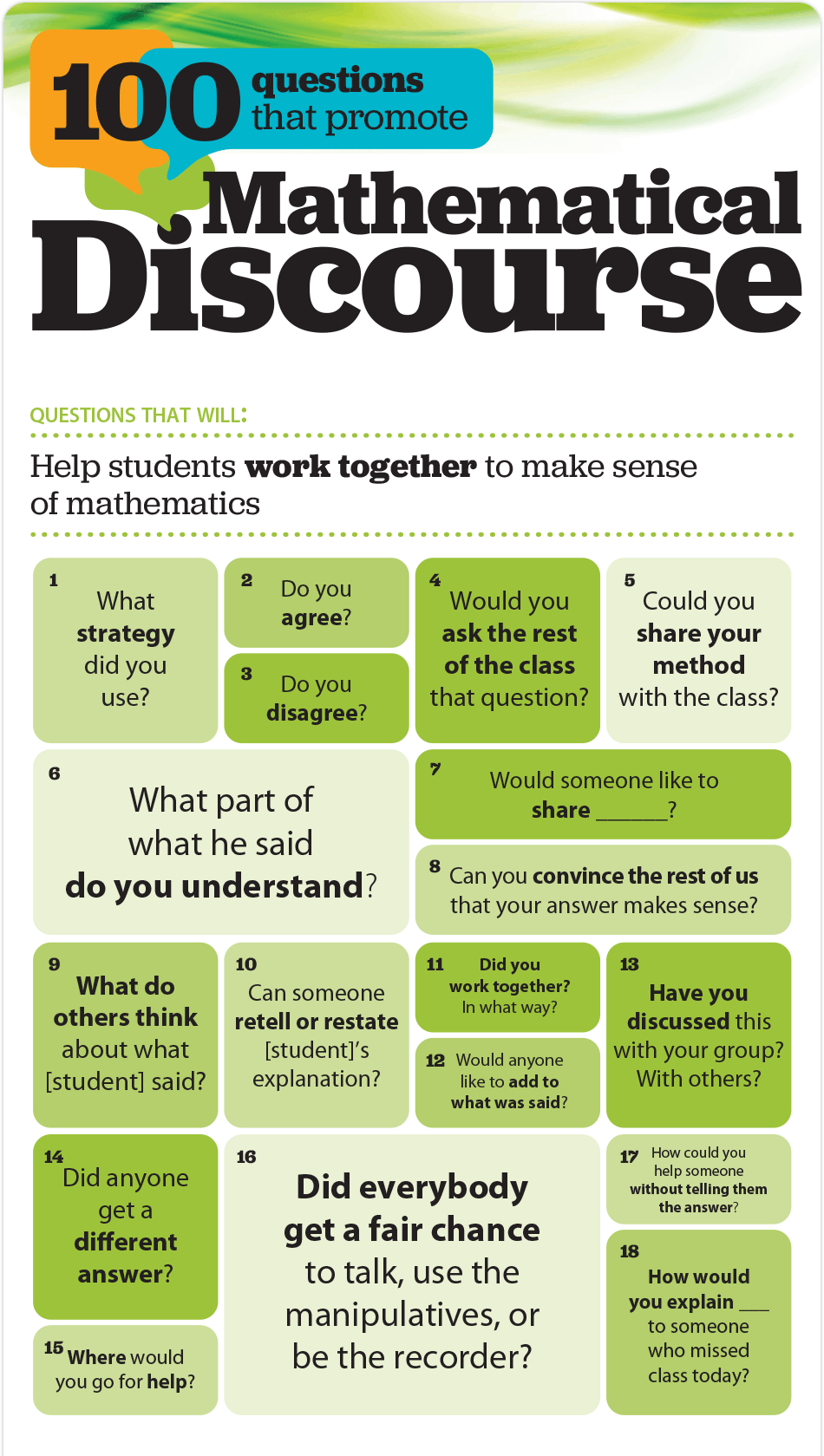
       I was recently introduced to a fantastic list of 100 questions that teachers can ask in mathematics class that will encourage students to think and reason and share their thoughts with each other.  A portion of these 100 questions are in the graphics in this post.  The rest can be found here.

       The questions are separated into categories that help students to:
  1. Work together to make sense of mathematics.
  2. Rely more on themselves to determine if something is mathematically correct.
  3. To reason mathematically.
  4. Evaluate their own processes and engage in productive peer interaction.
  5. Gain a better understanding with problem comprehension.
  6. Learn to conjecture, invent, and solve problems.
  7. Learn to connect mathematics, its ideas, and its applications.
  8. Persevere.
  9. Focus on the mathematics from activities.
       Every parent that has ever received the unimaginative response of "Fine." to the question, "How was school today." understands the frustration of trying encourage a dialogue with young people who are either unable or unwilling to do so.  Teachers face this dilemma every day.  Except, for teachers, their are tasked with making sure that the students are actually learning the content that they are teaching.  Teachers don't have the luxury of dismissing an uninformed, mono-syllabic response.  Hence teachers do their best to use strategies that will encourage students to share their thinking.  These questions help teachers to achieve this goal.

       Here is a sampling of some of these great, discourse-encouraging questions:

How would you explain _________ to someone who missed class today?

How did you reach that conclusion?

Can you think of a case where that wouldn't work?

Could you reword that in simpler terms?

How is your solution method the same as or different from (student)'s method?

How does this relate to ____________ ?


       These questions help students to understand that mathematics is not just a bunch of rules that lead to a single number answer.  We want students who are able to understand the reasoning behind the rules.  We want students to think and reason and discuss and struggle and fail and try again.  We want students to have strategies for finding solutions beyond just asking the teacher.  We want students to learn from each other, to recall past lessons, and to know how to check their own work.

       These questions are a great resource to our teachers.  When students are thinking, students are learning.


Friday, October 14, 2016

Schooling Isn't a Game to be Won

       Americans love competition.

       We follow sports teams.  We compare our Olympic medal count with those from other countries.  We brag about having faster cars and the newest cell phone, and the whitest teeth.  At times (it seems) everything is a competition; that we are always trying to surpass what our neighbors have or can do.

       This sense of competition (unfortunately) extends into our schools as well.  Our students want to know who got the highest test grade, who takes the most Advanced Placement courses; who got the best report card grades.  We are constantly comparing ourselves to each other.

       When it comes to schooling, I have a statement for our students (and their parents):


       School isn't a soccer game, it isn't the Olympics, and it isn't a Reality Show to be won.  School is about learning.  Some students will excel in some areas, some might excel in all areas (or appear to excel on all areas), and most will probably be average.  The goal for all of these students is to learn.

       The danger of the "competition" aspect of schooling is when students strive for high grades or correct answers by means that don't require a lot of learning.  Some students are good at "playing school"; they do what they need to do to get good grades (such as turning in homework and classwork on time and participating in class), but avoid actual studying and real learning.  They do this because of a misguided notion that the goal of school is getting good grades.  When student compete for "grades", they can miss the most important purpose of schooling which is learning.  In a classroom, this means that they are afraid to try new things or to offer suggestions or ideas for fear of being wrong (and perhaps labeled as "less smart").  This isn't what we want in our schools.

       Learning is a lifelong skill.  School cannot be a place where students merely learn how to do what they are told to do.  School has to be a place where the skill of learning is learned and understood.  A place where students learn how to problem solve and how to ask the right questions and how to access resources that they need.  Students shouldn't have to worry about doing better than other students.  They should only be concerned about learning.

       Let's make our schools a competition-free zone.  After all, there are plenty of other areas in a student's life where they can compete.  School should be one of them.

Sunday, October 9, 2016

Breaking News: High School Is Not Supposed to be Boring

       Too many parents have this idea that says, "If it was good enough when I was in high school, than it's good enough for my kids."  Of course, they hated it when they were in high school.  But for some reason, they are "OK" with the same boring classes and senseless assignments for their own children.

       I'm talking about high school classes with:

  • students sitting in rows
  • teacher always standing in the front of the room
  • worksheets, worksheets, worksheets
  • very little (or none) students discussing, asking questions, or working together
  • homework on stuff they already know how to do
  • no use of educational technology
       I've seen high school classrooms with multiple students who have their heads on their desks and the teacher seems to be "OK" with this.  Too many classes in which the teacher asks the class something like, "Do you understand?" and one student says "Yes" and the teacher assumes that everyone in the class understands.  And the students know that this is going to happen and they don't want to say out loud that they don't get it.  I've actually heard parents say to their children, "School is supposed to be boring.  That's just the way it is."  They believe this and (now) their children believe this.

       I've got breaking news for all of the parents and students who believe that school is supposed to be boring.

It does not have to be this way.


       Think about your favorite teacher in high school.  Or think about your child's favorite teacher in high school.  What makes this teacher so special?  Why does this teacher stand out among all of the high school teachers you've ever had?  Was he or she boring?  Do they appear to not care if you passed or failed?  Of course not.  We've got lots of high school teachers who work hard every day to engage their students in the learning.  They believe that it is their responsibility to ensure that all students are learning; and they understand that students cannot learn solely by sitting and listening.  

       Learning requires doing, talking, listening, questioning, arguing (at times), trying and failing and trying again.  Students need to get out of their seats during class from time to time (or everyday)--especially in high school classes that last 80 or 90 minutes.  High school students should work in small groups without the teacher for part of the class.  They do it in elementary school and middle school; so they can do it in high school too.  We have teachers who understand this very well and they establish a true learning environment in their classrooms.  Students know that these teachers really care about their learning and they make an effort to encourage the learning everyday.


       High school isn't supposed to be boring.  Learning rarely happens in the context of "boring".  Compliance may happen; memorization may happen; even decent grades may happen.  But learning won't happen.  And if learning isn't happening, then what's the point of school?

Monday, October 3, 2016

Three Years; 200 postings; 50,000 views

       Three years ago today I began this blog with the modest words below.  It has been a learning and a reflective experience to write about education in America.   I've considered some controversial topics and I've praised the many excellent people that work within the walls of our schools everyday. And I've receive great feedback from my readers; their stories and ideas.

       Thank you follow joining me in this journey.  There is always so much to do; so much to say.  And together we can do it all.


First Post from October 3, 2013

It's 6:30am; "No time like the present." (Right?)  So here is my first post; really my introduction to this blog.  This blog that I have said to myself for years (and to others) that I should write.  So here is the beginning.

The blog is called, What's So Good About about Education?.  The purpose (the vision) is to highlight the good things that occur in American education every single day.  There are lots of sources out there that talk about the bad things in education.  This would make the average person think that there is nothing good about education in America.  Well that's just not true.

In truth, I may talk about the good and the bad, but I want to stress that there is lots and lots of "Good" going on.  We need to acknowledge the hard work of teachers and the many, many successes of our students. 

I hope to  be able to do that.

Have a great school day America.  I know you will.

Saturday, October 1, 2016

Good Enough Isn't Good Enough

       Schools, educators, teachers...they are never satisfied.  We are the ultimate Olympic athletes when it comes to our desire to constantly improve.  In education, "Good Enough" is never good enough.

       While it is often true--though not in all schools--that most students do fine; most students learn to read pretty well, most students move on to the next grade, most students graduate.  There are always some students that don't or that struggle to reach these accomplishments.  And even for those that do succeed, What is our standard for success?  Is it a passing grade?  Is it to barely exceed the minimum?  Is it to be merely good enough?

       The best teachers are constantly striving to find ways to reach all of their students.  The students that do what they are told and are able to "succeed" in school without much effort should be pushed to do more.  The students who always excel academically should be pushed to do more.  And the students that struggle to meet the minimum requirements should be given the help they need to do better.  All students can do better; all teachers can improve; all schools can strive for better results.

       The goal of school is learning.  But students approach this goal from many different viewpoints.  Some strive to be "Number 1"; some do their best everyday and accept that they may be stronger in some areas than in other areas; some students struggle in math but are good at reading; some students seem to struggle in all academic subjects but are talented in the arts.  And some students have been beaten down so often by their schooling experience that they have given up on trying.  All of these people come together in the typical public school and it is the job of the educators to more all of them forward.

       It is hard to have one policy or one standard that applies to everyone when "everyone" is so different.  Maybe the goal shouldn't be to reach a standard as much as it should be to improve based on whatever your starting point is.  If you come to 7th grade able to run a mile in 9 minutes and 36 seconds, maybe you should strive to end 7th grade with a time of 9 minutes flat or 8:30.  Similarly, if you begin 7th grade with a reading ability that is considered "average", may you should strive to end the school year above average in reading.  And if you are a teacher who always struggled to help those students who always want to sit in the back of the classroom and never participate, maybe you want to have the goal to encourage them to answer questions and to offer their ideas at least twice in every class.

       The goal isn't to be Number 1; the goal isn't to "win".  School is not a competition.  The goal is always to improve regardless of your starting point.  Nobody should accept "Good Enough" as good enough.

Sunday, September 18, 2016

The Case Against Worksheets

The Case Against Worksheets

       The "worksheet" has been a staple of the P-12 educational experience for students for the past 30 to 40 years--maybe longer.  The advent of the mimeograph machine and then the photocopier made the duplicating of massive amount of worksheets easy, cheap, and increasing common.  Today there are multiple websites with pre-made worksheets for math, reading, geography, science, and just about any other school subject.  Some teachers love using worksheets.  Some use a worksheet everyday or nearly everyday.  In middle and high school math classes, students sitting in rows in the classroom and independently completing 20 or more math problems on a worksheet is an iconic image that many parents remember as a child and still expect to happen to their children today.

       The problem with the massive use of worksheets in today's classrooms is that they represent the opposite of everything we now know about how students learn best and what we hope to accomplish in our schools.  Math worksheets in particular go against many of the tenets of good learning and good teaching.  Here is my short list of why worksheets are a poor choice for today's classrooms:

  1. Worksheets are boring.
  2. Worksheets discourage students from working and learning together.
  3. Worksheets are often very low on the rigor scale.

Boring

       I often say to my teachers that it isn't our job to entertain students, but it is part of our responsibility to motivate students to do their best.  The old days of the teachers who basically use the "Because I say so" theory of teaching is over.  Students may do what they are told, but they won't like it.  So the next question is, "Why do we care if the students 'like it' or not."  And the answer is student engagement.  The Glossary of Education Reform says the following about students engagement:

...the concept of "students engagement" is predicated on the belief that learning improves when students are inquisitive, interested, or inspired, and that learning tends to suffer when students are bored, dispassionate, disaffected, or otherwise "disengaged."

       Simply put, there is no educational reason for a student to complete 20 (basically) identical math problems.  If they know how to do solve the problem, then completing about three should provide sufficient evidence that they can do it.  If they don't know how to solve the problem, then they won't be able to solve 20 problems.  Or, they will make the same mistake 20 times and be very upset to discover this mistake the next day when the class goes over the answers.

Students Working Together

       When there are 30 students sitting in class and learning something new, most won't fully understand everything there is to know about the new learning right away.  Some will try to link the new learning to past learning; some will try to memorize the steps or the procedures; some will just take notes and not really understand anything right away.  When the teacher assigns classwork that is meant to be done independently, students have a lot of questions.  Some will ask their questions, but most won't because they don't want the teacher to think that they don't get it; or they don't want their classroom peers to think that they are stupid.  Some students won't even know what questions to ask.

       However, when students are encouraged to work in groups of (say) two to four students AND when they are encouraged to ask each other questions, they are much more likely to ask their question(s) and to help each other.  Each person in the group may understand a different piece of the new learning and together they can help each other.  Additionally, we know that when students can explain what they are doing, they understand the concepts much better than when they merely answer questions or solve problems independently.


Rigor

       Although not always the case, worksheets tend to emphasize low-level, procedural skills such as following steps to solve a problem, or defining a word, or finding a fact from a reading passage.  While we want students to have these skills, I question the need to constantly repeat this (worksheet) activity for the purpose of helping students to gain these skills.  In today's classrooms, we want to emphasize thinking and reasoning and problem solving.  We want students to recognize particular situations that require particular skills or procedures.
  • What formula do I need for this problem?
  • What further information do I need to determine before I move forward?
  • I'm not sure what to do, but I'll try this first and see what happens and progress based on this "first try" experience.
       In the math world, we now use activities called Math Tasks.  (For some great examples, see youcubed, nrich, (also here), and MARS.)  Math tasks cover the same content as worksheets, but they require more than merely asking students to repeat what they heard a few minutes ago when the initial lesson was taught.  Good math tasks begin with some basic information and slowly increase the level of rigor as the tasks goes on.  Students spend the same amount of time in class on a math task as they would on a worksheet, but instead of doing the same thing over and over (20 or more times), they are pushed to think about the new learning in new ways.

       This sort of rigor is better suited for students to work in groups than to work individually.  Group work is more amenable to higher-level problem solving that requires input and ideas from multiple people.  The group members can discuss and debate the different solution methods and (hence) they can gain a stronger understanding of concept or standard being discussed.


        I could go on...

       Worksheets, at their worst, are used to keep students busy during precious class time.  In fact, many students refer to worksheets as "busy work".  Even the students know that (sometimes) teachers are just using worksheets to fill time in the class.  And this is time that could be better spent with student-to-student discourse or whole-class discourse at much higher levels than the simple worksheet could ever achieve.  Worksheets do not promote learning beyond simple recall and following procedures.

       Worksheets are "old school".  Worksheets do not prepare our students for their future.  Worksheets should be (very) infrequently used in today's classrooms if we truly intend to prepare our students for life after high school.


Thursday, September 15, 2016

A Tale of Two Classrooms -- Rules unnecessary

This is the tenth in a ten-part series based on the poster: A Tale of Two Classrooms.


---------------------------------------------------------------

Rules unnecessary

       Rules govern behavior.  Hence, rules are only necessary when behavior needs to be governed.

       When my child began high school, he was presented with ten school rules.  One of these rules was:
Every student must provide their name when asked to do so by an adult.

This was many years ago, but I still remember it because it seemed like such a strange rule.  I thought, "What student wouldn't give their name when an adult asked for it?"  But I assumed that this was a problem in the school and the school decided that this was sufficiently important of a problem to make the list of top ten school rules [!].  Despite this (disturbing) fact, I can certainly envision a high school that does not have this rule because this sort of behavior occurs so rarely that it doesn't make sense to include it in the official school rules.

       On the other hand, schools certainly have a number of rules that are very necessary because some behaviors may disrupt the learning process, cause harm to students or adults, or are considered unacceptable in a school setting.  These are generally rules that some students and/or adults might not follow if there were no such rules in place.

       Now imagine a classroom in which such rules were not necessary.  Students respect each other; students do their best to learn everyday; students help each other; and adults and students work together to think, reason, debate, create, and learn.  This sort of classroom would have less of a need for strict rules because there is already an understanding of purpose and acceptable behavior.  

       And this really isn't some sort of utopian view of the world.  All of us have had a class in school that we really liked.  Maybe we liked the teacher or the subject or the other students in the class or all three of these attributes.  In this class there was very little behavior that required a recitation of the school rules to address.  When someone did something unacceptable, a peer or leader would speak to that person--or the person would notice the fault on their own--and the problem was over.  More importantly, everyone in the classroom is focused on doing their best and helping each other and making the best use of their class time.


       When school is focused on the needs of the learner and the students understand their purpose and responsibilities, the rules become unnecessary.  This is the classroom that I want to be part of; this is the classroom that I want to lead.  This is the classroom where I can truly learn.


Thursday, September 8, 2016

A Tale of Two Classrooms -- Create

This is the eighth in a ten-part series based on the poster: A Tale of Two Classrooms.


---------------------------------------------------------------

Create

       Should school be a place where students (only) do what they are told to do?  Or, should school be a place the encourages and even requires students to think and hypothesize and create?

       When educators get together to talk about the factors that go into determining a course grade, we sometimes refer to some of these factors as "compliance" grades.  These are things such as: completing homework, completing classwork, following the school or classroom rules, and behaving properly.  While these are certainly going to be a part of the school experience for students, is it appropriate that a student's grade should be based on these "compliance" factors?

       Learning doesn't occur when teachers tell students exactly what to do and what to say.  Learning occurs when students are reminded of past lessons followed by additional information (or "content") and then students are given the task to put these two experiences together to make sense of them.  Learning is demonstrated when students can explain their thinking either orally or in writing (preferably both ways), when students ask questions about the new content, and/or when students take in the new content and find ways to use it to create something new.  The learning process may involve some level of compliance, but compliance alone isn't learning.

       In today's classroom, we want students to struggle with questions that can't be answered with a single word or in a very brief period of time.  We want students to go back to their notes, or the book, or the online resource to recall something they were taught yesterday or last week and to use that information to connect to what they are being asked to understand today.  We want students to understand this process for making connections and extending beyond what the teacher says.  We want students to imagine bigger, to think bigger, and to create bigger.

       The classroom isn't just a place to follow rules.  The classroom should be a place of thinking and talking and reasoning and arguing and offering solutions.  The classroom should be a place of "new" everyday.


Thursday, September 1, 2016

A Tale of Two Classrooms -- Kids Think

This is the fifth in a ten-part series based on the poster: A Tale of Two Classrooms.


---------------------------------------------------------------

Kids Think

       It seems crazy to suggest that classrooms in the 21st century should emphasize more student thinking and to imply that this wasn't always the case.  But if you think about the traditional classroom--the sort of classroom that many adults sat in when they were in school--you see a teacher standing in the front of the room and asking a lot of low-level, "recall" -type questions.

       "It's not positive, it's........?"
       "The capital of the United States is........?"
       " The largest planet is........?"

       A student could walk into the classroom after the lesson was taught and still be able to answer these questions.  These are simple, one answer, "just the facts" questions.  They don't require students to think.  Sometimes they don't even require students to memorize anything because the answer to these sorts of questions may be in the book or paper that is lying on the student's desk at the time the question is asked.  I've been in classrooms (today) when a teacher would ask a question and then point to the answer on the screen or the whiteboard and all the student had to do is read the word that the teacher pointed to.  This doesn't require thinking.  Even worse, low-level questions don't promote learning.

         In today's world, we need students who can analyze, evaluate, and create.  These skills are on the highest level of the revision of Bloom's Taxonomy.  These are the thinking skills.  These are the skills that enable students to compare and contrast pieces of information and to draw conclusions.  They help students to learn how to devise solutions to problems and how to come up with ideas and suggestions.  These are the skills that teach students how to learn.

       And thinking isn't supposed to be easy.  Academic thinking takes practice; it takes time; and it helps to have a supportive teacher.  The students with the first answer (the "fastest" answer) may not have the only answer.  Thinking also grows the brain by creating more connection among synapses.  Thinking adds content to students' long-term memory--which is good because more information in our long-term memory allows for more thinking--or more "space" in our short-term memory.  This is the place where we hold on to new information.

       A classroom that allows for a lot of student thinking must also allow for ideas and suggestions to flow without an immediate response from the teacher.  We want students to share their thoughts and ideas and to hear those of their peers without worry about being right or wrong all of the time.  Thinking is hard work; and school is the perfect place to cultivate this life skill.

Tuesday, August 30, 2016

A Tale of Two Classrooms -- Kids Question

 This is the fourth in a ten-part series based on the poster: A Tale of Two Classrooms.


---------------------------------------------------------------

Kids Question

       The typical, tradition classroom has the teacher doing most of the talking.  The teacher asks questions, the teacher gives information (verbally), the teacher decides if the answers are correct or incorrect.  And the students do very little talking.  In the traditional classroom, student talk is for answering the teacher's questions and that's about it.

       But in the Learning Classroom, students do a lot of talking.  They ask questions.  They offer solutions and ideas.  They consider alternatives, shortcuts, more efficient pathways to learning.  There are lots of great benefits to student talk in the classroom.   Here's a list of ten such benefits:

  1. Participation adds interest
  2. Participation engages students
  3. Participation provides the teacher feedback
  4. Participation provides the students feedback
  5. Participation can be used to promote preparation
  6. Participation can be used to control what’s happening in class
  7. Participation can be used to balance who’s contributing in class and how much
  8. Participation encourages dialogue among and between students
  9. Participation can be used to develop important speaking skills
  10. Participation gives students the opportunity to practice using the language of the discipline

       We want students to ask questions because real learning requires more than just memorizing what the teacher says.  It requires thinking and reasoning and trying and failing and trying again.  Real learning encounters road blocks from time to time and students to ask questions about how to navigate around these obstacles.   When students ask questions that are engaged in learning and they learn better and more deeply when they are engaged.


Public Schools and Choice

       Is it true that public school kids and their public school parents don't have choices?  I'm sure that I will expose my igno...

Teach100 blog