Showing posts with label tests. Show all posts

Saturday, July 9, 2016

Creating a Better High School - Part 3

       This is the third in a three-part series that will look at the structures in place in our current high schools that don't make sense or are not needed anymore.  I want to think about the best way that students learn and create a high school that will serve these learners.  I also want to think about the true purpose of high schools in our time.  My goal isn't to imagine a "High School of the Future", but instead to consider what can realistically be done today.  As always, I encourage my readers to add their thoughts and ideas.  Together we can create the high school that our students want and need today.

Create a Better High School

Part 1 - Current school structures that aren't necessary anymore.
Part 2 - How students learn and how schools can react to these learners.
Part 3 - The purpose of high school

-----------------------------------------------------------------------------------------------------------------

The Purpose of High School

       This could be a short post because all I really want to say is that the purpose of high school is "Learning".  That's it.

       Indeed, the purpose of schooling in general is learning.  However sometimes it seems that the purpose of high schools is "getting-a-good-grade".  This can be stated in many ways:
  • Getting a grade
  • Doing what your told
  • Compliance
  • Grade Point Average (GPA)
  • Test scores
But this is not the intention of high school.  The purpose of high school is learning.  We want students to learn.  In fact its more than that...We want students to learn how to learn.  Our current system is all about doing stuff to get a good grade.  Learning might take place; and we (as educators) certainly want learning to take place.  But many students are stuck in the rut that says, "I just have to do what I'm told to get the grade; to get the credit."  For many students, "Learning" comes in second or third place (if rated at all) in their list of priorities.
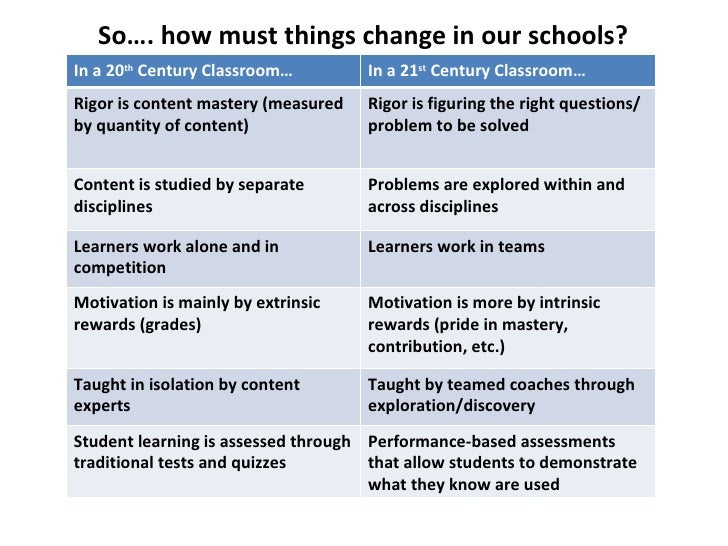
       So how do we create a better high school that emphasizes "Learning" over "getting-a-good-grade"?  We know that when students are interested and excited about what they are doing, they are more likely to try their best and more likely explore, to ask questions, and engage in the effort to complete the task.  Therefore, we need high school to include more project-based tasks.  We also need students to engage in tasks in small groups so that they have the chance to debate ideas with fellow students and allow their peers to evaluate their ideas and suggestions.

       I believe that we (also) need high school to include instructional techniques that encourage a growth mindset in our high school students.  Part of the reason that students sometimes show such a small amount of motivation is because they believe that no amount of effort will enable them to learn.  We want students to understand the value of effort.  Growth mindset teaching helps students to understand this.  But growth mindset is not well understood by our current teachers.
       Our better high school will evaluate learning in different ways.  Rubrics, peer evaluation, presentations, portfolios.  We already use a lot of these methods.  This is not futuristic; this is today.

       We have to separate the "Learning" of high school from the "Grading" of high school.


Saturday, September 5, 2015

The Pros and Cons of Standardized Testing

Warning:  If you are 100% against standardized testing or 100% in favor of standardized testing, you shouldn't read this blog post.  I'm going to some things that you will agree with, but you will be so blinded in anger over the things I say that you disagree with that you will never see the agreement parts.  Besides, you have already determined your thinking on this matter so there is no point for you to hear the opinions of others.

------------------------------------------------------------------------------------------------------------------

       Alright, maybe that warning was a little harsh.  I apologize.  In truth, I'd like to believe that the people who are on the extreme sides of this issue are a very small minority.  Most people have their views regarding standardized testing, and I would guess that most people fall somewhere in the middle of the issue.  I'm one of those people.

       In an ideal world, the students will come to school and do their best everyday to learn--and testing wouldn't be necessary.  The reason it wouldn't be necessary (in this ideal world) is because teachers would constantly gain an understanding of each student's level of learning through formative assessment practices; and students would ask questions about the things they didn't understand and keep working on these things until they got it.  The motivation would be the attainment of knowledge.

       To be fair, some students and teachers and whole schools work hard to (at least) approach this ideal world of education; but for the rest of us, we are still somewhere on our journey toward this world.  We are striving to emphasize learning over "getting-a-grade"; but we still need effective ways to measure learning--and testing is part of this process; and standardized testing is part of this process.

Some Pros of Standardized Testing

       In my view the "standardized" part of standardized testing is a pro.  Every student takes the same test regardless of the factors that influenced their learning (such as their teacher, the curriculum, the standards, the state they live in, etc.).  Think about the SAT test: colleges know that every student is taking the same test, so SAT scores can be compared to each other regardless of where in the country the test was taken.

       Also, the next generation of standardized tests (think PARCC and Smarter Balanced tests) are written to determine a measure of learning based on understanding content more than based on memorizing formulas and procedures.   This means that it will be harder for students to guess the right answers on these tests.  It also means that results will be based on true learning and understanding rather than on a student's ability to take a test.

Some Cons of Standardized Testing

       It may be a challenge to teach all of the content that is covered in a standardized test prior to the administration of the test.  Standardized tests typically have specific testing windows or a specific testing date on which to give the test.  Since different school districts start and end on different dates during the year and have different days off due to holidays and other reasons, it might be hard to structure a course outline that completely covers all of the material that will be assessed on a standardized test.  This occurs (sometimes) for Advanced Placement tests.  These AP tests usually have a particular May date for their administration and many school districts finish their school years in June.

       Some might argue that a "con" to standardized testing is that it might assess something that we don't teach or don't want to teach in the course.    I believe that there is general agreement of what needs to be taught in each grade and that this is less of an issue than some would have you believe.

       To me the biggest down side to standardize testing is that it gives the message to students (and parents) that the goal of school is getting a good grade on a (standardized) test rather than having the goal of learning.  Sometimes standardized test results are treated with great importance with newspaper articles and school-wide celebrations.  And sometimes these results are given too much importance when making course selection decisions for the next couple of school years.  As I said before, schools should emphasize learning and should de-emphasize "getting a grade".  A standardized test score should be just one piece of data that is used in conjunction with many other data points to make big decisions about a student's ability.


Sunday, August 30, 2015

Formative Assessment Is Not a Buzz Word

       Formative Assessments are the keys to identifying the actual learning that takes place within every student.  I'll admit that "formative assessment" is certainly an educational term that one wouldn't typically hear on a regular basis outside of education circles.  But it isn't a meaningless "buzz term" that we use to confuse people.

       Formative Assessment is something that good teachers do on a daily basis to gain information on how well the students are learning the daily objective or standard that is taught in class everyday.  If teachers didn't use some sort of formative assessment, they would only be delivering information instead of actually teaching.

       I think that people outside of education hear the word "assessment" and immediately think of "a test"; and then they think of a grade; and then they think about its impact on the course grade; and so on and so on--only thinking about grades.  Teachers on the other hand are much more interested in learning than they are in grades.  Formative assessments can be traditional quizzes or tests, but most of the time they are activities, questions, discussions, games, projects, exit tickets, pre-assessments--lots of strategies that teachers use to identify the level of learning that is occurring within each of their students.

       Formative Assessment emphasizes learning and de-emphasizes "the grade".  Formative assessment helps students to see the learning target (the goal) and it helps them to be successful in reaching that goal.

       So don't think of "tests" when you hear the term "Formative Assessment".  Instead think, "I'm glad my child's teacher is concerned about helping my child to learn well."

       Another phrase we use a lot is "Assessment for Learning".  Using Formative Assessments effectively helps students to learn and to learn well.  It isn't a "final exam" that (instead) tests what the student knows after the teaching and learning has already taken place.  Formative Assessment is what happens while the learning is taking place.  It recognizes that students aren't going to understand everything the first time they hear it.  They have to hear it and try it and make mistakes and try again and make more mistakes and learn from these mistakes and try it again...and eventually they get it.

       Mistakes are expected, respected, and inspected.  This is what Formative Assessments do.


Saturday, July 4, 2015

Educational Testing Should be Compared to a Health Check-up

       There's a lot of talk about testing in schools these days.

       Should we test students?  Is there too much testing?  What should be on the tests?  Are the tests too easy?  Are the tests too hard?  Do tests measure student ability?  Are high-stakes tests fair?  Standardized tests, the new SAT tests, college-readiness tests, ...and so on and so on.


     On a purely surface level, some students (and parents) do not like the big, end-of-course tests or the big standardized tests because they don't score well on these tests.  And that bad score leads to other negative and uncomfortable issues:
  • students feel bad
  • students feel not smart
  • course grade is negatively affected
  • looks bad on high school transcripts
  • negative affect on grade point average (G.P.A.)
  • negative affect on class rank
This opposition to this sort of testing has nothing to do with learning or the student's (or the parent's) feeling toward the test representing the quality of learning that took place during the course.  This opposition is purely about how the "after-effects" of the test will effect the student's stature, ranking, or reputation in some way.

       On a much different level, some people are concerned about the ability of the "big test" to accurately measure a student's academic ability in a particular subject area.  Alfie Kohn stated his many concerns about standardized testing in his 2000 article titled The case against standardized testing: raising the scores, ruining the schools.  In it, he offers a history of the origins of current-day standardized testing and lays out some of the problems with our current system.  On the other side of the debate, is the book Defending Standardized Testing (2005) edited by Richard Phelps.  This book examines testing via multiple points of view such as: research on standardized testing, misconceptions about large-scale testing, high-stakes nature of some assessments, and the issue of the growing testing industry.

       I view educational testing in the same way I view going to the doctor for a health checkup.  The two extremes are too extreme.  Never seeing a doctor is bad because you might never know if you are developing a serious health issue until its too late.  And seeing a doctor for a full physical checkup everyday is not necessary because your health isn't going to change on a day-to-day basis.  But seeing a doctor (perhaps annually) and following his/her advice is necessary for good health.

       Educational testing is necessary because there has to be some sort of measure of academic ability so that we can fairly compare a student's ability with other students.  If students never take advantage of standardized testing they could go through 12 years of formal schooling believing that all is well only to enter college and to discover that they are unprepared for college-level work.  Educational testing should not be used to rate schools as if they were in some sort of horse race.  They should be used to measure true learning--which is the purpose of schooling in the first place.  They should be used to provide students, parents, and teachers with good information on what students know and understand and what they don't.

       We don't have competitions with other people on who has the lowest cholesterol level or the highest pulse...We shouldn't have competitions on who gets the highest grade on standardized tests.  They should be used for individual results.


Monday, May 11, 2015

How Much Assessment is Too Much Assessment?


       So, here is how education is supposed to work...


  1. The teacher teaches something.
  2. The student learns it.
  3. The teacher verifies that it has been learned.

Step #3 (above) is a very important step.  In the art of teaching, the actual "teaching" part is (indeed) only a part of what we do.  The far more important part is ensuring that learning is taking place.  If students aren't learning anything, then (one might say) we are not really teaching.  (Maybe we are just "presenting".)

       Sometimes we think that learning has taken place when it hasn't taken place.  Students nod their heads and smile and don't seem to have any questions; and it "looks like" they are understanding.  But unless our teachers are also psychics and are able to actually know what their students are thinking; some form of assessment is necessary for teachers and students (and parents) to verify that the "learning" really happened.  (After all, the goal of education isn't to get grades; the goal is to learn.)

       Outside of education, when people think about "assessment", they usually think about tests such as "Chapter Tests" and "Final Exams".  But educators know that there are many, many different ways to assess student understanding.  In fact, our best teachers incorporate some form of assessment into every lesson that they plan everyday.  This makes sense because how can a teacher know how or when to move on to the next topic unless they know how well their students understood the last topic?

       Assessment should be a part of every lesson.  It can take many varied forms.  Here is a list of ways to assess student understanding in the classroom from David Wees:
  • 3 Things
    • List 3 things that a fellow student might misunderstand about the topic
  • Venn Diagram
    • Have students compare and contrast a topic using a Venn diagram
  • Write it down
    • Have students write down an explanation of what they understand.
  • My Favorite No
    • Students complete a math problem and write their solution on an index card.  The teacher selects his/her favorite wrong answer and analyzes it with the class.


  • Doodle It
    • Have students draw what they understand rather then writing it.
  • Chalkboard Splash
    • Numerous students respond to a prompt/question on the chalkboard or whiteboard at the same time
  • and 50 more to found here

       These many and varied forms of assessment could be graded or not graded.  But all of these assessments have the purpose of providing the teacher (and student) information about how well the students are learning.  Instead of assessment "of" learning, these include assessment "for" learning.

       So, How much assessment is too much assessment?  Assessment should take place frequently.  Some sort of assessment should occur with every lesson taught.  And we do this, the traditional, formal, summative assessments (like chapter tests) won't be such a big deal.


Thursday, April 9, 2015

Learning is not Pass/Fail


        Years ago I worked with a colleague in the research office of a major school system.  He always tried to find a way to make research and statistics understandable to the average person.  He once talked about the infamous College Acceptance Letter.  I'm not sure if this is still true today, but years ago you would apply to multiple colleges and then you would wait and wait and wait for a letter from these colleges that would tell you whether or not you have been accepted.  When the letter arrived, you would open it and there would be one or two paragraphs of "welcome" and "thank you" messages.  And, finally, somewhere halfway down the page you would get to the part that you really wanted to know:  Accepted or Not Accepted.

       My colleague suggested that the most important information in such a letter should come in the very beginning and the other stuff can be written farther down in the letter.  Better yet, he suggested, they should just send a letter with a smiley face or a frowny face!  That would be the simplest way to communicate the message and everyone would understand what it meant.

       I wonder if people outside of education often view learning in the same way?  "You get it."  or  "You don't get it."  We sometimes use the phrase "Filling your brain with knowledge."  I wonder if some people imagine learning to be this (sort of) empty skull or glass that is filled by the teacher.  When it is full, then you have learned it and you got it and you will always have it.

       In reality, learning is much more of a process with a somewhat hazy finish line.  While there are certainly facts that students can memorize (5 + 5 = 10; July 4, 1776 is the date of the signing of the Declaration of Independence; Paris is the capital of France), actually learning is much more of a process that develops over time and requires thinking and discussing and trying and failing and trying again--and learning from the mistakes.  Learning is much more like a baby learning to walk than it is like a switch that is off or on.

       We should think of learning as being more of a continuum and less of a Yes/No, Pass/Fail dichotomy.  After all, it isn't so much that we want our children to "pass" in school; what we really want is for our children to "learn" in school.  Employers don't care what grade you got on a test in high school.  They care about what you learned and are able to do.


Friday, November 7, 2014

Should we abolish Grades in our schools?

       Why do schools assign grades?

       Grades and grading are such natural parts of our educational system, it seems almost silly to ask this question.  It's like asking, Why do people walk?, or Why do have eyes?  Still, if we think about the meaning and purpose of grades, I would say that most people have an answer to this question.

       Grades provide a measure of success in a student's learning.

       Grades tell us our ability in a particular academic area.

       Well...maybe that is what grades are supposed to do, but (in reality) do grades serve other purposes?  If you are a teacher, have you ever given a student a bad grade because the assignment was handed in late?  Have you ever taken points off of a test because a student was talking during the test?  In these instances, the grade was determined (at least partially) based on a student's behavior and not on the student's ability.

       As a student, have you ever received a good grade and learned nothing about the thing you were graded on?  Have you ever received an "A" on a test based on what you were able to memorize?  In these instances, the grade didn't represent ability; it represented compliance.  You did what you were told to do.

       As a parent, do you ever question the good grades that you children earn?  Do you encourage your children to get good grades, or do you encourage your children to learn?  Do you view grades as a sort of competition...Your kid vs. the other kids...Who is going to win?

     I think about grades and grading a lot.  A quick Google search found other people who think about grades and grading in our schools.  One of my favorite people on Twitter Starr Sackstein. Also Alfie KohnJen Rubino, and Education Stormfront.  I worry that grading is taking over our education system.  I worry that learning--the joy of learning; the desire to learn--has fallen into a (far) second place.

       There is so much pressure on students to get good grades.  Do grades mean what they used to mean?  Do grades reflect a student's ability?  Does anyone care if grades reflect a student's ability?  Grades don't have to be the enemy; but (I think) the desire to seek good grades over the desire to learn is dangerous.  We give students a false sense accomplishment when we say that they have "earned" grades and they didn't.  We give parents a false sense of their child's ability too.  How many students get great grades in high school and then cannot make it to their sophomore year in college?  Surely, this isn't our goal.

       Why do schools assign grades?  Why (should) schools assign grades?  And, can we lessen the importance of grades and increase the importance of learning?

       I hope we can.


Monday, April 14, 2014

Testing That Helps Us Learn

       Schools and testing just seem to go together.  And along with "testing" comes "grading".  From the outside, school can seem like it is entirely made up of just testing and grading.  And, to be fair, schools and teachers spend a lot of time on the issues of testing and grading.  Parents like to hang report cards on the refrigerator and brag about high test grades.  Newspapers love to report about test scores of schools and school districts.  Colleges may have admission requirements related to test scores.  Even politicians like to talk about test scores.

     But inside the school our best teachers are concerned about entirely different tests.  These "tests" (or assessments) are the ones that tell students and teachers what they know and what they don't know.  We call these tests Formative Assessments--or Testing FOR knowledge.

       These tests might be graded or they might not be graded.  The purpose of these tests are not to get a grade, but instead to see what students know and what students are able to do.  These are the tests that teachers really care about; and they are the tests that students actually like because they actually give students information about what they have learned.

     The best part is that these "tests" might not even look like tests.  They might be one question at the end of the class that students answer (verbally or in writing).  It might be a game that students play in class that requires them to answer questions about current lesson topic--and earn points for their team!  It might be a mini-project in which students are given a situation that they have to make sense of and then decide what to do next.

     Formative assessments give teachers information about how well students are learning.  Teachers use this information to make decisions about what to do the next day.

     Formative assessments are a necessary part of the learning process.  It is unlikely that every students will learn and understand every lesson in the every class every day.  It takes trial and practice and support and discussion and mistakes and "try again" and more discussion and (yes) formative assessments every step of the way so that teachers and students can get information on what they know and don't know.

     Schools are supposed to be about learning.  Maybe someday, the "grading" part of school will go away and the only part that will remain will be the learning part.

     I hope to be here when that happens.


Sunday, March 16, 2014

The Value of National Testing

     Chapter tests, unit tests, and final exams have been around (seemingly) forever.  These are tests that happen in school.  But what about the nationwide tests that students take?  I'm talking about the SAT, the ACT, the NAEP (National Assessment of Educational Progress), and the new PARCC and Smarter Balance tests.  What is the value of these tests?

     Let's start with the SAT and ACT, because most people know about these tests.  The purpose of the SAT test is to reliably predict an individual's success in their first year of college (see report here); and the SAT does a pretty good job of doing this--particularly for mathematics.  The stated purpose of the ACT is:

     Your ACT composite score, together with your high school grades, indicates how prepared you are for   college. In addition, the scores from the various sections of the ACT will help your college place you in the right classes, matching your skills with course requirements. (citation)

     Of course, aside from these "official purposes", we know that lots of people attribute much more importance to these two tests.  And, to be fair, some colleges have "cut-off" scores; if you score below a cut-off score, then you won't be considered for admission.  Still, my feeling has always been that there are plenty of colleges in the U.S. and unless you are determined to go "ivy league", there is a college out there ready to accept your money...uh...uh...I mean...to accept you.  Also, I believe that the SAT/ACT do a good job of showing what you know and are able to do.  Let's face it, a lot of students are good at "playing school".  They know what to do to get an "A".  But some student get an "A" because they understand the material and other students get an "A" because they are good at "playing school".  The SAT/ACT helps to separate these two groups of students.


     The NAEP, on the other hand, probably does the best job in determining what our nation's student know and are able to do.  This test is given to a sample of students in every state.  Colleges don't look at this test and parents don't get individual scores from this test--so it is a "low-stakes" test.  Students don't feel external pressure to do well on this test and nobody hires a tutor to do better on this test.  The PARCC and the Smarter Balanced tests--the new tests to be used to assess the Common Core standards--are supposed to be more like the NAEP tests.  Colleges aren't asking "What did you get on your PARCC Algebra 2 test?" yet, but I believe they will in the coming years.

     The value of these new tests are really the same as the value of the old SAT/ACT tests; they are supposed to show what students have actually learned in school.  We have to brace ourselves for students who get good grades in school and bad grades on PARCC and Smarter Balanced.  It will happen to the students who are good at "playing school" but not so good at learning.

     Students who do well on these tests should do well in their college courses.  Students who don't do too well will know where they stand and will enter college (I think) with a better idea of what they need to do to succeed.

     Sometimes I worry that the reason more than 50% of students that start college and never finish is because their teachers and school counselors and parents made them feel that their good grades in high school meant that they would be academically successful in college.  Their PARCC and Smarter Balanced grades may give them a different point of view--and that's OK.

     The value of national tests is an unbiased view of a student's academic ability.


Public Schools and Choice

       Is it true that public school kids and their public school parents don't have choices?  I'm sure that I will expose my igno...

Teach100 blog