Showing posts with label formative assessments. Show all posts

Saturday, September 3, 2016

A Tale of Two Classrooms -- The Goal is Learning

This is the sixth in a ten-part series based on the poster: A Tale of Two Classrooms.


---------------------------------------------------------------

Goal is Learning

       Don't get me started.

       The idea that the goal of schools is "Learning" is a major theme of mine.  Last year I wrote a piece called Are Your Students Obsessed with Grades.  In this post I included a list of things that students do that suggest they are more concerned about grades than then are about learning.  Some of these include:
  • They are constantly asking, "Is this going to be graded?"
  • They refuse to do anything if it is not being graded.
  • They ask for "extra credit" or make-up work at the end of the marking term to raise their grade to the next letter grade.
These sort of behaviors from students suggest that we have created what I have called The Grading Monster in our schools.  Grades and grading and Grade Point Averages (GPAs) have grown to oversized importance in the minds of students (and sometimes in the minds of parents) to the point that many have forgotten that the goal of school is learning.

       Of course, we need a way to measure the degree or the level at which students are learning.  But that method of measuring is not the goal of schooling.  It is the result of schooling.  I wrote a piece called Learning vs. The Appearance of Learning last year.  In this post I talked about the problem of seeking grades over seeking learning.  You might think that they are the same:  If I get a good grade, than I must be learning.  But this isn't always the case.  Grades can sometimes be manipulated to be artificially high--which would give the student (and the parent) the appearance of learning.  And I'm not talking about grade inflation--which is the purposeful and unearned raising of grade.  I'm talking about students who (perhaps) always do their homework and always participate in class and (perhaps) don't do very well on tests and quizzes; but the way the final grade is calculated causes them to end up with a decent grade even though they didn't actually learn very much.

       For many people, the idea of viewing schools as having the goal of learning will require a major shift in their thinking.  However, for individual classrooms and individual teachers this can be accomplished through relatively minor steps.

  • Encourage student discourse - Allow students to ask questions and offer ideas and solutions without judging the "correctness" of these ideas right away.  Allow other students to question these ideas and suggestions.
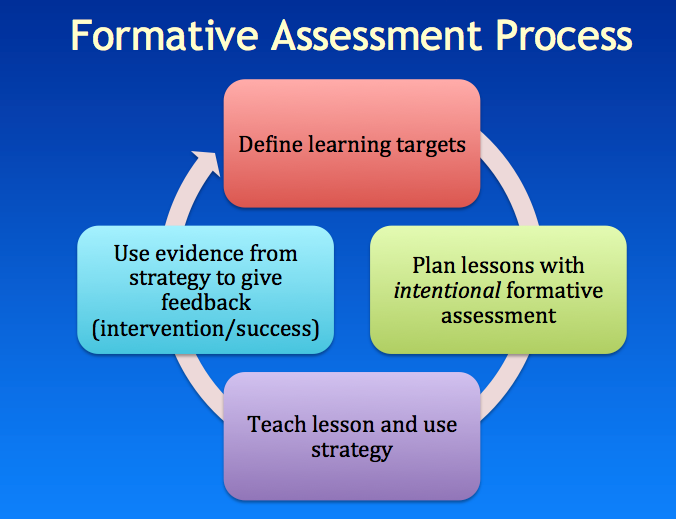
  • Formative assessments - Exit passes, classwork assignments, activities that provide feedback to students that is not a grade.  Instead the feedback could be teacher (or student) comments relative to the thinking that they have expressed in the assignment and (perhaps) suggestions for going further with that thinking.
  • Allow a little productive struggle and recognize students who tried and didn't get it the first time and tried again.  Help students to see that effort is important in the learning process.  Everything isn't "a grade".  No one expects students to "get it" the first time they are learning something new.
       There is a movement to abolish grades altogether in the effort to help students (and parents) to see the importance of learning.  I don't think that this will come to pass in my career, but if we truly want schools to be viewed as a place of learning, we will see the importance of grades and grading diminish.  This is important in the classrooms that we want to have in the 21st century.

       Learning is key.  Learning is everything.  If we aren't in school for learning, than why are we there?

Friday, May 20, 2016

Is There Too Much Testing?

       Testing.  


       The very word conjures up emotions in students and parents and school officials alike.  Within the educational community, this word conjures up other words like: measuring, accountability, fairness, purpose, practice, instructional time, online, paper/pencil, formative, and summative.  Your connection to these feelings and issues probably shapes your views about testing in our public schools.  Part of what makes this such a big issue is that there are no simple "right" and "wrong" solutions.  It is a complex problem that requires thought and discussion among many stakeholders.


       The goal of schooling is learning.  There may be other benefits such as socializing, joining a club or team, earning a diploma; but the goal is learning.  Our ability to measure learning has grown significantly over the past twenty years as educators come to understand the value of frequent formative assessments in combination with teaching strategies that engage students.  In the past, the school classroom was a very dictatorial place:  Teacher in the front doing most of the talking; students sitting in rows listening to the teacher and taking notes; test or quiz every Friday.  This system worked fine for the student who was able to learn by listening, but if you needed to ask questions, or clear up any confusion with the content prior to the test you probably struggled to learn in this environment.  And if you weren't able to concentrate on the teacher's words for two or three hours, you might have missed your first and only chance to get that precious information from the teacher.


       Today we know that learning requires doing and talking and questioning in addition to listening (and note taking).  We also know that we want to get a sense of the learning that is taking place on a daily basis and not just once a week or whenever the "Big Test" occurs.  This "measuring of daily learning" is what we call Formative Assessment.  It could be a game, a series of verbal questions from the teacher, an activity during class, a exit ticket (or exit pass),  Anything that gives the teacher and the student information as to their level of understanding the content or the objective for the day.  Usually when we argue about "Testing", this isn't the sort of testing that we are arguing about.

       The discussion over testing usually centers around what educators call summative tests.  These are chapter or unit tests, final exams, end-of-course tests, and major state tests.  These tests might be required to graduate from high school; or they may command a large portion of a final grade in a course; or they may be used to determine if you are ready for college (or if you will be accepted to college).  These are the tests whose results have some sort of consequence.

       A common issue that arises is a student who appears to be learning very well based on class grades and report card grades, but then this same student demonstrates a lower level of learning on one of these big tests.  I think that I worry when there is a public outcry over testing because of this scenario.  I feel that rather than arguing against giving the test, we should question why the discrepancy happened in the first place.  Clearly a student who fails an end-of-course test and earns an "A" or a "B" as a course grade cannot (both) be very knowledgeable about this content AND be very weak with this material.  Something is going on.  Perhaps both the course grade and the test are not true reflections of the student's ability.  Perhaps it is somewhere in the middle of these two extremes.

       Since the goal of school is learning, there should be accurate and valid methods for determining the extent of this learning.  It isn't enough for a student to come to school everyday and do what he's told to do and then walk out of school without some measure his learning.  Getting grades isn't enough.  What does it benefit a child to get good grades in school and not be able to read or do math at an acceptable level when he leaves school?  This is one of the reasons for instituting summative and state testing in the first place.  Also far too many students begin college but never finish college.  If more people took the results of these big tests seriously, they might be less in a rush to go to college until their abilities were more in-line with college-level expectations.


       Is there too much testing?  Why are you asking this question?  If it is because you don't like to see your child getting poor results on this test, than you should question the discrepancy between the course grades and the big test.  If it is because the results are not used for any useful purpose, then you should discuss this with you child's teacher or school.  Everything done in public schools should have a purpose; this includes testing.


Wednesday, September 23, 2015

Are Your Students Obsessed with Grades?

       Here's a quick checklist to see if your students are obsessed with grades:


  1. They are constantly asking, "Is this going to be graded?"
  2. They refuse to do anything if it is not being graded.
  3. They ask for "extra credit" or make-up work at the end of the marking term to raise their grade to the next letter grade.
  4. They only see the grade at the top of their returned work and ignore the helpful comments that the teacher has written.
  5. They try to memorize the information they need to know for tests.
  6. They follow procedures in mathematics for unknown reasons just to get the right answer.
       In short, students who are obsessed with grades are just "going through the motions" at school; they do what they're told, but they learn very little.  And when they take a test that can't be beat by memorizing (like a final exam) they show their true ability or lack thereof.  The challenge for these students is to do as little as possible to earn the grade they want.

THIS IS NOT THE WAY SCHOOL IS SUPPOSED TO WORK.

       School is supposed to be all about learning.  If students aren't learning, than we are wasting their time.  And if we are (somehow) justifying how these grades-obsessed students are getting A's and B's, then we are giving them (and their parents) a false sense of accomplishment.  Eventually someone will tell these students the truth about their academic abilities, and it would be a shame if they are in college (and paying for college) when they are hit with this truth-bomb.

       Teachers can help their students to de-emphasize grades by praising them for their thinking and reasoning.  They can emphasize learning by asking students to explain how they got the right answer instead of just accepting the right answer and moving on.  Formative assessments that require thinking and reasoning and justifying instead of just repeating information tell students that memorizing isn't good enough.

       We have to help students to be less obsessed about grades.


Saturday, September 5, 2015

The Pros and Cons of Standardized Testing

Warning:  If you are 100% against standardized testing or 100% in favor of standardized testing, you shouldn't read this blog post.  I'm going to some things that you will agree with, but you will be so blinded in anger over the things I say that you disagree with that you will never see the agreement parts.  Besides, you have already determined your thinking on this matter so there is no point for you to hear the opinions of others.

------------------------------------------------------------------------------------------------------------------

       Alright, maybe that warning was a little harsh.  I apologize.  In truth, I'd like to believe that the people who are on the extreme sides of this issue are a very small minority.  Most people have their views regarding standardized testing, and I would guess that most people fall somewhere in the middle of the issue.  I'm one of those people.

       In an ideal world, the students will come to school and do their best everyday to learn--and testing wouldn't be necessary.  The reason it wouldn't be necessary (in this ideal world) is because teachers would constantly gain an understanding of each student's level of learning through formative assessment practices; and students would ask questions about the things they didn't understand and keep working on these things until they got it.  The motivation would be the attainment of knowledge.

       To be fair, some students and teachers and whole schools work hard to (at least) approach this ideal world of education; but for the rest of us, we are still somewhere on our journey toward this world.  We are striving to emphasize learning over "getting-a-grade"; but we still need effective ways to measure learning--and testing is part of this process; and standardized testing is part of this process.

Some Pros of Standardized Testing

       In my view the "standardized" part of standardized testing is a pro.  Every student takes the same test regardless of the factors that influenced their learning (such as their teacher, the curriculum, the standards, the state they live in, etc.).  Think about the SAT test: colleges know that every student is taking the same test, so SAT scores can be compared to each other regardless of where in the country the test was taken.

       Also, the next generation of standardized tests (think PARCC and Smarter Balanced tests) are written to determine a measure of learning based on understanding content more than based on memorizing formulas and procedures.   This means that it will be harder for students to guess the right answers on these tests.  It also means that results will be based on true learning and understanding rather than on a student's ability to take a test.

Some Cons of Standardized Testing

       It may be a challenge to teach all of the content that is covered in a standardized test prior to the administration of the test.  Standardized tests typically have specific testing windows or a specific testing date on which to give the test.  Since different school districts start and end on different dates during the year and have different days off due to holidays and other reasons, it might be hard to structure a course outline that completely covers all of the material that will be assessed on a standardized test.  This occurs (sometimes) for Advanced Placement tests.  These AP tests usually have a particular May date for their administration and many school districts finish their school years in June.

       Some might argue that a "con" to standardized testing is that it might assess something that we don't teach or don't want to teach in the course.    I believe that there is general agreement of what needs to be taught in each grade and that this is less of an issue than some would have you believe.

       To me the biggest down side to standardize testing is that it gives the message to students (and parents) that the goal of school is getting a good grade on a (standardized) test rather than having the goal of learning.  Sometimes standardized test results are treated with great importance with newspaper articles and school-wide celebrations.  And sometimes these results are given too much importance when making course selection decisions for the next couple of school years.  As I said before, schools should emphasize learning and should de-emphasize "getting a grade".  A standardized test score should be just one piece of data that is used in conjunction with many other data points to make big decisions about a student's ability.


Sunday, August 30, 2015

Formative Assessment Is Not a Buzz Word

       Formative Assessments are the keys to identifying the actual learning that takes place within every student.  I'll admit that "formative assessment" is certainly an educational term that one wouldn't typically hear on a regular basis outside of education circles.  But it isn't a meaningless "buzz term" that we use to confuse people.

       Formative Assessment is something that good teachers do on a daily basis to gain information on how well the students are learning the daily objective or standard that is taught in class everyday.  If teachers didn't use some sort of formative assessment, they would only be delivering information instead of actually teaching.

       I think that people outside of education hear the word "assessment" and immediately think of "a test"; and then they think of a grade; and then they think about its impact on the course grade; and so on and so on--only thinking about grades.  Teachers on the other hand are much more interested in learning than they are in grades.  Formative assessments can be traditional quizzes or tests, but most of the time they are activities, questions, discussions, games, projects, exit tickets, pre-assessments--lots of strategies that teachers use to identify the level of learning that is occurring within each of their students.

       Formative Assessment emphasizes learning and de-emphasizes "the grade".  Formative assessment helps students to see the learning target (the goal) and it helps them to be successful in reaching that goal.

       So don't think of "tests" when you hear the term "Formative Assessment".  Instead think, "I'm glad my child's teacher is concerned about helping my child to learn well."

       Another phrase we use a lot is "Assessment for Learning".  Using Formative Assessments effectively helps students to learn and to learn well.  It isn't a "final exam" that (instead) tests what the student knows after the teaching and learning has already taken place.  Formative Assessment is what happens while the learning is taking place.  It recognizes that students aren't going to understand everything the first time they hear it.  They have to hear it and try it and make mistakes and try again and make more mistakes and learn from these mistakes and try it again...and eventually they get it.

       Mistakes are expected, respected, and inspected.  This is what Formative Assessments do.


Wednesday, July 29, 2015

The Grading Monster

       This is a story of a idea that grew up and got bigger and eventually took over a population.  The idea was to use grades to classify a student's ability.  This idea has grown into the the current Grading Monster that we have today.

       The origins of this idea, attributed to William Farish, seemed innocent enough--find a way for teachers to teach more students.  But what it did, instead, was to separate the important student-teacher relationship that had symbolized teaching for most of the 10,000 years prior.

     It would be fair to say that grades have overtaken the main purpose of schooling--which is to learn.  Of course this is not true for all students, but when students complain about academic performance, their complaint is much more commonly about their grade than about the learning that did or did not take place.

       Parents tell their children to get good grades rather than to learn a lot.  And when grades are low, discussions about how grades are determined and how these grades will affect course placement and/or college acceptance are the paramount concern over and above the concern that students are learning well enough.  More often than then not, the concern over learning is never brought up when grades are low.


       Dr. Justin Tarte talks about grades a lot in his blog Life of an Educator by Dr. Justin Tarte.  He points out many pitfalls that our educational system has fallen into when it comes to grades and grading.  Starr Sackstein is another blogging star of mine who has discussed grades and grading recently.  Clearly the effects of The Grading Monster are well known by educators and maybe, just maybe, we will begin to see this monster lose her strangle hold on our educational system.

       My thoughts on defeating this monster include the more common use of true formative assessments in our classrooms.  My definition of "formative assessments" is assessments and activities that provide to students and parents (and teachers) information on how well the students are learning.  Notice that I included the "activities" in this definition--as formative assessments don't have to be tests and quizzes.  In fact, I would advocate that most of the time formative assessments are not tests or quizzes.

       If we can emphasize the idea of learning and of measuring learning and de-emphasize the idea of getting-good-grades, we can defeat The Grading Monster and win back our schools for their true purpose--learning.


Saturday, July 4, 2015

Educational Testing Should be Compared to a Health Check-up

       There's a lot of talk about testing in schools these days.

       Should we test students?  Is there too much testing?  What should be on the tests?  Are the tests too easy?  Are the tests too hard?  Do tests measure student ability?  Are high-stakes tests fair?  Standardized tests, the new SAT tests, college-readiness tests, ...and so on and so on.


     On a purely surface level, some students (and parents) do not like the big, end-of-course tests or the big standardized tests because they don't score well on these tests.  And that bad score leads to other negative and uncomfortable issues:
  • students feel bad
  • students feel not smart
  • course grade is negatively affected
  • looks bad on high school transcripts
  • negative affect on grade point average (G.P.A.)
  • negative affect on class rank
This opposition to this sort of testing has nothing to do with learning or the student's (or the parent's) feeling toward the test representing the quality of learning that took place during the course.  This opposition is purely about how the "after-effects" of the test will effect the student's stature, ranking, or reputation in some way.

       On a much different level, some people are concerned about the ability of the "big test" to accurately measure a student's academic ability in a particular subject area.  Alfie Kohn stated his many concerns about standardized testing in his 2000 article titled The case against standardized testing: raising the scores, ruining the schools.  In it, he offers a history of the origins of current-day standardized testing and lays out some of the problems with our current system.  On the other side of the debate, is the book Defending Standardized Testing (2005) edited by Richard Phelps.  This book examines testing via multiple points of view such as: research on standardized testing, misconceptions about large-scale testing, high-stakes nature of some assessments, and the issue of the growing testing industry.

       I view educational testing in the same way I view going to the doctor for a health checkup.  The two extremes are too extreme.  Never seeing a doctor is bad because you might never know if you are developing a serious health issue until its too late.  And seeing a doctor for a full physical checkup everyday is not necessary because your health isn't going to change on a day-to-day basis.  But seeing a doctor (perhaps annually) and following his/her advice is necessary for good health.

       Educational testing is necessary because there has to be some sort of measure of academic ability so that we can fairly compare a student's ability with other students.  If students never take advantage of standardized testing they could go through 12 years of formal schooling believing that all is well only to enter college and to discover that they are unprepared for college-level work.  Educational testing should not be used to rate schools as if they were in some sort of horse race.  They should be used to measure true learning--which is the purpose of schooling in the first place.  They should be used to provide students, parents, and teachers with good information on what students know and understand and what they don't.

       We don't have competitions with other people on who has the lowest cholesterol level or the highest pulse...We shouldn't have competitions on who gets the highest grade on standardized tests.  They should be used for individual results.


Monday, May 11, 2015

How Much Assessment is Too Much Assessment?


       So, here is how education is supposed to work...


  1. The teacher teaches something.
  2. The student learns it.
  3. The teacher verifies that it has been learned.

Step #3 (above) is a very important step.  In the art of teaching, the actual "teaching" part is (indeed) only a part of what we do.  The far more important part is ensuring that learning is taking place.  If students aren't learning anything, then (one might say) we are not really teaching.  (Maybe we are just "presenting".)

       Sometimes we think that learning has taken place when it hasn't taken place.  Students nod their heads and smile and don't seem to have any questions; and it "looks like" they are understanding.  But unless our teachers are also psychics and are able to actually know what their students are thinking; some form of assessment is necessary for teachers and students (and parents) to verify that the "learning" really happened.  (After all, the goal of education isn't to get grades; the goal is to learn.)

       Outside of education, when people think about "assessment", they usually think about tests such as "Chapter Tests" and "Final Exams".  But educators know that there are many, many different ways to assess student understanding.  In fact, our best teachers incorporate some form of assessment into every lesson that they plan everyday.  This makes sense because how can a teacher know how or when to move on to the next topic unless they know how well their students understood the last topic?

       Assessment should be a part of every lesson.  It can take many varied forms.  Here is a list of ways to assess student understanding in the classroom from David Wees:
  • 3 Things
    • List 3 things that a fellow student might misunderstand about the topic
  • Venn Diagram
    • Have students compare and contrast a topic using a Venn diagram
  • Write it down
    • Have students write down an explanation of what they understand.
  • My Favorite No
    • Students complete a math problem and write their solution on an index card.  The teacher selects his/her favorite wrong answer and analyzes it with the class.


  • Doodle It
    • Have students draw what they understand rather then writing it.
  • Chalkboard Splash
    • Numerous students respond to a prompt/question on the chalkboard or whiteboard at the same time
  • and 50 more to found here

       These many and varied forms of assessment could be graded or not graded.  But all of these assessments have the purpose of providing the teacher (and student) information about how well the students are learning.  Instead of assessment "of" learning, these include assessment "for" learning.

       So, How much assessment is too much assessment?  Assessment should take place frequently.  Some sort of assessment should occur with every lesson taught.  And we do this, the traditional, formal, summative assessments (like chapter tests) won't be such a big deal.


Saturday, March 28, 2015

Learning vs. The Appearance of Learning


       How do you know if you've learned something?  Think of yourself and your own experiences.  It could be in school or in college or at home or at work or at the beach or anywhere.  Think about something you know and understand very well--how did you learn that?  Think about a time when someone tried to teach you something--like how to wash clothes, or how to fix something, or how to download a file on a computer.  How do you know when you have learned something?  How can you prove that you have learned something?

       Now let's look at our students (and our schools) and the question  becomes, How do we (the educators) know that our students are actually learning?  How can we prove or demonstrate that they have actually learned something?  And does this "proof" really demonstrate learning; or does it merely give the appearance of learning?  

       Do grades accurately measure learning?  Do tests accurately measure learning?  Do performance tasks accurately measure learning?  Can we use multiple such data points to measure true learning?  Maybe we can.  What if schools come up with a system of classwork and homework and written tests and verbal tests and formative tests and performance tasks and standardized tests; and we put all of the information from these multiple sources into a "bowl" and mix all of these multiple results together and then we make a determination of the level of learning attained by each student?  Since students demonstrate true knowledge and understanding in different ways, this method would allow each student to demonstrate what they know and are able to do.

       Of course, I am describing exactly the method that our public schools use to help us to make these determinations of learning.  Often, sadly, the end result of this process is a single letter grade.  So the challenge is, Does this single letter grade accurately describe the student's ability?  When it does, we have succeeded in communicating real learning; when it doesn't we have only communicated the appearance of learning.

       So the next question is: Who cares if the "B" or the "A" represents real learning or the appearance of learning.  If a child receives the same rewards (such as college admittance), then it doesn't matter if the learning was real or perceived.  The difference is, real learning is lasting and real learning can lead to future learning that builds on previous learning.  The mere appearance of learning is fleeting.  Eventually the student will reach a point where he or she will no longer be able to keep up the appearance of learning.

       This occurs in our students' P-12 schooling experience as they move up in the grades.  So often we hear parents say that they child did so well in school in earlier grades and was unable to continue to do well in later grades.  Of course, there are many reasons for this to occur, but one of these reasons is the issue of actual learning vs the appearance of learning.  This is a particular problem for over 50% of students that go to college.  They get accepted to a college and they cannot complete their degree program (sometimes they cannot complete their first full year of college) because their P-12 grades gave them and their parents only the appearance that they were learning.

       As a country, we can argue (and we do) over the purpose and validity of testing and grades and homework and course content and so many other aspects of our P-12 experience.  I believe that such arguments are generally good for the democratic purpose and I hope that such well-meaning arguments lead to better schools.  However, I would contend that such arguments should focus on helping our students to truly learn and attain knowledge.  When we (for instance) argue against a particular test because we fear that it will expose that our students are not as able as we want to think that they are, I would suggest that that is the wrong reason for refusing such a test.  

       As hard as it can be for some of us, we have to be honest with ourselves and with our children.  The goal shouldn't be to "win" at all costs.  The goal should be to learn.  School shouldn't be a competition against each other.  School should be about learning--and only about learning.

Saturday, February 21, 2015

What is the Best Way to Measure Academic Ability?

       One student is smart.  Another gets good grades.  Another is in the 90th percentile.  A fourth student gets a good SAT score.  Yet another graduated in the top 25% of her class.  And a different student scored a 4 on her AP test.

       What does all of this mean?  What is the best way to measure how well students are actually learning?  How do we know which are the students that are really learning and understanding and able to use the knowledge in different situations; and which students are dutifully doing what they are told to do and completing assignments and earning good grades not learning a thing?

       I think our educational system struggles with this question very often.  We want to learn--it is the main focus of schools to teach students and to help them to learn.  When I say "learn", I mean "real, actual learning".  Not memorizing and forgetting.  Not memorizing long enough to pass the test.  I mean learning; understanding; able to teach it to others; able to use the knowledge at a later time; able to build on the knowledge learned to learn more, higher-level material.  How do we measure a student's ability to actually learn?  How do we know who is really getting it and who only appears to be really getting it?

       Parents see their children's grades.  And (I think) parents make a determination of their children's abilities based on the grades that they get in school.  That is certainly understandable.  We don't expect all parents to be experts in education and we certainly don't expect all parents to be experts in measuring academic ability.  And if the grades (the test grades and homework grades and classwork grades and course grades) accurately reflect their children's abilities, then it is OK to use these grades to gain a sense of academic ability.


       But what do you do when your child gets great grades in class and lousy grades on the final exam, or the SAT, or the PARCC or Smarter Balanced test, or the college entrance exam?  What does it mean when we have students who do great in middle and high school and then cannot handle the academics in college?  Once again, What is the best way to measure academic ability?  Everyone likes to brag about their smart children; and everyone wants their children "to do well" in school.  But at some point we need to have a way to tell if their apparent ability (academically speaking) is actual ability.

       Large-scale testing is one way to measure actual academic ability.  State-level tests, SAT and ACT, PARCC, Smarter Balanced, and NAEP (National Assessment of Educational Progress) tests are all large-scale tests that attempt to do this.  The SAT is a good predictor of a students' ability to do well in their first year of college.  The new PARCC and Smarter Balanced tests are supposed to measure student abilities compared to standards that are taught over the previous school year.  NAEP is a national test given to a sampling of students in every state and in many subject areas to get a sense of our nation's students academic abilities.

       I believe that we want to use multiple data points to determine students' academic abilities.  If a students have good school grades and terrible large-scale testing grades, I believe that we should question why this is the case.  We shouldn't dismiss the low grades and not important; we should question why there is a lack of consistency in the grades.  Similarly, when students get high homework and classwork grades and low quiz and test grades, we should question this.  Sure, it may be that they are nervous when taking a quiz or test; but it also may be that they don't know the content and that is why their quiz and test grades are low.


       I think that it is difficult to use a single measure to determine a student's academic ability.  If you have a mechanic who has been fixing cars for (say) ten years and you asked her to take a test on fixing cars and then to go through a field test in which she actually fixed cars and then to write an essay on fixing cars, you would expect that she would earn similar scores.  This would be provide multiple pieces of evidence that she knows what she needs to know to do her job.  I think the same is true for students and academic subjects.  If a student is sufficiently knowledgeable in (say) Geometry, I would expect her to demonstrate this knowledge via verbal explanations, written exams, performance tasks, and large-scale testing.  And I would expect all of these measures to show a similar level of understanding.

       Our nation's schools have a responsibility to teach so that our students are truly learning.  We cannot accept the mere appearance of learning; we have to do the hard work of ensuring actual, true learning.  And we need to continue to develop and revised the best and most effective ways to measure that this "true learning" is actually taking place.


Monday, April 14, 2014

Testing That Helps Us Learn

       Schools and testing just seem to go together.  And along with "testing" comes "grading".  From the outside, school can seem like it is entirely made up of just testing and grading.  And, to be fair, schools and teachers spend a lot of time on the issues of testing and grading.  Parents like to hang report cards on the refrigerator and brag about high test grades.  Newspapers love to report about test scores of schools and school districts.  Colleges may have admission requirements related to test scores.  Even politicians like to talk about test scores.

     But inside the school our best teachers are concerned about entirely different tests.  These "tests" (or assessments) are the ones that tell students and teachers what they know and what they don't know.  We call these tests Formative Assessments--or Testing FOR knowledge.

       These tests might be graded or they might not be graded.  The purpose of these tests are not to get a grade, but instead to see what students know and what students are able to do.  These are the tests that teachers really care about; and they are the tests that students actually like because they actually give students information about what they have learned.

     The best part is that these "tests" might not even look like tests.  They might be one question at the end of the class that students answer (verbally or in writing).  It might be a game that students play in class that requires them to answer questions about current lesson topic--and earn points for their team!  It might be a mini-project in which students are given a situation that they have to make sense of and then decide what to do next.

     Formative assessments give teachers information about how well students are learning.  Teachers use this information to make decisions about what to do the next day.

     Formative assessments are a necessary part of the learning process.  It is unlikely that every students will learn and understand every lesson in the every class every day.  It takes trial and practice and support and discussion and mistakes and "try again" and more discussion and (yes) formative assessments every step of the way so that teachers and students can get information on what they know and don't know.

     Schools are supposed to be about learning.  Maybe someday, the "grading" part of school will go away and the only part that will remain will be the learning part.

     I hope to be here when that happens.


Public Schools and Choice

       Is it true that public school kids and their public school parents don't have choices?  I'm sure that I will expose my igno...

Teach100 blog