Showing posts with label Smarter Balanced. Show all posts

Tuesday, October 6, 2015

Teaching Mathematics For Understanding

       There has been a lot of debate in the U.S. about our student's ability in mathematics for the past decades--certainly for my entire career (which started in the 1980's). How do we compare with students in other countries? (see PISA results - 36th out of 70 for mathematics in 2012)  How do we compare with each other state-by-state?  (see NAEP results from 2013)

       What are the causes for these discrepancies?  What do other countries do differently compared to what we do in the U.S.?

       Ask a hundred people and (it seems) you would get a hundred answers.  Everything from "nothing's wrong" to "the system is broken".  Everyone has their point of view; there are experts on both sides of the every argument.

       Recently, I've read two sources on this issue that make a lot of sense to me.  The first is from Phil Daro.  He makes the point that many mathematics teachers in America have the goal of teaching students how to get the right answer.  In other countries the mathematics teachers have the goal of teaching students how to understand particular mathematical concepts.

       This makes sense to me because I've been that mathematics teacher and I've seen that mathematics teacher among my colleagues.  While I believe that our teachers want their students to understand and to gain a conceptual understanding, they are often fighting a battle against an accountability system that seems to reward "correct answers" more than awarding "correct understanding".  (Although the new PARCC and Smarter Balance assessments may have found a balance between these two competing forces.)  We are also fighting a culture of students who avoid the struggles needed understand these concepts and (instead) seek shortcuts for getting the right answer.

       The second source is an article by the education writer Amanda Ripley.  She took the PISA math test in an effort to understand the sort of thinking that it requires of students.  She also interviewed exchange students who spent time in schools in other countries.  From these interviews, she repeatedly heard these students remark about the following three differences between schools in the United States and schools in higher achieving countries.  These are:

  1. School is harder. There's less homework but the material is more rigorous. People take education more seriously, from selecting the content to selecting the teachers.
  2. Sports are just a hobby. In the U.S., sports are a huge distraction from the business of school, but that's not the case in other countries.
  3. Kids believe there's something in it for them. The students in other countries deeply believe that what they are doing in school affects how interesting their lives were going to be. Even if they don't like a class, they see their education as a stepping stone to their future.

       I believe that we have to take a honest look at ourselves here in the U.S. and be open to these differences if we are ever to see a significant rise in the achievement of our students.  Our current climate of new standards and new assessments provide to us an opportunity to make this huge adjustment in our teaching and in our understanding of the true purpose of our mathematics class rooms.

       We can do this.  We must do this.  We must do better.


Friday, March 6, 2015

Are the new PARCC and Smarter Balanced Tests Too Difficult?

       Public schools across the country are now using the new PARCC and Smarter Balanced assessments in Mathematics and English/Language Arts in grades 3 to high school.  Aside from the political commentary about these tests, some teachers have concerns that they are too difficult for their students.  Along with this concern comes concerns about hurting students' self-esteem, battling parents' perceptions of their children's abilities, and aligning earned course grades with earned PARCC and Smarter Balanced scores.

       I have heard and read comments that say that these tests are good for students who are very strong academically, but that they are inappropriate for students who are average or below average.  Sometimes parents have commented on sample problems and have stated that they are too hard for the students.

       The standards that these tests are written to are aligned to world-class education standards.  I realize that "world-class" is a buzz word, but I agree that these standards (and associated tests) represent an uptick with regard to rigor compared to those that they are replacing.  We know that too many of our students get good grades in elementary and middle school and then struggle with subjects in high school.  Or, they do fine (in terms of course grades) even through high school, but then they do poorly on the SAT or ACT.  We also know that many students graduate from high school, go to college, and do not graduate from college. (see college graduation rates)

       Hence, public schools are faced with this problem of students who appear to be learning and doing well in school, but then struggle with learning later.  We addressed this problem by incorporating tougher standards and putting in place assessments to see if the students are attaining these tougher standards.  In my opinion, this needs to happen; this must happen.  Nobody wants to see their own child struggling.    But we have to realize that this is already happening:


  • poor SAT/ACT scores
  • low AP scores
  • high percentages of students taking remedial math and english courses in college
  • students dropping out of college before earning a degree
       Until now, we have always been able to say "my kid gets good grades in school, so none of these other things matter to me".  But we have been fooling ourselves.  

       If we want students to be successful, we have to raise the standards (as we've done) and we have to insist on continually high standards throughout P-12 education.  This must happen.  Better education leads to better lives for our future adults--which leads to a better society for all of us.

       The tests are not too difficult.  We must, must, must insist on high standards, and we must do everything we can to help our students to achieve these higher standards.  I believe that our public schools will do exactly this in the years to come.  We will meet this challenge and we will raise student achievement and we will help to produce a society of educated people who are not afraid to face challenges, find solution, and succeed.


Saturday, February 21, 2015

What is the Best Way to Measure Academic Ability?

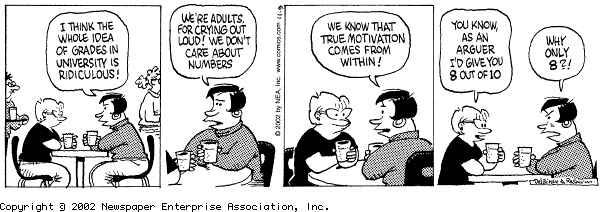
       One student is smart.  Another gets good grades.  Another is in the 90th percentile.  A fourth student gets a good SAT score.  Yet another graduated in the top 25% of her class.  And a different student scored a 4 on her AP test.

       What does all of this mean?  What is the best way to measure how well students are actually learning?  How do we know which are the students that are really learning and understanding and able to use the knowledge in different situations; and which students are dutifully doing what they are told to do and completing assignments and earning good grades not learning a thing?

       I think our educational system struggles with this question very often.  We want to learn--it is the main focus of schools to teach students and to help them to learn.  When I say "learn", I mean "real, actual learning".  Not memorizing and forgetting.  Not memorizing long enough to pass the test.  I mean learning; understanding; able to teach it to others; able to use the knowledge at a later time; able to build on the knowledge learned to learn more, higher-level material.  How do we measure a student's ability to actually learn?  How do we know who is really getting it and who only appears to be really getting it?

       Parents see their children's grades.  And (I think) parents make a determination of their children's abilities based on the grades that they get in school.  That is certainly understandable.  We don't expect all parents to be experts in education and we certainly don't expect all parents to be experts in measuring academic ability.  And if the grades (the test grades and homework grades and classwork grades and course grades) accurately reflect their children's abilities, then it is OK to use these grades to gain a sense of academic ability.


       But what do you do when your child gets great grades in class and lousy grades on the final exam, or the SAT, or the PARCC or Smarter Balanced test, or the college entrance exam?  What does it mean when we have students who do great in middle and high school and then cannot handle the academics in college?  Once again, What is the best way to measure academic ability?  Everyone likes to brag about their smart children; and everyone wants their children "to do well" in school.  But at some point we need to have a way to tell if their apparent ability (academically speaking) is actual ability.

       Large-scale testing is one way to measure actual academic ability.  State-level tests, SAT and ACT, PARCC, Smarter Balanced, and NAEP (National Assessment of Educational Progress) tests are all large-scale tests that attempt to do this.  The SAT is a good predictor of a students' ability to do well in their first year of college.  The new PARCC and Smarter Balanced tests are supposed to measure student abilities compared to standards that are taught over the previous school year.  NAEP is a national test given to a sampling of students in every state and in many subject areas to get a sense of our nation's students academic abilities.

       I believe that we want to use multiple data points to determine students' academic abilities.  If a students have good school grades and terrible large-scale testing grades, I believe that we should question why this is the case.  We shouldn't dismiss the low grades and not important; we should question why there is a lack of consistency in the grades.  Similarly, when students get high homework and classwork grades and low quiz and test grades, we should question this.  Sure, it may be that they are nervous when taking a quiz or test; but it also may be that they don't know the content and that is why their quiz and test grades are low.


       I think that it is difficult to use a single measure to determine a student's academic ability.  If you have a mechanic who has been fixing cars for (say) ten years and you asked her to take a test on fixing cars and then to go through a field test in which she actually fixed cars and then to write an essay on fixing cars, you would expect that she would earn similar scores.  This would be provide multiple pieces of evidence that she knows what she needs to know to do her job.  I think the same is true for students and academic subjects.  If a student is sufficiently knowledgeable in (say) Geometry, I would expect her to demonstrate this knowledge via verbal explanations, written exams, performance tasks, and large-scale testing.  And I would expect all of these measures to show a similar level of understanding.

       Our nation's schools have a responsibility to teach so that our students are truly learning.  We cannot accept the mere appearance of learning; we have to do the hard work of ensuring actual, true learning.  And we need to continue to develop and revised the best and most effective ways to measure that this "true learning" is actually taking place.


Sunday, October 26, 2014

Common Standards

     Well, I've held out this long.  I've tried to stay away from politics in this blog.  But I've talked about grades and grading; I've talked about national testing; and I've actually talked about Common Core before.  However, this time I want to share my thoughts about Common Core and address some of the counter-arguments that (in my opinion) are not sufficient to justify a school district or a state to refuse to use them.


      I support the use of the Common Core standards for English/Language Arts and for Mathematics.  I also support the common standards for Science that are coming to our public schools.  I support these standards because they were created by experts; they were vetted by experts; and they give all 50 million U.S. students a fair and equitable education.  We all know that education throughout the U.S. is not uniform because individual state standards vary widely.  Common Core sets a level playing field for all.  Additionally, these common standards are consistent with those from countries that produce students with the highest academic abilities.  We all love competition and we all love to win; so I would think that we would all want our students to be able to fairly compete with anyone in the world for 21st century jobs.  Common standards allow us to do this.

     So here are some bad reasons for turning away from common educational standards:

1) I'm a Republican and Common Core is a Democrat thing--so I'm against it.

     We live in a partisan country.  Some people are strongly Republican and some are strongly Democrat.  If a cause aligns to a particular political party, then the loyal will support it no matter the cause and no matter the details.  But Common Core is not a Democrat thing and it is not a Republican thing.  It came from the National Governors Association and Council of Chief State School Officers.  Just as No Child Left Behind was not a Republican thing (Edward Kennedy co-wrote NCLB), Common Core is not a Democrat thing.

2) Common Core is too hard.

     Compared to the academic standards in some states, Common Core will appear to be more rigorous, less rigorous, or about the same.  Since different states had different standards in the past, this comparison will look different to people in different parts of the country.  But the goal of school is to teach and prepare students for the world that they will inherit.  The goal is not for students to get good grades.  We want our students to be successful, but too many of our students have been very successful in high school only to fail in college.  That is a national shame on our nation.  Common Core is trying to prepare students for both higher education and for the word of work.  If it is hard, then students are being well prepared for their future.  Isn't that something we all want?

3) It was implemented too fast.

     States were given four years between state adoption of the Common Core standards and the actual implementation of the Common Core standards.  I think that a lot of people feel that the Common Core came all of sudden--one year we didn't have it, and the next year we did.  There was a lot of planning behind the scenes that the general public may not have seen.  This is why it seems to be so sudden to some.  If there were ten years between adoption and implementation, some people would feel the same way.  Why should we wait to give our students a world-class education?  And why give up on it just because it was fast?

     Also, public education is often accused of moving too slow.  Fifty million students and three million teachers comprise a very large group; and it is often slow for this group to change.  If we drag out the change and take our time, it might never happen.  We have to "rip off the band-aid".  Now is the time

4) (This bad reason hasn't occurred yet, but it will towards the end of this school year.)  See, everyone did poorly on the test.


     This year, for the first time, the PARCC and Smarter Balanced tests will be administered to students in grades 3 to high school.  In all likelihood, overall student scores will be low
compared to their class grades in math and English/Language Arts; or compared to past standardized test grades.  And there will be all sorts of renewed calls to cancel Common Core.

     In fact, whenever a new standardized test is administered, scores are often low at first and then increase over time.  Remember, the content of the courses are more difficult, so naturally the tests will be more difficult and some students won't be able to rise to that challenge as well as other students.  Once again, the goal of school is to teach and help students to be prepared for their future.  We are not helping students by giving them easy tests and then telling their parents that they are smart and then having these same students struggle after high school.  Colleges will recognize these new tests that same way they recognize the SAT and ACT tests.  They have to be the sort of tests that really prepare our students for college.

     We have a real chance to improve the education of millions.  And it could happen to this current generation of students.  We can say that we were there when U.S. public schools took a bold new step toward becoming the new standard in world-class education.  This is education's "moon shot".  Let's make a real difference; let's give our kids the best!


Sunday, March 16, 2014

The Value of National Testing

     Chapter tests, unit tests, and final exams have been around (seemingly) forever.  These are tests that happen in school.  But what about the nationwide tests that students take?  I'm talking about the SAT, the ACT, the NAEP (National Assessment of Educational Progress), and the new PARCC and Smarter Balance tests.  What is the value of these tests?

     Let's start with the SAT and ACT, because most people know about these tests.  The purpose of the SAT test is to reliably predict an individual's success in their first year of college (see report here); and the SAT does a pretty good job of doing this--particularly for mathematics.  The stated purpose of the ACT is:

     Your ACT composite score, together with your high school grades, indicates how prepared you are for   college. In addition, the scores from the various sections of the ACT will help your college place you in the right classes, matching your skills with course requirements. (citation)

     Of course, aside from these "official purposes", we know that lots of people attribute much more importance to these two tests.  And, to be fair, some colleges have "cut-off" scores; if you score below a cut-off score, then you won't be considered for admission.  Still, my feeling has always been that there are plenty of colleges in the U.S. and unless you are determined to go "ivy league", there is a college out there ready to accept your money...uh...uh...I mean...to accept you.  Also, I believe that the SAT/ACT do a good job of showing what you know and are able to do.  Let's face it, a lot of students are good at "playing school".  They know what to do to get an "A".  But some student get an "A" because they understand the material and other students get an "A" because they are good at "playing school".  The SAT/ACT helps to separate these two groups of students.


     The NAEP, on the other hand, probably does the best job in determining what our nation's student know and are able to do.  This test is given to a sample of students in every state.  Colleges don't look at this test and parents don't get individual scores from this test--so it is a "low-stakes" test.  Students don't feel external pressure to do well on this test and nobody hires a tutor to do better on this test.  The PARCC and the Smarter Balanced tests--the new tests to be used to assess the Common Core standards--are supposed to be more like the NAEP tests.  Colleges aren't asking "What did you get on your PARCC Algebra 2 test?" yet, but I believe they will in the coming years.

     The value of these new tests are really the same as the value of the old SAT/ACT tests; they are supposed to show what students have actually learned in school.  We have to brace ourselves for students who get good grades in school and bad grades on PARCC and Smarter Balanced.  It will happen to the students who are good at "playing school" but not so good at learning.

     Students who do well on these tests should do well in their college courses.  Students who don't do too well will know where they stand and will enter college (I think) with a better idea of what they need to do to succeed.

     Sometimes I worry that the reason more than 50% of students that start college and never finish is because their teachers and school counselors and parents made them feel that their good grades in high school meant that they would be academically successful in college.  Their PARCC and Smarter Balanced grades may give them a different point of view--and that's OK.

     The value of national tests is an unbiased view of a student's academic ability.


Public Schools and Choice

       Is it true that public school kids and their public school parents don't have choices?  I'm sure that I will expose my igno...

Teach100 blog