Showing posts with label Fixed Mindset. Show all posts

Friday, December 2, 2016

Changing Math Attitudes

       I'm borrowing the title of a Facebook group to use as the title for this post.  The group called Changing Math Attitudes is composed of math teachers and other educators and (I suppose) other folks that seek to share experiences and expertise in the effort of helping students (and adults) to see mathematics as something beautiful, sensible, and doable by everyone.

       The first step in improving abilities in anything is to believe that you can do it.  We want students to understand that mathematics is not a secret code to which only a privileged few have access.  There is no "math brain".  Everyone can understand mathematics and it will take a group effort by many people in many circumstances to effectively change the view of mathematics that so many people hold.  This is the view that says "I'm not good at math."  (And so many people freely say this out loud when they would never say that they can't read or that they are bad at Science or History.

       I especially enjoy reading the posts from this group because they are generally politically agnostic.  It isn't a group that is pushing a political agenda one way or the other.  And this makes sense too because the "I'm bad at math." attitude is not coming from one group of people who members of any single political persuasion.  All sorts of people hold this view and so we are talking to all people when we say that we want to change attitudes about mathematics.

       Any math teacher will tell you that most of the students in their classes that struggle to understand the math would do so much better if they held the view that effort would lead to success; if they believed that getting the wrong answer doesn't mean that you are "dumb" but instead means that you've had a learning experience that can lead to better understanding.  If students can escape the Fixed Mindset that says "No amount of effort will lead to success.", then we know that we can help them to get to a point of better understanding.

       Attitude is everything.  Attitude determines the effort that students will put forth.  Attitude allows for a second try and a third try and a fourth try; or attitude gives permission to not try at all.  Attitude is the force that is stronger than caring adults.  Attitude shapes our views and ultimately shapes our destiny.  When our attitude tells us to give it a try, we are on our way to a world of opportunities.


Monday, May 2, 2016

It's OK To Struggle When You're Learning Something New

       Years ago I knew of a little boy whom I never heard speak a word until he was nearly ten years old.  It wasn't that he couldn't talk; his disability was more serious than that...he was born with two older siblings and a mother who wanted the world to view her son as "Always Correct".  To ensure this perception, whenever anyone asked him a question, she would answer the question.  The older siblings did the same thing--but not for the same reason.  They just thought of him as a child that didn't talk much.  Clearly my nephew got the message (at a very early age) that other people would do things for him--even speak for him.  There was no reason to speak or even to think very much.  Of course, his mother loved him and she wanted the best for her son.  She didn't like to see him struggle to learn how to do things and didn't like to see him cry, so she did just about everything for him.

       Sometimes teachers are like this mother.  We want the best for our students and we want them to succeed.  So, sometimes we give them hints to nudge them toward the right answer; we compliment them for minor things (like repeating what we say); and we never want to suggest that they might be wrong about something.  Teachers are caring people and it makes sense that we want the best for our students.  But allowing students to have a false sense of achievement is not a caring thing to do.  And if this sort of (false) encouragement continues for a whole school year, and then the next year, and then the next year, we end up teaching students that learning is just memorizing stuff and repeating what the teacher says, and following directions.  That's not learning.

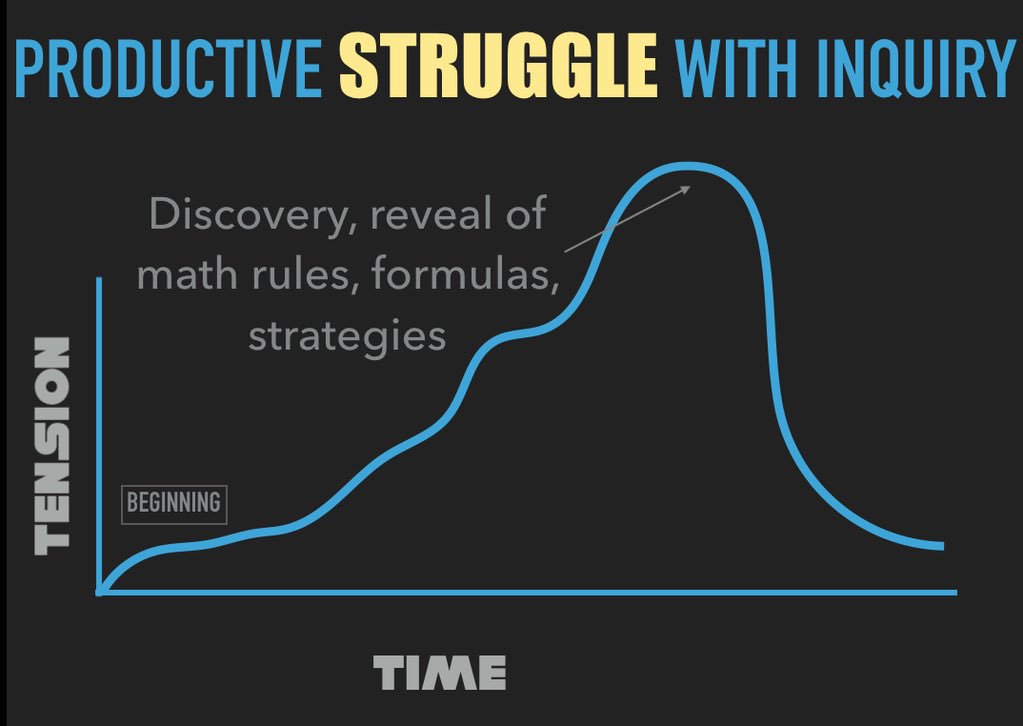
       Learning anything that is worth learning requires a certain amount of struggle.  No one expects you to learn something complex the first time you hear it.  You have to think about it, and practice with it, and make some mistakes, and learn from the mistakes, and make more mistakes, and then (maybe) you can claim success at learning.  It's OK to struggle and it's OK to allow your children to struggle.  We want students to know that learning is full of challenges and effort is required to overcome these challenges.  We want students to believe that they can do anything if they have the will to work at it until it is done.

       This is a difficult message for most parents to hear.  A lot of people have a fixed mindset about their children's abilities.  This means that they believe that their children are capable of doing some things and incapable of doing other things--and no amount of effort will change that.  This mindset leads to statements such as, "It's OK if you're not good at math because I was never good at math and some people just can't do math."  (Feel free to substitute other words in place of the word "math".)  This is a terrible message for students.  Instead, the message should be that hard work pays off and struggle leads to learning.


Saturday, April 23, 2016

When You're Learning And You Know It

When you're learning and you know it shout "Hooray".
When you're learning and you know it, then your face will really show it.
When you're learning and you know it shout "Hooray".

       It's a good feeling to learn something.  A good teacher will help students to recognize when they learn something and will praise them for their efforts in the learning process.  But a good teacher won't artificially praise students for little, minor steps or for mindless efforts to complete an assignment.  This sort of artificial recognition, though intended to benefit and encourage children, is not as good as when a teacher helps a child to know that effort and hard work--no matter the outcome--is praiseworthy.

       Sometimes students have a fixed mindset and they don't believe that they are able to learn.  These students need teachers to help them to realize that they are able to learn anything and that their effort will lead to achievement.  Even student with high achievement could have a fixed mindset and these students are less likely to take risks and try new things for fear of losing the title of "smart".  And when they stop trying, they stop learning and they stop growing intellectually.


       So when your students learn something, tell them to shout "Hooray".  Their brains are growing and their future is bright.


Friday, April 8, 2016

Encouraging a Growth Mindset for your Students

       Growth Mindset is an understanding that you can learn and achieve anything if you are willing to work and practice and study and try.  A student's ability to learn is not predetermined from birth.


       This is an important concept for teachers who seem to always have some students who believe that they are not born with the skills necessary to learn.  A common saying among some students is, "I don't have a math brain.", meaning, "I don't have the ability to learn math regardless of the extent of my efforts."  We know now that this is not true.  But teachers are often faced with the prospects of needing to convince some of their students that this is not true.
       This chart is filled with suggestions for helping students to view their perceived obstacles in a different way.  Part of a teacher's job is to motivate their students to do their best everyday.  The more that we can convince students and then demonstrated to students that effort leads to (at least some level of) success, the more we are able to create a learning atmosphere in which students believe that they can learn.

       Growth Mindset is for weak and strong students alike.  We also have students who have been successful in the traditional school setting who don't have a growth mindset.  These students may have been praised for their "smarts" and they may be afraid to try something new for fear of not succeeding.  This limits their ability to grow.  Hence, encouraging a growth mindset is for all students and not just for a few.  Our best teachers have always been encouraging a growth mindset.  We have all had teachers who were able to convince us to try and to work hard in the belief that we would eventually succeed.  We need to see this occurring much more often in our classrooms.


Sunday, September 13, 2015

Growth Mindset Parents

       I'm not sure if the idea of mindsets has broken out of the field of education and into the general public.  I hope it has.  Imagine if the parents of all of your students had a Growth Mindset and imagine if they helped their children (your students) to have a growth mindset.  That would be truly excellent scenario for any teacher!

       If you are not currently living this this ideal world, what can a teacher do to help her students' parents to understand the value of Growth Mindsets?

       Parents often ask teachers what they can do at home to help their children.  In the middle and high school years, sometimes the parents feel that they are not capable of helping their children because the content is beyond their ability.  This is an opportunity to talk about Growth Mindset with parents.  Here are some Growth Mindset suggestions that any parent can do:


  1. Help your child to understand that effort yields results.  Read, study, practice, quiz yourself.  
  2. Tell your child that true learning takes time.  You might not "get it" the first time.
  3. Make sure your child understands that it is OK to make mistakes.  We all learn from our mistakes.
  4. Praise your child for effort; don't praise your child for "being smart".  This seems counterproductive, but kids who are rewarded for "being smart" tend to take less chances for fear of losing the "smart" label.
  5. Never, never, never, never tell your child that you were bad at math or science or anything else.  This gives children an excuse for not doing well, and it makes them believe that they have some sort of genetic deformity that predestines them to be bad at these subjects.
       So much of these suggestions go against the idea of "playing school"--looking smart, pretending to learn, memorizing stuff for the test, only caring about grades, and not caring about learning.  We want students to understand the value of hard work.  Learning faster isn't learning better.  It's OK to make mistakes.  When students hear this from their teachers and then hear it again at home, they will believe it.

       Learning isn't a competition.  Students with a fixed mindset toward any particular subject can change to a growth mindset if they have supportive teachers and parents that encourage a growth mindset.

       Learning real does take a village--a Growth Mindset village would be a pretty good place to live!


Friday, September 11, 2015

Growth Mindset Teachers

       Have you heard about Mindsets?  In my school district, I am hard-pressed to meet a supervisor or a principal or a teacher who hasn't heard about it.  Here's a quick video that defines Growth and Fixed mindsets:


       Teachers who understand the Growth Mindset are able to help their students to understand that effort yields results and mistakes are the building blocks of true learning.  These teachers don't encourage their students to get good grades, they encourage questioning and curiousity.

       Students with a growth mindset believe that their is nothing that they can't do.  They don't mind making mistakes because they don't view them as mistakes.  Instead they view mistakes as an important part of the journey toward learning and true understanding.

       Teachers can help students to develop a growth mindset by praising their thinking and their effort, rather than praising that they simply got the right answer.  In fact, if students are constantly told that they are smart, research tells us that they tend to avoid making mistakes and they will hide the things that they can't do because they fear that they will lose the label of "being smart".

       This is (yet) another reason why we have to end this school culture of over-valuing grades.  School is supposed to be about learning and we want our students to understand that learning requires effort.  Effort requires trying new things and taking chances and not getting it right the first time.  This is not only "OK", it is necessary for true learning to take place.

       We love our growth mindset teachers that produce our growth mindset students.  Learning can be hard work.  We want our students to value this hard work and to recognize that there is always a prize waiting to reward them for this hard work.

Friday, August 21, 2015

11 Serious Questions for Teachers


       Yesterday I welcomed our 200+ secondary mathematics teachers to the 2015 - 2016 school year.  We do this every school year and it is always an exciting day.  We get to see people we haven't seen since last June; middle school teachers get to network with their high school colleagues.  The first day of school is getting closer and closer.

       This year I welcomed them with 11 serious questions about teaching.  Since this week is filled with the details of preparing those first lessons, decorating the classroom, preparing class resources, and learning about any new school policies and procedures, teachers don't usually get the chance to sit down for 30 minutes and reflect on why they do what they do.

       Here are the questions I asked them.  Read each one and take 30 seconds to reflect on your answer to the question.

  1. Why do you teach?
  2. What is your goal this year?
  3. Will you make a difference?
  4. What will you do differently this year?
  5. How do you view challenges?
  6. Where is the line between impossible and very difficult?
  7. Do your students have a Growth or Fixed Mindset?
  8. How do you know when they "get it"?
  9. Do student's term grades reflect their ability?
  10. How do you move your students from procedural to conceptual understanding?
  11. Why do you teach?
       Teachers have a job to do.  It is a difficult, complex job.  And the need to grow and to improve in the job is necessary because it isn't the sort of job in which a person knows everything they need to know when they graduate from college.  Teachers face new challenges every year and their ability to find solutions to those challenges is generally what separates good teachers from great teachers.

       Here is a movie clip I shared with the teachers in which FDR struggles to stand up straight and then boldly says, "Don't tell me, 'It can't be done.'"

       Why do you teach?


Public Schools and Choice

       Is it true that public school kids and their public school parents don't have choices?  I'm sure that I will expose my igno...

Teach100 blog