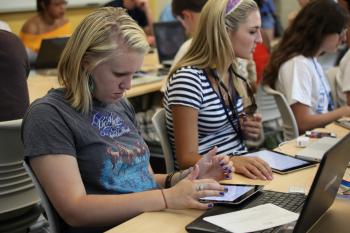
Education is important business.
Once in a while, a student needs to be somewhere else in the school during the time that she should be in my classroom. Club meetings, picture day, sporting events, ... lots of activity going on in a typical high school. So this mature and responsible student comes to me a day or two before and asks, "Are we doing anything important tomorrow?"
My answer is always the same: We do something important Every Day. Bell-to-bell learning; every minute, every day; valuable instructional time.... Call it what you will, the stuff that goes on in the classroom--in every classroom--is valuable and important.
Sometimes it is hard to see the importance of something we do everyday. It becomes commonplace; and without an engaging teacher it can become boring. The best learning occurs when the teacher understands the importance of every minute and communicates this to the students via thoughtful, engaging lessons.
Education is important; everyday, every minute.
Showing posts with label dedicated teachers. Show all posts
Thursday, March 31, 2016
Friday, October 2, 2015
Motivated to Learn
I often say to new teachers that it may not be your job to entertain your students, but it is certainly part of your job to motivate your students.
We know that actual "teaching" is only a part of a teachers job. The most major part of the job is ensuring that students are learning. Our best teachers know that most students don't learn strictly by listening. Learning requires doing, talking, asking questions, making mistakes, and doing some more. Teachers plan lessons that keep their students engaged.
Strategies to keep students motivated include lots of basic things such as:
We know that actual "teaching" is only a part of a teachers job. The most major part of the job is ensuring that students are learning. Our best teachers know that most students don't learn strictly by listening. Learning requires doing, talking, asking questions, making mistakes, and doing some more. Teachers plan lessons that keep their students engaged.
Strategies to keep students motivated include lots of basic things such as:
- Calling on students every class (preferably at least three times each class),
- Allowing opportunities for students to get out of their seats during every class,
- Playing games that require students to understand the objective for the day to do well in the game,
- Asking a lot of "Why" questions that require students to think and to explain their thinking,
- Allowing students choices to demonstrate their learning.
Students can't learn if they are not motivated to learn. Requiring students to sit still and listen to the teacher for 45 minutes or 50 minutes or 90 minutes is not an effective way to instill true learning.
What do you do to motivate your students to do their best everyday?
Tuesday, June 23, 2015
Why Do You Teach?
The school year ended four days ago and I am thinking about welcoming my teachers to the next school year. (Wow. That was a short summer vacation.)
Every year in our school district the teachers return to school one week before the students return. On one of the days of that first-week-back, all of the secondary teachers in the district meet in their subject areas for a full day of professional development before the school year begins. This is a time to learn about new resources, to network with other teachers in other schools, and to energize teachers to get excited about the new school year.
We know that an effective teaching strategy for student understanding is to ask a lot of questions that encourage students to think about what they are learning. If students can explain what they are doing and why they are doing it, they must understand it pretty well. It also reinforces the idea that we want students to understand underlining concepts and not just to get-the-right-answer.
In that vein, I am going to ask our teachers some questions in an effort to encourage them to think about what they do and why they do it. These question will challenge the teachers to consider different possibilities. They will be questions that defy simple answers.
I'm in the beginning stages of preparing this presentation and I am certainly open to suggestions. Feel free share (in the comment section below) other questions that you feel would be good questions for teachers in the beginning of the school year.
Questions:
(1) Why do you teach?
(2) What are your goals this year?
(3) What will you do differently this year?
(4) How will you make a difference?
(5) What do you want to learn this year?
(6) Why is mathematics difficult for some of your students?
(7) How will you help students who don't ask questions?
(8) How will you engage your students in their learning this year?
(9) How do you help your students to value "learning" over "getting-grades"?
(10) Why do you teach?
We ask (or should be asking) our students difficult questions every day. As such, we need to ask ourselves difficult questions. Teaching students who are willing and able and ready to learn is easy. But trying to reach the unwilling, the struggling, and the distracted student takes time and effort and expertise.
Why do you teach?
Every year in our school district the teachers return to school one week before the students return. On one of the days of that first-week-back, all of the secondary teachers in the district meet in their subject areas for a full day of professional development before the school year begins. This is a time to learn about new resources, to network with other teachers in other schools, and to energize teachers to get excited about the new school year.
In that vein, I am going to ask our teachers some questions in an effort to encourage them to think about what they do and why they do it. These question will challenge the teachers to consider different possibilities. They will be questions that defy simple answers.
I'm in the beginning stages of preparing this presentation and I am certainly open to suggestions. Feel free share (in the comment section below) other questions that you feel would be good questions for teachers in the beginning of the school year.
(1) Why do you teach?
(2) What are your goals this year?
(3) What will you do differently this year?
(4) How will you make a difference?
(5) What do you want to learn this year?
(6) Why is mathematics difficult for some of your students?
(7) How will you help students who don't ask questions?
(8) How will you engage your students in their learning this year?
(9) How do you help your students to value "learning" over "getting-grades"?
(10) Why do you teach?
We ask (or should be asking) our students difficult questions every day. As such, we need to ask ourselves difficult questions. Teaching students who are willing and able and ready to learn is easy. But trying to reach the unwilling, the struggling, and the distracted student takes time and effort and expertise.
Why do you teach?
Thursday, June 11, 2015
Congratulations to All First Year Teachers!
June, 2015
Congratulations on the completion of your first year of teaching. You did it!
After making the decision to be a teacher
- and finishing your degree
- and navigating the job market
- and landing a teaching job
you have reached the point in the school year where you can look back and say, "I did it. I've completed my first year of teaching."
Mostly, I hope you've learned that teaching isn't the sort of profession in which people start out knowing it all. Teaching is the sort of profession in which people get better at it the longer they do it. I hope you asked your colleagues a lot of questions this year. That shows that you are interested in growing and improving as a teacher. (You may have noticed that the teacher across the hall from you--who has been teaching for ten years--also asks a lot of questions because she wants to continue to improve every year.) Using different resources, using electronic resources, using different teaching strategies...it's a lot to learn in a signal year. Every year you will hear about new and cool stuff that you can use in your classroom. So find the thing that's right for you, and do that extra one or two new things next year. But don't worry about not doing it all; or not doing what that great teacher down the hall is doing.
Learning about teaching is a big part of teaching. There is no "one way" to be a great teacher. (That's why no one has given you the Book of Directions of Teaching.) This is what makes teaching hard--that non-educators don't realize. But it is also what makes teaching a true profession in which professionals such as yourself need to get together to make the best decisions for your students.
Enjoy your time off this summer. But also spend some time reflecting on this past year. What was great that you want to repeat next year? What didn't work that you want to improve upon next year? What is the cool digital tool that you heard about and never had time to learn about and that you may want to use next year? Look for webinars to attend; find people and chats on Twitter that will broaden your horizons; read a book about teaching or teaching strategies that may be specific to your area of teaching.
The best teachers are always learning and always improving.
Be a better teacher, and the next year, and the next year. And (again) congratulations on the completion of your first year of teaching. You did it! See you next year!
Monday, May 4, 2015
Attitude Trumps Ability
Remember when you left for school as a child and your mother said, "Do your best"? It turns out, that was pretty good advice.
Most students who don't succeed in their school subjects have plenty of ability but instead lack the desire to do their best. Maybe they believe that they don't have the natural, genetic, brainpower to succeed (read Mindsets by Carol Dweck). Maybe they have problems at home that make their schoolwork seem very unimportant. Maybe they have a fear of failure. I contend that most of the time, it isn't ability that is holding them back.
Here is the most common teacher phone call to parents:
Teacher: Hello Ms. Thompson.
Parent: Hello Ms. Salero. Is there a problem with my son, Donald, in your class?
Teacher: Donald has lots of ability; he just needs to put in the effort.
Every teacher knows that their job is two-fold:
(1) Teach
If learning isn't taking place, the best teachers with the best lesson plans won't make any difference in the lives of their students. Hence, teachers spend a lot of time thinking and experimenting with the best ways to motivate students to do their best.
When parents ask, "What can I do at home to help my child?", the best answer is to encourage your child to do their best everyday.
Students need to understand that learning takes time and learning is hard and learning requires struggle. But a lack of understanding after the first try does not mean that you are unable to learn. In fact, it's the struggle that helps your brain to make more connections and to retain what you are learning. Stanford educator, Jo Boaler, talks about this all of the time (see video). Students need to understand the value in making mistakes--it isn't an excuse to give up. In fact, mistakes are excellent learning opportunities.
Some students are anxious to learn and don't mind making mistakes. But others are so focused on "getting-the-right-answer" and "winning" that they are quick to give up when they don't understand something the first time. We need students to understand the value of productive struggle.
Keep trying; keep struggling; keep making mistakes; and keep learning.
Most students who don't succeed in their school subjects have plenty of ability but instead lack the desire to do their best. Maybe they believe that they don't have the natural, genetic, brainpower to succeed (read Mindsets by Carol Dweck). Maybe they have problems at home that make their schoolwork seem very unimportant. Maybe they have a fear of failure. I contend that most of the time, it isn't ability that is holding them back.
Here is the most common teacher phone call to parents:
Teacher: Hello Ms. Thompson.
Parent: Hello Ms. Salero. Is there a problem with my son, Donald, in your class?
Teacher: Donald has lots of ability; he just needs to put in the effort.
(1) Teach
(2) Encourage students to learn
If learning isn't taking place, the best teachers with the best lesson plans won't make any difference in the lives of their students. Hence, teachers spend a lot of time thinking and experimenting with the best ways to motivate students to do their best.
When parents ask, "What can I do at home to help my child?", the best answer is to encourage your child to do their best everyday.
Students need to understand that learning takes time and learning is hard and learning requires struggle. But a lack of understanding after the first try does not mean that you are unable to learn. In fact, it's the struggle that helps your brain to make more connections and to retain what you are learning. Stanford educator, Jo Boaler, talks about this all of the time (see video). Students need to understand the value in making mistakes--it isn't an excuse to give up. In fact, mistakes are excellent learning opportunities.
Some students are anxious to learn and don't mind making mistakes. But others are so focused on "getting-the-right-answer" and "winning" that they are quick to give up when they don't understand something the first time. We need students to understand the value of productive struggle.
Keep trying; keep struggling; keep making mistakes; and keep learning.
Thursday, April 9, 2015
Learning is not Pass/Fail
Years ago I worked with a colleague in the research office of a major school system. He always tried to find a way to make research and statistics understandable to the average person. He once talked about the infamous College Acceptance Letter. I'm not sure if this is still true today, but years ago you would apply to multiple colleges and then you would wait and wait and wait for a letter from these colleges that would tell you whether or not you have been accepted. When the letter arrived, you would open it and there would be one or two paragraphs of "welcome" and "thank you" messages. And, finally, somewhere halfway down the page you would get to the part that you really wanted to know: Accepted or Not Accepted.
In reality, learning is much more of a process with a somewhat hazy finish line. While there are certainly facts that students can memorize (5 + 5 = 10; July 4, 1776 is the date of the signing of the Declaration of Independence; Paris is the capital of France), actually learning is much more of a process that develops over time and requires thinking and discussing and trying and failing and trying again--and learning from the mistakes. Learning is much more like a baby learning to walk than it is like a switch that is off or on.
We should think of learning as being more of a continuum and less of a Yes/No, Pass/Fail dichotomy. After all, it isn't so much that we want our children to "pass" in school; what we really want is for our children to "learn" in school. Employers don't care what grade you got on a test in high school. They care about what you learned and are able to do.
Saturday, March 7, 2015
Blood Donors and Students: Doing the Right Thing
I've been a blood donor since I was 18 years old.
Over the years, I've grown more and more impressed with the blood donation system in the United States and Canada via the America's Blood Centers and the American Red Cross. They have a difficult and (yet) very important job.
Here is the difficult part:
Imagine if you had the job of trying to convince people to volentarily have a needle stuck in their arm? They would also have to answer a lot of personal questions about their past travels--especially if it included travel to certain countries--and questions about their possible drug use and even their sex lives and sex partners. As compensation for going through this ordeal, donors would receive a hearty "Thank You", a bottle of water, a snack, and occasionally a free T-shirt. No money; no raise; no notoriety. In fact, friends and neighbors would probably question your reasons for doing such a thing if you were a blood donor. And if all of this wasn't tough enough, only 38% of the U.S. population is eligible to give blood (source) because of various health and risk factors.
Here is the important part:
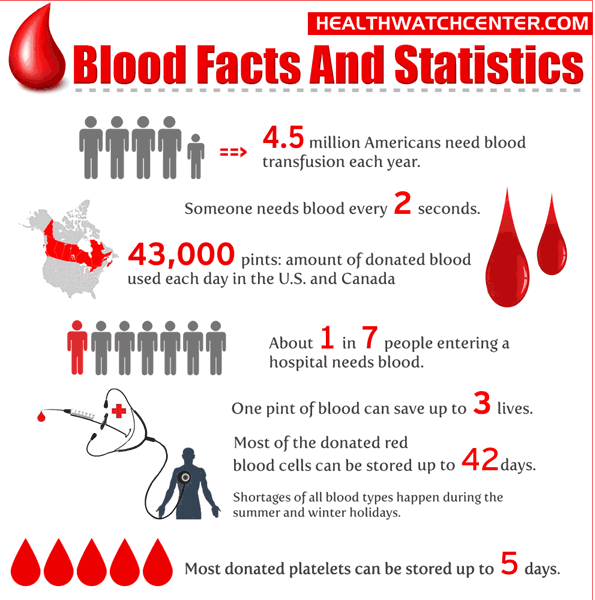
Blood can not be manufactured. The only way hospitals and medical centers can get blood is from people donating blood. Blood is needed everyday for accident victims, people with Sickle cell disease, and people with cancer (source). Over 15 million blood units are needed in the U.S. and Canada every year. To make matters even more dire, blood can only be stored for up to 42 days (see chart).
Hence, maintaining an adequate blood supply is difficult to do, and very important to be done. It is so important that is worth the effort of many people throughout the country to continually seek to find more and better methods of encouraging people to donate blood and to improve the blood donation process.
When I look at our public schools and their mission, I see many parallels to the efforts for encouraging more blood donors. Our public schools (also) have a difficult and important job to do. We accept students into our schools with many and varied backgrounds. Some are poor and ill-equipped to find success in the academics of traditional schooling; some are new to our country and are trying to learn English while also trying to learn math, science, and social studies. Some schools have few needed supplies and some classrooms have large numbers of students. Some teachers are very well prepared to educate their students and some are not as well prepared to do this job.
Yet, few would argue that the need for an educated public is important. It is important for the individual and it is important for the society at large. Hence, it is worth the struggle and the effort to continually search for ways to successfully educate all of our students.
This belief in the importance of education is certainly shared by educators; but we often find it difficult to convince some students and their parents. Like blood donors, we don't offer our students money or prizes for obtaining a good education. Instead, we offer them hope for a better future. We do our best to help our students to see the value in learning.
Education is (indeed) the art of selling students (and parents and communities) the future value of learning. It isn't the grades or the GPA or the credits earned. It isn't "doing what you're told because, 'I say so'". Learning is it's own reward. Learning is the right thing to do because it helps you and everyone around you to be an educated person.
Over the years, I've grown more and more impressed with the blood donation system in the United States and Canada via the America's Blood Centers and the American Red Cross. They have a difficult and (yet) very important job.
Here is the difficult part:
Imagine if you had the job of trying to convince people to volentarily have a needle stuck in their arm? They would also have to answer a lot of personal questions about their past travels--especially if it included travel to certain countries--and questions about their possible drug use and even their sex lives and sex partners. As compensation for going through this ordeal, donors would receive a hearty "Thank You", a bottle of water, a snack, and occasionally a free T-shirt. No money; no raise; no notoriety. In fact, friends and neighbors would probably question your reasons for doing such a thing if you were a blood donor. And if all of this wasn't tough enough, only 38% of the U.S. population is eligible to give blood (source) because of various health and risk factors.
Here is the important part:
Hence, maintaining an adequate blood supply is difficult to do, and very important to be done. It is so important that is worth the effort of many people throughout the country to continually seek to find more and better methods of encouraging people to donate blood and to improve the blood donation process.
When I look at our public schools and their mission, I see many parallels to the efforts for encouraging more blood donors. Our public schools (also) have a difficult and important job to do. We accept students into our schools with many and varied backgrounds. Some are poor and ill-equipped to find success in the academics of traditional schooling; some are new to our country and are trying to learn English while also trying to learn math, science, and social studies. Some schools have few needed supplies and some classrooms have large numbers of students. Some teachers are very well prepared to educate their students and some are not as well prepared to do this job.
Yet, few would argue that the need for an educated public is important. It is important for the individual and it is important for the society at large. Hence, it is worth the struggle and the effort to continually search for ways to successfully educate all of our students.
This belief in the importance of education is certainly shared by educators; but we often find it difficult to convince some students and their parents. Like blood donors, we don't offer our students money or prizes for obtaining a good education. Instead, we offer them hope for a better future. We do our best to help our students to see the value in learning.
Education is (indeed) the art of selling students (and parents and communities) the future value of learning. It isn't the grades or the GPA or the credits earned. It isn't "doing what you're told because, 'I say so'". Learning is it's own reward. Learning is the right thing to do because it helps you and everyone around you to be an educated person.
Thursday, February 26, 2015
Everyone Should Go to Community College
The Community College system in the United States is simply the perfect college option for many of our high school graduates in my opinion.
Here are some of my reasons for this statement:
- Close to home.
- Less expensive.
- Small classes.
Let's start with my first reason: Close to home. I went to a college that had the initials TSC. (This college has since been renamed.) Among the students at this college, we referred to "TSC" as meaning "The Suitcase College" because just about everyone went home on the weekends. I remember thinking at the time that high school students are always complaining about "living under the rules of their parents". They want to be on their own; they want their freedom. And, so, I thought that these people were hypocrites when, given the opportunity, would rush back home at every chance they got to do so.
Of course, it probably isn't fair to categorize young people this way. It is more likely that they rushed back home to be with their friends. It is also likely that they really didn't hate their parents as much as they said. According to the Higher Education Research Institute (and referenced here), 53% of college students attend a school within 100 miles of their home and 90% within 500 miles. This tells me that most students want to attend college close (or relatively close) to their home. Surely lower in-state tuition is part of the reason, but I think another reason is that newly graduated high school students are not completely ready to break all ties with their hometown by attending a college that is very far away.
Community colleges provide the college experience with college courses and college teachers while still remaining close (sometimes very close) to home. Students don't have to adjust to a new environment--perhaps with new foods and new expressions and maybe new fashions and (perhaps) a new climate--in addition to the (sometimes shocking) new experience of college-level course work. Change is hard and a lot of change at once can be too hard for some students to endure. The closeness of community colleges allows students to be close to friends and family and familiar settings, while they adjust to some aspects of college life.
Reason number two: Less Expensive. Full discloser; I am the cheapest cheapskate you will ever meet. If I see something for free, I take two. So my views of cost are probably skewed when compared to those of normal people. However, I would think that lots of middle-class, working class, and (certainly) poor people are interested in finding good deals wherever they can be found. And when you are talking about cost, Community Colleges are a very good deal.
Tuition costs at community colleges are not merely "less" than those of public and private four-year schools; they are dramatically less--50% less; maybe even 75% less. And students take the same courses and earn the same credit that they would at the much more expensive four-year schools. To put a dollar figure to it, according to the College Board (reference found here) the average cost of tuition and fees at a two-year school is only $3,131 which is just over one-third (60+% savings) of the cost for a year at a four-year institution.
Check out this recent study on the issue of college dropouts.
Finally my third reason: Small classes.
I have to be honest here; I'm not completely sure that community colleges can promise small classes or smaller classes that at four-year colleges. I did find this reference and this one that mention community colleges having smaller classes. But, to be fair, these references don't cite research. I know that people often talk about large lecture halls at big, four-year colleges. If it is true, then the "large lecture hall" is (yet) another major transition that students need to make when they begin college. Most high schools keep classes to 30 students or less; maybe 35 or 40 would be the biggest class that any high school student would typically experience.
Smaller classes don't make students smarter, but they do open the possibility that the teacher would have better relationships with his/her students. When students and teachers get to know each other, than students tend to do better in classes. This is the factor that helps small class sizes to lead to better academic performance by students.
The transition to college is a major life transition for 17 and 18 year old people. Many new things are happening all at once. A typical student might be able to handle some of these changes, but still struggle to handle all of these changes.
Community Colleges help students to manage these multiple changes by being close to home, having much lower costs, and having small classes (similar to high school classes). They also have all sorts of academic supports to help students to succeed. Community Colleges are a great deal. I think everyone interested in earning a BA or MA should consider Community College as a starting point.
Tuesday, February 24, 2015
Good Teachers are Great Learners
I think everyone has had the experience of teaching something to someone.
Parents teach their children to walk or to ride a bike or to drive. Friends teach their friends about cool stuff they find online or cool stuff they read about. Colleagues teach their co-workers trade skills on the job.
Sometimes, as a teacher, we are very attentive to the way our learner is "catching on" to what we are trying to show them. Sometimes, as a teacher, we just go through the steps and explanations with no regard whatsoever as to whether or not the learner is following us. And sometimes, as the teacher, we get very upset when the learner does "learn" what we just taught them.
"I just said that." "Weren't you listening?" How is possible for them to not understand when I did such a good job of explaining it?
Teacher know that "teaching" is only half of their job--maybe even less than half. Their main job is to ensure that students are learning. Lots of people are very knowledgeable about something; but that doesn't mean that they are good teachers.
Teachers excel at understanding their students and (to the best of their ability) at understanding how their students are thinking and what it is that is keeping their students from fully understanding the objectives of the lesson. Good teachers are great learners. They discover common errors that their students make and use that understanding to help their students to understand.
Good teachers learn about their students through questioning, discussions in class, notes on classwork, email messages or other electronic resources, meetings with parents, and sometimes facial expressions. Teachers who care about student learning do whatever they need to do to help their students to learn.
This is one reason why experienced teachers tend to have more success with student achievement than less experienced teachers. This sort of learning and understanding of students comes almost exclusively from experience. It is hard to gain this professional ability strictly from a teacher preparatory program. Teachers that continually strive to get to know their students and to learn how they think build an ability to anticipate problems in learning and to act on these anticipated problems as part of their lesson planning.
Teaching is a difficult job. Students are different and student backgrounds are different; and student abilities are different. Good teachers strive to understand these differences and to find ways to overcome these differences to help all of their students to learn.
Parents teach their children to walk or to ride a bike or to drive. Friends teach their friends about cool stuff they find online or cool stuff they read about. Colleagues teach their co-workers trade skills on the job.
Sometimes, as a teacher, we are very attentive to the way our learner is "catching on" to what we are trying to show them. Sometimes, as a teacher, we just go through the steps and explanations with no regard whatsoever as to whether or not the learner is following us. And sometimes, as the teacher, we get very upset when the learner does "learn" what we just taught them.
"I just said that." "Weren't you listening?" How is possible for them to not understand when I did such a good job of explaining it?
Teacher know that "teaching" is only half of their job--maybe even less than half. Their main job is to ensure that students are learning. Lots of people are very knowledgeable about something; but that doesn't mean that they are good teachers.
Teachers excel at understanding their students and (to the best of their ability) at understanding how their students are thinking and what it is that is keeping their students from fully understanding the objectives of the lesson. Good teachers are great learners. They discover common errors that their students make and use that understanding to help their students to understand.
Good teachers learn about their students through questioning, discussions in class, notes on classwork, email messages or other electronic resources, meetings with parents, and sometimes facial expressions. Teachers who care about student learning do whatever they need to do to help their students to learn.
This is one reason why experienced teachers tend to have more success with student achievement than less experienced teachers. This sort of learning and understanding of students comes almost exclusively from experience. It is hard to gain this professional ability strictly from a teacher preparatory program. Teachers that continually strive to get to know their students and to learn how they think build an ability to anticipate problems in learning and to act on these anticipated problems as part of their lesson planning.
Teaching is a difficult job. Students are different and student backgrounds are different; and student abilities are different. Good teachers strive to understand these differences and to find ways to overcome these differences to help all of their students to learn.
Thursday, January 22, 2015
Problems Seen and Problems Solved
American public schools can be described in some very large numbers:
Yipes! Those are certainly huge numbers. Of course, the United States is a big county of over 300 million people. When we talk about any "system" in the United States, we are going to use some very big numbers. And sometimes big numbers can make it seem as if the problems with our educational system are too big for us to solve. But there is no such thing as a problem that is too big to solve.
At one time in America it seemed ridiculous that women would ever get the right to vote. At one time it seemed impossible that man would ever walk on the moon. Separating our garbage into plastic and paper items in one spot and everything else in another spot was unheard of. Smoking cigarettes used to be common in restaurants and offices. And in our schools, it used to be practically impossible for students receiving Special Education services to sit in regular "mainstream" classrooms.
All of these problems weren't even viewed as problems by most of our society at one point. But then we recognized the problems and we changed public opinion about the problems and we took steps to address the problems.
Our public schools take steps to improve the lives of all of our students everyday. We all play a large part in our large system by finding ways to solve problems one student at a time; one problem at a time; one school at a time.
Nothing is impossible. Every problem has a solution. Strong, dedicated professionals in our schools are problem solvers--everyday.
Be a problem solver!
100,000 schools
3,700,000 teachers
55,000,000 students
700,000,000,000 dollars
Yipes! Those are certainly huge numbers. Of course, the United States is a big county of over 300 million people. When we talk about any "system" in the United States, we are going to use some very big numbers. And sometimes big numbers can make it seem as if the problems with our educational system are too big for us to solve. But there is no such thing as a problem that is too big to solve.
At one time in America it seemed ridiculous that women would ever get the right to vote. At one time it seemed impossible that man would ever walk on the moon. Separating our garbage into plastic and paper items in one spot and everything else in another spot was unheard of. Smoking cigarettes used to be common in restaurants and offices. And in our schools, it used to be practically impossible for students receiving Special Education services to sit in regular "mainstream" classrooms.
Our public schools take steps to improve the lives of all of our students everyday. We all play a large part in our large system by finding ways to solve problems one student at a time; one problem at a time; one school at a time.
Nothing is impossible. Every problem has a solution. Strong, dedicated professionals in our schools are problem solvers--everyday.
Be a problem solver!
Friday, December 26, 2014
Top Five Posts of 2014
As I complete my first full year of blogging, here is a look at the top five posts of 2014.
This was published on November 21st. This post recalled the Apollo 13 moving scene when the Ed Harris character said, "This is our finest hour". I compared this to educators today that view the exciting things happening in the world of education today. I said that today's educators do amazing things in (sometimes) difficult situations.
I was inspired to write this post after seeing a middle school student in my district give a speech titled, "Everyone has value." She told a story of a one-hundred dollar bill. She said, if she asked anyone of they would like to have a one-hundred dollar bill, people would say, "Yes" because everyone recognizes its value. And if she were to take that one-hundred dollar bill and crumple it up and step on it and then ask people if they wanted it, people would still take it because we still understand and appreciate its value.
I do believe that is our finest hour and we are fortunate to be teaching in this exciting time!
I was inspired to write this post after seeing a middle school student in my district give a speech titled, "Everyone has value." She told a story of a one-hundred dollar bill. She said, if she asked anyone of they would like to have a one-hundred dollar bill, people would say, "Yes" because everyone recognizes its value. And if she were to take that one-hundred dollar bill and crumple it up and step on it and then ask people if they wanted it, people would still take it because we still understand and appreciate its value.
Then she said that everyone has value and we should appreciate ourselves for who we are. It doesn't matter how we look or the clothes we wear because all of us have value.
What a joy it was to listen to this middle school student talking to other middle school students about self worth. This post really touched a soft spot in many of my readers. She is a beautiful example of the many great things that take place in our public schools everyday.
This post was a reprinting of an essay written by my daughter's middle school principal in the school newsletter. In it, he talked about looking back at his life and wishing he spent more time telling his children how special they are to him. The essay talked about appreciating every day and all of the people around you. It talked about something we all want--no regrets in our later life.
He said that we shouldn't take ourselves too seriously. He said that we should do our best everyday and not worry if we make mistakes sometimes. It was a bit of a tear-jerker essay and my readers real enjoyed reading his words. I first published this post in May, but republished it recently and (once again) it got a good response.
Principals are the most visible leaders in our public school system. They have a huge responsibility. This is the principal that everyone wants because he cares so much about his students.
This was the first of a three part series that I wrote in November of this year. And it was the most popular of the three parts. The series talked about the three things (in my opinion) that public schools must improve upon if we are to move forward with higher student achievement in the future.
This part talked about the achievement of poor students in our public schools. We know that poor students often have lower achievement than middle class and upper class students. This has been the case for most of the history of public schooling in America, and we continue to struggle to improve this situation. Still, we must do better by our poor students if we truly wish to see student achievement (overall) to rise. Also, we have a moral obligation to help these most vulnerable of our student populations.
After a successful Google Hangout session in front our our Mid-Maryland Mathematics Specialist Group back in March, I wrote this post about professional learning among educators today. No longer do we need to see people face-to-face to learn and to improve professionally. Today we have so many options from journals to books to online courses to social media to learn from others.
This was the most popular blog post in 2014 for my blog. My readers really responded to this idea of using the tools available to us today to learn from educators and others from all over the world--especially via online tools such as Google Hangout.
It has been a great learning year for me and a great year to talk about the great things that are happening in our public schools. Thank you for the feedback from my readers and I look forward to more learning and more positive stories about our schools and our educational system in 2015!
Wednesday, December 17, 2014
Good Teaching is Still More Important Than Technology
Lately, we've been spending a lot of time thinking about bringing more technology into our schools. We say, "This is how students think." "This is how we teach in the 21st century." "Our students will be at a disadvantage if they don't use technology in the classroom."All of this may be true, but let's not fool ourselves into thinking that newer and better technology is going to make our students smarter or better able to learn. The single most effective tool that schools have to raise student achievement is the ability of teacher. Good instruction trumps good technology every time. The more we learn about educational technology; the more we come to understand that the technology is just a tool for learning--no different from the tools we've had in the past.
Yesterday we had a meeting with mathematics supervisors in my state and during the meeting we had a Google Hangout discussion panel with three Educational Technology experts from around the country. We asked them questions about different digital tools and what might be best for learning. All of these Ed Tech experts told us that the tech is just a tool. The classroom is still all about learning and the ability of the teacher is the most important tool for student learning.
I think that this is a message that I should remind myself of from time to time. It can be easy to get caught up in the quest for "stuff" and forget our core mission--to educate. Technology should be used as we use a car--to get us from Point A to Point B. We can have a fancy car or an old clunker; if it gets us to our goal, then it is serving our purpose.
Friday, December 12, 2014
We're Never Satisfied
----------------------------------------------
A few years ago public schools had a rating system called Adequate Yearly Progress. The idea was that we would measure the progress of schools by the percentage of students who were learning at or above grade level. Each year the target (called the Annual Measurable Objective) for what was to be considered "Good" or "Making good progress" was raised a little bit. The idea was that after 12 years, everyone would have a target of 100%--that is, 100% of the students in your school would be learning at or above grade level.
People would say, "100% is unrealistic"; and the response would be, "OK. Let's make it 95% or 90%. Just, tell me which students in your school will be the ones whom we will say 'It's OK with us if you don't learn at or above grade level.' " Do you want to be the person who says this to a student? Do you want to be the person who says this to their parents?
Hence, we (as educators) are never satisfied. We are the football coach that is always pushing his players to work harder. We are the sales manager that is always pushing her salesman to sell more. We are the artist that is always pushing ourselves to paint better. We are the President of the United States who wakes up everyday unsatisfied because someone in the country is unemployed and wants a job.
We have lots of successes around us all of the time. But we never have 100% success. And we care about everyone of our students; and we want all of them to succeed. It's not that we aren't happy or aren't proud of our students who have succeeded. We just want all of them to succeed.
And that is What's So Good About Public Education in America...We are never satisfied until we figure out a way to help all of our students to succeed. I believe we are doing better than ever before. Through professional learning communities and strong leadership at all levels, we are seeing successes that we didn't see many years ago. Through research about learning and research about how the brain works, we are working smarter than ever before.
But we're never satisfied until we truly reach all students.
Friday, December 5, 2014
Students with Learning Disabilities Learn
There was a time when students with learning disabilities were labeled dumb or weak or unmotivated or any one of a multitude of other names from people who didn't understand anything about learning disabilities. Over my lifetime (I'm 51 years old), that has dramatically changed.
I'm not a Special Educator, but today every educator knows something about students with disabilities. This is because every single teacher in our public schools receives some training in working with students who have learning disabilities. Over the past decade, schools have made an extra special effort to improve the achievement of students with learning disabilities because (under the Elementary and Secondary Education Act of 2001) schools were partially "graded" on their ability to educate students with learning disabilities.
Today most schools have teachers who are specially trained to work with students who have learning disabilities. These students are given Individual Education Plans that are backed up by federal law. We now know how to diagnose specific learning disabilities and we are constantly getting better at addressing the educational needs of these special students.
When we say, "All students can learn.", we mean "all students". It is still a struggle for these students and a struggle for schools to find the best way to help them; but the successes of today are tremendous compared to the extremely few successes public schools saw decades ago.
As a mathematics supervisor, I often say that it sometimes seems that we spend 90% of our time on 10% of our students. And that "10%" is largely made up of students with learning disabilities. Schools and school systems are always talking about strategies to help these students. And when smart people get together and think together and share experiences, we usually end up with ideas that benefit students.
The U.S. Department of Education has an office dedicated to helping students with learning disabilities. In 1975, the Individuals with Disabilities Education Act (IDEA) was passed by congress. This law told our schools that students with learning disabilities are our students and it is our responsibility to teach them and to help them as much as we can.
Friday, November 21, 2014
This is our finest hour
Do you remember the scene in the movie Apollo 13 when guy said "It would be the worst disaster NASA's ever experienced." and the Ed Harris character said, "With all due respect sir, I believe this is going to be our finest hour."?
After all of the problems that had taken place over the past few days, he believed in his team at NASA and he believed that the astronauts would return safely to earth. He knew that it would be the hearts and minds of the dedicated professionals at NASA that would ensure this outcome.
Have you ever looked at your school or school district and said "This is our time to shine.", "We could be the best school district in the country.", "This is our finest hour."?
Dedicated professional educators working together can do amazing things in the most difficult of situations. We live in a world with answers to the most difficult educational questions. Where we don't have clear answers, we have years of experience and mountains of desire to help all of our students to succeed within our staffs. The daily decisions and the year-long goals of every teacher have the potential to achieve world-class results with every student body in every school in our country.
Teachers live in a world that sometimes makes it easy to see the obstacles and hard to triumphs. In the same way that students who are motivated to do well can overcome limitations in ability; so too can schools and school systems achieve great things when they believe that great things can happen.
Of course it takes hard work and lots of collaboration. Nothing in life worth doing comes easy. But it can certainly happen. Do you believe it?
Is this your finest hour?
Have you ever looked at your school or school district and said "This is our time to shine.", "We could be the best school district in the country.", "This is our finest hour."?
Dedicated professional educators working together can do amazing things in the most difficult of situations. We live in a world with answers to the most difficult educational questions. Where we don't have clear answers, we have years of experience and mountains of desire to help all of our students to succeed within our staffs. The daily decisions and the year-long goals of every teacher have the potential to achieve world-class results with every student body in every school in our country.
Teachers live in a world that sometimes makes it easy to see the obstacles and hard to triumphs. In the same way that students who are motivated to do well can overcome limitations in ability; so too can schools and school systems achieve great things when they believe that great things can happen.
Of course it takes hard work and lots of collaboration. Nothing in life worth doing comes easy. But it can certainly happen. Do you believe it?
Is this your finest hour?
Wednesday, November 19, 2014
We Must Do Better - Part 3
This post is part three of a three-part series titled We Must Do Better.
I love public schools; and there is a lot to cheer about when it comes to the ability of public schools to prepare students for their futures. But there are three major areas in which public schools must improve if we want to see ourselves as providing a world-class education to our nation's children.
1) We must raise the achievement of poor children.
2) We must increase graduation rates.
3) We must provide continuous, high-quality professional development to our teachers.
It isn't that there aren't other areas that can and should improve in our public schools. But improvement in these three areas are absolutely critical if we truly want our school system to be exceptional and of the highest quality for all of our students.
----------------------------------------------------------------------------------------------------------------
I love public schools; and there is a lot to cheer about when it comes to the ability of public schools to prepare students for their futures. But there are three major areas in which public schools must improve if we want to see ourselves as providing a world-class education to our nation's children.
1) We must raise the achievement of poor children.
2) We must increase graduation rates.
3) We must provide continuous, high-quality professional development to our teachers.
It isn't that there aren't other areas that can and should improve in our public schools. But improvement in these three areas are absolutely critical if we truly want our school system to be exceptional and of the highest quality for all of our students.
----------------------------------------------------------------------------------------------------------------
We Must Do Better
Part 3 - Continuous, high-quality professional development for teachers
The subjects of the first two parts of this series--the achievement of poor children and the need to increase high school graduation rates--dealt with issues of which many people are aware. They are discussed in journals and newspapers often. The subject of this part is considerably less well discussed in the mainstream press and much less well known among the general public.
When discussing elements of the education that influence student achievement, researchers agree that the ability of the teacher is among the most important factors. The Center for Public Education has stated:
A good place to start is the National Board of Professional Teaching Standards. In January of 2013, the NBPTS celebrated its 100,000th National Board Certified Teacher. After 25 years of looking at the teaching profession and looking at research on developing high-ability teachers, the NBPTS has established five core propositions that represent what "all accomplished teachers share in their expertise and dedication to advance student achievement."
We know that the best teachers are constantly learning and constantly improving. They build on past successes and even learn from past mistakes. They constantly search for better ways to reach every student.
Teachers need regular opportunities to meet with other teachers to talk about what they do with other teachers. This professional learning community helps to build teacher ability--which, in turn, leads to higher student achievement. Its hard work to constantly improve. You can't merely give a teacher a book or article to read. They have to think about students; think about classroom strategies; think about questions to ask students; anticipate answers and areas where students will struggle. They have to try new things and make mistakes and try again and make new mistakes...and try again.
As a nation, we need to help to provide all teachers with high-quality professional development. And it needs to occur on a regular and ongoing basis. It can't be one or two days a year. It must be ongoing if we really intend to see improvement over time. Its hard. It costs money. It can look different for different teachers or for schools that teach to different student communities. As with so many things in life, professional development is understood to be necessary, but delivering it in a meaningful way is a challenge.
When discussing elements of the education that influence student achievement, researchers agree that the ability of the teacher is among the most important factors. The Center for Public Education has stated:
A growing body of research shows that student achievement is more heavily influenced by teacher quality than by students’ race, class, prior academic record, or school a student attends. This effect is particularly strong among students from low-income families and African American students.Of course, just about any person who has ever had the experience of being a student can tell you that good teachers have helped them to learn much better than poor teachers that they have had. Hence, there is very little debate that high-quality teachers in the classroom will lead to higher student achievement. And so the next logical question is, How do we ensure that every teacher will be highly-able and highly-effective in every classroom?
A good place to start is the National Board of Professional Teaching Standards. In January of 2013, the NBPTS celebrated its 100,000th National Board Certified Teacher. After 25 years of looking at the teaching profession and looking at research on developing high-ability teachers, the NBPTS has established five core propositions that represent what "all accomplished teachers share in their expertise and dedication to advance student achievement."
We know that the best teachers are constantly learning and constantly improving. They build on past successes and even learn from past mistakes. They constantly search for better ways to reach every student.
Teachers need regular opportunities to meet with other teachers to talk about what they do with other teachers. This professional learning community helps to build teacher ability--which, in turn, leads to higher student achievement. Its hard work to constantly improve. You can't merely give a teacher a book or article to read. They have to think about students; think about classroom strategies; think about questions to ask students; anticipate answers and areas where students will struggle. They have to try new things and make mistakes and try again and make new mistakes...and try again.
As a nation, we need to help to provide all teachers with high-quality professional development. And it needs to occur on a regular and ongoing basis. It can't be one or two days a year. It must be ongoing if we really intend to see improvement over time. Its hard. It costs money. It can look different for different teachers or for schools that teach to different student communities. As with so many things in life, professional development is understood to be necessary, but delivering it in a meaningful way is a challenge.
Monday, April 7, 2014
Teacher Doing What They Love Best
Public schools are filled with great teachers who love to teach. Third grade teachers who, "Love the 3rd Grade." and high school teachers who, "Love to teach Biology." and (yes) lots of middle school teachers who, "Love Middle School." I've put these sentences in quotes because very often I hear teachers make these statements.
Sometimes people who don't work in education can't believe it when they hear teachers talk about how much they love working with students. Maybe this is because they have a negative attitude toward children or teenagers. Maybe this is because television and movies have portrayed school classrooms as disorganized and chaotic. But the truth is that many teachers love what they do and they love to help students to learn.
Parents are much more comfortable with school when they know that their children have excellent and caring teachers. Students do much better academically when they have knowledge teachers that love what they do. As a country, we succeed when we have a well education population and that begins with teachers.
Everyone remembers their favorite teacher. Who was your favorite teacher? It was probably a person who was very nice; who loved teaching; who loved being with students; and who made an effort to really get to know you. Great teachers have a great influence on people and (by extension) on our society. Teachers make a difference everyday.
I am thankful for the great teachers in our public schools who love what they do everyday.
Parents are much more comfortable with school when they know that their children have excellent and caring teachers. Students do much better academically when they have knowledge teachers that love what they do. As a country, we succeed when we have a well education population and that begins with teachers.
Everyone remembers their favorite teacher. Who was your favorite teacher? It was probably a person who was very nice; who loved teaching; who loved being with students; and who made an effort to really get to know you. Great teachers have a great influence on people and (by extension) on our society. Teachers make a difference everyday.I am thankful for the great teachers in our public schools who love what they do everyday.
Thursday, March 6, 2014
Dedicated Teachers Love What They Do
What's so good about public education? Answer: Dedicated Teachers
Dedicated, caring teachers make school special for students everyday. Students want to make their teachers proud--especially when they know that their teachers really care. Dedicated teachers make school fun and they make students believe that they can do things that they didn't think they could do.
Dedicated teachers make parents very, very happy. Who doesn't want their children to have great teachers?? Parents always worry that their children might get a teacher who is uncaring or mean or unwilling to help their child. When our kids get a great teacher, we are relived and very grateful.
Anyone who doesn't work in education is always amazed when their friends or neighbors who are teachers spend so much time talking about their students and working on ways to make their lessons engaging. So many people come home from work and never think about work until the next day. Dedicated teachers think about teaching all of the time--or so it seems.
Teaching is such a challenge--teachers are always striving to improve. Dedicated teachers work hard to improve all of the time. Dedicated teachers make our public schools great!
Thursday, October 3, 2013
The Art of Education
The challenge of education is the art of education. Namely, it is the art of finding the best way to reach every single student. Learning styles and teaching styles have to "mesh". Someone said that teaching really IS rocket science. I've also heard that teachers make hundreds of decisions everyday--often on the fly while the class is going on.
We know that our best teachers connect with their students. They get to know them. They talk with them in the hallways and in the stands during football games. They care about their students. And their students want to make their teachers proud of them.
This blog is constantly on the lookout for positive stories about public education in America. Let me know your stories. Maybe I'll have some guest contributors. And I want to post pictures and videos of the good and great things that are taking place across the nation in our K-12 classrooms.
When I taught high school and middle school mathematics, I always enjoyed making Positive Phone Calls home to parents. It's amazing to me, but nearly every parent told me that they never received a positive phone call from a teacher. It made me feel good and the parents loved it. Word got out to my students that I did this and students actually WANTED me to call their parents. It was great.
Teachers are always looking for ways to connect with their students. I see it every time I visit a classroom. And I read about it on Twitter and in journals often. I am anxious to share these great ideas with others.
Congratulations to all the teachers who have mastered the Art of Teaching.
Keep it up!
We know that our best teachers connect with their students. They get to know them. They talk with them in the hallways and in the stands during football games. They care about their students. And their students want to make their teachers proud of them.
This blog is constantly on the lookout for positive stories about public education in America. Let me know your stories. Maybe I'll have some guest contributors. And I want to post pictures and videos of the good and great things that are taking place across the nation in our K-12 classrooms.
When I taught high school and middle school mathematics, I always enjoyed making Positive Phone Calls home to parents. It's amazing to me, but nearly every parent told me that they never received a positive phone call from a teacher. It made me feel good and the parents loved it. Word got out to my students that I did this and students actually WANTED me to call their parents. It was great.
Teachers are always looking for ways to connect with their students. I see it every time I visit a classroom. And I read about it on Twitter and in journals often. I am anxious to share these great ideas with others.
Congratulations to all the teachers who have mastered the Art of Teaching.
Keep it up!
Subscribe to:
Posts (Atom)
Public Schools and Choice
Is it true that public school kids and their public school parents don't have choices? I'm sure that I will expose my igno...
Teach100 blog
-
The Case Against Worksheets The "worksheet" has been a staple of the P-12 educational experience for students for the pa...
-
The data is overwhelming: 10.7 million school-aged children living in poverty ( source ) Over 50% of school-aged children are eli...
-
I'm going to start by saying that I went to college, my wife went to college, my siblings went to college, I want my children to ...