Showing posts with label reasoning. Show all posts

Monday, February 6, 2017

The Value of Reasoning in an Era of Fake News and Alternative Facts


       What do you believe?  Why do you believe it?  How do you decide what you believe?  Is there a difference between your perception of something and the actual truth?  Have you ever thought something was true for a long time only to discover what you thought was true (for months or years) turned out to be false the whole time?

       The old adage is "Don't believe everything you read."  This is valuable advice today just as much as it was in the past.  The Information Age not only increased the volume of information coming at us on a daily basis, it also increased the sources that create and publish this information.  Ordinary individuals can write blogs (case in point: me [!]) as easily as large institutions.  Information may or may not be vetted and fact-checked before being published.

       Another common source of information is friends and family; people you trust.  But what if your circle of friends and family is composed of lots of people that are just like you?  They look like you; they talk like you; they think like you.  You go through your life talking to these people and hearing the same things all of the time and eventually you believe that all people believe this.  But when you reference "all people", what you really mean is "all of the people that I know"--which is probably a subset of (say) all of the people in your town or all of the people in your country.  This phenomenon is knows as the Echo Chamber.

       Wikipedia defines Echo Chamber as a metaphorical description of a situation in which information, ideas, or beliefs are amplified or reinforced by communication and repetition inside a defined system.  Although the free flow of ideas via the internet might have lessened this effect, some have found that the internet has only amplified the Echo Chamber effect.

       Hence, we now live in an age in which the ability to weed out truth and facts may be harder than ever before.  Students, perhaps particularly teenagers, can become easy victims of believing in partial truths, fake news, and so called alternative facts.  This is why we need to teach students to question the things they read; to consider the source of their information; and to seek other points of views or at least other sources to confirm or to deny what they hear, see, or read.  Reasoning (the action of thinking about something in a logical, sensible way) is a skill that is more important today than ever before.  Our openness to consider other views influences our openness to people, places, foods, and experiences.

       We can't move forward and solve problems as a people or as a country, if we aren't able to fully understand the issues that we face.  Reasoning is a valuable skill.  Like any other skill, reasoning requires opportunities for practice to get good at it.  Schools should be able to provide these opportunities.


Tuesday, November 1, 2016

Math Problems with Lots of Paths from A to B: Open Middle

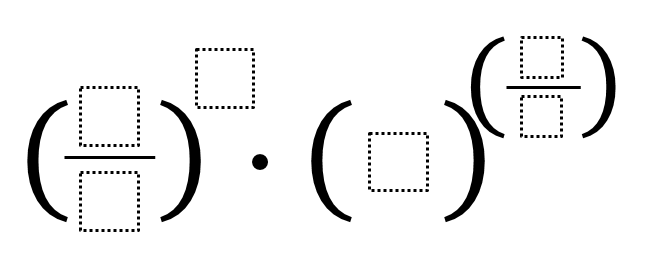
Directions:  Fill in the boxes using the whole numbers 1 through 6 to make the largest (or smallest) possible number. Use each digit at most once.

       Who ever said that there is only one way to get the answer in a math problem?  

       OK...(unfortunately) lots of people say this.  But, guess what, the best math questions don't have just one way to be solved.  Because the best math problems don't have the simplistic goal of merely following the steps you are told to follow and getting an answer.  The best math problems have much broader goals: Thinking, Reasoning, Problem Solving, Perseverance

       I've recently been introduced to a great source of these math problems called Open Middle.  Open Middle math problems start the same and end the same (with one particular correct answer), but they have an "open middle"; there are many ways to approach and to ultimately solve the problem.  The above problem is a sample of an Open Middle problem.  

       Open Middle has math problems for grades Kindergarten to high school mathematics.  They are great for getting students to use recently learned math in novel ways.  And when students have a chance to talk about the way they went about solving the problem, they gain an ever stronger grasp of the mathematics by hearing from their peers--a strategy known as Number Talks.  

       Students learn that it is OK to think about solutions differently.  One student may have a very complicated solution that makes sense to her.  Another may have a clever solution that no one ever thought of--not even the teacher!  Learning from each other is a great way to experience math and to understand that math is vibrant and alive with many possibilities.

       Students may think of Open Middle problems as puzzles, but listen to the math vocabulary that they use when the work on their solutions.  Students who are bored with the typical math class are excited to spend lots of time working on Open Middle problems because they are relatively easy to start.  Every attempt at an Open Middle problem helps students to learn what to do and (perhaps) what not to do.  They don't view wrong answers as failures but instead as a closer step toward the final answer.

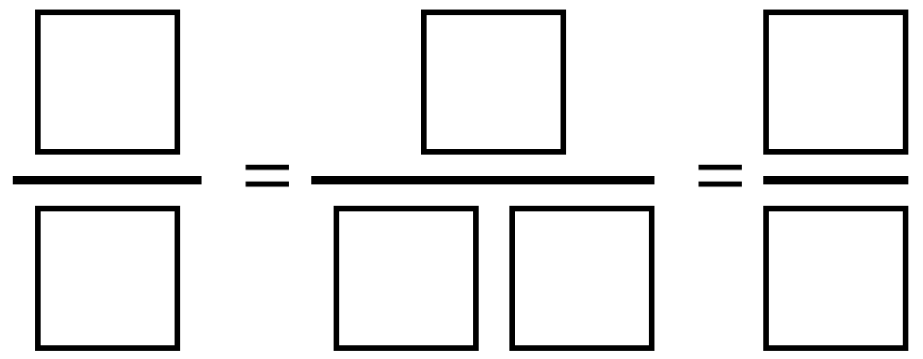
Directions: Using the whole numbers 1 through 9 no more than once, create 3 equivalent fractions.


Tuesday, September 6, 2016

A Tale of Two Classrooms -- Solve Problems

This is the seventh in a ten-part series based on the poster: A Tale of Two Classrooms.


---------------------------------------------------------------

Solve Problems

       School used to be:

  • Read the book
  • Memorize the facts
  • Recite what you've memorized
over and over and over again.  

       What are the capitals of the states in the United States?
       What year did World War 1 begin?
       What is the formula for finding the area of a triangle?

       Today's learners need so much more than mere memorization skills.  They need to know how to use these facts to make predictions, to see connections, and to find solutions.  The classrooms we need today require students to think and reason and discuss and hypothesize.  We need students who can be presented with a problem and know the tools they need to address the issues involved in the problem; and to find a way to solve the problem.

       Problem solving prepares students for the real world they will encounter beyond high school; be it college or career or relationships or buying a car or choosing a route to a destination.  We need problem solvers.  And the classroom is the ideal place to practice problem solving skills.  It isn't enough to have students who are only good at memorizing procedures or memorizes mere facts.  Anyone can find facts with the click of a mouse today.  Schools have to push students to do more.

       As with any other skill, problem solving takes practice.  Students need to hear from other students in addition to hearing from a teacher.  They need to be presented with problems that are (perhaps) a little bit beyond their reach, yet close enough to their abilities so that they can have ideas on where to begin.  Classroom need to have an atmosphere that respects effort and ideas so that students are free to offer their suggestions.  And we need to understand that problem solving is a slow process.  The quickest answer isn't always the correct answer.  Taking time to think is important.

       We need more and better problem solvers.


Wednesday, July 6, 2016

Creating a Better High School - Part 2

       This is the second in a three-part series that will look at the structures in place in our current high schools that don't make sense or are not needed anymore.  I want to think about the best way that students learn and create a high school that will serve these learners.  I also want to think about the true purpose of high schools in our time.  My goal isn't to imagine a "High School of the Future", but instead to consider what can realistically be done today.  As always, I encourage my readers to add their thoughts and ideas.  Together we can create the high school that our students want and need today.

Create a Better High School

Part 1 - Current school structures that aren't necessary anymore.
Part 2 - How students learn and how schools can react to these learners.
Part 3 - The purpose of high school

-----------------------------------------------------------------------------------------------------------------

How students learn and how schools can react to these learners

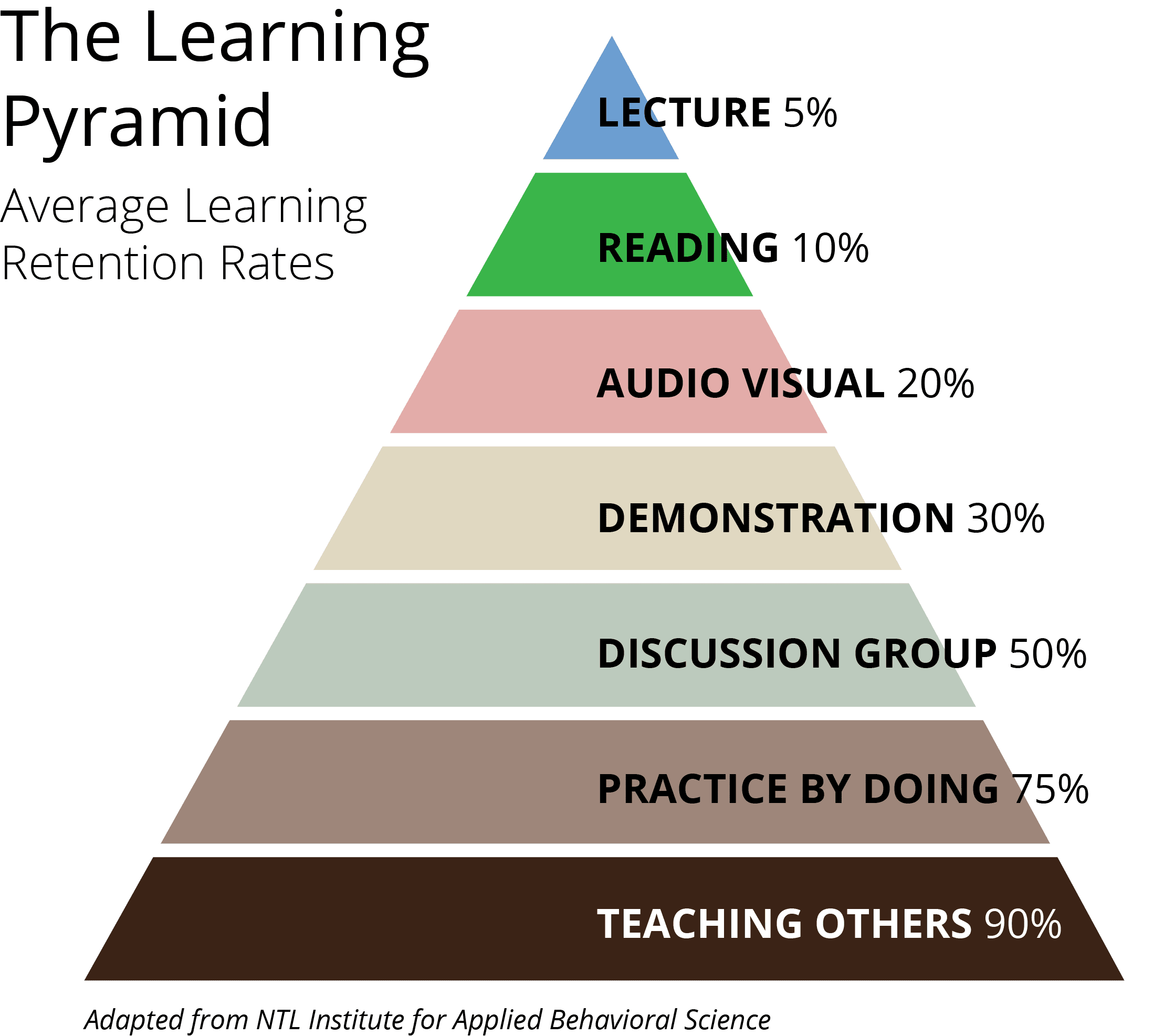
        When I think about creating a new high school, I'm really thinking about all of the traditional structures of our current high schools that don't respond to the way students learn.  The typical high school class still consists of a teacher in the front of the room who does most of the talking while students sit in rows facing the front of the room and take notes.  Students generally only talk to answer a question; to which the teacher confirms or denies its correctness.  This sort of learning (generally) falls in the "Lecture" category which is the least effective strategy for helping students to learn.

       The organization Jobs for the Future has recently published a series of papers titled Students at the Center.  In this series, they list four principles of student-centered learning.  These are:
  • Learning is personalized
  • Learning is competency based
  • Learning takes place anytime, anywhere
  • Students exert ownership over their learning
These four principals lead to deeper learning which is the sort of learning that gets students exited about what they are learning and encourages retention of their learning.  Deeper learning prepares students for both college and careers because it teaches them how to solve problems, how to work with other people, and how to think critically.

       The "changes" needed in our current high schools are changes that respond to these four principles and respond to the best ways that students learn.  This will require changes for teachers as well as changes in the expectations for schools from our parents.  Part of the struggle of changing high schools is that every adult has had the same basic schooling experience.  We are comfortable with it.  Teachers teach the way they were taught--they didn't devise these structures, they just mimic from their high school teachers and the only changes are additions of what they thought their teachers should have done and subtractions of what they thought their teachers did wrong.

       We need our high schools to be the places in which students are still learning to write and read and do math and understand history and make and appreciate art and learn about physical fitness.  But all of this has to be done in a way that encourages learning as opposed to encouraging "getting-a-good-grade" and encouraging competition with other students.  Students need to actually solve problems, to work with each other, to talk and learn how to argue their point.  The college-bound students should be able to master the beginnings of Physics and Calculus; but should also be to experience the work of the field they aspire to enter.  They should be able to more than just what they are told to do.  They should be thinkers and reasoners and creators and doers.  The career-bound students should master the art of expressing themselves in written and oral forms; they (too) should experience the workplace before leaving high school.  They should know how to build on the basic skills of any job and seek ways to make it better.

       We want students to learn; we want them to learn how to learn; and we want them to learn in abundance.  Because learning doesn't stop when you receive your high school diploma.


Thursday, April 14, 2016

Education that REALLY Prepares Our Students

 
       This week I've had the great fortune of attending the National Council of Teachers of Mathematics (NCTM) Annual Meeting.  Many subject areas hold these types of large, national conferences to help teachers and supervisors and school board members and principals to grow professionally and help students to achieve.

       I attended one particular session that discussed the need for our schools to examine the needs of the world that we live in and to make appropriate changes to the education that we provide to our students--the adults and workforce of the next generation.  The speaker was Diane Briars; President of NCTM.  She referenced the book Education for Life and Work (2012) that discussed the sort of competencies that will increase in the near future.  These include:


  • non-routine analytic skills
  • non-routine interactive skills
  • thinking
  • reasoning
  • expressing information to others
  • interpreting information and responding appropriately

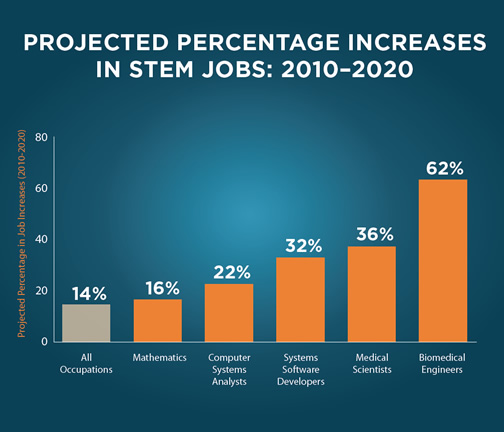
       Math teachers know that we teach reasoning and problem solving and analytic thinking.  But we currently teach these skills under the guise of Algebra and Geometry courses.  Is there a better way?  Would it be better to teach these skills within a context rather than strictly in the abstract?  And what about the actual teaching strategies that are employed when presenting such content to students?  Ms. Briars cited a study from 2014 that stated students learn better in active learning classrooms than they do in the traditional lecture-type classrooms.  Active-learning classrooms would use strategies such as: (i) Occasional group problem solving, (ii) Tutorials completed during class, (iii) Use of personal response systems, and (iv) Increased emphasis on student discourse including student-to-student discourse and teacher-to-student discourse.

       Finally, in the report titled, A Common Vision , the Mathematical Association of America (MAA) states that the status quo of teaching mathematics to our undergraduate students is no longer acceptable given that so many students struggle to complete the first one or two mathematics classes offered to them.  We need to see cooperation between the P-12 system and the collegiate system to create courses and course pathways that help students to learn the skills they need to learn to be successful in the world they will inherit.  One possible solution is to offer math courses that are not based on Algebra or Calculus--considering that the content learned in these classes is not necessary for the majors that some of our students seek.  For instance, Journalism may not need to know Calculus, but they will need to know statistics and how to interpret data.  

       From time to time, great institutions need to examine their work in light of the goals that they seek to achieve.  Education is one of those great institutions.  Such change should not be rare but (indeed) should be ongoing.  We no longer live in the 1920s or the 1960s or even in the 2000s.  We have an obligation to prepare our students for their world.  


Monday, April 11, 2016

"I Can Barely Read"

       "I can barely read."  

       You never hear anyone ever say this with pride.

--------------------------------------------------------------------------------------------------------

       Last week I attended a Professional Learning session about Blended Learning.  Three English teachers were presenting.  One of them said, "...and we're all English teachers, so when we put grades into the grade book, we are all bad at math so we look for shortcuts."

       I am a mathematics supervisor and everyone in the room knows who I am.  When the teacher made this statement about being bad at math, another teacher looked at me and sort of made a face that said, "I think you just insulted the math supervisor who is sitting over there."  The speaker saw this face and looked at me; and then other people in the room began to realize what was going on.  Slowly people started to laugh at the slightly embarrassing situation that this teacher put herself in.


       I didn't want this presenter to feel bad so--with everyone looking at me and wondering how I was going to react--I said, "It's OK."  And then I said (with great pride), "I can barely read."  And the whole room broke out in a loud laugh.

       Why is it perfectly acceptable in our society for grown, educated people to say (out loud and in front of other grown, educated people), "I can't do math."?  But it is completely unacceptable and cause for embarrassment to say (in front of other people; and with great pride), "I can't read."  Why aren't people embarrassed that they can't do math in the same way they would be embarrassed to not being able to read?

       Teachers, parents, coaches, and all leaders need to speak up when they hear children (and adults) proudly saying that they can't do math.  It reinforces to students that it is OK to be bad at math.  This leads to students who refuse to put in the effort to learn mathematics.  Students begin to believe that they really can't do math AND they believe that this is perfectly OK and it's not OK.

       Math is important.  Math is reasoning.  Math is thinking.  Math is problem solving.  Math is perseverance in the presence of difficult situations.  And everyone can do math.

       What you say is important.  People are listening.  If you would never say, "I can't read.", then don't ever say, "I can't do math."


Public Schools and Choice

       Is it true that public school kids and their public school parents don't have choices?  I'm sure that I will expose my igno...

Teach100 blog