Showing posts with label resources. Show all posts

Sunday, October 30, 2016

When Students are Thinking, Students are Learning


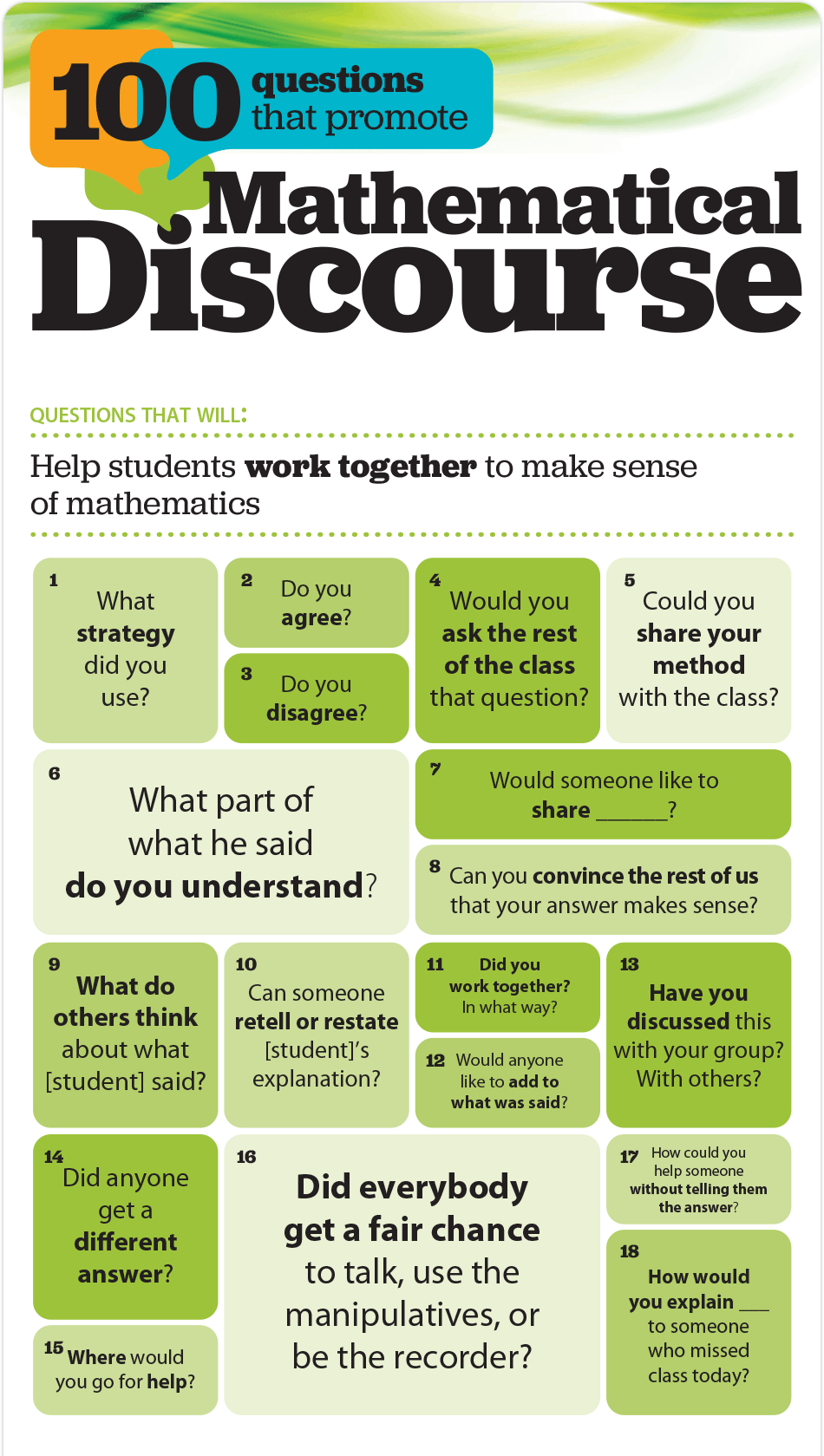
       I was recently introduced to a fantastic list of 100 questions that teachers can ask in mathematics class that will encourage students to think and reason and share their thoughts with each other.  A portion of these 100 questions are in the graphics in this post.  The rest can be found here.

       The questions are separated into categories that help students to:
  1. Work together to make sense of mathematics.
  2. Rely more on themselves to determine if something is mathematically correct.
  3. To reason mathematically.
  4. Evaluate their own processes and engage in productive peer interaction.
  5. Gain a better understanding with problem comprehension.
  6. Learn to conjecture, invent, and solve problems.
  7. Learn to connect mathematics, its ideas, and its applications.
  8. Persevere.
  9. Focus on the mathematics from activities.
       Every parent that has ever received the unimaginative response of "Fine." to the question, "How was school today." understands the frustration of trying encourage a dialogue with young people who are either unable or unwilling to do so.  Teachers face this dilemma every day.  Except, for teachers, their are tasked with making sure that the students are actually learning the content that they are teaching.  Teachers don't have the luxury of dismissing an uninformed, mono-syllabic response.  Hence teachers do their best to use strategies that will encourage students to share their thinking.  These questions help teachers to achieve this goal.

       Here is a sampling of some of these great, discourse-encouraging questions:

How would you explain _________ to someone who missed class today?

How did you reach that conclusion?

Can you think of a case where that wouldn't work?

Could you reword that in simpler terms?

How is your solution method the same as or different from (student)'s method?

How does this relate to ____________ ?


       These questions help students to understand that mathematics is not just a bunch of rules that lead to a single number answer.  We want students who are able to understand the reasoning behind the rules.  We want students to think and reason and discuss and struggle and fail and try again.  We want students to have strategies for finding solutions beyond just asking the teacher.  We want students to learn from each other, to recall past lessons, and to know how to check their own work.

       These questions are a great resource to our teachers.  When students are thinking, students are learning.


Sunday, May 8, 2016

EdCamp

       EdCamp is sweeping the nation!  Have you heard about EdCamp? Check out this quick (1 minute) video:


       EdCamp is like a huge faculty room with teachers from all over your school district (or state) coming to one place to talk about whatever education topic they want to talk about; and to do so with other teachers who are interested in sharing ideas and hearing from others on the same topic.

       I often tell our new teachers that an important way to grow and to improve professionally is to talk with and hear from other teachers.  Everyone has ideas; everyone has something to contribute.  Different teachers have different experiences; different teachers hear about and use different resources.  One teacher uses Desmos (for example) to demonstrate attributes of graphs and equations; another teacher uses PearDeck to gather quick formative information from students (and to enhance student engagement); a third teachers uses TenMarks to determine the level of understanding her Algebra 1 have of a particular standard.  (And so on.)  The teachers using these resources may feel like they don't have anything special to share, but these resources that they use everyday might be completing new to someone else.  Everyone gets better at what they do when they hear from other teachers.

       EdCamp brings together teachers to talk about teaching.  And the teachers that come to EdCamp are the teachers that want to share their knowledge and want to hear from others.  Contact your state education office or your district's Office of Professional Learning.  See if there is an EdCamp being planned near you.  Or host your own EdCamp.

       Better teachers make better students; and EdCamp makes teachers better.


Thursday, June 11, 2015

Congratulations to All First Year Teachers!

June, 2015

Dear First Year Teacher,

       Congratulations on the completion of your first year of teaching.  You did it!

       After making the decision to be a teacher 
  • and finishing your degree 
  • and navigating the job market 
  • and landing a teaching job
you have reached the point in the school year where you can look back and say, "I did it.  I've completed my first year of teaching."

       You probably learned some things that you didn't expect to learn--and that's a good thing.  (Learning is always a good thing.) For instance, you might have learned that some students didn't retain the learning they had previous years.  This might have caused you to consider different teaching strategies to reach these students and to help them to learn this year's content.  Secondly, you might have learned that you understand your content so much better now that you have taught it--compared to when you just had to learn it as a student yourself.  This might have caused you to consider that your students (too) may learn well be "doing" or by "teaching" (or explaining) what they know with other students.  Lasting, you might have learned that great lessons may take a lot of time to prepare and not-so-great lessons can be prepared quickly--and you have to find a balance between the physical time you have and the your desire to keep your students motivated to do their best.

       Mostly, I hope you've learned that teaching isn't the sort of profession in which people start out knowing it all.  Teaching is the sort of profession in which people get better at it the longer they do it.  I hope you asked your colleagues a lot of questions this year.  That shows that you are interested in growing and improving as a teacher.  (You may have noticed that the teacher across the hall from you--who has been teaching for ten years--also asks a lot of questions because she wants to continue to improve every year.)  Using different resources, using electronic resources, using different teaching strategies...it's a lot to learn in a signal year.  Every year you will hear about new and cool stuff that you can use in your classroom.  So find the thing that's right for you, and do that extra one or two new things next year.  But don't worry about not doing it all; or not doing what that great teacher down the hall is doing.

       Learning about teaching is a big part of teaching.  There is no "one way" to be a great teacher.  (That's why no one has given you the Book of Directions of Teaching.)  This is what makes teaching hard--that non-educators don't realize.  But it is also what makes teaching a true profession in which professionals such as yourself need to get together to make the best decisions for your students.

       Enjoy your time off this summer.  But also spend some time reflecting on this past year.  What was great that you want to repeat next year?  What didn't work that you want to improve upon next year?  What is the cool digital tool that you heard about and never had time to learn about and that you may want to use next year?  Look for webinars to attend; find people and chats on Twitter that will broaden your horizons; read a book about teaching or teaching strategies that may be specific to your area of teaching.

       The best teachers are always learning and always improving.

       Be a better teacher, and the next year, and the next year.  And (again) congratulations on the completion of your first year of teaching.  You did it!  See you next year!


Public Schools and Choice

       Is it true that public school kids and their public school parents don't have choices?  I'm sure that I will expose my igno...

Teach100 blog