Showing posts with label workforce. Show all posts

Friday, October 21, 2016

The Struggle for Change in Our Schools


       This sign hung at the Gillette Stadium in Foxborough, Massachusetts this week during the annual MassCUE conference.  "MassCUE" stands for the Massachusetts Computer Using Educators.  The conference was also sponsored by the M.A.S.S. (that is, the Massachusetts Association of School Superintendents).  The sign begs the question, Why is it that schools (education) is not changing if everything around the schools are changing?  I think I know the answer...

       The sign reminds us that the world is changing.  Indeed it is.  The changes that have occurred in the world have been driven by market forces such as efficiencies in manufacturing.  They have been driven by technology such as computers and cell phones and the capacity of these technologies (and others) to accomplish tasks much faster and easier.  The sign says the workforce is changing.  One big factor is the lower demand for low-skill jobs.  Less workers are needed to do a job that took more workers a few decades ago.  This (again) is largely due to the creation of machines and equipment that have been built to do jobs faster and better than human workers ever could.


       The sign says that technology is changing.  Few would need any strong justification to argue this point.  Computer chips are constantly being made to be smaller and faster.  (Although this scenario may come to an end soon.)  Computers are smaller and more powerful.  And the applications of this great processing speed appear to be endless.  Finally, the sign suggests that students are changing.  Different clothes, different music, and (once again) technology available at every turn.  Of course, these "different" students are also living in this "different" world; so of course since they are living a different experience than their parents, it makes sense that students of today are different from students of 20 or 40 years ago.
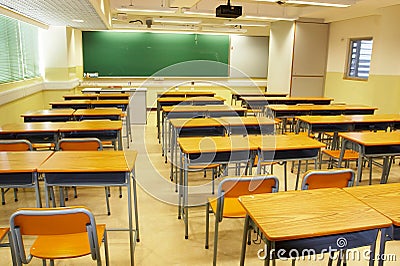
       So why are we surrounded by change and yet we are stuck with relatively little change in our schools?  By "little change", I mean high school classes of about 30 students with one teacher doing most of the talking.  Course requirements nearly the same for all students, even though we have students with different needs and different abilities.  The school day has basically the same start and stop time as 50 years ago.  The school year is basically the same as 50 years ago.  (And not because of farming needs 100 years ago.)  I would argue that the changes to the world, the workforce, technology, and students occurred as a sort of evolution.  No one person or group of people orchestrated these changes.  They happened as a natural phenomenon of humans living on earth and trying to better their situation.  As a species, we are always looking for ways to improve our life and our surroundings.  So we develop better tables and better chairs and better cars and better watches and so on.  Each generation is a little better than the one before it for all of these things.  But a change in schools requires that we conscientiously do something.

       School change requires a community that wants the schools to change.  Someone has to propose the change (or changes).  Someone has to agree.  Then someone has to convince the school board.  And so on and so on.  In the end, while educators may see the need for change in our schools (and not all educators see this change), non-educators often don't see the need for this change.  The common expression is, "This is the way school was when I was a kid.  It was good enough for me, so it will be good enough for you."  The general public is weary of major changes.  Change is disruptive and unsettling.  It is uncomfortable.  People (as a group) don't generally want things to change.  They may accept changes that are forced upon them (such as a new cable company because the old one merged with the new one), but when given the choice it seems that most would vote against change.  This is why (in my opinion) schools are so slow to change.


       As an educator, it is frustrating because I sometimes wonder if we are preparing our students for anything more than higher-level coursework.  Are they learning the skills they need to succeed in the workforce of the 21st century?  Are they able to cope with the world that they will inherit?  Is a high GPA enough?  How do we help the public to embrace the sort of change that will benefit their children?

       Can we allow our schools to change?


Saturday, October 17, 2015

Learning is a Social Activity

       Learning is a social activity.

       A quick search of respected sources such as General Psychology, Psychology Today (article by Dr. Matthew J. Edlund, and one of my favorite education writers Annie Murphy Paul will help all of us to understand that the best learning requires active participation by the learner.  (View an excellent talk by Dr. Paul here.) The old days of "sit and get", don't-talk-in-class, teacher-in-the-front-of-the-room-doing-all-of-the-talking have been shown to be effective for an incredibly small percentage of our students.


     The problem is that most of our current teachers grew up in a school setting in which less student talk was the norm.  The teacher was the sole source of knowledge in the classroom and the students were discouraged from sharing their thoughts and ideas with each other.  Hence, many current classrooms engage in this same classroom structure that existed 20 and 40 and 60 years ago.  "It was good enough for me, and so it will be good enough for my students" as the thinking goes.

       This is a problem because the old model of presenting information to students and basically asking them to memorize it isn't enough for the workforce of today--and it isn't completely necessary in the age of the internet.  We are able to obtain facts very easily now.  The challenge to our teachers is to help our students to use that information to make connections to other information; to build things; to create things; and to solve problems.

       This requires our teachers to have a knowledge of how students learn and to use that knowledge to create lessons that incorporate the strategies that are most effective in helping our students to learn.
       This also requires teachers to be comfortable with students talking to each other in class; students getting out of their seats to share information and ideas with other students; and students making mistakes (and learning from these mistakes) during class time.  Some teachers struggle with this "active learning" approach because of the fear that such a classroom atmosphere would be difficult to manage.  Such an environment in the classroom requires planning and structure and good communication between the teacher and the students.  Students need to understand the objectives of the activities and they need to be accountable for doing their part.  Yet, this is the classroom that most students will tell you that they want.  And they want it because they struggle with learning through a strict sit-and-listen-and-take-notes sort of classroom.

       Learning is a social activity no matter where the learning takes place.  Adults who learn via asking questions and reading information and watching others and making mistakes and asking more questions, etc.; should not expect students to learn any differently.

       And if students aren't learning, then what's the point of school?


Public Schools and Choice

       Is it true that public school kids and their public school parents don't have choices?  I'm sure that I will expose my igno...

Teach100 blog