Dear Students,
As a brand new school year begins, I want to share some of my thoughts about school and education in the hopes that they will help you to have a successful year of learning.
Note that I've used the wording "learning" and I didn't say a successful year of getting good grades. Grades may be one indication of your learning, but grades are not the purpose of school. Indeed the reason we adults have these rules about going to school is because we want to do our part in preparing you to be as prepared as you can be for the majority of your life as an adult. Hence, school shouldn't be a competition for grades, but instead it should be a journey of learning.

Some of you will learn best by sitting still and quiet in your chair and listening to your teacher and (maybe) writing some notes. But we now know that most students don't do their best learning in this way. Learning requires you to ask questions and to be curious about what you are taught. You need time practice; you need time to make mistakes and fix those mistakes and make more mistakes...and so on and so on.
Have you ever read a book that you really liked and felt that you were a fast reader? But at other times you read a book that you weren't interested in and it seemed to take a long time to get through it. Learning is like that. So try to find something interesting in everything that you learn in school and you will find that learning itself can be interesting.
Have you ever read a book that you really liked and felt that you were a fast reader? But at other times you read a book that you weren't interested in and it seemed to take a long time to get through it. Learning is like that. So try to find something interesting in everything that you learn in school and you will find that learning itself can be interesting.
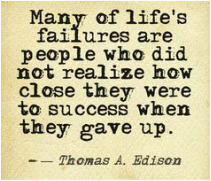 I think the important thing to know about learning is that learning can be a struggle at times and that's OK. If you learned everything the first time a teacher taught it to you, than you probably are ready to move on to a tougher class (or a tougher teacher). Faster is Smarter. Learning shouldn't be a competition to be the first person to finish an assignment. Learning takes time. So don't worry if you don't get it the first time. True learning rarely comes fast.
Your teacher is there to help you when you don't get it the first time. If your teacher doesn't help you then you need to tell someone; tell your mother or father or a guidance counselor. No teacher should make you feel bad about not learning. No one is an expert in everything--including your teacher. Most teachers are glad to help you--that's why they are teachers.
So work hard at your learning this year. Take responsibility for your learning. Don't look for shortcuts or for "the easy way". People who know how to learn can learn anything. You can learn anything. Ask for help and don't give up.
School is an opportunity for every student. It, unfortunately, is not an opportunity that every child in world is given. Appreciate this opportunity and do your best everyday.
Have a great school year!