Showing posts with label college. Show all posts

Thursday, March 16, 2017

If School was Equal for Everyone

       If school was equal for everyone...


  • The most struggling students would have the best teachers.  We know that good teachers make a difference in student outcomes.  Our best teachers are also our best motivators; they help students to see the value of effort and their students try hard and do their best every day.  Students who struggle academically need good teachers who believe that all students can learn and show this by their actions as well as by their words.  I hate to say it, but students who have a lot of support at home--students with parents that value education--typically do fine in school regardless of the quality of their teacher.  If there are only a relatively small portion of the teaching force that is in the "best" category, they should be teaching the most struggling students.
  • Students would be allowed to learn at their own pace.  They wouldn't have to "move on" because the rest of the class is learning faster than they are.  And they wouldn't have to sit in class being bored with nothing to do because they "get it" faster than everyone else.  Student engagement is increased when students have some control as to the pace of their learning.
  • Opportunities for all sorts of classes would be available to all students.  Music, art, physical education, higher-level (college-prep) classes would be available to everyone.  If a student struggles in math but wants to take Calculus at some point, there would be a path of courses (and professional educator assistance) to help her to get to Calculus.  If a student wanted to take two or three foreign languages prior to high school graduation, he could do that and still complete all of the other requirements.
  • There would be a lot less competition for grades and a lot more desire for learning.  "A" students would receive no more praise than "C" students because effort would be valued over performance.  Students who didn't "get it" the first time or the second time would be given multiple opportunities to reach proficiency.  Some will exceed expectations and some will barely meet the expectations.  But all will be rewarded for learning.
  • Students with career goals after high school will receive the same amount of help and guidance as students with college goals.  Preparation for civil participation will be part of every students' P-12 experience.  And students who don't know what they want to do after high school, will receive opportunities to understand their skills and to consider different options.
     We live in an imperfect world filled with imperfect people, imperfect teachers, imperfect students, and imperfect schools.  We can wish for perfection, but we can't realistically reach perfection.  The best we can do is recognize our needs, understand our problems, and work together to find the best solutions for our students.  Amazing things happen when we work together.  While (usually) quite un-amazing things happen when we refuse to change in the name of we've-always-done-it-this-way.

       Our schools work hard to produce the best outcomes for our students given the staff and money and facilities and materials and students and parents that we have.  When things don't work, the answer to fix it and make it work.  Everything can be better; it may take a lot of hard work, but it can be better.

       Our schools may not be equal for everyone, but they can be the most positive places for our students and teachers if we want them to be.

Tuesday, December 27, 2016

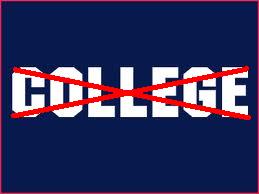
College Not For All

       I'm going to start by saying that I went to college, my wife went to college, my siblings went to college, I want my children to go to college, and everyone I work with went to college.  I'm a big fan of "going to college".  College provides specialized knowledge in a specific field of study; often by people who are experts in that field.  There is a benefit to going to college, but since this post is about "not going to college", I'll just say that the benefits of college are well documented.


       So why am I (a lifelong educator) writing about not going to college?  Because public school desire to teach ALL students.  All students are welcome in our public schools.  We take all students.  We don't have some sort of litmus test that permits some students to enter our public schools and denies others t enter; we take everyone.  And in doing so, we have an obligation to teach all students.  This means that we teach the students who are college-bound as well as those that are not.  This leads to the dilemma of all public schools: Are we preparing students for college?  Are we preparing them for the world of work?  Or, Are we doing both?  (And if the answer is the latter, then How do we do that?)

       We know that all students won't go to college.  (source)  We also know that some will go to college and won't finish college. (sourceHere is a slideshow of 25 jobs that don't require a college degree--although nearly all (or actually all) of these jobs require some sort of education and/or training beyond high school.  So the question remains, How do prepare the college-bound students and the non-college-bound students at the same time?

       The simple answer is that this is a complex problem.  It is a problem that (in my opinion) requires multiple options and pathways for high school students.  It is a problem that does not lend itself to one-size-fits-all solutions.

       It is fair to say that all public schools recognize this need to prepare students for their lives beyond high school--whatever they may be.  But it is also fair to say that some requirements are aimed (more) at the college-bound students than at the non-college-bound students.

       My solution views these two subgroups of students as much more alike then different in terms of the skills and knowledge that they need for both college and work.  Clearly, reading and basic mathematics understanding is needed.  By "reading", I include understanding the context of what is being read; and I include reading and understanding non-fiction and technical manuals.  Our civilized world requires reading.  Medical reports, insurance papers, legal documents such as wills and mortgages all require a level of reading in which people can read and understand.  By "basic mathematics", I include understanding and calculating things such as sales tax and interest income.  People should be able to gain information from a chart, graph, or table of numbers.  People need to know what a percent means and what fractions mean.  Calculators can do the calculations, but people need to do the "understanding".  Beyond reading and mathematics, I believe that a good understanding of other typical high school subjects is needed to help people gain an understanding of the world and the people around them.  These include science, history, art, some computer skills, health, and knowing a foreign language--which is extremely common outside of the United States.

       Beyond these academics, I believe that the rules and regulations that take place in a high school and in the classroom should instill in our students a sense of right and wrong as well as a sense of how to exist as an adult in society.  When my daughter was in kindergarten, her teacher told us that everything they do has a purpose.  What may look like "fun" or "downtime" to the non-kindergarten-teacher observer, has a purpose.  Similarly, everything in high school should have a purpose.  Whether you are going to college or work, you need to be on time, you need to be polite, you need to listen.  You need to learn from others and you need to be able to work with others.  You need to know that sometimes you'll get some help to do things and sometimes you have to do things on your own.  You need to be responsible and you need to take on responsibilities.

       It seems to me that when employers complain about young people in the workplace, it isn't so much that they lack reading and mathematics skills--although I hear this as well.  It is more that they lack the ability to accept responsibilities, to understand written and verbal directions, and to follow through on important tasks.  These skills are needed for the college students also.

       College isn't for everyone.  But public schools and their graduation requirements and daily rules and regulations are for everyone.  Learning is a lifelong skill.  It doesn't stop on graduation day.  We want all students to succeed regardless of the path they take after college.


Tuesday, August 16, 2016

Do You Want to "Go" to College, or to "Graduate" from College?

     Lots of people "go" to college.  But not a lot of people "graduate" from college.


       According to the National Center for Educational Statistics, 36% of 25 - 29 year old people in the United States had a bachelor's degree in 2015.  This number represents approximately half of the people in this age group who began college at some point after their high school graduation.  Why are so many people able to graduate from high school and not able to graduate from college?

       A report from Complete College America provides some answers.  Part-time students rarely graduate.  While full-time students graduate at a (dismal) rate of 60.6% completing their 4-year program within 8 years; the equivalent statistic for part-time students is only 24.3%.  Another problem is students taking more credits that they need due to poor advice or odd policies that steer them to unnecessary and extra (unneeded) credits.  A bachelor degree should require just 120 credits, but the average student earning a bachelor degree completes 136.5 credits and the average time to earn all of those credits is more than four years.

     So here is my list of ideas to help students to graduate from college.  (Spoiler Alert:  These are pretty basic ideas.  But like everything else in life, students have to learn them at some point.  If no one every teaches these things to our college students and they don't develop these skills on their own, then we can't expect them to have these skills.)


  1. You are responsible for your college success.
       It's not the professor's fault; it's not your parent's fault; it's not "the colleges" fault.  You, the student, have to take on the responsibility for your college success.  You have to get the correct information about courses you need to graduate.  You have to know the deadlines for signing up for courses, for completing course work and projects.  You have to ask for help if you need help in a course.  You can blame others if you want to, but in the end it is you that does or does not get the diploma.

     2.  Make a plan.

       Number of credits needed per semester.  Courses needed; pre-requisites needed.  Materials needed.  How much time do I need to study?  What is a good, quiet place for me to study?  Do I have time for sleeping and eating and hanging out with friends.  You can't always to everything you want to do when you're working on your bachelor's degree.  But be sure to allow some down time along with your school work time.  But Make A Plan.  It won't magically fall into place; you need to plan accordingly.

     3. Don't give up when it gets difficult.

       It's OK to struggle a little bit when you are learning new things.  And it is certainly OK to get a "B" or a "C" once in a while.  But don't convince yourself that you can't do something just because you don't get it the first time.  You are a student; you're learning.  It's OK to work hard toward your goal of graduating from college--everyone does.

       I don't mean to suggest that college students are lazy and that's why they don't graduate.  There are lots of reasons why college students don't graduate.  I just think that a lot of students aren't prepared for the varied responsibilities of college and it hurts them in the long run.  I also believe that most high school graduates can complete college with the necessary supports along the way.


Saturday, June 18, 2016

Preparing Our Students for College and/or Careers


       "College and Career" has become the new buzzword in American high schools.  We want to prepare students to be ready for the social and academic demands of college; and--for students who go to college and don't go to college--we want to prepare our students for the demands of being in a working environment.  This has become a rallying cry for our P-12 school system because of so many surveysstudies (also see this study) and articles that have touted how unsuccessful our schools have been at accomplishing this goal.

       Certainly many recent high school graduates (and their parents) can speak from personal experience.  They completed high school and received their diploma, but they couldn't do the same in college.  Among students that began college in 2007, less than 40% completed their Bachelor's degree by 2011.  Even if you give them another two years the college graduation rate is still very low--59.4% (source).  Employment rates for high school graduates may (certainly) be affected by general conditions of employment in society, however employers often have serious concerns about the readiness that recent high school (and college) graduates have for the workplace.  So what should be done to better prepare students for college and careers?

       First let's define the problem that is faced by our public schools.  In a (very) broad sense, we need to be everything for everyone.  We need to prepare the rich kids and the poor kids, the learning disabled and the academic superstars, the sports kids and the theatre kids and the band kids.  And we need to prepare them for community college, for 4-year colleges, for selective and ivy-league colleges, as well as for certification in cosmetology and welding and mechanics.  Additionally, we want them to be able to express themselves in writing, verbally, and online.  We want them to know that it is important to be on-time, to be polite, to be a learner (for jobs and for college), to be wise with money and credit, to make good decisions.

       Hence, our public schools are tasks to develop rules and policies and requirements for everyone even though everyone isn't following the same path after high school.  So we have to find a balance between what's necessary for most or all students with what's probably really, really helpful for some of the students.  For instance, mathematics is important, but should we require all students to take and pass (and know) Algebra 2?  Financial Literacy is important, but do middle school students need to learn about home mortgages?  Finding the right balance can be tough.


       The other issue is that too many students (and parents) view high school as just a list of requirements to complete.  The idea of "learning" is too far removed from the idea of "getting-a-grade".  How do we help students to see the value of what they are learning in the midst of a system that constantly "rates" students with grades?  Too many people feel that school is merely another one of life's competitions in which there are few winners.  How does this prepare students for their life after high school.  Therefore, our P-12 schools are also tasked with helping students to appreciate the learning and to increase their understanding of their abilities to learn.

       Some of this can be done with requirements from school districts and from state education agencies.  But, it seems to me, that some of this requires a societal view of school as preparing students for after school.  We need parents to support this view; we need television to support this view; we need law-makers to support this view.  College and career readiness is a big job and it requires a big response from all of us.

Friday, May 20, 2016

Is There Too Much Testing?

       Testing.  


       The very word conjures up emotions in students and parents and school officials alike.  Within the educational community, this word conjures up other words like: measuring, accountability, fairness, purpose, practice, instructional time, online, paper/pencil, formative, and summative.  Your connection to these feelings and issues probably shapes your views about testing in our public schools.  Part of what makes this such a big issue is that there are no simple "right" and "wrong" solutions.  It is a complex problem that requires thought and discussion among many stakeholders.


       The goal of schooling is learning.  There may be other benefits such as socializing, joining a club or team, earning a diploma; but the goal is learning.  Our ability to measure learning has grown significantly over the past twenty years as educators come to understand the value of frequent formative assessments in combination with teaching strategies that engage students.  In the past, the school classroom was a very dictatorial place:  Teacher in the front doing most of the talking; students sitting in rows listening to the teacher and taking notes; test or quiz every Friday.  This system worked fine for the student who was able to learn by listening, but if you needed to ask questions, or clear up any confusion with the content prior to the test you probably struggled to learn in this environment.  And if you weren't able to concentrate on the teacher's words for two or three hours, you might have missed your first and only chance to get that precious information from the teacher.


       Today we know that learning requires doing and talking and questioning in addition to listening (and note taking).  We also know that we want to get a sense of the learning that is taking place on a daily basis and not just once a week or whenever the "Big Test" occurs.  This "measuring of daily learning" is what we call Formative Assessment.  It could be a game, a series of verbal questions from the teacher, an activity during class, a exit ticket (or exit pass),  Anything that gives the teacher and the student information as to their level of understanding the content or the objective for the day.  Usually when we argue about "Testing", this isn't the sort of testing that we are arguing about.

       The discussion over testing usually centers around what educators call summative tests.  These are chapter or unit tests, final exams, end-of-course tests, and major state tests.  These tests might be required to graduate from high school; or they may command a large portion of a final grade in a course; or they may be used to determine if you are ready for college (or if you will be accepted to college).  These are the tests whose results have some sort of consequence.

       A common issue that arises is a student who appears to be learning very well based on class grades and report card grades, but then this same student demonstrates a lower level of learning on one of these big tests.  I think that I worry when there is a public outcry over testing because of this scenario.  I feel that rather than arguing against giving the test, we should question why the discrepancy happened in the first place.  Clearly a student who fails an end-of-course test and earns an "A" or a "B" as a course grade cannot (both) be very knowledgeable about this content AND be very weak with this material.  Something is going on.  Perhaps both the course grade and the test are not true reflections of the student's ability.  Perhaps it is somewhere in the middle of these two extremes.

       Since the goal of school is learning, there should be accurate and valid methods for determining the extent of this learning.  It isn't enough for a student to come to school everyday and do what he's told to do and then walk out of school without some measure his learning.  Getting grades isn't enough.  What does it benefit a child to get good grades in school and not be able to read or do math at an acceptable level when he leaves school?  This is one of the reasons for instituting summative and state testing in the first place.  Also far too many students begin college but never finish college.  If more people took the results of these big tests seriously, they might be less in a rush to go to college until their abilities were more in-line with college-level expectations.


       Is there too much testing?  Why are you asking this question?  If it is because you don't like to see your child getting poor results on this test, than you should question the discrepancy between the course grades and the big test.  If it is because the results are not used for any useful purpose, then you should discuss this with you child's teacher or school.  Everything done in public schools should have a purpose; this includes testing.


Tuesday, May 17, 2016

High School Graduation and Beyond

       May and June is the time in the school year when we think and hear a lot of graduation.  High school and college students are graduating; completing one important life event and moving on to the next.  It's exciting, it's a happy time, it's a time to celebrate!

       As a nation, we have a lot to celebrate because we have seen a rise in the high school graduation rates over the past few years and that's a very good thing for our nation.  In the 2013 - 2014 school year, the high school graduation rate was 82.3%--an increase of over three percentage points from the 2010 - 2011 school year.

       Our society demands a workforce that is willing and able to continually learn and to use the knowledge of past learnings.  Students who succeed beyond high school are the people who understand that their ability to do a job is not dependent on the grades they earned in high school as much as it is on their desire to continually learn and to do their best.  We need thinkers and doers and believers.  While high school graduation is a big step (and an important step), it is still only one step.  Those students who were only successful in "playing school" and earning grades without any concern for learning will find it difficult to succeed in college or the workforce in places where thinking and problem solving is necessary.

       Sometimes it seems like we put too much on our schools.  We teach courses, but we also teach how to work together, how to get along with others, how to learn, how to struggle, how to accept responsibility.  No one gets a grade for these things; no one is denied a diploma for not attaining these traits.  But those that lack the ability to do these things often struggle to live in a society that doesn't always give you second chances; a place where breaking the rules have real consequences and no one is there to remind you what to do and when to do it.

       We all get one chance to make the most of our 13 years of K-12 education.  After that, the number of opportunities rise with the number of decisions.  It's not enough to do what you're told; just ask those that barely graduated high school.


Wednesday, April 27, 2016

Future Schools: It's All About the Learning

       In the future, our middle and high schools won't use grades and grading--at least not the way we think of grades and grading today.  Parents will brag about what their children are learning.  As the school year ends, students will reflect on what they learned--rather than on the grades they got.  Colleges will identify qualified applicants based on what they have learned in their P-12 schools.


      Students will move at their own pace; some will finish high school when they are 16 and some finish when they are 21--and both are perfectly acceptable.  There will be an appreciation for the value of education throughout our society; and all students will feel valued in their schools.  Teachers will teach classes and help individuals; sometimes face-to-face and sometimes online.  "Sit-and-get" lecture will be replaced with active learning that includes students working and learning together--actually talking with each other during school.  Questions will be asked and problems will be solved everyday.  Students will view effort and struggle as value and necessary elements of the learning process.

       Computers and tablets will be viewed as tools for learning and for gaining information.  Students will find the data and facts that they need to make conclusions and to discover new things; to prove theorems and to create stories and art; to publish, to communicate with their learning team, and to keep lists of further areas of inquiry.

       Some students are already enjoying this school experience; for others it probably sounds like a fantasy.  I believe that current elementary school students will see pieces of this future school before they graduate and their children will see this school system as normal.  Our society can not accept an outdated system to prepare our students for their futures.  Change is not a luxury; it is a necessity.  It's not about being #1 in the world; it's about doing what's right for the next generation.


Monday, April 18, 2016

Why Do You Remember Your SAT Score?

       What's your social security number?  What is your phone number?  How tall are you?  When were you born?  What did you get on your SATs?  Huh??  Why is your SAT score is a number that you memorize every bit as much as your phone number?  I can't find any survey data that says the percentage of adults who recall their SAT score (from among adults who have taken the SAT), but my own anecdotal evidence suggests that it is very high.  I dare say that a far majority--maybe more than 75%--of adults who have taken the SAT more than 20 years ago can still recall their score today.

       Why?

        Why is this number, this score--which has no power whatsoever in lives of people in their 30s and 40s--so ingrained in our memories?  It's just a number that (years ago) described our ability to do high school mathematics and our knowledge of grammar, vocabulary, and reading comprehension.  It won't get us a raise or a promotion twenty-plus years later.  There's no college admission counselor to impress when you're in your late 30s.   We're certainly not going to get any reward or trophy or recognition of any kind.

       So why is your SAT score so important to you that you remember it for your whole life?  Why?  I have a theory....  At the time we took the SAT, everyone around us made a big deal about it.  It was billed as the most important test we will ever take.  They said, "Your life depends on it."  (Or something to that effect.)  It was like training for the Olympics.  The test date was on our mind for weeks before.  We thought and thought and thought about it.  We worried about it.  It was a sort of a milestone in our young lives; like getting our driver's license.  We might have taken it more than once because someone said that that was a good idea.  It was an accomplishment akin to graduating from high school or running a mile in six minutes or going out on your first date.

       I think that taking the SATs was billed as such a huge event in our lives, that most of us figured it was important enough to remember our scores.  But, I fear, that it also produced a generation of people that valued test scores over actual learning.  Today in education, we are trying to change this thinking.

       Today educators value frequent formative assessment over the results of unit tests and final exams.  We value multiple data points over the "one big test".  We value a combination of conceptual understanding and procedural knowledge over the mere regurgitation of facts.  Learning and the measurement of learning has come a long way.  Some colleges don't even use the SAT as a consideration for admission.  Others use it as one of many factors for making the admission decision.

       Aside from the college admission process, your SAT score really isn't very important in your life.  Americans are competitive people.  We like to win.  We don't want people to pass us on the highway; we don't want to lose a promotion to someone else; we don't want our lawn to look worse than our neighbor's lawn.  We have to stop competing for everything.  Your SAT score does not define who you are.  You won't "win" or "lose" anything because of your SAT score; especially twenty-plus years after you take the SAT.

       There are lots of experiences that most adults would gladly like to forget about their high school experiences.  Your SAT score should be one of them.


Thursday, April 14, 2016

Education that REALLY Prepares Our Students

 
       This week I've had the great fortune of attending the National Council of Teachers of Mathematics (NCTM) Annual Meeting.  Many subject areas hold these types of large, national conferences to help teachers and supervisors and school board members and principals to grow professionally and help students to achieve.

       I attended one particular session that discussed the need for our schools to examine the needs of the world that we live in and to make appropriate changes to the education that we provide to our students--the adults and workforce of the next generation.  The speaker was Diane Briars; President of NCTM.  She referenced the book Education for Life and Work (2012) that discussed the sort of competencies that will increase in the near future.  These include:


  • non-routine analytic skills
  • non-routine interactive skills
  • thinking
  • reasoning
  • expressing information to others
  • interpreting information and responding appropriately

       Math teachers know that we teach reasoning and problem solving and analytic thinking.  But we currently teach these skills under the guise of Algebra and Geometry courses.  Is there a better way?  Would it be better to teach these skills within a context rather than strictly in the abstract?  And what about the actual teaching strategies that are employed when presenting such content to students?  Ms. Briars cited a study from 2014 that stated students learn better in active learning classrooms than they do in the traditional lecture-type classrooms.  Active-learning classrooms would use strategies such as: (i) Occasional group problem solving, (ii) Tutorials completed during class, (iii) Use of personal response systems, and (iv) Increased emphasis on student discourse including student-to-student discourse and teacher-to-student discourse.

       Finally, in the report titled, A Common Vision , the Mathematical Association of America (MAA) states that the status quo of teaching mathematics to our undergraduate students is no longer acceptable given that so many students struggle to complete the first one or two mathematics classes offered to them.  We need to see cooperation between the P-12 system and the collegiate system to create courses and course pathways that help students to learn the skills they need to learn to be successful in the world they will inherit.  One possible solution is to offer math courses that are not based on Algebra or Calculus--considering that the content learned in these classes is not necessary for the majors that some of our students seek.  For instance, Journalism may not need to know Calculus, but they will need to know statistics and how to interpret data.  

       From time to time, great institutions need to examine their work in light of the goals that they seek to achieve.  Education is one of those great institutions.  Such change should not be rare but (indeed) should be ongoing.  We no longer live in the 1920s or the 1960s or even in the 2000s.  We have an obligation to prepare our students for their world.  


Wednesday, January 20, 2016

Higher Rates of Women in Engineering


       Are we doing enough to encourage girls to pursue careers in Engineering?

       It isn't enough (anymore) to say that there are more women in Engineering today then there were 10 and 20 and 30 years ago.  The numbers of women in Engineering in these past years was so low that (one would hope) those numbers have gone up.  But recently, the percentage of females earning bachelor degrees in engineering has stubbornly remained only steady.

       Lots of data suggest that the number of female engineers should be increasing.  More high school women are taking Statistics, Calculus, and Physics.  More women than men have been enrolled in college since 1978.  Women have been earning more college degrees than men since 1981.  And the prospects for jobs in engineering is growing.  
       Opportunities abound; so if you're a middle or high school teacher or principal, or you're a parent of girl, be sure they get the message that they can do anything.  Don't feed the stereotype that says men are engineers.  Help them to be proud of their abilities and to pursue their dreams.  

       We need more women to be engineers.


Wednesday, September 23, 2015

Are Your Students Obsessed with Grades?

       Here's a quick checklist to see if your students are obsessed with grades:


  1. They are constantly asking, "Is this going to be graded?"
  2. They refuse to do anything if it is not being graded.
  3. They ask for "extra credit" or make-up work at the end of the marking term to raise their grade to the next letter grade.
  4. They only see the grade at the top of their returned work and ignore the helpful comments that the teacher has written.
  5. They try to memorize the information they need to know for tests.
  6. They follow procedures in mathematics for unknown reasons just to get the right answer.
       In short, students who are obsessed with grades are just "going through the motions" at school; they do what they're told, but they learn very little.  And when they take a test that can't be beat by memorizing (like a final exam) they show their true ability or lack thereof.  The challenge for these students is to do as little as possible to earn the grade they want.

THIS IS NOT THE WAY SCHOOL IS SUPPOSED TO WORK.

       School is supposed to be all about learning.  If students aren't learning, than we are wasting their time.  And if we are (somehow) justifying how these grades-obsessed students are getting A's and B's, then we are giving them (and their parents) a false sense of accomplishment.  Eventually someone will tell these students the truth about their academic abilities, and it would be a shame if they are in college (and paying for college) when they are hit with this truth-bomb.

       Teachers can help their students to de-emphasize grades by praising them for their thinking and reasoning.  They can emphasize learning by asking students to explain how they got the right answer instead of just accepting the right answer and moving on.  Formative assessments that require thinking and reasoning and justifying instead of just repeating information tell students that memorizing isn't good enough.

       We have to help students to be less obsessed about grades.


Friday, August 21, 2015

11 Serious Questions for Teachers


       Yesterday I welcomed our 200+ secondary mathematics teachers to the 2015 - 2016 school year.  We do this every school year and it is always an exciting day.  We get to see people we haven't seen since last June; middle school teachers get to network with their high school colleagues.  The first day of school is getting closer and closer.

       This year I welcomed them with 11 serious questions about teaching.  Since this week is filled with the details of preparing those first lessons, decorating the classroom, preparing class resources, and learning about any new school policies and procedures, teachers don't usually get the chance to sit down for 30 minutes and reflect on why they do what they do.

       Here are the questions I asked them.  Read each one and take 30 seconds to reflect on your answer to the question.

  1. Why do you teach?
  2. What is your goal this year?
  3. Will you make a difference?
  4. What will you do differently this year?
  5. How do you view challenges?
  6. Where is the line between impossible and very difficult?
  7. Do your students have a Growth or Fixed Mindset?
  8. How do you know when they "get it"?
  9. Do student's term grades reflect their ability?
  10. How do you move your students from procedural to conceptual understanding?
  11. Why do you teach?
       Teachers have a job to do.  It is a difficult, complex job.  And the need to grow and to improve in the job is necessary because it isn't the sort of job in which a person knows everything they need to know when they graduate from college.  Teachers face new challenges every year and their ability to find solutions to those challenges is generally what separates good teachers from great teachers.

       Here is a movie clip I shared with the teachers in which FDR struggles to stand up straight and then boldly says, "Don't tell me, 'It can't be done.'"

       Why do you teach?


Saturday, July 4, 2015

Educational Testing Should be Compared to a Health Check-up

       There's a lot of talk about testing in schools these days.

       Should we test students?  Is there too much testing?  What should be on the tests?  Are the tests too easy?  Are the tests too hard?  Do tests measure student ability?  Are high-stakes tests fair?  Standardized tests, the new SAT tests, college-readiness tests, ...and so on and so on.


     On a purely surface level, some students (and parents) do not like the big, end-of-course tests or the big standardized tests because they don't score well on these tests.  And that bad score leads to other negative and uncomfortable issues:
  • students feel bad
  • students feel not smart
  • course grade is negatively affected
  • looks bad on high school transcripts
  • negative affect on grade point average (G.P.A.)
  • negative affect on class rank
This opposition to this sort of testing has nothing to do with learning or the student's (or the parent's) feeling toward the test representing the quality of learning that took place during the course.  This opposition is purely about how the "after-effects" of the test will effect the student's stature, ranking, or reputation in some way.

       On a much different level, some people are concerned about the ability of the "big test" to accurately measure a student's academic ability in a particular subject area.  Alfie Kohn stated his many concerns about standardized testing in his 2000 article titled The case against standardized testing: raising the scores, ruining the schools.  In it, he offers a history of the origins of current-day standardized testing and lays out some of the problems with our current system.  On the other side of the debate, is the book Defending Standardized Testing (2005) edited by Richard Phelps.  This book examines testing via multiple points of view such as: research on standardized testing, misconceptions about large-scale testing, high-stakes nature of some assessments, and the issue of the growing testing industry.

       I view educational testing in the same way I view going to the doctor for a health checkup.  The two extremes are too extreme.  Never seeing a doctor is bad because you might never know if you are developing a serious health issue until its too late.  And seeing a doctor for a full physical checkup everyday is not necessary because your health isn't going to change on a day-to-day basis.  But seeing a doctor (perhaps annually) and following his/her advice is necessary for good health.

       Educational testing is necessary because there has to be some sort of measure of academic ability so that we can fairly compare a student's ability with other students.  If students never take advantage of standardized testing they could go through 12 years of formal schooling believing that all is well only to enter college and to discover that they are unprepared for college-level work.  Educational testing should not be used to rate schools as if they were in some sort of horse race.  They should be used to measure true learning--which is the purpose of schooling in the first place.  They should be used to provide students, parents, and teachers with good information on what students know and understand and what they don't.

       We don't have competitions with other people on who has the lowest cholesterol level or the highest pulse...We shouldn't have competitions on who gets the highest grade on standardized tests.  They should be used for individual results.


Saturday, June 27, 2015

Somebody Has To Tell Them

       Nobody likes to hear bad news.  And nobody wants to be the person to give the bad news.


       In our public schools, we (sometimes) have the following problem...a student is not achieving at an acceptable level.  He tries to do well; he does some things well; but overall his achievement is too low for his grade or age level.  Public schools have lots of ways of helping students to raise their level of achievement and (indeed) it is our job and moral responsibility to do so.

       The problem is that someone has to tell the student and his parents that he is achieving below grade level.  That is a hard conversation to have.  No teacher wants to tell their students' parents this news.  No parent wants to hear this news.  But someone has to do it because we don't want to allow students to go through school thinking that they are doing fine (academically) when, in fact, they are below grade level.

       Sometimes we try to give this news through grades on report cards or via standardized testing grades, but the message doesn't always get through.  Sometimes students get a few good grades on minor assignments and parents "hang on" to those grades and seem to ignore the poor grades on the more major assignments.

       And so, sometimes students go through elementary and middle school thinking that they are doing fine and then they get to high school and struggle with their academic course work.  Even worse, sometimes these struggling students even go through high school with no one in authority ever telling them that they are below grade level.  These are the students that go on to college and (only) then are finally told that they do not have the ability that they thought they had--no one ever told them.

       Our job is to help students to learn.  Part of that job is telling students how well they are learning.  We don't help our students by letting them think that all is fine when it isn't.  Someone will tell them at some point, so it might as well be sooner rather than later.  It doesn't have to be an argumentative conversation.  Teachers and schools will help students to do better--that's our job.

       One way to communicate this message is to have a grading policy that rewards high academic achievement and discourages mere compliance with school and classroom rules.  While we certainly want students to behave in school, what we really want is for students to learn in school.  Teachers who have high expectations for their students and are very clear about those expectations tend to have students who reach those expectations.

       It's OK to tell students that they have not achieved the goal yet.  It doesn't mean that they will never get there, but it does tell them that where they are (academically) is not acceptable and they have to do more, try more, and achieve more.

       Somebody has to tell them.  Be brave and be the one who cares the most about your students.  Be clear about your expectations and tell students when they have and haven't met these expectations.


Wednesday, June 17, 2015

How Do You Define "Winning"?

       Expectations play a large part in our perceptions of just about everything.  If you go shopping and expect to pay $75. for good pair of running shoes and find out that they only cost $50. you're happy because it was less than you expected.  If, instead, they cost $125. you're not happy because it was more than you expected.  But what if your expectations were not reasonable?  What if the average cost of good running shoes is $135.?  Compared to this average, it seems like a pretty good deal to get a good pair of running shoes for $125.

       How do you define "winning" when it comes to the education of your child?  What are your expectations?  To what do you compare your child's progress?  Some people look at the comparison of their child's test scores with other students in the class.  In high school, some people look at their child's class rank (which is a comparison of your child with other students in his/her grade).  Other people might look strictly at letter grades.  Are these legitimate measures of comparison?  What if your child always earns the top score in his/her class, but the class is below average when compared to the achieve of all students in the school?  Is your child really "winning" if everyone that he/she is surpassing is below average?

       This competitive nature of ours is misplaced if the goal is to win (or to appear to win) without any concern towards actual learning.  This is why education has standards.  Standards tell us--grade-by-grade--how we are doing compared to where we should be (academically speaking).  When these standards lead to a college-ready status, they tell us that our children are on the path towards being ready for the rigors of college-level work when they are still in middle and high school.


       This comparison is important because too many of our students are graduating from high school being told that they are "winners" because of some lesser standard that they've achieved only to find out that they are not prepared for college.  Less than 50% of students who enter college ever earn a college degree.  If our high school graduation rate was this low, there would be a national outcry from every corner of the country.  But, for some reason, at the college level, this figure is considered acceptable.  Why?

       Our high schools have to be willing to give our students (and their parents) the hard truth about their academic ability.  We should help them as much as we can and we should be compasionate when we give them this news.  But we have to make it clear exactly where they stand when compared to the standards.

       High standards are not an insurmountable barrier.  Most students rise to the challenge when they are pushed to think harder and do more.  If "winning" is important to us, then let's win for real.  Let's push our students to reach their potentials.  They can do it with our help.


Monday, June 8, 2015

How Much Help is the Right Amount of Help for High School Students?

       Parents and teachers want school-age children to be responsible--at least, "responsible" given their age.  But what is the right amount of responsibility for a high school student--or for a new college student?  How much "help" do 16 year olds (or 18 year olds, or 20 year olds) need to navigate the rigors of high school courses, college courses, and college life?

       Some high school students seem to breeze through high school with very little guidance from adults while others struggle--same for college.  These students make some teachers say, "See!  They can do it, so anyone of you can do it."  But is this just a "sink or swim" mentality?  Does this viewpoint help students learn responsibility, or does it prevent them from succeeding.

       On the other end of the spectrum, some say that we help student too much in high school and (so) they aren't prepared for the independence of college courses.  (Is it true that college teachers don't help their students?  I hope not.)  High schools help students to remember deadlines and they offer after-school help.  Is that "too much" help?  What is the proper balance of teaching responsibility and helping students to successfully navigate courses and school programs?

       I believe that their is value in allowing students to make mistakes and to learn from those mistakes.  I also believe that we should not be so extreme in our "caring" at the high school level that we (as teachers) do too much for students to the point that they only doing-what-they-are-told and are not learning anything.  But should we allow them to fail a course if they know the content but struggle to meet deadlines?

       Should we really expect 14 year old 9th graders to hear a long, long, long list of directions and rules on the first day of school and then penalize them for not following rule # 56 on the 23rd day of school?  Should we have to remind 11th graders of the term paper deadline everyday for three weeks?  How much help is the right amount of help?

       I think my main concern is for students who capable of learning what they need to learn at a satisfactory level (or higher), but they struggle with skills such as organization, planning ahead, learning school procedures (such as college course sequences), and meeting deadlines.  I know that these skills are important and (certainly) we want these future employees to have these skills.  But is high school and college the right place for penalizing teenagers and young adults who are still developing these skills?  I am particularly concerned about students who drop out of high school or college due to a lack of organization and not due to a lack of academic ability.

       As public schools, we should do everything we can to help our students to succeed.  But how much "help" is too much help, and how much "help" is too little help?


Wednesday, May 20, 2015

Graduation and Austin Cincotta


       A recent report from America's Promise Alliance on high school graduation rates reports that the United States High School Graduation Rate rose to 81.4% in 2013.  This represents a steady increase over the two prior years--a promising trend toward the (albeit, lofty) goal of a 90% high school graduation rate by 2020.  Ninety percent?? Maybe.   By 2020??  Not likely.

       About 3.3 million students are expected to graduate from high school this year according to the National Center for Educational Statistics. When we talk about millions of high school graduates and their collective prospects in the working world and the college world, it's easy to look at broad trends and predict likely outcomes.  But when we look at individuals, we move to the realm of real people with real concerns, real emotions, and real dreams for the their future.

       One of this year's high school graduates is my son, Austin Cincotta.  He was born in the waning years of the 20th century and grew up in the early years of the digital age.  He never used a rotary phone and he never changed a TV channel by turning a dial on the television.  He's loves his family, is a good friend, has been a boy scout since first grade, plays multiple instruments, and is interested in robotics and motion pictures.  He is excited about graduating from high school and moving on to the next phase of life.

       As for me, I am very excited for him and for the types of experiences that he will have over the next few years.  He will experience the freedoms and responsibilities of college while he thinks about his future endeavors.  He will be frustrated by meeting requirements that don't seem to have a direct link to his interests, and he will thrive in the areas that do.  He will have support from family and friends and (hopefully) from his school and his teachers.

     Our P-12 system along with family and community has done its best to prepare my son for his life after high school.  There will be ups and downs.  Ultimately his ability to make decisions, to meet goals, and achieve are up to him.  Still, I have the following hopes:


  • I hope he is willing to ask questions when he doesn't understand something and he needs to understand it
  • I hope he chooses right over wrong, even when right isn't comfortable
  • I hope he understands the value of hard work and sees (or "imagines" if he can't see it) the benefits on the other side of hard work
  • I hope he takes some chances that may be based on good criteria, but who's endpoint cannot always be known at the beginning.
  • I hope he loves what he does
       When he was little, people always told me that I couldn't protect him from all of life's dangers.  I still can't.  I can try, but I can't do it all of the time.  It is his time to face the joys and dangers of life.

       Ladies and gentleman of the world, I present my son, Austin Cincotta--quite possibly the most precious and special high school graduate this year!

       Be nice to him.  He's still learning.


Monday, April 13, 2015

I Shouldn't Be Here - Again

In preparation for my three-part series on the urgent need to improve the achievement of poor students in America's public schools, I am re-printing a blog post that I wrote in January 2014.

---------------------------------------------------------------------------

I Shouldn't Be Here

     I am enjoying my 26th year working in education this year.  In that time I've been a middle and high school mathematics teacher, a high school mathematics chairperson and a district teacher specialist.  I've worked in the research and accountability office and I am now a supervisor of secondary mathematics--overseeing the mathematics program for 20,000+ students in my school district.  Still, had things worked out the way they were "supposed" to, I should have never done any of this.

     You see, I grew up in a lower-middle income family--which is an overtly nice and formal way to put it.  I have a brother and two sisters.  I was among the first generation to benefit from the Free and Reduced Meals program; a benefit I received from elementary to high school.

       When I was in 10th grade in 1980 the National Center for Educational Statistics (NCES) did a national survey of students from my class.  They followed up with us ten years later and this is what they found:  Only about 5% of the students in my economic family situation graduated from college.  (Good news: NCES did the same study with the 10th graders from 2002 and found that 14.5% of the low-income students from that class ended up with a college degree by 2012.  That's better than 5%, but still much too low.)

     So, had I followed the path that most of my peers did, I should have never went to college; and I certainly should have never graduated from college.  Which means, no teaching job, no promotions, and certainly no Master's degree later on.  Hence, I shouldn't be here.

     The reasons I AM here are many.  One of the biggest is simply public education.  My K-12 teachers never told me I couldn't go to college; they never told me I couldn't do whatever I wanted to do.

       I also had the good fortune of two wonderful parents who struggled to raise four children and to make ends meet while generally keeping a positive attitude.  I often say that "If we were poor, I never knew it."  Still, the ability of my parents to pay a greatly reduced price for lunch for four children was an incredible benefit to my family.  Who knows how much less my parents would have been forced to provide for us had this not been an option?

       And so, with help from my teachers in our (free) public school, and encouragement from home, I was able to attend college, graduate from college, and enjoy the occupational benefits of a college education--as is the case of my three siblings as well.

       Still, I always felt like I was one of the (extremely few) lucky ones.

Saturday, April 4, 2015

We Want Students To FINISH College

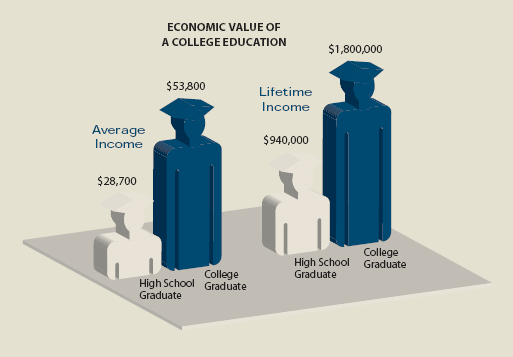
       The importance of a college education is well established.  People understand that a college education will increase the likelihood of entering into a satisfying profession and earning a higher income.  Indeed, college enrollment has risen significantly over the past 15 years.  In 2011, 21 million people attended U.S. colleges compared to only 15.9 million in 2001.

       We have won the battle of convincing students of the value of going to college.  But our goal isn't really for more students to "go" to college; our goal should really be for more students to "graduate" from college.  On that metric we are still far from claiming victory.


       Rates vary depending on the source of the information, but overall it is fair to say that merely getting accepted to college is absolutely not a guarantee of graduating from college.  In fact, many colleges have such a terrible graduation rate among students that have been attending for four years that they prefer to publicize their SIX YEAR graduation rate rather than their four year graduation rate.  According to the Chronicle of Higher Education, the six-year graduation rate means the percentage of students who are able to complete a four-year program within six years [!] .  Even this extra time only raises the overall college graduation rate to around 50%.


       Can you imagine the outcry from the public, from our government, and from our students if the high school graduation rate was only 50%???  Yet, this fact is not widely known by the public.  Little more than half of our students that begin college actually finish college.  And if you look at the data by race, the news is even worse.

       Of course there are many reasons for why students drop out of college.  A Harvard Study cites the following reasons:
- not being prepared for the rigors of academic work
- inability to cope with the competing demands of study, family, and work
- cost


       Our public schools are in a constant battle with students (and sometimes with parents) over the dueling pressures of Learning versus Getting Good Grades.  Some students care little about actual learning and only want to do what is necessary to earn a good grade.  While their teachers are pushing them to learn, to understand, and to use the learning they've acquired to learn more.  I believe that a major reason for the low college graduation rate is students who do enough in high school to get accepted to college, but don't enough (in high school) to gain the knowledge and the discipline they need to succeed in college.

       We must do better on this front.  We must continue to stress the importance of true learning and true understanding of P-12 content.  We have to lessen the importance of grades and increase the importance of real learning.  In the end, it's not that we want students to attend college; what we really want is for students to graduate from college.


Public Schools and Choice

       Is it true that public school kids and their public school parents don't have choices?  I'm sure that I will expose my igno...

Teach100 blog