Starting a new job is exciting...and scary. And when that new job involves a classroom full of students who are depending on you; and they all have parents who are depending on you; and you're expected to use technology that you've never used before; and some student don't try to do their best every day; and ... and ... and .... Well, you get the idea. New teachers and veteran teachers have pretty much the same job and the same responsibilities. But I've got good news for new teachers: You don't have to know everything.
Today's teachers are better trained and better prepared for that first day on the job than ever before. Policies and laws and general "good practice" have prepared our college graduates well. Student teaching requirements and excellent mentors during teacher training programs help our future teachers to understand curriculum, experiment with teaching strategies, and learn to interact with students. But teaching is not the sort of job that can be fully learned in a college classroom. Teaching requires practice and a fair amount of trial and error. Every student is different and every group of students are different. You can't be fully prepared for every situation when you begin teaching.
For this reason, I tell new teachers that they are not expected to know everything when they begin their career. I encourage them to ask a lot of questions and to seek advice from fellow teachers and from their principal and assistant principal. It isn't that new teachers aren't prepared to accept the responsibilities of the job--they certainly are. But teaching is much more of an art than some sort of mechanical process. Anyone can explain some idea or concept to a bunch of students. But a teacher wants every student to understand the idea so well that they can discuss it with other students, ask questions about it, and even build on this new knowledge and find connections to other ideas and knowledge that they already have.
New teachers who strive to improve and to learn from others are usually viewed in a good light, even if they make a few mistakes along the way. Furthermore, I feel that it is the responsibility of the school and the school district to continually provide supports that will help new teachers to become better teachers. We know that our best teachers are the ones who continually look for new and better ways to reach their students. The world changes and we need teachers who are willing to change as well. This is true for experienced teachers as well as for new teachers.
We understand that it is stressful to accept a new job with new surroundings, new people, and new responsibilities. We want new teachers to be comfortable and confident. With adequate supports, new teachers can approach everyday knowing that nobody is perfect and mistakes are part of the learning process. This is what we tell our students and it applies to the teachers too. Teaching is an awesome responsibility, and understanding that teaching is a learning process helps new teachers to get through that first year eager to begin their second year.
Learning is highly dependent on the skills and abilities of the teacher. According to Hattie, the following influences rank very high in their ability to raise student achievement:
teacher estimates of achievement
collective teacher efficacy
teacher credibility
classroom discussion
teacher clarity
improved classroom instruction
Since we know that teachers influence student outcomes, we want to be sure that our teachers are the best that they can be. Hence, teachers are evaluated on a regular basis to be sure the they are effective and (hopefully) are improving.
A common tool that some school use to evaluate teachers is the Charlotte Danielson Framework for Teaching. This tool, updated in 2013, looks at the job of teachers in four different domains:
Planning and Preparation
The Classroom Environment
Instruction
Professional Responsibilities
Each of these four domains are further divided into five or six components that zero in on specific factors that influence effective teaching. When this Framework is used to evaluate teachers, each component of each domain is considered and teachers are provided with a plethora of useful feedback. It is this feedback, along with conversations between the teacher and the evaluator, that lead to continuous improvement among our teachers.
Different school systems use different processes for evaluating teachers. However, all school systems recognize the value of teacher evaluations. Schools change. New materials, new technology, new information about how students learn; all combine together and require teachers to change what they do from time to time. No one wants a teacher who has used the same materials for 20 years; or who hasn't changed their teaching strategies (or improved their teaching strategies) for 20 years. We want teachers that recognize the needs of their students and adjust their teaching accordingly.
Teacher evaluations are an important part of the teaching profession. The improvement that we seek in our students, we also seek in our teachers.
What does it mean when you get an A in a class? I'm not asking, "What is it supposed to mean?" I'm asking, "What does it actually mean?" Does the "A" in Chemistry mean the same as the "A" in History? Does the "A" in Physical Education mean the same as the "A" in English? What does a "B" mean; what does a "D" mean? Did you ever get an "A" in a class--middle school, high school, or college--and then brag to your friends that you didn't learn a thing? Did you ever get an "A" or a "B" in a class and fail the final exam? Did you know someone who consistently earned "A's" and "B's" in math classes and couldn't score over 500 on the math portion of the SATs?
Howard Pitler list four major problems with our current system of using letter grades:
There is no consistency from teacher to teacher or from school to school. Schools and school districts may have different policies about grading; and these policies aren't necessarily the same from school to school or from school district to school district.
Teachers decide the factors that go into a course grade and they decide
the weighting for each of these factors. So called "hard teachers" and
"easy teachers" is actually a real thing when it comes to grading in the
letter grading system. Some teachers are more demanding than others; some teachers award
"points" for non-academic behaviors such as showing up to class on time
or not using all of your allotted bathroom passes. Merely completing homework can be part of the grade regardless of the quality or the "learning" that may have occurred while completing the homework.
Grades discourage students from learning. Pitler quotes Alfie Kohn who says,
“Kids who are graded—and have been encouraged to try to improve their
grades—tend to lose interest in the learning itself, avoid challenging
tasks whenever possible (in order to maximize the chance of getting an A),
and think less deeply than kids who aren’t graded.” The target becomes
the grade rather than the learning. Students take less challenging
classes because they want to “protect” their GPAs.
4. Lastly, true learning often requires multiple attempts in which ultimate success doesn't happen until the end of the process. When students are more concerned about "getting grades", they tend to try less, they are less willing to go through the necessary struggle needed to achieve the ultimate level of true learning.
There is another way to measure student learning and that is to compare their learning against standards (or proficiencies or competencies) that everyone can agree on. Proficiency-based Learning is not new. In fact it is growing in popularity among educators who want students and parents to have a better understanding of the actual learning that is taking place in our schools. One of the hallmarks of proficiency-based learning is the idea that students need time to re-visit topics and ideas in their journey toward true learning and true understanding. Hence, assessments are used to help students and parents to "see" the learning that occurred and to recognize the learning that still needs to happen. When students are re-assessed, grades aren't averaged. Instead, higher grades at a later time in the learning process are recognized as the actual level of learning that occurred. Therefore, students are encouraged to try harder.
Proficiency-based Learning should also allow students to work at their own pace. Ideally, they should not move on to something new until they have a good understanding of the current lesson or idea or standard. Also, students may have opportunities to demonstrate their understanding in multiple ways; not always via a summative test--however these tests can be still be used.
Schools are for learning, not for "getting grades". And we need to have a better system for identifying the learning that takes place. Too many students are graduating from high school without the skills to hold a job or complete college or make good decisions for themselves. We need to do better for our students so that they will have better options for their futures.
My entire professional career has been in Secondary Mathematics. As a middle school teacher, high school teachers, department chair, and supervisor; I have been immersed in the field of teaching and learning mathematics. Whenever conversations arise about the instruction for very weak students or for very advanced students, there seems to always be special considerations for students when it comes to mathematics. Principals, school counselors, and special educator alike all agree that the teaching and learning of mathematics seem to require very different skills compared to the teaching and learning of reading and history and (perhaps) other subjects.
Keith Devlin has a relatively simple answer to this question which he explains in his paper written for the Mathematical Association of America titled, In Math You Have to Remember, In Other Subjects You Can Think About It. Devlin explains that mathematics is often taught as a series of rules that you just have to memorize. Whereas other subjects such as history and science are taught within a context that help the learner to make sense of the content. Mathematics could be taught within a context (and, I would say SHOULD be taught within a context), but it usually isn't. This makes mathematics seem like a secret language with tricks and complicated rules that sometimes work in some situations and don't work in other situations. When mathematics is taught as merely a bunch of skills without any understanding of how and when to use these skills, many students struggle to be successful.
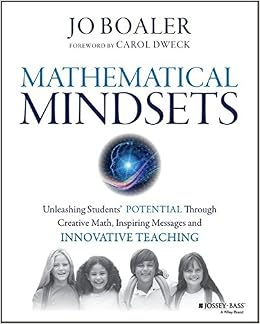
In her book Mathematical Mindsets, Stanford professor Jo Boaler explains that all students can learn mathematics if teachers are equipped to help students to build understanding. While it is relatively easy for trained secondary mathematics teachers to learn these techniques, most teachers have not received this training when they were in college. Furthermore, most adults today (parents, school principals, school counselors, etc) grew up learning mathematics through a strictly procedural approach. Because of this experience, most adults believe that mathematics should be taught as a bunch of skills.
Fortunately, more and more teachers are mixing more and more conceptual understanding in their mathematics classrooms along with learning the skills. There are places in which math is taught somewhat differently than it was taught in past generations, and this is a good thing in my opinion even if it makes some parents feel uncomfortable. Math should not be taught as 100% skills without any connection to the real world. For most students, this sort of instruction is just too abstract for them to understand.
Mathematics is also a subject that builds on itself from school year to school year. Students need to have a good understanding of the concepts so that they can build on previously learned content to understand the new content. This idea of building from year to year is more prevalent in mathematics than it is in other subject areas.
Education and learning is the result of hours of planning and hard work on the part of teachers and students. Behind the scenes in every public school that cares about student learning, there are individual and teams of teachers that use data to make good instructional decisions.
In years past, we only had data from chapter tests. But since the chapter was completed and the instruction has already moved on to the next topic, this data was already "old news". It couldn't be used to help us to make good instruction decision for right now. Today teachers understand the power of using data to guide their decisions. When the public hears about school data, they often think about tests results--probably because that is the most common form of data that is published in the news. But teachers use all sorts of data that doesn't include test data.
Data-Driven Decision Making
Public school teachers measure student progress in many ways in today's classrooms. Teachers use rubrics to assess projects or some assignments. Teachers use games. Teachers use exit tickets. Questions, discourse, group work, individual work, electronic responses, etc. Teachers have multiple sources of student data. This data is used to help teachers to decide:
Who gets it.
Who sort of gets it.
Who doesn't get it.
These determinations are used to help teachers to prepare for the next lesson. Chapter tests and large, state-wide standardized tests are a "final" product of the educational process. They don't help us in our day-to-day planning. It is the daily collection of data from formative assessments that inform instructional decision. It is also this data (or the information from this data) that help students to gain a sense of how well they are understanding the content.
Indeed, learning is a process. It takes time and practice and effort. It requires students and teachers to ask a lot of questions and often to make mistakes along the way. It requires thinking and reasoning based on what we've done so far and what we still need to do. The data that comes from these efforts help all of us to measure progress toward the goal of learning. Most of this data analyzing is invisible to the public. It is the technical work of teaching that is too "un-interesting" to print in the newspapers and yet vital to the practice of teaching.
Data drives decisions for students and schools. Data is the fuel that keeps our classrooms running in the right direction.
If students aren't learning, then the teacher isn't succeeding.
This is a harsh statement. Clearly there are lots of reasons that prevent students from learning. Some of these reasons can be due to teacher actions in the classroom and some are outside the control of the teacher. But the main goal of school is learning. If the student isn't learning, than we haven't met this main goal.
Of course, not all students learn in the same way. When a teachers presents a lesson--be it via lecture, or a game, or discovery learning, or through the use of a task, or some combination of these methods--some students will "get it" and some will not. And so our best teachers are constantly looking for different ways (different teaching strategies) to help students to learn. This (indeed) is the part of teaching that very, very complex. Trying to understand the best way to help students to learn--every student in every class--is the struggle of every teacher.
Alas, the world of education is full of ideas to help us. Some of these ideas fall into the category good suggestions that any teacher should use, such as:
Scaffolding - breaking up the learning into smaller chucks and allowing students the time to learn one-piece-at-a-time in the effort to get them to learn the whole idea or standard.
Graphic Organizers - providing students with different ways to organize information so that "many ideas or facts" are easier to see and to understand.
Multisensory - presenting new information in multiple ways that help the students brain to store the information in multiple ways. For instance, verbally explaining something while also writing the information on a whiteboard or computer screen, while also (perhaps) providing a manipulative or foldable for the student to hold and work with tactilely.
Other ideas are more specific as to the sort of instructional style that may take place in a classroom. A typical example of this would Direct Instruction or Lecture. This is very typical in classrooms in the United States; particularly in our high schools. Adults in their 70's and 80's probably received instruction in this manner when they were in high school and their grandchildren and great-grandchildren likely receive their high school instruction in this same mode. Some people refer to this sort of instruction as Traditional classroom instruction--and it clearly is not effective for all students.
More teachers are using a Discovery Learning approach to classroom instruction at least some of the time in their classes. This approach allows students to build on past learnings by completing tasks and problems that require them to do so. Students may work individually or in small groups of three or four while the teacher responds to students' questions and encourages students to think about other solutions. This approach is common in some countries but is much less used in the United States.
I am part of a couple of math groups on Facebook and I posed the question, "Is Direct Instruction Necessary?" I went on to ask if Discovery Learning could be the sole or major teaching strategy in a high school math class. Of course the responses that I received were various and wide ranging, but I did learn a lot more about individuals and groups of teachers who use this approach with some success.
When teachers are continuously searching for more and better ways to reach their students, everyone wins: students, teachers, schools, society.
In the past, this phrase was a derogatory phrase that meant (at the extreme) the only thing we do during class time is to prepare students to take a test. This implied that we never taught additional topics that weren't on the test, and that we never taught at a higher rigor level than what was required on the test. The other (more broad) implication was even worse; We didn't concern ourselves with whether or not students actually learned anything, our only concern was that they got a high score on a test.
This sort of Teaching to the Test probably did occur at many public schools, but I would hope that teachers (and schools) never lost their desire to encourage learning over mere test grades. Indeed, teaching at a higher rigor level than was required on a test would serve the dual purpose of (1) helping students gain a higher level of conceptual understanding, as well as (2) helping students to score well on a test. So we had incentives to go beyond the content that appeared on a test.
Today we see teaching to the test much differently. First of all, we are now seeing standardized tests that require much more than merely a single-word, or single-number answer. Today's test require students to demonstrate a high level of understanding. This means that the days of memorizing formulas or (even worse) memorizing shortcuts and tricks are over. Student who are only able to follow procedures and answer low-level questions will not earn high marks on today's tests. Secondly, I feel that there is a renewed interest in teaching students how to engage and reason and think and argue and prove. These are the skills that lead to a better conceptual understand over and above the old get-the-right-answer sort of teaching that took place in the past. In this world, Teaching to the Test is the same thing as simple "Good Teaching".
I know that the issue of standardized testing has become as controversial and divisive as the abortion issue to some people. I found a great article on the Pros and Cons of Standardized Testing that may provide additional information to those folks that only see one side of this issue. Regardless of your views, all people want their children to do well in school and (I hope) "doing well" means learning and not getting-good-grades for most people. The primary objective for our public schools is certainly learning. If students aren't learning, than there's no point in coming to school.
Today I am seeing a resurgence in helping teachers to explore classroom strategies that help students to learn concepts so well that they can teach them to other students. Gone are the days of rote memorization. That sort of teaching isn't good enough if we want to prepare our students for the world of work and further learning in their futures. Teaching to the Test is good if it helps our students to be better problem solvers.
Schools, educators, teachers...they are never satisfied. We are the ultimate Olympic athletes when it comes to our desire to constantly improve. In education, "Good Enough" is never good enough.
While it is often true--though not in all schools--that most students do fine; most students learn to read pretty well, most students move on to the next grade, most students graduate. There are always some students that don't or that struggle to reach these accomplishments. And even for those that do succeed, What is our standard for success? Is it a passing grade? Is it to barely exceed the minimum? Is it to be merely good enough?
The best teachers are constantly striving to find ways to reach all of their students. The students that do what they are told and are able to "succeed" in school without much effort should be pushed to do more. The students who always excel academically should be pushed to do more. And the students that struggle to meet the minimum requirements should be given the help they need to do better. All students can do better; all teachers can improve; all schools can strive for better results.
The goal of school is learning. But students approach this goal from many different viewpoints. Some strive to be "Number 1"; some do their best everyday and accept that they may be stronger in some areas than in other areas; some students struggle in math but are good at reading; some students seem to struggle in all academic subjects but are talented in the arts. And some students have been beaten down so often by their schooling experience that they have given up on trying. All of these people come together in the typical public school and it is the job of the educators to more all of them forward.
It is hard to have one policy or one standard that applies to everyone when "everyone" is so different. Maybe the goal shouldn't be to reach a standard as much as it should be to improve based on whatever your starting point is. If you come to 7th grade able to run a mile in 9 minutes and 36 seconds, maybe you should strive to end 7th grade with a time of 9 minutes flat or 8:30. Similarly, if you begin 7th grade with a reading ability that is considered "average", may you should strive to end the school year above average in reading. And if you are a teacher who always struggled to help those students who always want to sit in the back of the classroom and never participate, maybe you want to have the goal to encourage them to answer questions and to offer their ideas at least twice in every class.
The goal isn't to be Number 1; the goal isn't to "win". School is not a competition. The goal is always to improve regardless of your starting point. Nobody should accept "Good Enough" as good enough.
The "worksheet" has been a staple of the P-12 educational experience for students for the past 30 to 40 years--maybe longer. The advent of the mimeograph machine and then the photocopier made the duplicating of massive amount of worksheets easy, cheap, and increasing common. Today there are multiple websites with pre-made worksheets for math, reading, geography, science, and just about any other school subject. Some teachers love using worksheets. Some use a worksheet everyday or nearly everyday. In middle and high school math classes, students sitting in rows in the classroom and independently completing 20 or more math problems on a worksheet is an iconic image that many parents remember as a child and still expect to happen to their children today.
The problem with the massive use of worksheets in today's classrooms is that they represent the opposite of everything we now know about how students learn best and what we hope to accomplish in our schools. Math worksheets in particular go against many of the tenets of good learning and good teaching. Here is my short list of why worksheets are a poor choice for today's classrooms:
Worksheets are boring.
Worksheets discourage students from working and learning together.
Worksheets are often very low on the rigor scale.
Boring
I often say to my teachers that it isn't our job to entertain students, but it is part of our responsibility to motivate students to do their best. The old days of the teachers who basically use the "Because I say so" theory of teaching is over. Students may do what they are told, but they won't like it. So the next question is, "Why do we care if the students 'like it' or not." And the answer is student engagement. The Glossary of Education Reform says the following about students engagement:
...the concept of "students engagement" is predicated on the belief that learning improves when students are inquisitive, interested, or inspired, and that learning tends to suffer when students are bored, dispassionate, disaffected, or otherwise "disengaged."
Simply put, there is no educational reason for a student to complete 20 (basically) identical math problems. If they know how to do solve the problem, then completing about three should provide sufficient evidence that they can do it. If they don't know how to solve the problem, then they won't be able to solve 20 problems. Or, they will make the same mistake 20 times and be very upset to discover this mistake the next day when the class goes over the answers.
Students Working Together
When there are 30 students sitting in class and learning something new, most won't fully understand everything there is to know about the new learning right away. Some will try to link the new learning to past learning; some will try to memorize the steps or the procedures; some will just take notes and not really understand anything right away. When the teacher assigns classwork that is meant to be done independently, students have a lot of questions. Some will ask their questions, but most won't because they don't want the teacher to think that they don't get it; or they don't want their classroom peers to think that they are stupid. Some students won't even know what questions to ask.
However, when students are encouraged to work in groups of (say) two to four students AND when they are encouraged to ask each other questions, they are much more likely to ask their question(s) and to help each other. Each person in the group may understand a different piece of the new learning and together they can help each other. Additionally, we know that when students can explain what they are doing, they understand the concepts much better than when they merely answer questions or solve problems independently.
Rigor
Although not always the case, worksheets tend to emphasize low-level, procedural skills such as following steps to solve a problem, or defining a word, or finding a fact from a reading passage. While we want students to have these skills, I question the need to constantly repeat this (worksheet) activity for the purpose of helping students to gain these skills. In today's classrooms, we want to emphasize thinking and reasoning and problem solving. We want students to recognize particular situations that require particular skills or procedures.
What formula do I need for this problem?
What further information do I need to determine before I move forward?
I'm not sure what to do, but I'll try this first and see what happens and progress based on this "first try" experience.
In the math world, we now use activities called Math Tasks. (For some great examples, see youcubed, nrich, (also here), and MARS.) Math tasks cover the same content as worksheets, but they require more than merely asking students to repeat what they heard a few minutes ago when the initial lesson was taught. Good math tasks begin with some basic information and slowly increase the level of rigor as the tasks goes on. Students spend the same amount of time in class on a math task as they would on a worksheet, but instead of doing the same thing over and over (20 or more times), they are pushed to think about the new learning in new ways.
This sort of rigor is better suited for students to work in groups than to work individually. Group work is more amenable to higher-level problem solving
that requires input and ideas from multiple people. The group members
can discuss and debate the different solution methods and (hence) they
can gain a stronger understanding of concept or standard being
discussed.
I could go on...
Worksheets, at their worst, are used to keep students busy during precious class time. In fact, many students refer to worksheets as "busy work". Even the students know that (sometimes) teachers are just using worksheets to fill time in the class. And this is time that could be better spent with student-to-student discourse or whole-class discourse at much higher levels than the simple worksheet could ever achieve. Worksheets do not promote learning beyond simple recall and following procedures.
Worksheets are "old school". Worksheets do not prepare our students for their future. Worksheets should be (very) infrequently used in today's classrooms if we truly intend to prepare our students for life after high school.
The typical, tradition classroom has the teacher doing most of the talking. The teacher asks questions, the teacher gives information (verbally), the teacher decides if the answers are correct or incorrect. And the students do very little talking. In the traditional classroom, student talk is for answering the teacher's questions and that's about it.
But in the Learning Classroom, students do a lot of talking. They ask questions. They offer solutions and ideas. They consider alternatives, shortcuts, more efficient pathways to learning. There are lots of great benefits to student talk in the classroom. Here's a list of ten such benefits:
Participation adds interest
Participation engages students
Participation provides the teacher feedback
Participation provides the students feedback
Participation can be used to promote preparation
Participation can be used to control what’s happening in class
Participation can be used to balance who’s contributing in class and how much
Participation encourages dialogue among and between students
Participation can be used to develop important speaking skills
Participation gives students the opportunity to practice using the language of the discipline
We want students to ask questions because real learning requires more than just memorizing what the teacher says. It requires thinking and reasoning and trying and failing and trying again. Real learning encounters road blocks from time to time and students to ask questions about how to navigate around these obstacles. When students ask questions that are engaged in learning and they learn better and more deeply when they are engaged.
The bad news is that everyone doesn't believe this. In fact, lots of people don't believe this. How many times have you or someone you know said, "I'm not good at math." or "I'm not a 'math person'." or "I don't have a math brain."? You never hear people say this about Science or Social Studies; it's only about math. And the reason people say this is (probably) because of the way they learned math in school.
Math has always been taught as a bunch of rules to follow, a lot to senseless things to memorize, and a whole lot of procedures to do. Nobody ever taught you why these procedures make sense or why these rules are in place. They just said something like "You have to know it." (This is akin to the parent who says to his or her child, "Because I say so.") Not a very good reason and certainly not a compelling reason for learning and understanding.
And to make matters worse, we now have generations of people (parents and grandparents) who believe that this is the way math is supposed to be taught. We have parents saying to their children, "I know it's hard and I know it doesn't make sense, but this is just the way it is and you have to do it." This is a terrible message for students to receive. It says to students that even their parents think that math is weird and confusing and doesn't make sense. It reinforces the message that says "You will probably not understand this." So a lot of students accept this message and basically say, "Fine. I'm never going to 'get it', so I'm not going to try anymore."
It doesn't have to be this way. Our mathematics classrooms can be filled with positive messages that tell students that math is about creativity and making connections. Messages that tell students that it is OK to make mistakes in math class because that is how you learn. And messages that explain that you don't have to be first to get the correct answer. In fact the best math students are slow in thinking and reasoning and understanding.
Everything in this post comes from Dr. Jo Boaler and from the website that she created called YouCubed. She has spent her professional career trying to understand how students learn and how teachers teach. Her ideas and suggestions can lead to a new world of mathematics teaching and mathematics learning. All of this is based on research and not from one person's point of view or experience.
Understanding math is important and we need public school teachers to teach for understanding; we need parents to encourage understanding in math class; and we need students to believe that they can learn mathematics as easily as any other subject.
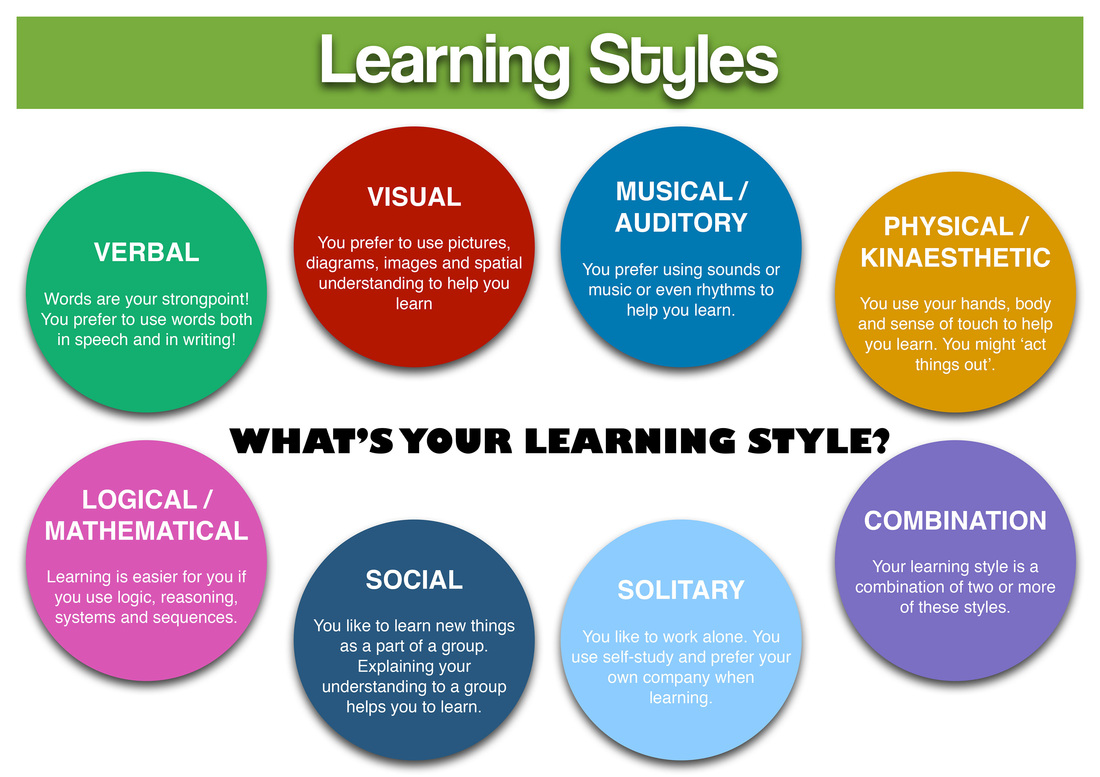
The goal of school is learning. The challenge for our schools is to help all students to learn when students are so different. Some prefer to work by themselves. Others need to bounce ideas off of their peers. Some need only to hear the information while others need to actively "do" something to help them to learn.
The mystery of how students learn has baffled educators for a long time. The puzzle of "some-kids-get-it" and "some-kids-don't-get-it" has been difficult to understand. I think that--for a long time--teachers referred to their own ability to learn (and perhaps that of their peers) and felt that all students probably learned the same way they did. In fact, I wonder sometimes if some present day teachers use the same technique. And while there are still many unknowns in the field of learning, it is fair to say that we know more today about how students learn than at any time in our history.
For starters, brain research has provided a wealth of information about how we learn. Here's a short list of things to know about how the brain learns:
We receive information better when it's visual.
We remember the big picture better than the details.
Sleep affects learning and memory.
Less sleep reduces your ability to learn new information.
We learn best by teaching others.
Next, we have a lot of help in the field of learning from experts and practitioners. After a while, we begin to see common themes in the area of helping students to learn:
Engagement - Students who actively participate in their learning find it enjoyable and are better able to retain the information.
Challenge - We learn best when we are forced to think and try and fail and try again. Also, when we are forced to recall past learning and use that information to understand the current learning.
Growth Mindset - If we believe that effort yields results then we are more likely to do our best to preserve in the face of any struggles that may occur as we learn new material.
Still, teaching is certainly a combination of Art and Science. Teaching requires building positive relationships so that we can understand our students and construct our lessons in a way that meets their learning needs. Teaching requires the ability to motivate students and to spark their interest in learning. Teachers need to challenge students enough to keep it interesting, but not too much so that it becomes too overwhelming.
The challenge of teaching is the challenge of learning how students learn. We're getting better at this, but we still have a lot to learn [!].
This is an exciting time to be a teacher. The field of education, like medicine and energy and information technology, is growing in the knowledge domain. We are constantly learning more about how children learn and the best ways to help them to learn. Brain research and its connections to learning have been able to provide to our teachers simple strategies to help students to learn. For instance, we now know that our student's brains grow and thrive when they are able to have good social connections with other students. Therefore, we need to provide time for student-to-student discourse in the learning environments of our classrooms. We know that the brain and the body are interwoven and are built to help each other. That's why it is important for students to get up and out of their seats regularly during class time; and recess is an important part of learning and brain development. Also, we know that fear and stress prevent students from doing their best in school because our brains are designed to err on the side of caution. Fear shuts down our student's ability to explore and to try new things because their brains are more concerned with staying safe.
In the past, teachers and relied on their own experiences as students themselves and later on their own teaching experience to help them to reach their students. But this is never going to be good enough because we are all limited in our experiences to a particular school or a particular town or a particular age group of students. The research findings and subsequent professional development about these findings help our teachers to learn about learning beyond what they see in their classrooms. Initiatives such as Blended Learning, Universal Design for Learning, and Flipped Classrooms all stem from relatively recent research on how children learn best and how to incorporate these research findings into the classroom.
Of course all of these exciting frontiers in education require (at least) some level of changing from the "known" image of the classroom to something different--and that can be scary for some people. Present-day parents who sat in neat rows in every classroom and rarely spoke in class and worked on (the now-dreaded) worksheets all day long may be against anything different from what they experienced simply because "It worked for me." That's why the research is so important. It isn't some guy with and idea, it is actual science that is informing us of the most effective classroom strategies to help students to learn. This is a good change for our students and a necessary change.
Public, private, elementary, secondary...approximate 1% of the population of the United States are teachers. With fifty million students, we need a lot of teachers.
And considering the importance of education, we (particularly) need good, effective teachers. We need teachers who do their best to understand how their students think and how they learn. We need teachers who understand the content that they teach, but mostly we need teachers who want to work with children; we need teachers who like to work with children.
Over my career, I've noticed a subtle difference between wanting to be a teacher and wanting to be an effective teacher. Our best teachers are also good learners. They study their craft; they learn from other teachers; they seek information about adolescents and how the brain works. No one is born with this knowledge; it takes time and effort to gain this level of expertise. And most people never know the hard work that went into making these teachers so effective.
In the book Linking Teacher Evaluation and Student Learning, authors Pamela Tucker and James Stronge give the following list of attributes of effective teachers:
Have formal teacher preparation training.
Hold certification of some kind (standard, alternative, or provisional) and are certified within their fields.
Have taught for at least three years.
Are caring, fair, and respectful.
Hold high expectations for themselves and their students.
Dedicate extra time to instructional preparation and reflection.
Maximize instructional time via effective classroom management and organization.
Enhance instruction by varying instructional strategies, activities, and assignments.
Present content to students in a meaningful way that fosters understanding.
Monitor students' learning by utilizing pre- and postassessments, providing timely and informative feedback, and reteaching material to students who did not achieve mastery.
Demonstrate effectiveness with the full range of student abilities in their classrooms, regardless of the academic diversity of the students.
Everyone wants their children to have effective, caring teachers. Class time is valuable learning time and effective teachers make the best use of this time.
Like New Year's Day and your birthday and the first day of school, Mondays can be important (and frequent) firsts. They are opportunities to begin something great; to get a fresh start. Everyone is well rested from their two-day vacation and filled with stories of their adventures over the weekend. Mondays can be the days to move on from the trails and tribulations of the past week and begin anew.
How do you begin the school week in your classroom? What is your goal for the week? How do you greet your students on Mondays?
In the same way that (we know) students tend to be more attentive in the beginning of every class, we have a unique opportunity on every Monday to take advantage of the "newness" of the week and to start something exciting.
As I finish my second full year of blogging, I'd like to take a look back at 2015 and the five posts that got the biggest response from my readers. But first I'd like to thank some of the many fellow bloggers that I've read and (sometimes) responded to over this year. These professionals have caused me to pause and think about the various issues in public education that (perhaps) need to be changed; or that need to at least be debated. I've also read many, many inspiring stories about teachers who work very hard--with little recognition--to help their students to succeed.
Thank you to Alice Keeler, Starr Sackstein, Justin Tarte, Annie Murphy Paul, and Daisy Dyer Duerr. I used to think that these were Super-Hero People who had some special gift or ability in the area of education. But I've come to understand that they are just regular people like you and me who are eager to share their thoughts and ideas with the rest of us. I, for one, am extremely grateful to include them among my professional learning community. (And so are tens of thousands of other educators who follow these folks!) I am continually inspired by your words; you keep me going and keep me writing. Thank you.
This was the second (and most popular) of a three-part series of Open Letters to the three most important stakeholders in our educational system: Students, Teachers, and Parents. I wrote this "letter" to teachers on the eve of the 2015 - 2016 school year. It was published on August 19th. In it, I talked about how excited teachers are when a new school year begins--something, I bet, a lot of students don't realize. I wrote about the tough job of teaching and I applauded the men and women who accept this responsibility. Sometimes being a teacher involves difficult conversations with students about the need to continually struggle to learn something that isn't easy at first. Teachers shape the minds that shape the future of our country. Teachers' influence over student achievement is well documented. We always need great teachers.
Published on March 28th, this is an issue in which I feel very deeply. The issue of the best way to measure learning and the problem (at times) of students appearing to be learning well (i.e. - getting good grades) but its only an appearance and it isn't real learning.
I feel that P-12 education is the time when we have to be honest with students and their parents. We don't want students to believe that they are achieving at a high level only to learn later in life (perhaps while sitting in a college class) that the grades they earned in high school did not represent their true ability. The job of schools is to help students to learn. We need to use multiple measures to get a true picture of their level of learning. "Getting-a-good-grade" is not the job of schools.
#3) We Should Value Good Thinking More Than We Value Good Memorizing
This post, from May 29th, quotes from Dr. Jo Boaler and Cathy Seeley. In it, I talk about how our students' thinking should be rewarded more than their ability to memorize math facts. Sometimes elementary children who are very good at memorizing their multiplication facts (and recited them quickly) are viewed as being more able than students who cannot do this. But we really don't students who can merely memorize facts. What we really want is students who can think and reason and build on known facts to gain further knowledge. Sometimes students memorize facts without knowing why the facts are true. Later in their P-12 education they struggle because of this lack of understanding. The goal isn't speed; the goal is learning.
I began this post (from April 3rd) with a simple question:
Does you your child's mathematics teacher assign a lot of worksheets for homework and classwork?
If the answer is YES - Not a very effective teacher. If the answer is NO - Likely to be a more effective teachers.
Of course, this is an exaggeration, but the point is that this staple of P-12 education (the worksheet) should be a thing of the past. They are boring; they are very un-engaging; and they de-emphasize thinking over mere "following steps". They represent the opposite of what we want to see in our classrooms today. Students should be spending class time reasoning and thinking and debating; they should be sharing ideas and thoughts. They should hear from other students. By the response I got from my readers, I'm thinking that this idea is not as radical as it may sound to some.
This post had the most views of any post I've written since I started blogging more than two years ago (142 posts). I talked about the idea of Growth Mindsets as created by Carol Dweck. Specifically I talked about teachers who have the mindset that says anyone can learn. These teachers help their students to understand that learning is always possible; productive struggle is a good thing; and their past negative learning experiences does not predict their future learning.
Thank you to everyone who have shared this journey of learning and thinking with me in 2015. The best of us are always trying to improve and to learn more. Continue on and find your way to be the best educator you can be.
I remember my Algebra 1 teacher taking off his shoes and socks in class one day. He did it to demonstrate the need to do certain things in a proper order--otherwise, it just doesn't work. The Algebra lesson probably had something to do with Order of Operations, but the real lesson was to complete each step in a process in the correct order.
That lesson happened over 30 years ago and I still remember it because it was a little silly; a little goofy. It wasn't a lecture; it wasn't a worksheet; it wasn't the normal classroom. It was strange and odd and that it probably why I remember it. As an educator (now), I think I also remember this event in class because it showed me that my teacher was willing to be a little silly to make a point. He didn't have to be the Big Formal Authority in the classroom at every second of the class. He was allowed to have some fun with his class--and still be a great teacher.
I often tell teachers that it is not our job to entertain. But it is part of our responsibility to motivate students to do their best. Students don't think in educational terms such as "student engagement", "participatory learning", and "stations". Most students just this fun. It's not a show; it's not entertainment. "Fun" to students is when the math class or the English class involves the students in the learning. Its when students are not forced to stay seated for the whole period; to listen and not talk for the whole period; to take notes and learn on their own for the whole period.
What students call "fun", teachers call "good teaching". You don't have to be an entertainer to be a good, engaging teacher. Chances are most teachers are already excited about the content that they teach. The job is to convey that excitement to your students. Involve them in the learning. Allow for time out of their seats; time to talk and argue with other students; time to think and create and share their thoughts and ideas.
Students don't just "like" the class better when they are involved, they actually "learn" better. And isn't that the whole point of school in the first place?
Our school district recently had an essay contest in which students were asked to describe their Ideal Math Class. Submissions came in from students in grades 4 to 12. Nearly every student said that they wanted to work in groups for at least a portion of the class time. Students want to have the opportunity to ask each other questions and to share their ideas with a small group of peers.
Students able to take ownership of the subject matter.
Students develop communication and teamwork skills.
Content is reinforced as students work together and "teach" each other. This improves understanding through additional discussion and explanation.
Content may be broken down into parts. This allows students to tackle larger and more complex problems and assignments than they would be able to do individually.
Students can work together to pool their expertise, knowledge and skills.
Students hold one another responsible and accountable.
Teaches students to plan more effectively and manage their time.
Instructors benefit by seeing students approach problems in novel and unique ways. This can improve the instructor's perspective and make their future teaching more effective.
Instructors are able to have the content reinforced by giving the students ways to apply what they have learned in a collaborative setting.
As teachers, we want students to have different learning experiences. We know that all students do not learn best by merely listening to the teacher and taking notes. We want students to learn how to learn and one way to do that is to give them these opportunities in the controlled atmosphere of the classroom. "Group work" is a general term that can be implemented in many ways in the classroom. The Cornell University Center for Teaching Excellence has suggested many ways for teachers to incorporate group work into their lessons. Marzano lists cooperative learning as one of his Nine High Yield Instructional Strategies. Group work breaks the mold of the traditional teaching model that keeps the teacher in the front of the room all the time and the students in neat rows of desks and (usually) not talking very much. Group work requires planning and preparation on the teacher's part. It also requires teachers to allow some productive, learning noise to be part of their typical class on a regular basis. As we prepare our students for the world of work, we need to give them opportunities to work and to learn with their peers as this will (very likely) be a part of their own professional experiences as adults.
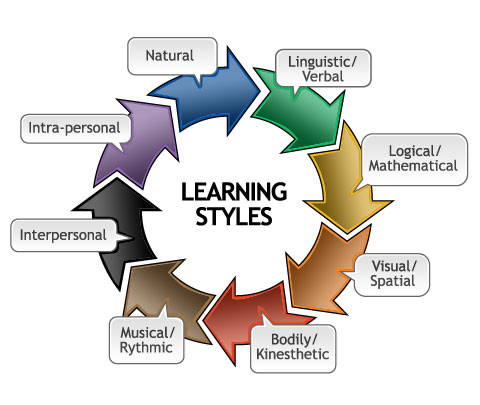
How does a teacher enable students to learn? How do students learn? How do people learn? Teachers who seek to reach their students struggle with these questions all of the time. Experience (and research) tell us that students learn differently. When we teach a lesson to 30 students; some get it right away, some get part of it, some don't get it at all. How is that possible? All of the students heard the same lesson; yet not all of the students had the same level of "Learning".
This can lead to a difficult and awkward situation in which the teacher feels offended that the his or her efforts went to naught; and the student feels embarrassed that he or she wasn't able to learn as well as other students. Our best teachers understand that all students don't learn in the same way and (so) they try to find different ways to present information. They present is verbally; they present it visibly on a whiteboard on a screen; they use videos; they have students read some information; they have other students explain their thinking; and so on. We use these different strategies to keep the class interesting and to increase student engagement. But we also do this because we know that all students won't learn the same way and we need to find a way to present the content in different ways so that we reach all of our students.
Einstein has been associated with the quote, "I never teach my pupils, I only provide the conditions in which they can learn." I don't know if he really said this, but the statement may be correct. It may be that no teacher can actually MAKE students learn. It may be that the best we can do is to encourage students to learn. We do this by getting to know our students very well and using this knowledge to include into our lessons those aspects that our students will find interesting. If the students are interested than they are more apt to try their best even if the learning is difficult.
Still, even when we understand about different learning styles and the value of good relationships with students, teachers are still faced with some topics that seem to be difficult for many students. Once again we struggle to crack this code of learning. How do teachers help students to understand complex topics? Indeed, this is the art of teaching. Some teachers are better at this than other teachers. In my experience, the teachers who are able to reach the most students are the teachers who learn from their own experiences (including their own failures) and who seek input from other teachers via conversations with colleagues, reading journals and research, and taking courses about learning.
Learning isn't a complete mystery--but it isn't a completely solved mystery either. Current research about how the brain works will help to answer some of our questions. Collaboration with professional teachers helps too. Teaching is rewarding and (at times) frustrating. As we learn more about the process of learning we will have more teachers with greater abilities to address the needs of more and more of our students.

 New teachers who strive to improve and to learn from others are usually viewed in a good light, even if they make a few mistakes along the way. Furthermore, I feel that it is the responsibility of the school and the school district to continually provide supports that will help new teachers to become better teachers. We know that our best teachers are the ones who continually look for new and better ways to reach their students. The world changes and we need teachers who are willing to change as well. This is true for experienced teachers as well as for new teachers.







.png)