Showing posts with label engagement. Show all posts

Tuesday, October 11, 2016

Why Can't High School Classrooms Be More Like Elementary Classrooms?

       Every level of schooling from elementary school to high school has its challenges.  Among them are teaching to the academic and age level of the students.  No one wants second graders to read high school level novels and it wouldn't be appropriate to take 15 minutes of class time to explain to high school students how to use scissors.

       However, when teachers create a learning environment in their classrooms there are some aspects of learning that are true for both elementary and high school students.  One of these is the idea that when students are engaged in their learning, they tend to do better.  There are plenty of reasons why this makes sense, and they apply to little kids as well as teenagers (and adults).

       In elementary school, while it may be true that the children are more excited about learning and school just because little kids are generally happy and willing to do what they are told to do; it is also true that their teachers work hard to make the learning engaging.  Look at this list of aspects of an elementary classroom, and consider which (if any) could not also be aspects of a high school classroom:

  • motivating posters on the walls
  • opportunities for students to be out of their seats often
  • opportunities for students to talk with each other during a lesson
  • working in whole groups
  • working in small groups
  • working individually
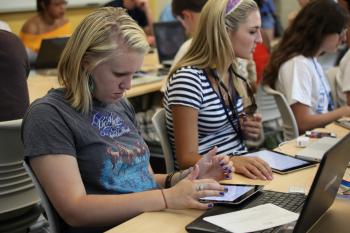
  • using educational technology
  • students given choices (perhaps about what to read or where to sit or how to solve a problem)
  • calling on every student every day
  • classwork that is challenging ("too easy" is boring and "too hard" can lead to disinterest)

       The things that make elementary classrooms fun and interesting can be replicated in our high schools.  High school students like to learn.  They also like to receive a gold star and a smiley face every once in a while.  They like to get out of their seats during a class activity and they like to ask questions of their peers to help them to understand a new concept.  High school students like motivational posters on the walls and they like to use educational technology.  All of these things keep high school students engaged in the learning process, even when the learning is difficult.

       There should be more similarities between our elementary and our high school classes when it comes to engaging students to learn.

Saturday, June 11, 2016

Reflecting on the School Year


       Did I do all I could to help my students to learn?
       Did I improve as an educator this year?
       Did I encourage my quietest students to participate?
       Did I emphasize "learning" over "getting-a-good-grade"?
       Did I communicate my expectations clearly?
       Did I establish good relationships with my students?
       Did I call on every students everyday?
       Did I help my reluctant learners to do their best?
       Did I work with parents to help my struggling learners?
       Did I push my highly-able students to do better?
       Did I model a growth mindset for my students?
       Did I provide appropriate and timely feedback?
       Did I demand the best from all of my students?
       Did I engage my students in their learning?
       Did I collaborate with my colleagues?
       Did I try something new in the classroom this year?
       Did I share my knowledge with other teachers?


       Teaching is an imperfect profession.  We get better every year; but we always have room to improve.  We connect with our students, but there are always some students that we can't reach.  We learn new strategies to address different learners, but we struggle to succeed with everyone.  Since we work with people (students) and not robots, every year is different--every day is different.  What worked last year doesn't work this year.  The lesson we spent two hours preparing usually leads to good student understanding, but not always and not with every student.

       The need to reflect on our practice and to improve every year is necessary.  Students change, principals change, resources change, the world changes.  We can't do the same thing for ten or twenty years.  We have to change too.  And when our results are less than we desire, we can't expect better results unless we change.  I often hear people say that there is no manual for being a good parent; the same is true for teachers.  But there are lots of books and courses and journals and EdCamps and conferences and colleagues for teachers to turn to get ideas and suggestions.  Experience helps; and our best teachers are those people who consistently seek to improve--those that reflect on their successes and failures of the past and yearn to improve.


Tuesday, April 5, 2016

Blended Learning - 21st Century Schools


       For the past two decades we (in education) have been talking about 21st century schools.  I've read books about it; I've attended lectures; I've read articles; I've had numerous conversations.  The crucial need to end our 19th century, factory-model schools and begin to give our students the school experience that will (best) prepare them for the world that they will inherit has been upon us for a long time.

       When I look at the trend toward Blended Learning, I see the 21st century school that I've always imagined.

  • Students are learning at their own pace.
  • Teachers can give better individual feedback.
  • Students have choices of how they learn best.
  • More student-to-student discussion
  • More emphasis on learning and less emphasis on grading
  • More student engagement
  • Less discipline issues because less students being bored in class
  • Better preparation for college and career
    • Research skills
    • Personal responsibility for learning
    • Working in teams and working individually
       Change is always hard.  But change that helps students to be better learners is change that is necessary.  Blended Learning should become the norm in our public schools.  The traditional classroom of sitting in rows and listening to lectures is not the best way to learn anymore.

       Take some time and learn about Blended Learning.  It is the right thing for our students for today and for tomorrow.


Saturday, December 26, 2015

Students Remember the Fun Stuff

       I remember my Algebra 1 teacher taking off his shoes and socks in class one day.  He did it to demonstrate the need to do certain things in a proper order--otherwise, it just doesn't work.  The Algebra lesson probably had something to do with Order of Operations, but the real lesson was to complete each step in a process in the correct order.

       That lesson happened over 30 years ago and I still remember it because it was a little silly; a little goofy.  It wasn't a lecture; it wasn't a worksheet; it wasn't the normal classroom.  It was strange and odd and that it probably why I remember it.  As an educator (now), I think I also remember this event in class because it showed me that my teacher was willing to be a little silly to make a point.  He didn't have to be the Big Formal Authority in the classroom at every second of the class.  He was allowed to have some fun with his class--and still be a great teacher.

       I often tell teachers that it is not our job to entertain.  But it is part of our responsibility to motivate students to do their best.  Students don't think in educational terms such as "student engagement", "participatory learning", and "stations".  Most students just this fun.  It's not a show; it's not entertainment.  "Fun" to students is when the math class or the English class involves the students in the learning.  Its when students are not forced to stay seated for the whole period; to listen and not talk for the whole period; to take notes and learn on their own for the whole period.


      What students call "fun", teachers call "good teaching".  You don't have to be an entertainer to be a good, engaging teacher.  Chances are most teachers are already excited about the content that they teach.  The job is to convey that excitement to your students.  Involve them in the learning.  Allow for time out of their seats; time to talk and argue with other students; time to think and create and share their thoughts and ideas.

       Students don't just "like" the class better when they are involved, they actually "learn" better.  And isn't that the whole point of school in the first place?

Tuesday, November 17, 2015

It's Time for Our Schools to Leave the 20th Century

       You know the old joke about Rip Van Winkle and schools?  He falls asleep for a hundred years and upon waking up he sees everything he used to know has changed dramatically.  The houses look so different.  The clothes that people wear are very different.  And the cars...wow.  Then he finds a school and walks inside.  He goes into a classroom and he is comforted to see that schools and classrooms haven't changed a bit.

       We educators don't think this is very funny.

       In fact, it is embarrassing for us carry out the important work of education today in the same way that we did this work 50 or 30 or even 20 years ago.  Doing so ignores the research about learning that has been done over the past few decades.  It ignores the research about how the brain reacts to the stimuli that occurs in classrooms.

       For instance, we know that most students can't learn to the best of their ability strictly by sitting in class for a whole class period and listening to the teacher talking (and taking notes).  We know that students are more engaged when they have the opportunity to participate verbally and when they have a chance to get up out of their seat and participate physically in some way.  We have technology that we didn't have (even 20) years ago that can be tapped to help our students to prepare for the information world that they will enter after high school.

        We are not preparing our students by merely teaching them to read, write, and do arithmetic.  These things are important, but they are not enough.  Memorizing facts long enough to get a good test grade will not prepare our children for the world that they will inherit.  Our schools have the responsibility to mirror the society that our students will experience.

       Twentieth Century schooling is not what our students need.  Most of them have never even lived in the 20th century.  I believe that our current education leaders understand this need for our schools to change.  Part of the responsibility of our public schools is to explain this need for change to our parents and to our communities.  Staying the same is easy; change is hard.  Schools often face opposition from communities who tend to say that "The old way was good enough for me and it's good enough for our kids."  We need to make the case against this sort of thinking.

       Someone needs to speak for our students and for their futures.


Saturday, November 7, 2015

Group work is a Necessity for Students

       Our school district recently had an essay contest in which students were asked to describe their Ideal Math Class.  Submissions came in from students in grades 4 to 12.  Nearly every student said that they wanted to work in groups for at least a portion of the class time.  Students want to have the opportunity to ask each other questions and to share their ideas with a small group of peers.


       In fact, the benefits of group work in the classroom are well known.  The Center for Innovation in the Research and Teaching has compiled the following list of benefits of group work:


  • Students able to take ownership of the subject matter.
  • Students develop communication and teamwork skills.
  • Content is reinforced as students work together and "teach" each other.  This improves understanding through additional discussion and explanation.
  • Content may be broken down into parts.  This allows students to tackle larger and more complex problems and assignments than they would be able to do individually.
  • Students can work together to pool their expertise, knowledge and skills.
  • Students hold one another responsible and accountable.
  • Teaches students to plan more effectively and manage their time.
  • Instructors benefit by seeing students approach problems in novel and unique ways. This can improve the instructor's perspective and make their future teaching more effective.

  • Instructors are able to have the content reinforced by giving the students ways to apply what they have learned in a collaborative setting.


       As teachers, we want students to have different learning experiences.  We know that all students do not learn best by merely listening to the teacher and taking notes.  We want students to learn how to learn and one way to do that is to give them these opportunities in the controlled atmosphere of the classroom.

       "Group work" is a general term that can be implemented in many ways in the classroom.  The Cornell University Center for Teaching Excellence has suggested many ways for teachers to incorporate group work into their lessons.  Marzano lists cooperative learning as one of his Nine High Yield Instructional Strategies.  

       Group work breaks the mold of the traditional teaching model that keeps the teacher in the front of the room all the time and the students in neat rows of desks and (usually) not talking very much.  Group work requires planning and preparation on the teacher's part.  It also requires teachers to allow some productive, learning noise to be part of their typical class on a regular basis.

       As we prepare our students for the world of work, we need to give them opportunities to work and to learn with their peers as this will (very likely) be a part of their own professional experiences as adults.


Friday, October 9, 2015

Five Steps to Effective Schools


       I should have titled this post, Five Humongous Mountains to Traverse that Lead to Effective Schools.  But anyone who has ever worked within our public school system already knows that the best results only ever come from hard work and massive efforts.

       As I think about what is necessary for any school or school system to be truly effective, I keep coming down to these five propositions:

  1. The purpose of school is learning.
  2. Teachers facilitate learning.
  3. #2 (above) requires a great understanding of how students learn.
  4. Teachers plan lessons that include strategies that are effective in helping students to learn based on the students' learning styles.  (That is, based on #3 above.)
  5. Students learn.

The Purpose of School is Learning

       Some people might have trouble accepting this first proposition.  The time and effort we put into sports and activities (and worrying about grades) may certainly lead some to believe that schools have other purposes or (at least) competing purposes.  

       These other purposes are wonderful and they help to make "school" a welcoming place.  They give our students a sense of being part of the community and they teach our students that the world is full of opportunities.  Still, I believe that the true purpose of school is learning.  It's not grades, it's not sports, it's not standing-in-lines and doing-what-you're-told and putting-your-name-in-the-upper-right-hand-corner-of-the-page.  The purpose of school is learning.

Teachers Facilitate Learning

       Some teachers feel that their job is to teach and their students' jobs are to learn.  I believe that teachers' main job is to facilitate learning.  If students aren't learning, then what's the point--what are we doing day in and day out?  Teaching is (of course) a big part of the job, but if we believe that the purpose of school is learning (see #1 above), then we must believe that student learning is a crucial part of every teacher's responsibility.

       The difficulty in traversing this mountain is nestled in the fact that we can't force anybody to do anything.  If we have a student (or many students) who  refuse to accept the opportunity for learning we (as teachers) are limited in our ability to make this happen.  Yet, I would ask, What does a good parent do when her child refuses to go to sleep at bedtime?  Does she give up?  Does she allow the child to do that which she knows is not in his best interests?  No.  She reads on to my next proposition [!] .

Understanding How Students Learn

       Let's face it...the first two mountains were molehills relative to mountain #3.  In fact, I would guess that 90% of teachers are in full agreement with the first two propositions.  It is this third proposition in which our journey across toward effective schools really begins to get difficult.  Indeed, we have some great teachers who have been teaching for over ten and 20 years who still struggle with this question: How Do Students Learn?

       From my point of view, I believe that a full understanding of how students learn requires formal training (or professional development) and experience.  No new teacher is fully prepared for the job of teaching, because a new teacher cannot fully understand how students learn without having the experience of interacting with students and making instructional decisions based on those interactions.

       Resources on the science of learning are plentiful.  An excellent list of fairly recent breakthroughs in our understanding of learning can be found here.  Edutopia compiled an excellent list of brain-based learning resources recently.  Here is an excellent blog on the Science of Learning.  If you want to dive deep into this subject, the National Academies Press put out a full volume on How People Learn.  Teachers can take courses about how students learn and learning theory, and teachers can seek out information from these and other sources to build their knowledge about how students learn.  

       If teachers are to succeed in facilitating learning, they must have a working knowledge of how students learn.  Hence, my third proposition is likely to be the biggest barrier to effective schools.  It is hard for individual teachers to gain the volume of knowledge needed to be very successful on this front; and it takes to time and experience for teachers to use and to fine tune this knowledge.  I believe that most of our good teachers are perpetually improving their skills at understanding how students learn.  Teacher that do not view this skill as necessary will forever be only marginally effective and will prevent our public schools from achieving their primary objective: Learning.

Use Knowledge of How Students Learn to Plan Effective Lessons with Effective Strategies

       This step goes hand-in-hand with #3 (above).  In practice, teachers gain an understanding of their students, search for strategies and activities that they feel would be engaging for their students, and then plan their lessons to incorporate their strategies and activities.  After teaching the lesson, the teacher evaluates its effectiveness and (perhaps) makes some adjustments for the next time that this lesson is taught.

       Matching effective strategies to the learning abilities of the students is difficult, complex work.  Indeed, this is the hard part of teaching and a major stumbling block in our efforts to be as effective as we can be.  This is where the "science" of teaching appears to become much more of an "art".  It is where individual teachers interact with individual students.  This complex work (in my opinion) requires teachers to work in groups and in Professional Learning Communities (PLCs) to gain the knowledge and experiences from many professionals in order to build on each teacher's knowledge and experience.

Students Learn

       The end result successfully completing steps 1 through 4 is student learning.  For some schools, this finish line far from view and much work is needed to begin to see this end result.  For others, this goal is well within view and is getting closer each school year.

       The first step to any problem is identifying the problem and then to identify a path to solving the problem.  These five steps will definitely lead to effective schools.  Achieving these five steps requires significant effort.  We have to be a team of teachers and administrators and researchers and parents and community.  All of our schools can be effective schools.

       Our students deserve nothing less than our collective best.


Friday, October 2, 2015

Motivated to Learn

       I often say to new teachers that it may not be your job to entertain your students, but it is certainly part of your job to motivate your students.
       We know that actual "teaching" is only a part of a teachers job.  The most major part of the job is ensuring that students are learning.  Our best teachers know that most students don't learn strictly by listening.  Learning requires doing, talking, asking questions, making mistakes, and doing some more.  Teachers plan lessons that keep their students engaged.

       Strategies to keep students motivated include lots of basic things such as:

  1. Calling on students every class (preferably at least three times each class),
  2. Allowing opportunities for students to get out of their seats during every class,
  3. Playing games that require students to understand the objective for the day to do well in the game, 
  4. Asking a lot of "Why" questions that require students to think and to explain their thinking,
  5. Allowing students choices to demonstrate their learning.
       Students can't learn if they are not motivated to learn.  Requiring students to sit still and listen to the teacher for 45 minutes or 50 minutes or 90 minutes is not an effective way to instill true learning.

       What do you do to motivate your students to do their best everyday?


Public Schools and Choice

       Is it true that public school kids and their public school parents don't have choices?  I'm sure that I will expose my igno...

Teach100 blog