Showing posts with label NAEP. Show all posts

Saturday, November 5, 2016

High School Students are Learning Much More Today

       High school students are learning much more today than they did in past generations.  So often we hear about students who are not succeeding--and we certainly have too many students who struggle to succeed in our high schools.  But compared to past generations, our schools have done a good job at increasing student achievement.  Here's my short list of some of these accomplishments:


  • Course taking in high school for math and science has been rising from 1990 to 2009 according to the Condition of Education from the National Center for Educational Statistics.
    • 76% of HS students took Algebra 2 in 2009 compared to only 54% in 1990.
    • 70% of HS students took Chemistry in 2009 compared to only 49% in 1990.
    • taking Physics and Calculus have also increased dramatically in this timeframe.
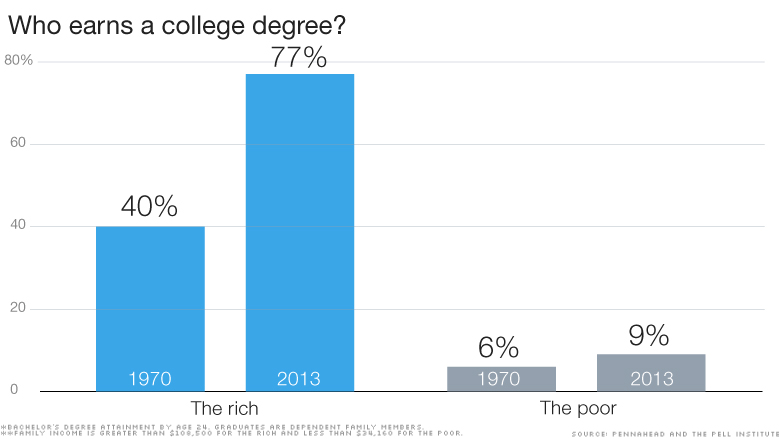
  • People in the Millennial generation (born from 1981 to 1996) have a higher percentage of earning college degrees than people in the Baby Boomer generation (born from 1946 to 1964).
    • For men this number went up from 17% to 21%.
    • For women this number went up from 14% to 27%.
  • Math scores on the National Assessment of Educational Progress (NAEP) have increased for 9 year-olds from 1973 to 2012.  The same is true for 13-year-olds.  
  • Reading scores on the NAEP have increased for 9-year-olds from 1971 to 2012.
       I was at a conference recently in which the speaker said that the average poor student today is two-and-a-half years ahead (in terms of learning) than poor students from a generation ago.  I can't find the source for this statistic, but if it is true then it tells me that making this sort of comparison can help us to gauge increases in student achievement.

       We always hear stories about failing schools and failing students and failing this and that.  Of course we can do better; and we are always going to have students that struggle academically.  But by raising the bar again and again over time, we have pushed students to learn more and more.  The world has changed and our schools need to change if we are really meant to prepare our students for this new world.  I think it helps to take a step back from the constant negative stories about education and take some time to think about the improvements that have been made.

       We are always improving and this improvement must come while simultaneously moving forward.  


Wednesday, April 8, 2015

Poverty Should Not be a Barrier to Education


       The Statue of Liberty quote (written by Emma Lazarus) says it well:

Give me your tired, your poor, 
Your huddled masses yearning to breathe free, 
The wretched refuse of your teeming shore. 
Send these, the homeless, tempest-tossed, to me: 
I lift my lamp beside the golden door.

       At the turn of the 20th century, the golden door was the gateway to America for many people from Europe and other far-off lands.  Today, (I contend) this golden door is our nation's public schools.  We accept all students and we teach all students.  But when we look at the achievement of our students, we see two distinct groups:  poor students (who now make up a majority of our public school students) and non-poor students.

       I just read a great article in the April 2015 issue of District Administration (by Tim Goral) that talks about confronting the crisis of educating low-income students in our public schools.  I'm calling it a "crisis" because of the following two facts:

  1. Low-income students make up half of the population of public school students in the United States.
  2. Low-income students struggle to maintain acceptable academic results.
These two facts are largely undisputed among educators and education researchers.  Taken together they express the most major issue facing our public schools today and (perhaps) our society in the future.  While our students from middle and upper-income families tend to show good achievement throughout their  P-12 schooling experience, the growing numbers of students from poor families continue to demonstrate bleak achievement results.  This is evident on the NAEP results as well as just about any state-level results (and local results).

       I believe that this is the "Sputnik" event of our time.  However, I fear that while this is a well-known problem among educators, it is not a well-know problem for people outside of education--particularly middle and upper-income people outside of education.  We need change on a national level; a national effort.  We need advocates throughout the country to make the general public aware of this problem.


       I believe that our nation's schools have the people and the tools to turn around this "rising tide of mediocrity that threatens our very future as a nation and a people."  (quoted from A Nation at Risk)  This is a difficult and complicated problem that we must solve.

       And I am certain that we will solve this problem.


Saturday, February 21, 2015

What is the Best Way to Measure Academic Ability?

       One student is smart.  Another gets good grades.  Another is in the 90th percentile.  A fourth student gets a good SAT score.  Yet another graduated in the top 25% of her class.  And a different student scored a 4 on her AP test.

       What does all of this mean?  What is the best way to measure how well students are actually learning?  How do we know which are the students that are really learning and understanding and able to use the knowledge in different situations; and which students are dutifully doing what they are told to do and completing assignments and earning good grades not learning a thing?

       I think our educational system struggles with this question very often.  We want to learn--it is the main focus of schools to teach students and to help them to learn.  When I say "learn", I mean "real, actual learning".  Not memorizing and forgetting.  Not memorizing long enough to pass the test.  I mean learning; understanding; able to teach it to others; able to use the knowledge at a later time; able to build on the knowledge learned to learn more, higher-level material.  How do we measure a student's ability to actually learn?  How do we know who is really getting it and who only appears to be really getting it?

       Parents see their children's grades.  And (I think) parents make a determination of their children's abilities based on the grades that they get in school.  That is certainly understandable.  We don't expect all parents to be experts in education and we certainly don't expect all parents to be experts in measuring academic ability.  And if the grades (the test grades and homework grades and classwork grades and course grades) accurately reflect their children's abilities, then it is OK to use these grades to gain a sense of academic ability.


       But what do you do when your child gets great grades in class and lousy grades on the final exam, or the SAT, or the PARCC or Smarter Balanced test, or the college entrance exam?  What does it mean when we have students who do great in middle and high school and then cannot handle the academics in college?  Once again, What is the best way to measure academic ability?  Everyone likes to brag about their smart children; and everyone wants their children "to do well" in school.  But at some point we need to have a way to tell if their apparent ability (academically speaking) is actual ability.

       Large-scale testing is one way to measure actual academic ability.  State-level tests, SAT and ACT, PARCC, Smarter Balanced, and NAEP (National Assessment of Educational Progress) tests are all large-scale tests that attempt to do this.  The SAT is a good predictor of a students' ability to do well in their first year of college.  The new PARCC and Smarter Balanced tests are supposed to measure student abilities compared to standards that are taught over the previous school year.  NAEP is a national test given to a sampling of students in every state and in many subject areas to get a sense of our nation's students academic abilities.

       I believe that we want to use multiple data points to determine students' academic abilities.  If a students have good school grades and terrible large-scale testing grades, I believe that we should question why this is the case.  We shouldn't dismiss the low grades and not important; we should question why there is a lack of consistency in the grades.  Similarly, when students get high homework and classwork grades and low quiz and test grades, we should question this.  Sure, it may be that they are nervous when taking a quiz or test; but it also may be that they don't know the content and that is why their quiz and test grades are low.


       I think that it is difficult to use a single measure to determine a student's academic ability.  If you have a mechanic who has been fixing cars for (say) ten years and you asked her to take a test on fixing cars and then to go through a field test in which she actually fixed cars and then to write an essay on fixing cars, you would expect that she would earn similar scores.  This would be provide multiple pieces of evidence that she knows what she needs to know to do her job.  I think the same is true for students and academic subjects.  If a student is sufficiently knowledgeable in (say) Geometry, I would expect her to demonstrate this knowledge via verbal explanations, written exams, performance tasks, and large-scale testing.  And I would expect all of these measures to show a similar level of understanding.

       Our nation's schools have a responsibility to teach so that our students are truly learning.  We cannot accept the mere appearance of learning; we have to do the hard work of ensuring actual, true learning.  And we need to continue to develop and revised the best and most effective ways to measure that this "true learning" is actually taking place.


Sunday, October 12, 2014

Improved and Improving Students Abilities in Mathematics

     Over the past generation (or two), the mathematics abilities of students in the United States has improved.

     Take a minute and let that opening sentence sink in a little bit.  We are constantly hearing about how poor our nation's students do in mathematics compared to other nations; sometimes we hear the same comments compared to previous generations in the United States.  But the truth is, we are improving when in comes to mathematics abilities of our students.


        The graph (above) depicts the average NAEP mathematics scores for 4th and 8th grade students since 1990.  NAEP stands for the National Assessment of Educational Progress.  It is sometimes referred to as the Nations Report Card.  Among many other subject areas, NAEP periodically tests the math abilities of 4th, 8th, and 12th grade students throughout the United States.  This test is given to a representative sample of students in every state.  It is a "low-stakes" test and only aggregate results are determined.  (That is, there are no individual student results reported for NAEP tests.)

     We can see the overall increases over this time period on this graph.  While this is good news, it is also fair to say that students in the United States need to do much better than they are currently doing in mathematics achievement if we ever hope to rival our counterparts in other some other nations.  The ability of American students to reason and problem solve in mathematics is lacking.  Even students who appear to do well in math classes--as indicated by their grades--sometimes struggle in higher level math classes that require reasoning and understanding.

     So while we are improving in overall math ability over the past couple of generations, we need to continue to improve (and quicken the pace of improvement) if we want our students to be successful in world that they will inherit.

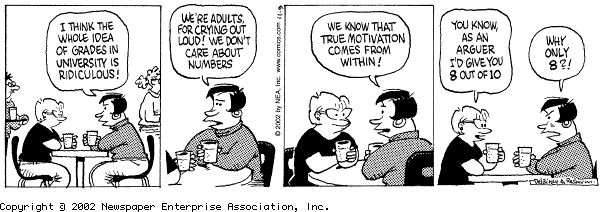
     This requires a change in the way mathematics is taught in United States.  We need to de-emphasize "grading" and re-emphasize "learning".  Students (and parents) who are only concerned about grades sometimes overlook the main purpose of schooling--which is learning.

     So let's keep the positive trend in rising math ability going.  We must.

Public Schools and Choice

       Is it true that public school kids and their public school parents don't have choices?  I'm sure that I will expose my igno...

Teach100 blog