Showing posts with label teacher. Show all posts

Friday, December 2, 2016

Changing Math Attitudes

       I'm borrowing the title of a Facebook group to use as the title for this post.  The group called Changing Math Attitudes is composed of math teachers and other educators and (I suppose) other folks that seek to share experiences and expertise in the effort of helping students (and adults) to see mathematics as something beautiful, sensible, and doable by everyone.

       The first step in improving abilities in anything is to believe that you can do it.  We want students to understand that mathematics is not a secret code to which only a privileged few have access.  There is no "math brain".  Everyone can understand mathematics and it will take a group effort by many people in many circumstances to effectively change the view of mathematics that so many people hold.  This is the view that says "I'm not good at math."  (And so many people freely say this out loud when they would never say that they can't read or that they are bad at Science or History.

       I especially enjoy reading the posts from this group because they are generally politically agnostic.  It isn't a group that is pushing a political agenda one way or the other.  And this makes sense too because the "I'm bad at math." attitude is not coming from one group of people who members of any single political persuasion.  All sorts of people hold this view and so we are talking to all people when we say that we want to change attitudes about mathematics.

       Any math teacher will tell you that most of the students in their classes that struggle to understand the math would do so much better if they held the view that effort would lead to success; if they believed that getting the wrong answer doesn't mean that you are "dumb" but instead means that you've had a learning experience that can lead to better understanding.  If students can escape the Fixed Mindset that says "No amount of effort will lead to success.", then we know that we can help them to get to a point of better understanding.

       Attitude is everything.  Attitude determines the effort that students will put forth.  Attitude allows for a second try and a third try and a fourth try; or attitude gives permission to not try at all.  Attitude is the force that is stronger than caring adults.  Attitude shapes our views and ultimately shapes our destiny.  When our attitude tells us to give it a try, we are on our way to a world of opportunities.


Wednesday, September 21, 2016

My Favorite Teacher

       My favorite teacher wasn't supposed to be my favorite teacher.

       I heard he was tough.  I heard he makes you write a lot.  I heard there was a lot of reading in his class.  One person said he was mean.

       He was my 7th grade English teacher.  I was 12 years old.  When I got my class schedule for the year, I started to ask friends if they knew any of my teachers.  The comments about this teacher (it seemed) were all bad.  Of course, at 12 years old, when I said things such as, "Everyone says he's a mean teacher.", what I really meant was, "The extremely small number of 13 year old boys (3) that I spoke with about this said he was mean."

       But they were my friends and I believed them, so when the first day of school came I was worried about this teacher and this class.  His class was third period and up to that point in the day, everything had gone pretty well.  I entered his class with a more than a little concern.

       He let us sit anywhere we wanted to sit.  He gave each of us a number and then told us to sit at the desk that had that number.  So all of us got up out of our seats (after just two minutes in the class) and moved to a different seat.  After that, he had each of us "meet" the two people who were sitting next to us.  Then we went around the room and each student said something about one of the students sitting next to us.  Then he told us about himself.  But instead of saying how many years he was a teacher and how much he loved English (which is the sort of introduction that most teachers give) he told us that he had three sisters, he weighed 265 pounds, and he liked to go bow hunting for deer.

       I actually remember more about that first class, but the point is his class was all about relationships.  He wanted to get to know us and he wanted us to get to know each other.  Everyday as students walked into his class he would ask us specific questions about things we were interested in and some students would ask him about things that he was interested in.  Our class involved a lot of discussions and he always linked these discussions to something the someone (or many of us) were interested in.  He never made a big deal about grades.  He never put anyone down for getting a bad grade or even for failing to complete an assignment on time.  If students earned a "D" or an "F" (and some did) he didn't get mad at them.  In fact, one student in particular who failed his class seemed to have a great relationship with him.


       We did do a lot of writing and we did do a lot of reading.  It was an ENGLISH class [!].  That's what you do in an English class.  My friends' opinions of what determined "a lot" probably meant that they didn't want to do any writing and reading.  Another thing that he often did was to not accept the first answer or idea that a student put forth.  He wanted many ideas; or he wanted us to be able to expand on our ideas.  The goal in his class was learning.  It wasn't "answering questions".  We didn't earn "points" for cleaning the chalkboard or for not using all of our bathroom passes.  We only earned grades for good writing and good thinking (participation).  This was probably the part my friends referred to as "being mean", since they were generally pretty good at "earning" good grades while learning very little.  Those techniques probably didn't work in his class.

       I didn't refer to this person as "My favorite teacher" until years later--after high school.  And the reason he was my favorite was because he didn't belittle us.  He pushed us to do our best.  Some were more ready for that "push" than others, but all of us knew that we couldn't just slide by and earn a high grade in his class without producing something of quality.

       My favorite teacher wasn't a popular teacher; he wasn't a coach of a sports team; he made us laugh from time to time, but he wasn't known as a "fun" teacher.  He probably didn't care about being liked.  He was firm and fair.  He spoke to his students in pretty much the same way he spoke to our parents.  He knew what he was doing and he had a reason for everything he asked us to do.

Thursday, September 1, 2016

A Tale of Two Classrooms -- Kids Think

This is the fifth in a ten-part series based on the poster: A Tale of Two Classrooms.


---------------------------------------------------------------

Kids Think

       It seems crazy to suggest that classrooms in the 21st century should emphasize more student thinking and to imply that this wasn't always the case.  But if you think about the traditional classroom--the sort of classroom that many adults sat in when they were in school--you see a teacher standing in the front of the room and asking a lot of low-level, "recall" -type questions.

       "It's not positive, it's........?"
       "The capital of the United States is........?"
       " The largest planet is........?"

       A student could walk into the classroom after the lesson was taught and still be able to answer these questions.  These are simple, one answer, "just the facts" questions.  They don't require students to think.  Sometimes they don't even require students to memorize anything because the answer to these sorts of questions may be in the book or paper that is lying on the student's desk at the time the question is asked.  I've been in classrooms (today) when a teacher would ask a question and then point to the answer on the screen or the whiteboard and all the student had to do is read the word that the teacher pointed to.  This doesn't require thinking.  Even worse, low-level questions don't promote learning.

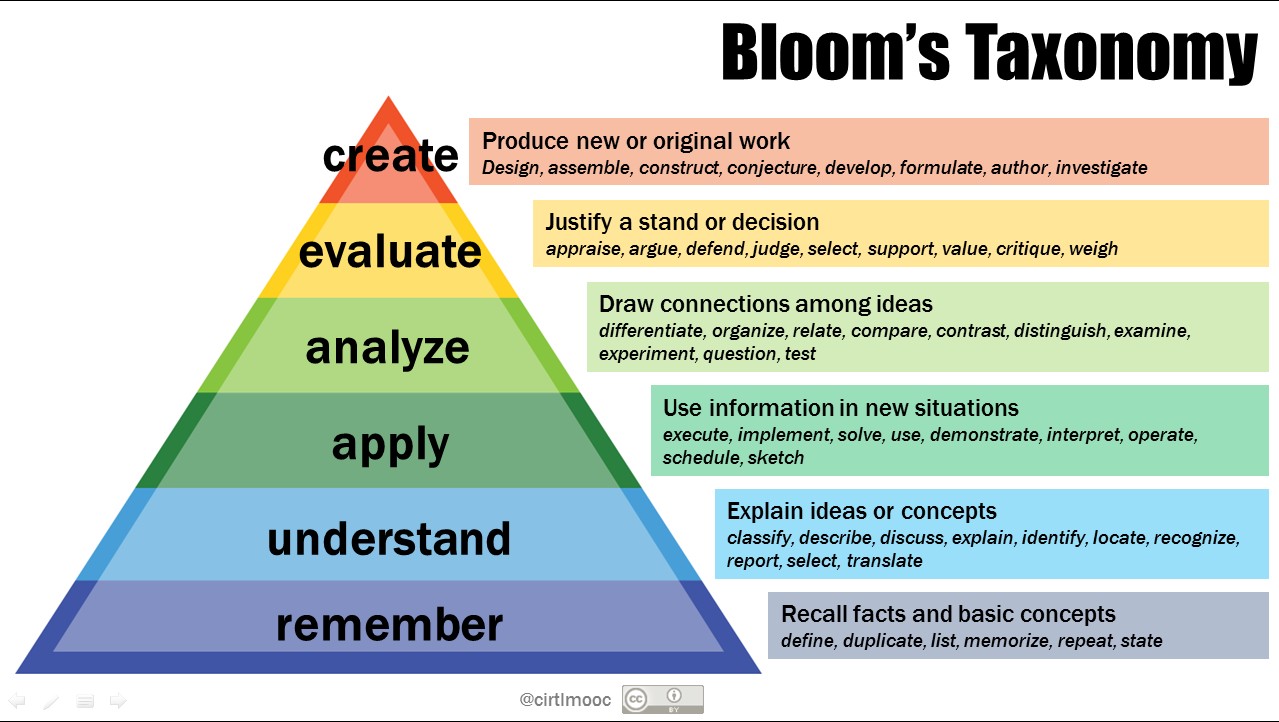
         In today's world, we need students who can analyze, evaluate, and create.  These skills are on the highest level of the revision of Bloom's Taxonomy.  These are the thinking skills.  These are the skills that enable students to compare and contrast pieces of information and to draw conclusions.  They help students to learn how to devise solutions to problems and how to come up with ideas and suggestions.  These are the skills that teach students how to learn.

       And thinking isn't supposed to be easy.  Academic thinking takes practice; it takes time; and it helps to have a supportive teacher.  The students with the first answer (the "fastest" answer) may not have the only answer.  Thinking also grows the brain by creating more connection among synapses.  Thinking adds content to students' long-term memory--which is good because more information in our long-term memory allows for more thinking--or more "space" in our short-term memory.  This is the place where we hold on to new information.

       A classroom that allows for a lot of student thinking must also allow for ideas and suggestions to flow without an immediate response from the teacher.  We want students to share their thoughts and ideas and to hear those of their peers without worry about being right or wrong all of the time.  Thinking is hard work; and school is the perfect place to cultivate this life skill.

Wednesday, August 17, 2016

The First Day of School


       The first day of school is filled with excitement for students and teachers.  New clothes (maybe), sharp pencils, backpack, re-connecting with friends, searching for the new classroom, new teacher, making new friends, first day in the new grade.  Clean slate, new school year, ice-breaker/get-to-know-you activities, setting goals.  Of course, there's also the tentative side of the first day of school.  "Will I make friends?"  "Will the teacher be nice?"  "Can I do the work?"

       The first day of school is a whole lot of "new" all at once.  It's exciting, but it can be scary too.  In fact, the first day of school is like many "firsts" that students experience.  The first day in a new Social Studies chapter after a test.  The first day of the new marking period.  The first day after Christmas vacation.  The first day of the soccer season.  Students experience a lot of firsts and (just like many life events) the more you practice, the better you get.  So it's OK if your child is experiencing a little excitement mixed with a little nervousness.  This is good practice for all of the firsts that will come later.

       All the best for a great first day of school!  It will a wonderful, emotional day--but mostly wonderful.


Thursday, May 5, 2016

The Science of Learning

       This is an exciting time to be a teacher.  The field of education, like medicine and energy and information technology, is growing in the knowledge domain.  We are constantly learning more about how children learn and the best ways to help them to learn.  Brain research and its connections to learning have been able to provide to our teachers simple strategies to help students to learn.  For instance, we now know that our student's brains grow and thrive when they are able to have good social connections with other students.  Therefore, we need to provide time for student-to-student discourse in the learning environments of our classrooms.  We know that the brain and the body are interwoven and are built to help each other.  That's why it is important for students to get up and out of their seats regularly during class time; and recess is an important part of learning and brain development.  Also, we know that fear and stress prevent students from doing their best in school because our brains are designed to err on the side of caution.  Fear shuts down our student's ability to explore and to try new things because their brains are more concerned with staying safe.


       In the past, teachers and relied on their own experiences as students themselves and later on their own teaching experience to help them to reach their students.  But this is never going to be good enough because we are all limited in our experiences to a particular school or a particular town or a particular age group of students.  The research findings and subsequent professional development about these findings help our teachers to learn about learning beyond what they see in their classrooms.  Initiatives such as Blended Learning, Universal Design for Learning, and Flipped Classrooms all stem from relatively recent research on how children learn best and how to incorporate these research findings into the classroom.

       Of course all of these exciting frontiers in education require (at least) some level of changing from the "known" image of the classroom to something different--and that can be scary for some people.  Present-day parents who sat in neat rows in every classroom and rarely spoke in class and worked on (the now-dreaded) worksheets all day long may be against anything different from what they experienced simply because "It worked for me."  That's why the research is so important.  It isn't some guy with and idea, it is actual science that is informing us of the most effective classroom strategies to help students to learn.  This is a good change for our students and a necessary change.

       This is an exciting time to be a teacher!


Public Schools and Choice

       Is it true that public school kids and their public school parents don't have choices?  I'm sure that I will expose my igno...

Teach100 blog