Showing posts with label failure. Show all posts

Wednesday, June 15, 2016

Is Your Child Advanced in Mathematics?

       It seems that, more than in other subjects, the placement of students in advanced mathematics is often a contentious issue. Elementary schools have different policies about placing students in classes that teach math at grade levels that are above the student's current grade.  Middle schools often offer high school mathematics classes, but some stop at Algebra 1 and some go beyond Algebra 1.

       The ability of a school or school system to determine a student's math ability (or "advanced" math ability) can be hard to do with great accuracy--especially when we are trying to make this determination with eight and nine year old children.  It's not enough that they are getting good grades in their math work; math is more than mere calculation.  And higher-level math is all about reasoning and thinking and understanding.  The kid that is good at memorizing, isn't always good at (say) the abstraction that comes with manipulating variables and graphing a line.

      Yet, I think that (too often) we get a false impression of a student's math abilities from merely looking at their elementary grades on the report card.  Sometime students are placed in advanced classes and at some point in middle school they start to struggle because they were pushed to learn higher and higher levels of math too fast.  On the other hand, there are certainly students who are highly able in mathematics and they should be encouraged to take more challenging classes that are commensurate with their abilities. So goes the dilemma of trying to identify the truly highly-able students from those that only appear to be highly-able.

       One method that helps is using multiple data points.  When students breeze through their multiplication tables and get "A's" on their report cards, but do poorly on standardize tests or on unit tests, this should be a cause for concern.  Maybe this student is good at memorizing facts and procedures and not good at understanding concepts.  This student is successful at procedural assignments (such as long division with whole numbers), but may struggle with more abstract assignments (such as a math task with multiple answers).

       Of course, we know that it is OK for students to struggle as they learn new concepts (see previous blog post), but many students view this struggle as a sign that they aren't good at math; or a sign that the teacher is doing something wrong.  We don't want students to struggle because they have been inappropriately placed.  Truly able students (and Growth Mindset students) don't mind the struggle because they enjoy the journey toward learning.  Also they understand that it is OK if they don't get it the first time.  Continual effort will eventually pay off.  Students who never tried hard to do well in math and then are placed in an advanced math class and then are upset when they don't get it the first time...these may be the students that we are pushing too quickly.

       Is your child advanced in mathematics?  How do you know?

Tuesday, May 17, 2016

High School Graduation and Beyond

       May and June is the time in the school year when we think and hear a lot of graduation.  High school and college students are graduating; completing one important life event and moving on to the next.  It's exciting, it's a happy time, it's a time to celebrate!

       As a nation, we have a lot to celebrate because we have seen a rise in the high school graduation rates over the past few years and that's a very good thing for our nation.  In the 2013 - 2014 school year, the high school graduation rate was 82.3%--an increase of over three percentage points from the 2010 - 2011 school year.

       Our society demands a workforce that is willing and able to continually learn and to use the knowledge of past learnings.  Students who succeed beyond high school are the people who understand that their ability to do a job is not dependent on the grades they earned in high school as much as it is on their desire to continually learn and to do their best.  We need thinkers and doers and believers.  While high school graduation is a big step (and an important step), it is still only one step.  Those students who were only successful in "playing school" and earning grades without any concern for learning will find it difficult to succeed in college or the workforce in places where thinking and problem solving is necessary.

       Sometimes it seems like we put too much on our schools.  We teach courses, but we also teach how to work together, how to get along with others, how to learn, how to struggle, how to accept responsibility.  No one gets a grade for these things; no one is denied a diploma for not attaining these traits.  But those that lack the ability to do these things often struggle to live in a society that doesn't always give you second chances; a place where breaking the rules have real consequences and no one is there to remind you what to do and when to do it.

       We all get one chance to make the most of our 13 years of K-12 education.  After that, the number of opportunities rise with the number of decisions.  It's not enough to do what you're told; just ask those that barely graduated high school.


Monday, May 2, 2016

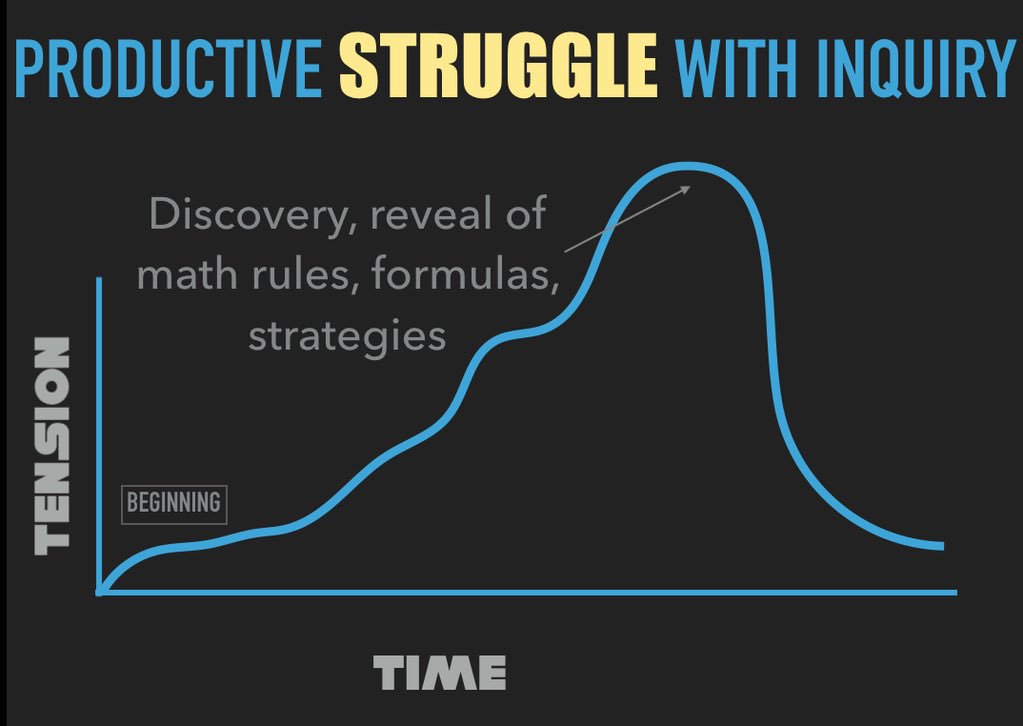
It's OK To Struggle When You're Learning Something New

       Years ago I knew of a little boy whom I never heard speak a word until he was nearly ten years old.  It wasn't that he couldn't talk; his disability was more serious than that...he was born with two older siblings and a mother who wanted the world to view her son as "Always Correct".  To ensure this perception, whenever anyone asked him a question, she would answer the question.  The older siblings did the same thing--but not for the same reason.  They just thought of him as a child that didn't talk much.  Clearly my nephew got the message (at a very early age) that other people would do things for him--even speak for him.  There was no reason to speak or even to think very much.  Of course, his mother loved him and she wanted the best for her son.  She didn't like to see him struggle to learn how to do things and didn't like to see him cry, so she did just about everything for him.

       Sometimes teachers are like this mother.  We want the best for our students and we want them to succeed.  So, sometimes we give them hints to nudge them toward the right answer; we compliment them for minor things (like repeating what we say); and we never want to suggest that they might be wrong about something.  Teachers are caring people and it makes sense that we want the best for our students.  But allowing students to have a false sense of achievement is not a caring thing to do.  And if this sort of (false) encouragement continues for a whole school year, and then the next year, and then the next year, we end up teaching students that learning is just memorizing stuff and repeating what the teacher says, and following directions.  That's not learning.

       Learning anything that is worth learning requires a certain amount of struggle.  No one expects you to learn something complex the first time you hear it.  You have to think about it, and practice with it, and make some mistakes, and learn from the mistakes, and make more mistakes, and then (maybe) you can claim success at learning.  It's OK to struggle and it's OK to allow your children to struggle.  We want students to know that learning is full of challenges and effort is required to overcome these challenges.  We want students to believe that they can do anything if they have the will to work at it until it is done.

       This is a difficult message for most parents to hear.  A lot of people have a fixed mindset about their children's abilities.  This means that they believe that their children are capable of doing some things and incapable of doing other things--and no amount of effort will change that.  This mindset leads to statements such as, "It's OK if you're not good at math because I was never good at math and some people just can't do math."  (Feel free to substitute other words in place of the word "math".)  This is a terrible message for students.  Instead, the message should be that hard work pays off and struggle leads to learning.


Public Schools and Choice

       Is it true that public school kids and their public school parents don't have choices?  I'm sure that I will expose my igno...

Teach100 blog