Showing posts with label learning. Show all posts

Thursday, March 23, 2017

Education Without Grades

 
       Imagine P - 12 schooling without grades.

       Learning?  Yes.
       Art?  Yes.
       Clubs?  Yes.
       Teachers, friends, computers, classes, classrooms?  Yes, yes, yes, yes, and yes.
       Grades?  No.

       The idea of an educational landscape without grades is not so new and (in fact) there are a significant number of schools that are experimenting this idea right now.  New York High School English teacher, Starr Sackstein, has been talking about this for years.  We still teach and we still assess.  We just don't use the traditional grading system of attaching a number or a letter to that assessment.

       The problem with "grading" is that it has grown to be a monster that we can't control.  Parents and students alike will tell you that they care more about "getting-a-good-grade" than they do about "learning".  As with so many other aspects of American life, grading has become a competition to be won, rather than a method for measuring learning and understanding of academic content.  Add to this that grading systems vary widely from school to school and even from teacher to teacher (sometimes) in the same school to the point that it is hard to say what a particular grade actually means; or if the same "grade" means the same thing from one class to another.

       Still, it can be hard to convince a generation that (whether they like it or don't like it) has grown up with the letter grade system, that a no grades system is a better way to conduct our middle and high schools.  Here is a great article that contains students' thoughts about living through a "no-grades" experiment.  (Spoiler alert: One-third liked the idea, one-third didn't like it, and one-third didn't care.)

       I often say that the goal of education is learning.  If something hampers our efforts to help students to learn, I think we should do something about that.  Grades and grading have (in many cases) become the new goal or the more prominent goal of education in the minds of many students and parents.  That's a problem.  If we are preparing students for the world of work, what will be their motivation if without grades in the workplace?

       Colleges regularly get rid of students that can't keep up academically.  It doesn't matter what their grades were in high school.  What matters is what they know and are able to do.  Same thing with employers.  Good grades might get you the job, but only true ability will enable you to keep the job.  We need to teach students the value of learning exceeds the value of earning good grades.  Maybe the way to do this is to get rid of the grades.

       What do you think?


Monday, March 20, 2017

New Teachers Don't Have to Know Everything

       Starting a new job is exciting...and scary.  And when that new job involves a classroom full of students who are depending on you; and they all have parents who are depending on you; and you're expected to use technology that you've never used before; and some student don't try to do their best every day; and ... and ... and ....  Well, you get the idea.  New teachers and veteran teachers have pretty much the same job and the same responsibilities.  But I've got good news for new teachers:  You don't have to know everything.

       Today's teachers are better trained and better prepared for that first day on the job than ever before.  Policies and laws and general "good practice" have prepared our college graduates well.  Student teaching requirements and excellent mentors during teacher training programs help our future teachers to understand curriculum, experiment with teaching strategies, and learn to interact with students.  But teaching is not the sort of job that can be fully learned in a college classroom.  Teaching requires practice and a fair amount of trial and error.  Every student is different and every group of students are different.  You can't be fully prepared for every situation when you begin teaching.

       For this reason, I tell new teachers that they are not expected to know everything when they begin their career.  I encourage them to ask a lot of questions and to seek advice from fellow teachers and from their principal and assistant principal.  It isn't that new teachers aren't prepared to accept the responsibilities of the job--they certainly are.  But teaching is much more of an art than some sort of mechanical process.  Anyone can explain some idea or concept to a bunch of students.  But a teacher wants every student to understand the idea so well that they can discuss it with other students, ask questions about it, and even build on this new knowledge and find connections to other ideas and knowledge that they already have.

       New teachers who strive to improve and to learn from others are usually viewed in a good light, even if they make a few mistakes along the way.  Furthermore, I feel that it is the responsibility of the school and the school district to continually provide supports that will help new teachers to become better teachers.  We know that our best teachers are the ones who continually look for new and better ways to reach their students.  The world changes and we need teachers who are willing to change as well.  This is true for experienced teachers as well as for new teachers.

       We understand that it is stressful to accept a new job with new surroundings, new people, and new responsibilities.  We want new teachers to be comfortable and confident.  With adequate supports, new teachers can approach everyday knowing that nobody is perfect and mistakes are part of the learning process.  This is what we tell our students and it applies to the teachers too.  Teaching is an awesome responsibility, and understanding that teaching is a learning process helps new teachers to get through that first year eager to begin their second year.


Tuesday, March 7, 2017

What is Blended Learning?

              Blended learning is an education program (formal or informal) that combines online digital media with traditional classroom methods. It requires the physical presence of both teacher and student, with some element of student control over time, place, path, or pace.

       My school district has begun the journey into Blended Learning over the past couple of years.  As an educator approaching his 30th year in the business, I view Blended Learning as an effort to bridge all of the positive and effective teaching and learning strategies that the educational and research communities have learned over the past few decades.

       Like any new initiative, Blended Learning will take some time for teachers and students and parents to learn and understand.  We will have to discover new and better ways to implement it in a way that is most beneficial to our students.  This effort will be well worth it.  Blended Learning--as I see it--addresses the following educational beliefs:


  1. Learning at your own pace.  In a traditional classroom, 30 students learn the same thing at the same time.  If you pick up on the topic quickly, you have to wait for your classmates to catch up.  If you struggle to understand the topic, you have to move to something else before you fully understand.  Blended Learning allows students to move at their pace.  Everyone is learning the same topic, but fast learners are given more challenging work and struggling learners are given more assistance.
  2. Multiple ways to show what you know.  In the traditional class, students can only demonstrate their understanding through classwork and homework and tests.  While this isn't a terrible method for measuring student knowledge, we certainly know that this method can lead to the appearance of learning when (in reality) little learning occurred.  Classwork can be graded on completion instead of quality.  Homework completion can come from lots of parental help for some and no parental help for others.  And tests can earn high grades due to cramming and memorizing rather than due to actual learning.  In the Blended classroom, students work with each other and help each other; teachers can spend more time one-on-one with their students (or in small groups).  Students can demonstrate their understanding through informal assessments and assignments in addition to more formal and traditional testing.
  3. Multiple attempts to learn.  We know that learning is a process.  Few students can sit in six or seven classes a day and learn six or seven different things strictly from listening and taking notes.  Learning requires listening and thinking and doing and sometimes failing the first couple of attempts.  Blended Learning recognizes the learning process and students understand that it is OK if they don't get it right away.  Blended Learning also provides different modalities for student learning.  These include: small group work, individual work, using online resources, using paper and pencil resources, and allowing students to verbalize their understanding.
       Blended Learning recognizes that students learn in different ways and at different rates--and this is not only OK, it is expected that all students learn in different ways.  The goal is learning.  Blended Learning permits students to be students and to learn in a way that works for them.  Learning isn't a competition.  Learning faster isn't better than learning slower.  Everyone that reaches the finish line is a winner.  Blended Learning helps students to see the value of learning.

Thursday, February 16, 2017

When Students are Engaged, Grades Don't Matter


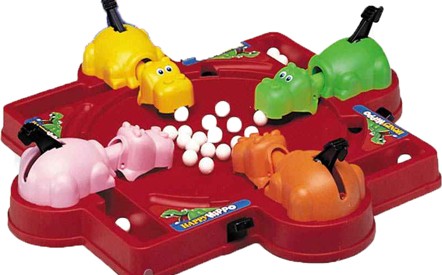
       My daughter's girl scout group had their annual Thinking Day recently.  Thinking Day is a special annual day when Girl Scouts around the world think of each other and express their thanks and appreciation for the International Girl Scouts organization.  Since my daughter is in high school, her group was tasked with creating a game or activity for the younger girl scouts to do.  They decided to do a Lifesize Hungry Hungry Hippo game.

       The game has four competitors who begin the game in one corner of a square floor space with lots of small balloon in the middle of the square.  Each competitor is on a scooter facing the middle of the square and holds a laundry basket.  An older girl pushes the competitors towards the middle of the square and their job is to capture as many balloons as possible with their laundry baskets.  A jump rope is tied to each scooter and the older girls pull the competitors back to their original corner and collect the balloons they have captured.  This continues for one minute.  The person with the most balloons wins.

       My daughter set up a white board to keep track of the number of balloon caught by each competitor.  But after a few rounds it became clear that no cared who "won" the game because it was so much fun just to play the game.  The points didn't matter.  There was a line of girls waiting to play the game.  Girls came back again and again to play Hungry Hungry Hippos.  Parents were taking pictures and videos.  The game is fun and exciting and full of action.  Everyone could participate and everyone had fun.

       In education circles, we refer to this scenario as Student Engagement.  When students are engaged in the activity that takes place in their classroom, the "grade" becomes much less important and the "learning" becomes much more important.  Students want to finish the task or express their viewpoint or add to the discussion.  They become so engrossed in the activity that other matters such as grades and the remaining time in the class and social media and all of the things that distract students when they are bored suddenly become invisible.

       This sort of engagement doesn't have to be a rare occurrence for our students in school.  In fact, teachers who understand the value of student engagement strive to find and to create activities that engage their students intellectually and emotionally and even physically everyday.  Students who are engaged are more likely to do their best everyday.  They are less likely to zone out and doze off in class.   Some strategies for engaging students are simple and basic such as:

  • calling on every students every day
  • allowing a time in every class for students to get out of their seat
  • getting to know every students and establishing a good relationship with each student
  • dividing each class period into several 5 to 15 minute sections with different activities in each class section (such as: whole group discussion, individual work, small group work)
Other strategies involve more preparation such playing a game to review material, using manipulatives in a math lesson, students using technology for part of a lesson.  The 20th century classroom with a teacher doing all of the talking is not the best way to conduct a classroom if you want all students to achieve.  When students are engaged, students are learning.  While teachers are not responsible for creating an entertaining environment in their classroom, they are responsible for motivating their students to do their best.

       Every student should be Hungry Hungry for learning.


Thursday, February 9, 2017

High School Should Not be a GPA Competition


       You may need good grades to get accepted to college.  But what you really need is good learning (and a good ability to learn) to graduate from college.  Lots of people go to college, but not a lot of people graduate from college.  A study completed in 2015 found that only 52.9% of students who began college in 2009 had earned a college degree by 2015.  This means that even if we allow students an additional two years to complete a 4-year degree, we are still have only barely half of the students graduating from college.  (Imagine the outcry if the high school graduation rate was 50%!)

       Another study has found that one reason for this dismal college graduation rate is a lack of preparation in secondary schools.  As a educator with 30 years of secondary school experience, I would suggest that it isn't so much that we don't prepare students well, but instead (perhaps) we struggle in our communication with students (and with their parents) when we talk about their actual academic ability.

       First of all, our grading system probably doesn't tell the whole story.  Grades are often the primary communication tool that a school has with its students (and their parents) about how well they are doing.  High grades imply high ability and low grades imply low ability.  But is this always true?  And what to medium grades imply?  We don't have a uniform method for determining grades from school district to school district, so does a "B" mean the same thing in every high school in America?

       Secondly, we have high school graduation requirements that are developed in each state in the United States.  Different states have different requirements; although there may be similarities.  But the bigger issue (to me) is:  Is "Graduating from high school" the same as "Being prepared for college"?  Should we have one set of criteria that says "This is sufficient for high school graduation." and another set of (higher level) criteria that says "This is sufficient for good preparation for college."  I think a lot of people feel that if they graduate from high school, then they are prepared for college-level work.  But this isn't always true.

       Hence, high school should not be a place where we only care about getting good grades and getting a high Grade Point Average (GPA).  That might be good enough to get you recognized in high school; and good enough to get accepted to college.  But students who only know how to get good grades without an accompanying ability to learn, will struggle in college.

       Everything in life isn't a competition.  Your education is one of these things.  It doesn't matter if you come in first place.  What matters is that you learn well.

Friday, February 3, 2017

Learning and Thinking - (getting the right answer isn't good enough anymore)


       Learning and thinking have always been closely linked.  But sometimes, in our schools, we only achieve the appearance of learning--often accompanied by very little thinking.  This problem has been recognized by educators for a long time.  In recent years, however, we have been addressing this issue on various fronts.

       Let me begin by explaining what I mean by the term Appearance of Learning.  This is when students get good grades, but their actual learning is very low.  The grade to the students and to their parents makes it appear as if they have learned a lot, but the attainment of those grades may have been based partly on non-academic measures such as good behavior or mere compliance with rules such as turning in homework on time.  This is a problem because when students move on to more complicated coursework that requires previous knowledge, they struggle due to never actually learning the earlier content in the first place.

     Over the past few years, there has been a stronger attempt to balance the need for teaching skills (such as solving an equation) with the need for teaching conceptual understanding (such as using an equation to solve a problem).  This sort of "teaching" is different from when our students' parents were in school--a time in which just-getting-the-answer might have seemed good enough.  Today we know that this isn't good enough.  Students going to college and students going to work need skills and knowledge beyond merely doing what they are told to do.  Today's world demands more from our citizens.


       Our schools recognize this need and we are trying to make changes to address this challenge.  It's hard to change a system of 100,000 schools, 50,000,000 students, and 3,000,000 teachers.  But (indeed) this change is already happening.  What we used to call a "computer room" is now just about any classroom in the building.  Classrooms with students sitting in nice, neat, straight rows that discouraged collaboration among students have been replaced with classrooms with tables or desks arranged in groups to encourage students to work together and ask questions of each other and learn together.  Grades for non-academic behaviors (mentioned above) are strongly discouraged so that a student's grade can more accurately reflect his/her ability in the content.  Finally, student engagement strategies and growth mindset strategies are constantly being discussed and implemented.  These reflect our knowledge of the best way that students learn.  No longer do we expect everyone to learn strictly by listening to the teacher and taking notes.

       Indeed, the change to an educational system that requires more from our high school graduates is well underway.  The past is in the past and we're not going back.  Those that choose not to change risk creating a generation that is ill prepared for the challenges that they will face.  Learning, thinking, reasoning, and problem solving will be more and more integrated into our schools.

       You're welcome.


Sunday, January 29, 2017

Flaws in the Letter Grade System

       What does it mean when you get an A in a class?  I'm not asking, "What is it supposed to mean?"  I'm asking, "What does it actually mean?"  Does the "A" in Chemistry mean the same as the "A" in History?  Does the "A" in Physical Education mean the same as the "A" in English?  What does a "B" mean; what does a "D" mean?  Did you ever get an "A" in a class--middle school, high school, or college--and then brag to your friends that you didn't learn a thing?  Did you ever get an "A" or a "B" in a class and fail the final exam?  Did you know someone who consistently earned "A's" and "B's" in math classes and couldn't score over 500 on the math portion of the SATs?

       Howard Pitler list four major problems with our current system of using letter grades:
  1. There is no consistency from teacher to teacher or from school to school.  Schools and school districts may have different policies about grading; and these policies aren't necessarily the same from school to school or from school district to school district.
  2. Teachers decide the factors that go into a course grade and they decide the weighting for each of these factors.  So called "hard teachers" and "easy teachers" is actually a real thing when it comes to grading in the letter grading system.  Some teachers are more demanding than others; some teachers award "points" for non-academic behaviors such as showing up to class on time or not using all of your allotted bathroom passes. Merely completing homework can be part of the grade regardless of the quality or the "learning" that may have occurred while completing the homework.
  3. Grades discourage students from learning.  Pitler quotes Alfie Kohn who says, 

 “Kids who are graded—and have been encouraged to try to improve their grades—tend to lose interest in the learning itself, avoid challenging tasks whenever possible (in order to maximize the chance of getting an A), and think less deeply than kids who aren’t graded.” The target becomes the grade rather than the learning. Students take less challenging classes because they want to “protect” their GPAs.

 4.  Lastly, true learning often requires multiple attempts in which ultimate success doesn't happen until the end of the process.  When students are more concerned about "getting grades", they tend to try less, they are less willing to go through the necessary struggle needed to achieve the ultimate level of true learning.

       There is another way to measure student learning and that is to compare their learning against standards (or proficiencies or competencies) that everyone can agree on.  Proficiency-based Learning is not new.  In fact it is growing in popularity among educators who want students and parents to have a better understanding of the actual learning that is taking place in our schools.  One of the hallmarks of proficiency-based learning is the idea that students need time to re-visit topics and ideas in their journey toward true learning and true understanding.  Hence, assessments are used to help students and parents to "see" the learning that occurred and to recognize the learning that still needs to happen.  When students are re-assessed, grades aren't averaged.  Instead, higher grades at a later time in the learning process are recognized as the actual level of learning that occurred.  Therefore, students are encouraged to try harder.

       Proficiency-based Learning should also allow students to work at their own pace.  Ideally, they should not move on to something new until they have a good understanding of the current lesson or idea or standard.  Also, students may have opportunities to demonstrate their understanding in multiple ways; not always via a summative test--however these tests can be still be used.

       Schools are for learning, not for "getting grades".  And we need to have a better system for identifying the learning that takes place.  Too many students are graduating from high school without the skills to hold a job or complete college or make good decisions for themselves.  We need to do better for our students so that they will have better options for their futures.


Wednesday, January 25, 2017

Why Is Teaching Mathematics So Different Than Teaching Other Subjects?

       My entire professional career has been in Secondary Mathematics.  As a middle school teacher, high school teachers, department chair, and supervisor; I have been immersed in the field of teaching and learning mathematics.  Whenever conversations arise about the instruction for very weak students or for very advanced students, there seems to always be special considerations for students when it comes to mathematics.  Principals, school counselors, and special educator alike all agree that the teaching and learning of mathematics seem to require very different skills compared to the teaching and learning of reading and history and (perhaps) other subjects.

       Keith Devlin has a relatively simple answer to this question which he explains in his paper written for the Mathematical Association of America titled, In Math You Have to Remember, In Other Subjects You Can Think About It.  Devlin explains that mathematics is often taught as a series of rules that you just have to memorize.  Whereas other subjects such as history and science are taught within a context that help the learner to make sense of the content.  Mathematics could be taught within a context (and, I would say SHOULD be taught within a context), but it usually isn't.  This makes mathematics seem like a secret language with tricks and complicated rules that sometimes work in some situations and don't work in other situations.  When mathematics is taught as merely a bunch of skills without any understanding of how and when to use these skills, many students struggle to be successful.


       In her book Mathematical Mindsets, Stanford professor Jo Boaler explains that all students can learn mathematics if teachers are equipped to help students to build understanding.  While it is relatively easy for trained secondary mathematics teachers to learn these techniques, most teachers have not received this training when they were in college.  Furthermore, most adults today (parents, school principals, school counselors, etc) grew up learning mathematics through a strictly procedural approach.  Because of this experience, most adults believe that mathematics should be taught as a bunch of skills.


       Fortunately, more and more teachers are mixing more and more conceptual understanding in their mathematics classrooms along with learning the skills.  There are places in which math is taught somewhat differently than it was taught in past generations, and this is a good thing in my opinion even if it makes some parents feel uncomfortable.  Math should not be taught as 100% skills without any connection to the real world.  For most students, this sort of instruction is just too abstract for them to understand.


       Mathematics is also a subject that builds on itself from school year to school year.  Students need to have a good understanding of the concepts so that they can build on previously learned content to understand the new content.  This idea of building from year to year is more prevalent in mathematics than it is in other subject areas.


Sunday, January 22, 2017

When Learning Doesn't Happen, Who's Fault Is It?

       When something goes wrong, is it your fault or is it someone else's fault?

       You're late to work, you fail a class, you break a shoelace, you gain weight, you run out of milk.  Small things and big things; they happen every day.  Are you the kind of person that says, "It's my fault." most of the time when things go wrong; or are you the kind of person who says (essentially), "It's someone else's fault." most of the time when things go wrong.


       Maybe this isn't a fair question.  Certainly there are times when it is my fault and times when it is someone else's fault.  You can't answer such an abstract question with a definitive answer one way or the other.  Well, OK.  Maybe so.  But surely you know someone who almost never takes responsibility for anything that happens in their life.  When they are late to work; it's because of slow drivers and red traffic lights.  When they gain weight; it's because other people are constantly offering them sweets.  When they lose a game of cards; it's because the cards weren't shuffled well.

       When middle and high school students struggle to learn in school; Who's fault is it?  Who is ultimately responsible for their learning?  Who bears the greatest ownership for whether or not they learn math and English and science?  There is no doubt that this is a controversial question.  This is a question in which any answer would have troublesome consequences.  Another way to ask this question is, "Do we blame the schools, or blame the students?"  Unfair you say?  Maybe.  Probably.  But this is a question that educators get often.  I am going to begin by looking at the extreme answers.

1) It's the student's fault

       This view says that students bear the ultimate responsibility for their own learning.  The teacher's job is to teach.  It is the student's job to learn.  If the student isn't learning, they should seek extra help; they should ask questions; they should try harder.  Middle and high school children aren't babies; they understand how school "works".  They should advocate for themselves.  It's their life.

       The problem with this view, in my opinion, is the question of age-appropriate responsibility that is given to students.  My father used to say that the trouble with kids is that they act their age.  In addition to learning math and English and science, students are also learning how to be an adult.  They are learning about making good decisions.  Teenagers need structure; they need guidelines.  Sometimes a student is struggling in a subject and doesn't know what questions to ask.  Sometimes students are afraid to speak up in class in front of their peers.  Sometimes students don't realize the ramifications of not learning.  While, of course we want our students to be responsible for their own learning, we can't expect an 11 year-old 6th graders nor a 15 year-old 10th grader to act like a fully responsible adult at all times.

2) It's the teacher's fault

       This view says, if students aren't learning, then the teacher isn't doing his/her job.  Teachers are trained to teach and to help students to learn.  The teachers went to college to learn how to teach and they spent two or more years as full-time, untenured teachers to learn "in the field".  If students aren't learning, then it's the teachers fault.

       The problem with this view, (again) in my opinion, is the idea that all students learn in the same way; or that teachers should be experts in all student learning styles after a couple of years of practice.  In fact, students are very, very different in their learning styles.  Some learn from only listening, while others have to listen and practice, while others have to hear it in a different way before they "get it".  Middle and high school students have varied past experiences in their education and teachers are always faced with students of varying abilities.  Some students don't speak up much and teachers have to find a way to understand how well they are catching on to the learning objectives without hearing (verbally) directly from the student.  And some students are burdened with problems at home that have priority over their education in the student's mind.


       So who's fault is it?  If we can't say it's the student's fault and we can't say it's the teachers fault (and we still have learning that isn't happening) then who's fault is it?

       We live in a world that loves to point fingers and loves to have clear, simple "right/wrong" answers.  We want to have a villain that we can point to; someone to blame; someone to yell at.  Everything is a soccer game with winners and losers.  We don't like complicated things, complex things.  These are too hard to understand and too hard to fight.

       Who's fault is it?  I think it depends on the person that you are.  If you are the type to take responsibility for your actions, then you probably lean toward the side that says students should be responsible for their own learning.  If you are the type to blame others and nothing is ever your fault, then you probably lean toward the side that says the teachers and the schools are to blame.  As for me--and as an educator--I take a middle-of-the-road view.  Sure we want students to be responsible, but teachers should do everything that they can to help students to learn.  It's not enough to just "teach".  If students aren't learning, teachers and schools should ask why.  They should take a hard look at these students and provide whatever help they can.

       I believe that our public schools are constantly concerned about students who struggle to learn.  Most of time, these students get the help that they need.  But sometimes they don't.  In the end, as with so many things in life, I believe that we have to work together to help our most vulnerable students to get the help that they need.  Learning requires a little struggling for everyone.  For those who can't meet this struggle, we should all be there to help them.


Saturday, January 7, 2017

Teachers Seeking Innovative Learning Strategies

       If students aren't learning, then the teacher isn't succeeding.

       This is a harsh statement.  Clearly there are lots of reasons that prevent students from learning.  Some of these reasons can be due to teacher actions in the classroom and some are outside the control of the teacher.  But the main goal of school is learning.  If the student isn't learning, than we haven't met this main goal.

       Of course, not all students learn in the same way.  When a teachers presents a lesson--be it via lecture, or a game, or discovery learning, or through the use of a task, or some combination of these methods--some students will "get it" and some will not.  And so our best teachers are constantly looking for different ways (different teaching strategies) to help students to learn.  This (indeed) is the part of teaching that very, very complex.  Trying to understand the best way to help students to learn--every student in every class--is the struggle of every teacher.

       Alas, the world of education is full of ideas to help us.  Some of these ideas fall into the category good suggestions that any teacher should use, such as:

  • Scaffolding - breaking up the learning into smaller chucks and allowing students the time to learn one-piece-at-a-time in the effort to get them to learn the whole idea or standard.
  • Graphic Organizers - providing students with different ways to organize information so that "many ideas or facts" are easier to see and to understand.
  • Multisensory - presenting new information in multiple ways that help the students brain to store the information in multiple ways.  For instance, verbally explaining something while also writing the information on a whiteboard or computer screen, while also (perhaps) providing a manipulative or foldable for the student to hold and work with tactilely.  
Other ideas are more specific as to the sort of instructional style that may take place in a classroom.  A typical example of this would Direct Instruction or Lecture.  This is very typical in classrooms in the United States; particularly in our high schools.  Adults in their 70's and 80's probably received instruction in this manner when they were in high school and their grandchildren and great-grandchildren likely receive their high school instruction in this same mode.  Some people refer to this sort of instruction as Traditional classroom instruction--and it clearly is not effective for all students.

       More teachers are using a Discovery Learning approach to classroom instruction at least some of the time in their classes.  This approach allows students to build on past learnings by completing tasks and problems that require them to do so.  Students may work individually or in small groups of three or four while the teacher responds to students' questions and encourages students to think about other solutions.  This approach is common in some countries but is much less used in the United States.   

       I am part of a couple of math groups on Facebook and I posed the question, "Is Direct Instruction Necessary?"  I went on to ask if Discovery Learning could be the sole or major teaching strategy in a high school math class.  Of course the responses that I received were various and wide ranging, but I did learn a lot more about individuals and groups of teachers who use this approach with some success.  

       When teachers are continuously searching for more and better ways to reach their students, everyone wins: students, teachers, schools, society.


Wednesday, January 4, 2017

Three Cheers for Middle School!


       When I interview future mathematics teachers, some embarrassingly say to me, "I actually prefer to teach at the middle school level."  Then they go on to say that their parents and friends think that they are crazy to be a middle school teacher.  This is because so many people have this image of middle-school-aged children as being wild and out of control all of the time.  I hear this so often; sometimes in silly way and sometimes in a very serious way.  As a longtime educator I can tell you that this image is untrue and unfair to young teenagers.

       Middle school is great!  The excitement and energy of the students is part of the reason that middle schools are so great.  Our best middle school teachers understand how to use that energy to engage students and to foster learning.  When middle school students are respected and appropriately challenged academically, they rise to the occasion and show their best everyday.  Middle schools are the places where you have classes with tall girls and short boys; shy kids and talkative kids.  Middle school students are fun and interesting to get to know.  They are excited to leave their elementary school and they are anxious to go to high school.

       We want and we need teachers who understand the middle school child; understand how they think and how they learn.  Teachers who are excited to teach everyday and to help their students to discover their ability to solve problems and to ask difficult questions.  We need teachers to encourage our middle school students to read and to understand more difficult text; including non-fiction text.  Middle school is often the place in which students first encounter difficulty with their academics, so we need teachers who are excited to help these students to preserve through these difficult times and to find ways to succeed.

       I know many middle school teachers who love their job.  These teachers understand the "line" between allowing students to express themselves while keeping the class of students in control.  Middle school students understand the need for structure and appreciate teachers who insist on this structure.  Middle school can be the best years of a student's school career when they have great teachers and leaders who care about them.

       Middle school is a great place to be.  Everyone should appreciate the excitement and energy of our nation's middle schools.


Sunday, December 11, 2016

Is It Possible to Help Students Too Much?

       How much is too much?


       Can you care too much?  Can you love too much?  Can you help too much?  When it comes to students and learning, sometimes teachers and parents help too much.

       Their hearts in the right place, but goals are short sighted.  Teachers and parents help too much when they tell students the answers in an effort for them to complete the classwork or the homework.  They seek the short-term goal of compliance with an assignment.  But they don't see the longer-term goal of helping students to learn how to learn.

       Educators have an expression for the results of too much help.  We call it, "Learned Helplessness".  It's when students learn to purposefully not try too hard because they know that a parent or a teacher or someone will eventually give them the answer or do the work for them.

       Since most students (and some adults) don't see or understand the benefits of learning, they believe that school is only a series of assignments that they have to complete because they are told to do so; or because they get a grade for completing it.  Therefore, they don't see the need to try hard and fail sometimes and learn from these failings and try again.  "Learning" isn't their goal; compliance is their goal.  Therefore they only seek to complete the worksheet, or answer the questions, or write the paper; because they only seek to get the grade.  And if the student can find someone else to do this--and the students basically gets the same reward (the same grade) either way--then the easy route is to let someone else do it.


       Of course teachers and parents want their students (and children) to succeed, so sometimes they provide this help in an effort to help them to get success.  But there is a terrible downside to too much help.  When the parent isn't there and the too-much-helping teacher isn't there, the child (maybe now a young adult) isn't able to solve problems on their own.  Since there was always someone there to do the hard stuff, the young adult is now either helpless or forced to learn how to learn new things at point in life when mistakes are more costly.  One area where this is often seen is the first year of college.  Students who haven't learned how to struggle to learn something new and expect someone else to do all of the hard stuff for them, fail and drop out of college.

       School is about learning; and it's about learning how to learn.  We aren't helping our kids by doing the work for them.  As teachers and as parents, we have to try to worry less about "the grade" and much, much more about the learning.  There is no benefit to children who graduate from high school but aren't able to think for themselves and make decisions by themselves and solve their own problems.

       Yes, you can help too much.


Sunday, December 4, 2016

Teaching to the Test Is Not a Bad Practice Anymore


       Education has this phrase:

Teaching to the Test

In the past, this phrase was a derogatory phrase that meant (at the extreme) the only thing we do during class time is to prepare students to take a test.  This implied that we never taught additional topics that weren't on the test, and that we never taught at a higher rigor level than what was required on the test.  The other (more broad) implication was even worse; We didn't concern ourselves with whether or not students actually learned anything, our only concern was that they got a high score on a test.

       This sort of Teaching to the Test probably did occur at many public schools, but I would hope that teachers (and schools) never lost their desire to encourage learning over mere test grades.  Indeed, teaching at a higher rigor level than was required on a test would serve the dual purpose of (1) helping students gain a higher level of conceptual understanding, as well as (2) helping students to score well on a test.  So we had incentives to go beyond the content that appeared on a test.  

       Today we see teaching to the test much differently.  First of all, we are now seeing standardized tests that require much more than merely a single-word, or single-number answer.  Today's test require students to demonstrate a high level of understanding.  This means that the days of memorizing formulas or (even worse) memorizing shortcuts and tricks are over.  Student who are only able to follow procedures and answer low-level questions will not earn high marks on today's tests.  Secondly, I feel that there is a renewed interest in teaching students how to engage and reason and think and argue and prove.  These are the skills that lead to a better conceptual understand over and above the old get-the-right-answer sort of teaching that took place in the past.  In this world, Teaching to the Test is the same thing as simple "Good Teaching".

       I know that the issue of standardized testing has become as controversial and divisive as the abortion issue to some people.  I found a great article on the Pros and Cons of Standardized Testing that may provide additional information to those folks that only see one side of this issue.  Regardless of your views, all people want their children to do well in school and (I hope) "doing well" means learning and not getting-good-grades for most people.  The primary objective for our public schools is certainly learning.  If students aren't learning, than there's no point in coming to school.  

       Today I am seeing a resurgence in helping teachers to explore classroom strategies that help students to learn concepts so well that they can teach them to other students.  Gone are the days of rote memorization. That sort of teaching isn't good enough if we want to prepare our students for the world of work and further learning in their futures.  Teaching to the Test is good if it helps our students to be better problem solvers.  

       Teaching to the Test is just good teaching.


Tuesday, November 15, 2016

(When the World Can Seem Scary,) School is a Place to Feel Safe


       Sometimes the world can be a scary place for children.

       Teachers understand that their students come from a multitude of home experiences.  While many students come from safe, loving, supportive homes; an increasing amount of our students come from households that are stressful, intimidating, and maybe even dangerous.  Single-parent households have risen from 16% in 1980 to 26% in 2014.  Five percent of households have no parent.  (source)  Child abuse (including child sexual abuse) unfortunately continues to plague our nation with 1 in 3 girls and 1 in 5 boys being sexually abused before they turn 18 years old.  16 million adults and nearly 700,000 children (12 - 17 years old) have Alcohol Use Disorder.  3400 children are killed or injured in 2015 due to a gun crime.

       When our students walk into our schools, we want them to know that school is a safe place.  We will do everything we can to keep you safe.  School safety is at the top of every principal's list and every teacher's list (after Learning) when it comes to our public schools.  Regardless of your home situation, school is a place for students to feel safe.  This is important because every needs someone to talk to when they are anxious or worried or scared.  When their world is uncertain and the TV and internet is filled with violence and horror and sometimes hate, students of all ages need a place to feel safe.
       Safety is a source of pride for educators.  Protecting students and giving them the tools to make good decisions is our goal.  We strive to be a place of solace; a place with people you can talk to; a place with people who will help you no matter what problems you may have.

       We welcome students everyday.  

       We protect students everyday.


Tuesday, November 8, 2016

Always Looking Toward the Future

       School is about learning.

       Although we "do" a lot of things in school: sitting, listening, following rules, writing, reading, playing sports, eating lunch, seeing our friends, joining clubs; the primary goal of school is learning.  If we're not learning, we're wasting time and we're losing an opportunity.  If we're not learning, we're planting the seeds of lifelong struggles to support ourselves and our families; we're risking our dreams.

       This is why schools are always looking toward the future.  Elementary teachers are preparing their students to be successful in middle school.  Middle school teachers are preparing their students to be successful in high school.  And high school teachers are preparing their students to be successful in college or in a career.  There is always a "next step"; another mountain to climb; another goal to achieve.  Schools understand this and teachers understand this.

       Pre-K to grade 12 contain a lot of "steps".

  • 14 years of school
  • 2,520 school days
  • 16,380 hours of school
  • homework, classwork, books, notes, pencils, laptops, studying
Just as children physically grow a little bit each day, they should also learn a little bit each day.  In the end, the actual ability to learn will be their most valuable asset.  In the end, we want all of our students to continually look toward their future.


Saturday, November 5, 2016

High School Students are Learning Much More Today

       High school students are learning much more today than they did in past generations.  So often we hear about students who are not succeeding--and we certainly have too many students who struggle to succeed in our high schools.  But compared to past generations, our schools have done a good job at increasing student achievement.  Here's my short list of some of these accomplishments:


  • Course taking in high school for math and science has been rising from 1990 to 2009 according to the Condition of Education from the National Center for Educational Statistics.
    • 76% of HS students took Algebra 2 in 2009 compared to only 54% in 1990.
    • 70% of HS students took Chemistry in 2009 compared to only 49% in 1990.
    • taking Physics and Calculus have also increased dramatically in this timeframe.
  • People in the Millennial generation (born from 1981 to 1996) have a higher percentage of earning college degrees than people in the Baby Boomer generation (born from 1946 to 1964).
    • For men this number went up from 17% to 21%.
    • For women this number went up from 14% to 27%.
  • Math scores on the National Assessment of Educational Progress (NAEP) have increased for 9 year-olds from 1973 to 2012.  The same is true for 13-year-olds.  
  • Reading scores on the NAEP have increased for 9-year-olds from 1971 to 2012.
       I was at a conference recently in which the speaker said that the average poor student today is two-and-a-half years ahead (in terms of learning) than poor students from a generation ago.  I can't find the source for this statistic, but if it is true then it tells me that making this sort of comparison can help us to gauge increases in student achievement.

       We always hear stories about failing schools and failing students and failing this and that.  Of course we can do better; and we are always going to have students that struggle academically.  But by raising the bar again and again over time, we have pushed students to learn more and more.  The world has changed and our schools need to change if we are really meant to prepare our students for this new world.  I think it helps to take a step back from the constant negative stories about education and take some time to think about the improvements that have been made.

       We are always improving and this improvement must come while simultaneously moving forward.  


Tuesday, November 1, 2016

Math Problems with Lots of Paths from A to B: Open Middle

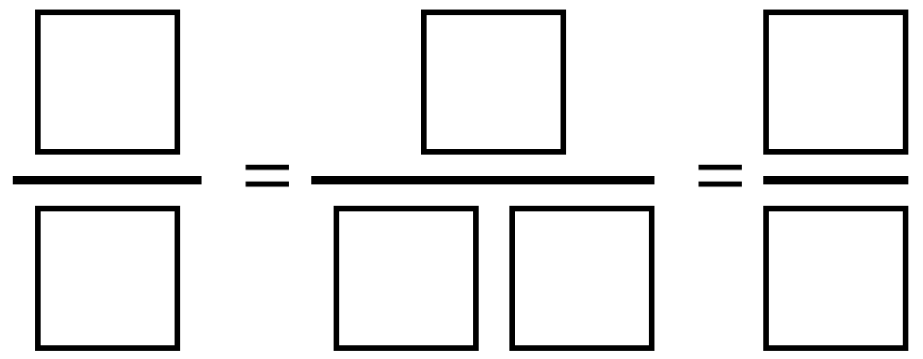
Directions:  Fill in the boxes using the whole numbers 1 through 6 to make the largest (or smallest) possible number. Use each digit at most once.

       Who ever said that there is only one way to get the answer in a math problem?  

       OK...(unfortunately) lots of people say this.  But, guess what, the best math questions don't have just one way to be solved.  Because the best math problems don't have the simplistic goal of merely following the steps you are told to follow and getting an answer.  The best math problems have much broader goals: Thinking, Reasoning, Problem Solving, Perseverance

       I've recently been introduced to a great source of these math problems called Open Middle.  Open Middle math problems start the same and end the same (with one particular correct answer), but they have an "open middle"; there are many ways to approach and to ultimately solve the problem.  The above problem is a sample of an Open Middle problem.  

       Open Middle has math problems for grades Kindergarten to high school mathematics.  They are great for getting students to use recently learned math in novel ways.  And when students have a chance to talk about the way they went about solving the problem, they gain an ever stronger grasp of the mathematics by hearing from their peers--a strategy known as Number Talks.  

       Students learn that it is OK to think about solutions differently.  One student may have a very complicated solution that makes sense to her.  Another may have a clever solution that no one ever thought of--not even the teacher!  Learning from each other is a great way to experience math and to understand that math is vibrant and alive with many possibilities.

       Students may think of Open Middle problems as puzzles, but listen to the math vocabulary that they use when the work on their solutions.  Students who are bored with the typical math class are excited to spend lots of time working on Open Middle problems because they are relatively easy to start.  Every attempt at an Open Middle problem helps students to learn what to do and (perhaps) what not to do.  They don't view wrong answers as failures but instead as a closer step toward the final answer.

Directions: Using the whole numbers 1 through 9 no more than once, create 3 equivalent fractions.


Sunday, October 30, 2016

When Students are Thinking, Students are Learning


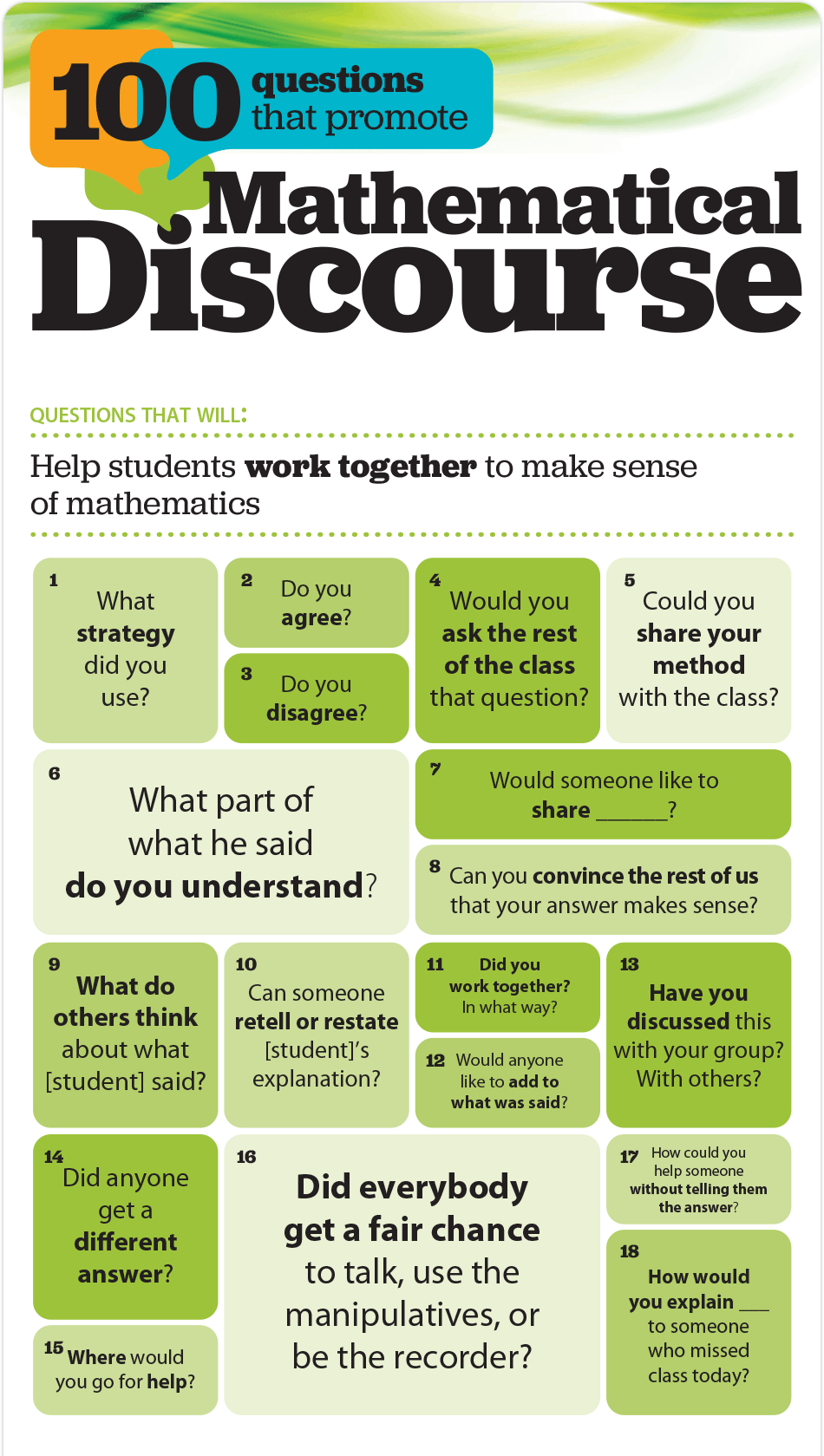
       I was recently introduced to a fantastic list of 100 questions that teachers can ask in mathematics class that will encourage students to think and reason and share their thoughts with each other.  A portion of these 100 questions are in the graphics in this post.  The rest can be found here.

       The questions are separated into categories that help students to:
  1. Work together to make sense of mathematics.
  2. Rely more on themselves to determine if something is mathematically correct.
  3. To reason mathematically.
  4. Evaluate their own processes and engage in productive peer interaction.
  5. Gain a better understanding with problem comprehension.
  6. Learn to conjecture, invent, and solve problems.
  7. Learn to connect mathematics, its ideas, and its applications.
  8. Persevere.
  9. Focus on the mathematics from activities.
       Every parent that has ever received the unimaginative response of "Fine." to the question, "How was school today." understands the frustration of trying encourage a dialogue with young people who are either unable or unwilling to do so.  Teachers face this dilemma every day.  Except, for teachers, their are tasked with making sure that the students are actually learning the content that they are teaching.  Teachers don't have the luxury of dismissing an uninformed, mono-syllabic response.  Hence teachers do their best to use strategies that will encourage students to share their thinking.  These questions help teachers to achieve this goal.

       Here is a sampling of some of these great, discourse-encouraging questions:

How would you explain _________ to someone who missed class today?

How did you reach that conclusion?

Can you think of a case where that wouldn't work?

Could you reword that in simpler terms?

How is your solution method the same as or different from (student)'s method?

How does this relate to ____________ ?


       These questions help students to understand that mathematics is not just a bunch of rules that lead to a single number answer.  We want students who are able to understand the reasoning behind the rules.  We want students to think and reason and discuss and struggle and fail and try again.  We want students to have strategies for finding solutions beyond just asking the teacher.  We want students to learn from each other, to recall past lessons, and to know how to check their own work.

       These questions are a great resource to our teachers.  When students are thinking, students are learning.


Monday, October 24, 2016

The Time Has Come to Question Everything We Do in Education

Why is the school day six-and-a-half hours?

Why is the school year from September to June?
Why do have to use Carnegie Units in high school?
Why are grades so important?

Why does every class have to have a textbook?

Why do I have to use a pencil in math class?

Why does high school start so early in the day?

Why do schools compare themselves to each other?

Why do I have to memorize things that are easily found online?

Why does the teacher do most of the talking in class?

Why do we rank students in high school?

Why do we brag about high grades and not about high learning?

Why do have student desks and chairs?

Why do all of the chairs face in the same direction?

Why is there 14 years of schooling from Pre-K to high school graduation?

Why?


       Cars change; buildings change; clothes change; planes change: people change; the world changes.  Why don't schools change?  

       Why?

Public Schools and Choice

       Is it true that public school kids and their public school parents don't have choices?  I'm sure that I will expose my igno...

Teach100 blog