Showing posts with label conceptual understanding. Show all posts

Friday, February 3, 2017

Learning and Thinking - (getting the right answer isn't good enough anymore)


       Learning and thinking have always been closely linked.  But sometimes, in our schools, we only achieve the appearance of learning--often accompanied by very little thinking.  This problem has been recognized by educators for a long time.  In recent years, however, we have been addressing this issue on various fronts.

       Let me begin by explaining what I mean by the term Appearance of Learning.  This is when students get good grades, but their actual learning is very low.  The grade to the students and to their parents makes it appear as if they have learned a lot, but the attainment of those grades may have been based partly on non-academic measures such as good behavior or mere compliance with rules such as turning in homework on time.  This is a problem because when students move on to more complicated coursework that requires previous knowledge, they struggle due to never actually learning the earlier content in the first place.

     Over the past few years, there has been a stronger attempt to balance the need for teaching skills (such as solving an equation) with the need for teaching conceptual understanding (such as using an equation to solve a problem).  This sort of "teaching" is different from when our students' parents were in school--a time in which just-getting-the-answer might have seemed good enough.  Today we know that this isn't good enough.  Students going to college and students going to work need skills and knowledge beyond merely doing what they are told to do.  Today's world demands more from our citizens.


       Our schools recognize this need and we are trying to make changes to address this challenge.  It's hard to change a system of 100,000 schools, 50,000,000 students, and 3,000,000 teachers.  But (indeed) this change is already happening.  What we used to call a "computer room" is now just about any classroom in the building.  Classrooms with students sitting in nice, neat, straight rows that discouraged collaboration among students have been replaced with classrooms with tables or desks arranged in groups to encourage students to work together and ask questions of each other and learn together.  Grades for non-academic behaviors (mentioned above) are strongly discouraged so that a student's grade can more accurately reflect his/her ability in the content.  Finally, student engagement strategies and growth mindset strategies are constantly being discussed and implemented.  These reflect our knowledge of the best way that students learn.  No longer do we expect everyone to learn strictly by listening to the teacher and taking notes.

       Indeed, the change to an educational system that requires more from our high school graduates is well underway.  The past is in the past and we're not going back.  Those that choose not to change risk creating a generation that is ill prepared for the challenges that they will face.  Learning, thinking, reasoning, and problem solving will be more and more integrated into our schools.

       You're welcome.


Wednesday, January 25, 2017

Why Is Teaching Mathematics So Different Than Teaching Other Subjects?

       My entire professional career has been in Secondary Mathematics.  As a middle school teacher, high school teachers, department chair, and supervisor; I have been immersed in the field of teaching and learning mathematics.  Whenever conversations arise about the instruction for very weak students or for very advanced students, there seems to always be special considerations for students when it comes to mathematics.  Principals, school counselors, and special educator alike all agree that the teaching and learning of mathematics seem to require very different skills compared to the teaching and learning of reading and history and (perhaps) other subjects.

       Keith Devlin has a relatively simple answer to this question which he explains in his paper written for the Mathematical Association of America titled, In Math You Have to Remember, In Other Subjects You Can Think About It.  Devlin explains that mathematics is often taught as a series of rules that you just have to memorize.  Whereas other subjects such as history and science are taught within a context that help the learner to make sense of the content.  Mathematics could be taught within a context (and, I would say SHOULD be taught within a context), but it usually isn't.  This makes mathematics seem like a secret language with tricks and complicated rules that sometimes work in some situations and don't work in other situations.  When mathematics is taught as merely a bunch of skills without any understanding of how and when to use these skills, many students struggle to be successful.


       In her book Mathematical Mindsets, Stanford professor Jo Boaler explains that all students can learn mathematics if teachers are equipped to help students to build understanding.  While it is relatively easy for trained secondary mathematics teachers to learn these techniques, most teachers have not received this training when they were in college.  Furthermore, most adults today (parents, school principals, school counselors, etc) grew up learning mathematics through a strictly procedural approach.  Because of this experience, most adults believe that mathematics should be taught as a bunch of skills.


       Fortunately, more and more teachers are mixing more and more conceptual understanding in their mathematics classrooms along with learning the skills.  There are places in which math is taught somewhat differently than it was taught in past generations, and this is a good thing in my opinion even if it makes some parents feel uncomfortable.  Math should not be taught as 100% skills without any connection to the real world.  For most students, this sort of instruction is just too abstract for them to understand.


       Mathematics is also a subject that builds on itself from school year to school year.  Students need to have a good understanding of the concepts so that they can build on previously learned content to understand the new content.  This idea of building from year to year is more prevalent in mathematics than it is in other subject areas.


Wednesday, July 6, 2016

Creating a Better High School - Part 2

       This is the second in a three-part series that will look at the structures in place in our current high schools that don't make sense or are not needed anymore.  I want to think about the best way that students learn and create a high school that will serve these learners.  I also want to think about the true purpose of high schools in our time.  My goal isn't to imagine a "High School of the Future", but instead to consider what can realistically be done today.  As always, I encourage my readers to add their thoughts and ideas.  Together we can create the high school that our students want and need today.

Create a Better High School

Part 1 - Current school structures that aren't necessary anymore.
Part 2 - How students learn and how schools can react to these learners.
Part 3 - The purpose of high school

-----------------------------------------------------------------------------------------------------------------

How students learn and how schools can react to these learners

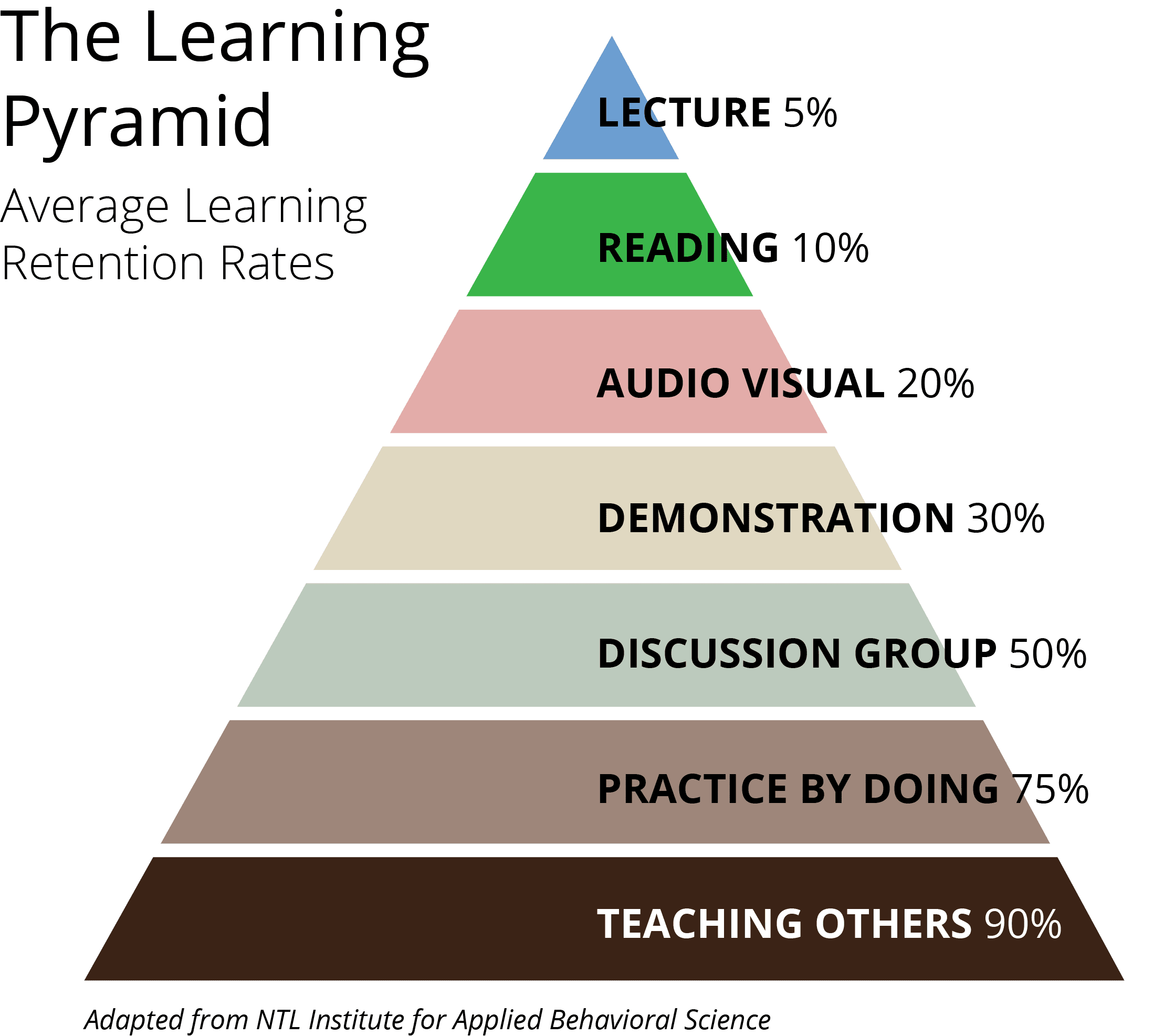
        When I think about creating a new high school, I'm really thinking about all of the traditional structures of our current high schools that don't respond to the way students learn.  The typical high school class still consists of a teacher in the front of the room who does most of the talking while students sit in rows facing the front of the room and take notes.  Students generally only talk to answer a question; to which the teacher confirms or denies its correctness.  This sort of learning (generally) falls in the "Lecture" category which is the least effective strategy for helping students to learn.

       The organization Jobs for the Future has recently published a series of papers titled Students at the Center.  In this series, they list four principles of student-centered learning.  These are:
  • Learning is personalized
  • Learning is competency based
  • Learning takes place anytime, anywhere
  • Students exert ownership over their learning
These four principals lead to deeper learning which is the sort of learning that gets students exited about what they are learning and encourages retention of their learning.  Deeper learning prepares students for both college and careers because it teaches them how to solve problems, how to work with other people, and how to think critically.

       The "changes" needed in our current high schools are changes that respond to these four principles and respond to the best ways that students learn.  This will require changes for teachers as well as changes in the expectations for schools from our parents.  Part of the struggle of changing high schools is that every adult has had the same basic schooling experience.  We are comfortable with it.  Teachers teach the way they were taught--they didn't devise these structures, they just mimic from their high school teachers and the only changes are additions of what they thought their teachers should have done and subtractions of what they thought their teachers did wrong.

       We need our high schools to be the places in which students are still learning to write and read and do math and understand history and make and appreciate art and learn about physical fitness.  But all of this has to be done in a way that encourages learning as opposed to encouraging "getting-a-good-grade" and encouraging competition with other students.  Students need to actually solve problems, to work with each other, to talk and learn how to argue their point.  The college-bound students should be able to master the beginnings of Physics and Calculus; but should also be to experience the work of the field they aspire to enter.  They should be able to more than just what they are told to do.  They should be thinkers and reasoners and creators and doers.  The career-bound students should master the art of expressing themselves in written and oral forms; they (too) should experience the workplace before leaving high school.  They should know how to build on the basic skills of any job and seek ways to make it better.

       We want students to learn; we want them to learn how to learn; and we want them to learn in abundance.  Because learning doesn't stop when you receive your high school diploma.


Wednesday, June 15, 2016

Is Your Child Advanced in Mathematics?

       It seems that, more than in other subjects, the placement of students in advanced mathematics is often a contentious issue. Elementary schools have different policies about placing students in classes that teach math at grade levels that are above the student's current grade.  Middle schools often offer high school mathematics classes, but some stop at Algebra 1 and some go beyond Algebra 1.

       The ability of a school or school system to determine a student's math ability (or "advanced" math ability) can be hard to do with great accuracy--especially when we are trying to make this determination with eight and nine year old children.  It's not enough that they are getting good grades in their math work; math is more than mere calculation.  And higher-level math is all about reasoning and thinking and understanding.  The kid that is good at memorizing, isn't always good at (say) the abstraction that comes with manipulating variables and graphing a line.


      Yet, I think that (too often) we get a false impression of a student's math abilities from merely looking at their elementary grades on the report card.  Sometime students are placed in advanced classes and at some point in middle school they start to struggle because they were pushed to learn higher and higher levels of math too fast.  On the other hand, there are certainly students who are highly able in mathematics and they should be encouraged to take more challenging classes that are commensurate with their abilities. So goes the dilemma of trying to identify the truly highly-able students from those that only appear to be highly-able.

       One method that helps is using multiple data points.  When students breeze through their multiplication tables and get "A's" on their report cards, but do poorly on standardize tests or on unit tests, this should be a cause for concern.  Maybe this student is good at memorizing facts and procedures and not good at understanding concepts.  This student is successful at procedural assignments (such as long division with whole numbers), but may struggle with more abstract assignments (such as a math task with multiple answers).

       Of course, we know that it is OK for students to struggle as they learn new concepts (see previous blog post), but many students view this struggle as a sign that they aren't good at math; or a sign that the teacher is doing something wrong.  We don't want students to struggle because they have been inappropriately placed.  Truly able students (and Growth Mindset students) don't mind the struggle because they enjoy the journey toward learning.  Also they understand that it is OK if they don't get it the first time.  Continual effort will eventually pay off.  Students who never tried hard to do well in math and then are placed in an advanced math class and then are upset when they don't get it the first time...these may be the students that we are pushing too quickly.

       Is your child advanced in mathematics?  How do you know?

Monday, April 18, 2016

Why Do You Remember Your SAT Score?

       What's your social security number?  What is your phone number?  How tall are you?  When were you born?  What did you get on your SATs?  Huh??  Why is your SAT score is a number that you memorize every bit as much as your phone number?  I can't find any survey data that says the percentage of adults who recall their SAT score (from among adults who have taken the SAT), but my own anecdotal evidence suggests that it is very high.  I dare say that a far majority--maybe more than 75%--of adults who have taken the SAT more than 20 years ago can still recall their score today.

       Why?

        Why is this number, this score--which has no power whatsoever in lives of people in their 30s and 40s--so ingrained in our memories?  It's just a number that (years ago) described our ability to do high school mathematics and our knowledge of grammar, vocabulary, and reading comprehension.  It won't get us a raise or a promotion twenty-plus years later.  There's no college admission counselor to impress when you're in your late 30s.   We're certainly not going to get any reward or trophy or recognition of any kind.

       So why is your SAT score so important to you that you remember it for your whole life?  Why?  I have a theory....  At the time we took the SAT, everyone around us made a big deal about it.  It was billed as the most important test we will ever take.  They said, "Your life depends on it."  (Or something to that effect.)  It was like training for the Olympics.  The test date was on our mind for weeks before.  We thought and thought and thought about it.  We worried about it.  It was a sort of a milestone in our young lives; like getting our driver's license.  We might have taken it more than once because someone said that that was a good idea.  It was an accomplishment akin to graduating from high school or running a mile in six minutes or going out on your first date.

       I think that taking the SATs was billed as such a huge event in our lives, that most of us figured it was important enough to remember our scores.  But, I fear, that it also produced a generation of people that valued test scores over actual learning.  Today in education, we are trying to change this thinking.

       Today educators value frequent formative assessment over the results of unit tests and final exams.  We value multiple data points over the "one big test".  We value a combination of conceptual understanding and procedural knowledge over the mere regurgitation of facts.  Learning and the measurement of learning has come a long way.  Some colleges don't even use the SAT as a consideration for admission.  Others use it as one of many factors for making the admission decision.

       Aside from the college admission process, your SAT score really isn't very important in your life.  Americans are competitive people.  We like to win.  We don't want people to pass us on the highway; we don't want to lose a promotion to someone else; we don't want our lawn to look worse than our neighbor's lawn.  We have to stop competing for everything.  Your SAT score does not define who you are.  You won't "win" or "lose" anything because of your SAT score; especially twenty-plus years after you take the SAT.

       There are lots of experiences that most adults would gladly like to forget about their high school experiences.  Your SAT score should be one of them.


Tuesday, October 6, 2015

Teaching Mathematics For Understanding

       There has been a lot of debate in the U.S. about our student's ability in mathematics for the past decades--certainly for my entire career (which started in the 1980's). How do we compare with students in other countries? (see PISA results - 36th out of 70 for mathematics in 2012)  How do we compare with each other state-by-state?  (see NAEP results from 2013)

       What are the causes for these discrepancies?  What do other countries do differently compared to what we do in the U.S.?

       Ask a hundred people and (it seems) you would get a hundred answers.  Everything from "nothing's wrong" to "the system is broken".  Everyone has their point of view; there are experts on both sides of the every argument.

       Recently, I've read two sources on this issue that make a lot of sense to me.  The first is from Phil Daro.  He makes the point that many mathematics teachers in America have the goal of teaching students how to get the right answer.  In other countries the mathematics teachers have the goal of teaching students how to understand particular mathematical concepts.

       This makes sense to me because I've been that mathematics teacher and I've seen that mathematics teacher among my colleagues.  While I believe that our teachers want their students to understand and to gain a conceptual understanding, they are often fighting a battle against an accountability system that seems to reward "correct answers" more than awarding "correct understanding".  (Although the new PARCC and Smarter Balance assessments may have found a balance between these two competing forces.)  We are also fighting a culture of students who avoid the struggles needed understand these concepts and (instead) seek shortcuts for getting the right answer.

       The second source is an article by the education writer Amanda Ripley.  She took the PISA math test in an effort to understand the sort of thinking that it requires of students.  She also interviewed exchange students who spent time in schools in other countries.  From these interviews, she repeatedly heard these students remark about the following three differences between schools in the United States and schools in higher achieving countries.  These are:

  1. School is harder. There's less homework but the material is more rigorous. People take education more seriously, from selecting the content to selecting the teachers.
  2. Sports are just a hobby. In the U.S., sports are a huge distraction from the business of school, but that's not the case in other countries.
  3. Kids believe there's something in it for them. The students in other countries deeply believe that what they are doing in school affects how interesting their lives were going to be. Even if they don't like a class, they see their education as a stepping stone to their future.

       I believe that we have to take a honest look at ourselves here in the U.S. and be open to these differences if we are ever to see a significant rise in the achievement of our students.  Our current climate of new standards and new assessments provide to us an opportunity to make this huge adjustment in our teaching and in our understanding of the true purpose of our mathematics class rooms.

       We can do this.  We must do this.  We must do better.


Public Schools and Choice

       Is it true that public school kids and their public school parents don't have choices?  I'm sure that I will expose my igno...

Teach100 blog