Showing posts with label education. Show all posts

Monday, March 27, 2017

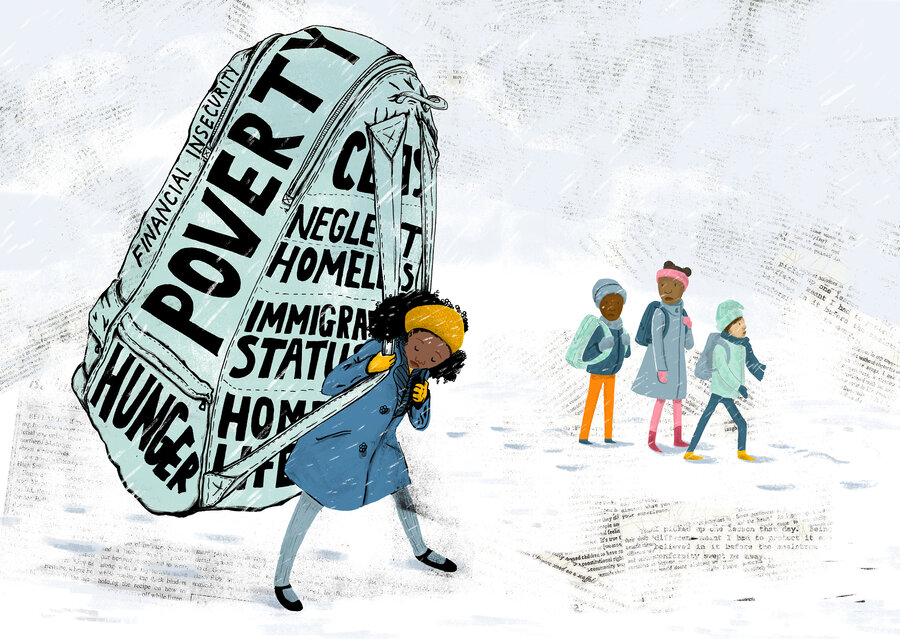
Achievement of Poor Students is the Educational Challenge of Our Time

       The data is overwhelming:

  • 10.7 million school-aged children living in poverty (source)
  • Over 50% of school-aged children are eligible for Free and Reduce Price Meals (source)
and the results are terrible:
  • Children living in poverty miss more days of schools than children who do not live in poverty.
  • Dropout rates are higher among student from low-income families.
  • 40% of children living in poverty are not prepared for primary schooling.
  • Less than 30% of students from the bottom quarter of income go to college; and less than half of them finish college. (source)
       The academic achievement of poor students has been a challenge that our nation has seen for decades.  Back in the time when earning a high school diploma was less necessary for acquiring a good job, our failure to adequately help poor students was less of an issue.  The penalty for not succeeding in school, while present, was not so severe.  Low-skilled jobs, manufacturing jobs, and service jobs were relatively plentiful and attaining a middle class life-style, while still somewhat difficult, was more possible.  

       Today, high school graduation (and the hard and soft skills that we want our students to gain in high school) is much more of a necessity than ever before.  Technology has lowered the number of low-skilled jobs and "Career and College Readiness" has become so much more than a slogan.


       The statistics are well known.  Student from families in which the parents have college degrees usually do well in school.  Students from families in which the parents didn't finish high school usually do poorly in school.  We are faced with the daunting challenge of overcoming this generational force that seems to keep pulling our most vulnerable students down.  Since "learning" is not something that can be forced on a person, our schools need to find a way to convince poor students (and their families) that schooling and education are important.  Knowledge is power.  Academics leads to more opportunities.  

       This is especially true as students move to middle and high school.  The subject content is more difficult; the reading level is higher; and the consequences of better achievement that are recorded and stored in student records are asked for from colleges and universities later on.  It's hard to do hard things--even for bright students.  The issue isn't the level of intelligence.  The issue is the level of motivation that encourages students to carry on even when the work gets harder.

       No one wants to fail.  Poor students are burdened with many hardships that come with a lack of money: less books at home; less technology at home; poor or no healthcare that leads to sick students getting sicker rather than getting better; less food and/or less healthy food.  We need to understand these challenges that are part of the daily experience of our poor students.

       This has been a problem in education for a long time.  There are pockets of success around the country, but we are far from declaring victory over this problem.  Of all the issues facing education, the issue of educating our poor students looms high above the rest in my opinion.  When this issue is properly addressed and we begin to see improved results, we can truly say that we have given our best to our students and to our society.


Thursday, March 23, 2017

Education Without Grades

 
       Imagine P - 12 schooling without grades.

       Learning?  Yes.
       Art?  Yes.
       Clubs?  Yes.
       Teachers, friends, computers, classes, classrooms?  Yes, yes, yes, yes, and yes.
       Grades?  No.

       The idea of an educational landscape without grades is not so new and (in fact) there are a significant number of schools that are experimenting this idea right now.  New York High School English teacher, Starr Sackstein, has been talking about this for years.  We still teach and we still assess.  We just don't use the traditional grading system of attaching a number or a letter to that assessment.

       The problem with "grading" is that it has grown to be a monster that we can't control.  Parents and students alike will tell you that they care more about "getting-a-good-grade" than they do about "learning".  As with so many other aspects of American life, grading has become a competition to be won, rather than a method for measuring learning and understanding of academic content.  Add to this that grading systems vary widely from school to school and even from teacher to teacher (sometimes) in the same school to the point that it is hard to say what a particular grade actually means; or if the same "grade" means the same thing from one class to another.

       Still, it can be hard to convince a generation that (whether they like it or don't like it) has grown up with the letter grade system, that a no grades system is a better way to conduct our middle and high schools.  Here is a great article that contains students' thoughts about living through a "no-grades" experiment.  (Spoiler alert: One-third liked the idea, one-third didn't like it, and one-third didn't care.)

       I often say that the goal of education is learning.  If something hampers our efforts to help students to learn, I think we should do something about that.  Grades and grading have (in many cases) become the new goal or the more prominent goal of education in the minds of many students and parents.  That's a problem.  If we are preparing students for the world of work, what will be their motivation if without grades in the workplace?

       Colleges regularly get rid of students that can't keep up academically.  It doesn't matter what their grades were in high school.  What matters is what they know and are able to do.  Same thing with employers.  Good grades might get you the job, but only true ability will enable you to keep the job.  We need to teach students the value of learning exceeds the value of earning good grades.  Maybe the way to do this is to get rid of the grades.

       What do you think?


Tuesday, March 7, 2017

What is Blended Learning?

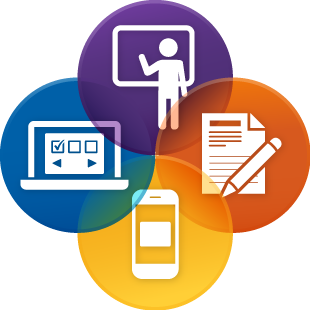
              Blended learning is an education program (formal or informal) that combines online digital media with traditional classroom methods. It requires the physical presence of both teacher and student, with some element of student control over time, place, path, or pace.

       My school district has begun the journey into Blended Learning over the past couple of years.  As an educator approaching his 30th year in the business, I view Blended Learning as an effort to bridge all of the positive and effective teaching and learning strategies that the educational and research communities have learned over the past few decades.

       Like any new initiative, Blended Learning will take some time for teachers and students and parents to learn and understand.  We will have to discover new and better ways to implement it in a way that is most beneficial to our students.  This effort will be well worth it.  Blended Learning--as I see it--addresses the following educational beliefs:


  1. Learning at your own pace.  In a traditional classroom, 30 students learn the same thing at the same time.  If you pick up on the topic quickly, you have to wait for your classmates to catch up.  If you struggle to understand the topic, you have to move to something else before you fully understand.  Blended Learning allows students to move at their pace.  Everyone is learning the same topic, but fast learners are given more challenging work and struggling learners are given more assistance.
  2. Multiple ways to show what you know.  In the traditional class, students can only demonstrate their understanding through classwork and homework and tests.  While this isn't a terrible method for measuring student knowledge, we certainly know that this method can lead to the appearance of learning when (in reality) little learning occurred.  Classwork can be graded on completion instead of quality.  Homework completion can come from lots of parental help for some and no parental help for others.  And tests can earn high grades due to cramming and memorizing rather than due to actual learning.  In the Blended classroom, students work with each other and help each other; teachers can spend more time one-on-one with their students (or in small groups).  Students can demonstrate their understanding through informal assessments and assignments in addition to more formal and traditional testing.
  3. Multiple attempts to learn.  We know that learning is a process.  Few students can sit in six or seven classes a day and learn six or seven different things strictly from listening and taking notes.  Learning requires listening and thinking and doing and sometimes failing the first couple of attempts.  Blended Learning recognizes the learning process and students understand that it is OK if they don't get it right away.  Blended Learning also provides different modalities for student learning.  These include: small group work, individual work, using online resources, using paper and pencil resources, and allowing students to verbalize their understanding.
       Blended Learning recognizes that students learn in different ways and at different rates--and this is not only OK, it is expected that all students learn in different ways.  The goal is learning.  Blended Learning permits students to be students and to learn in a way that works for them.  Learning isn't a competition.  Learning faster isn't better than learning slower.  Everyone that reaches the finish line is a winner.  Blended Learning helps students to see the value of learning.

Saturday, January 14, 2017

Data, Data, Data Leading to High Achievement

     Education and learning is the result of hours of planning and hard work on the part of teachers and students.  Behind the scenes in every public school that cares about student learning, there are individual and teams of teachers that use data to make good instructional decisions.


       In years past, we only had data from chapter tests.  But since the chapter was completed and the instruction has already moved on to the next topic, this data was already "old news".  It couldn't be used to help us to make good instruction decision for right now.  Today teachers understand the power of using data to guide their decisions.  When the public hears about school data, they often think about tests results--probably because that is the most common form of data that is published in the news.  But teachers use all sorts of data that doesn't include test data.

Data-Driven Decision Making

       Public school teachers measure student progress in many ways in today's classrooms.  Teachers use rubrics to assess projects or some assignments.  Teachers use games.  Teachers use exit tickets.  Questions, discourse, group work, individual work, electronic responses, etc.  Teachers have multiple sources of student data.  This data is used to help teachers to decide:
  1. Who gets it.
  2. Who sort of gets it.
  3. Who doesn't get it.
These determinations are used to help teachers to prepare for the next lesson.  Chapter tests and large, state-wide standardized tests are a "final" product of the educational process.  They don't help us in our day-to-day planning.  It is the daily collection of data from formative assessments that inform instructional decision.  It is also this data (or the information from this data) that help students to gain a sense of how well they are understanding the content.

       Indeed, learning is a process.  It takes time and practice and effort.  It requires students and teachers to ask a lot of questions and often to make mistakes along the way.  It requires thinking and reasoning based on what we've done so far and what we still need to do.  The data that comes from these efforts help all of us to measure progress toward the goal of learning.  Most of this data analyzing is invisible to the public.  It is the technical work of teaching that is too "un-interesting" to print in the newspapers and yet vital to the practice of teaching.

       Data drives decisions for students and schools.  Data is the fuel that keeps our classrooms running in the right direction.


Sunday, December 4, 2016

Teaching to the Test Is Not a Bad Practice Anymore


       Education has this phrase:

Teaching to the Test

In the past, this phrase was a derogatory phrase that meant (at the extreme) the only thing we do during class time is to prepare students to take a test.  This implied that we never taught additional topics that weren't on the test, and that we never taught at a higher rigor level than what was required on the test.  The other (more broad) implication was even worse; We didn't concern ourselves with whether or not students actually learned anything, our only concern was that they got a high score on a test.

       This sort of Teaching to the Test probably did occur at many public schools, but I would hope that teachers (and schools) never lost their desire to encourage learning over mere test grades.  Indeed, teaching at a higher rigor level than was required on a test would serve the dual purpose of (1) helping students gain a higher level of conceptual understanding, as well as (2) helping students to score well on a test.  So we had incentives to go beyond the content that appeared on a test.  

       Today we see teaching to the test much differently.  First of all, we are now seeing standardized tests that require much more than merely a single-word, or single-number answer.  Today's test require students to demonstrate a high level of understanding.  This means that the days of memorizing formulas or (even worse) memorizing shortcuts and tricks are over.  Student who are only able to follow procedures and answer low-level questions will not earn high marks on today's tests.  Secondly, I feel that there is a renewed interest in teaching students how to engage and reason and think and argue and prove.  These are the skills that lead to a better conceptual understand over and above the old get-the-right-answer sort of teaching that took place in the past.  In this world, Teaching to the Test is the same thing as simple "Good Teaching".

       I know that the issue of standardized testing has become as controversial and divisive as the abortion issue to some people.  I found a great article on the Pros and Cons of Standardized Testing that may provide additional information to those folks that only see one side of this issue.  Regardless of your views, all people want their children to do well in school and (I hope) "doing well" means learning and not getting-good-grades for most people.  The primary objective for our public schools is certainly learning.  If students aren't learning, than there's no point in coming to school.  

       Today I am seeing a resurgence in helping teachers to explore classroom strategies that help students to learn concepts so well that they can teach them to other students.  Gone are the days of rote memorization. That sort of teaching isn't good enough if we want to prepare our students for the world of work and further learning in their futures.  Teaching to the Test is good if it helps our students to be better problem solvers.  

       Teaching to the Test is just good teaching.


Saturday, November 19, 2016

A Few Laughs is Always a Good Thing


       Ok.  I'm constantly seeing posters in teachers classrooms that make me laugh.  So here's my post from the lighter side of education--filled with cute, funny, maybe inspirational posters and sayings that keep me grounded and remind me that education is (of course) important, but it's OK to laugh and chuckle and even laugh at myself from time to time.
       What are your favorite education posters?  What makes you laugh?  What do you want your students to see in your classroom (when--perhaps--they should be listening to you)?

Tuesday, November 1, 2016

Students, Teachers, and Parents: Working Together to Improve Education


       Education, as with most things in life, works best when everyone works together.

       Of course, parents and students and teachers don't always agree about what's best for education.  So I've devised a plan for systemic improvement:

Concentrate solely on the school that your children attend.


      You see, we view education in the entire United States differently than we view education in the schools our children attend.  For years Gallop has polled parents about their views of education; and for years they have received essentially the same results:


  1. We are not happy with the state of schools in the United States.
  2. We are happy with the state of the school in our community.

       It happened again this year.  In 2016, only 43% of those polled said that they are Completely Satisfied or Very Satisfied with quality of education in the United States.  Of these same people (same poll; same year), 76% said that they are Completely Satisfied or Very Satisfied with quality of education that their children are receiving.

       So here's my plan:  

Let's just do everything we can do improve the school(s) our children attend.


       The U.S. is too big.  17,000 school districts. 100,000 schools.  50,000,000 students.  Who can even comprehend the immensity of such a huge system???

       If we all just concentrate our energies on the schools in our community, we have a much better chance of seeing real improvement.  Better teachers, better students, better learning.  It can be done if we all do our part for our own schools.  And when the community disagrees on something, let's listen to each other and compromise on a solution that is best for our students and best for our community.  Every wins when we work together.


       (And isn't "working together" a lesson that we want all of our children to learn?)


Monday, October 3, 2016

Three Years; 200 postings; 50,000 views

       Three years ago today I began this blog with the modest words below.  It has been a learning and a reflective experience to write about education in America.   I've considered some controversial topics and I've praised the many excellent people that work within the walls of our schools everyday. And I've receive great feedback from my readers; their stories and ideas.

       Thank you follow joining me in this journey.  There is always so much to do; so much to say.  And together we can do it all.


First Post from October 3, 2013

It's 6:30am; "No time like the present." (Right?)  So here is my first post; really my introduction to this blog.  This blog that I have said to myself for years (and to others) that I should write.  So here is the beginning.

The blog is called, What's So Good About about Education?.  The purpose (the vision) is to highlight the good things that occur in American education every single day.  There are lots of sources out there that talk about the bad things in education.  This would make the average person think that there is nothing good about education in America.  Well that's just not true.

In truth, I may talk about the good and the bad, but I want to stress that there is lots and lots of "Good" going on.  We need to acknowledge the hard work of teachers and the many, many successes of our students. 

I hope to  be able to do that.

Have a great school day America.  I know you will.

Saturday, October 1, 2016

Good Enough Isn't Good Enough

       Schools, educators, teachers...they are never satisfied.  We are the ultimate Olympic athletes when it comes to our desire to constantly improve.  In education, "Good Enough" is never good enough.

       While it is often true--though not in all schools--that most students do fine; most students learn to read pretty well, most students move on to the next grade, most students graduate.  There are always some students that don't or that struggle to reach these accomplishments.  And even for those that do succeed, What is our standard for success?  Is it a passing grade?  Is it to barely exceed the minimum?  Is it to be merely good enough?

       The best teachers are constantly striving to find ways to reach all of their students.  The students that do what they are told and are able to "succeed" in school without much effort should be pushed to do more.  The students who always excel academically should be pushed to do more.  And the students that struggle to meet the minimum requirements should be given the help they need to do better.  All students can do better; all teachers can improve; all schools can strive for better results.

       The goal of school is learning.  But students approach this goal from many different viewpoints.  Some strive to be "Number 1"; some do their best everyday and accept that they may be stronger in some areas than in other areas; some students struggle in math but are good at reading; some students seem to struggle in all academic subjects but are talented in the arts.  And some students have been beaten down so often by their schooling experience that they have given up on trying.  All of these people come together in the typical public school and it is the job of the educators to more all of them forward.

       It is hard to have one policy or one standard that applies to everyone when "everyone" is so different.  Maybe the goal shouldn't be to reach a standard as much as it should be to improve based on whatever your starting point is.  If you come to 7th grade able to run a mile in 9 minutes and 36 seconds, maybe you should strive to end 7th grade with a time of 9 minutes flat or 8:30.  Similarly, if you begin 7th grade with a reading ability that is considered "average", may you should strive to end the school year above average in reading.  And if you are a teacher who always struggled to help those students who always want to sit in the back of the classroom and never participate, maybe you want to have the goal to encourage them to answer questions and to offer their ideas at least twice in every class.

       The goal isn't to be Number 1; the goal isn't to "win".  School is not a competition.  The goal is always to improve regardless of your starting point.  Nobody should accept "Good Enough" as good enough.

Sunday, August 14, 2016

Parent's Role in Improving Student Achievement

       If you have a child in elementary, middle, or high school, then your main concern is helping your child to do well in school.  You have a person or persons in your household that is a member of the most important cliental in the educational community--the students.  And as a parent, you have influence over your children.  Your attitudes and actions toward school matter.

       We need your help!

       So here is my short list of the three top things that parents can do to help their children to do well in school.


  1. Healthy relationships all around.  
Help your child to make friends with classmates and to get to know the teacher or teachers.  You (the parent) should try to get to know your child's teacher(s) too.  Communication is the key to all healthy relationships.  So try to discover the best way to contact the teacher.  Make sure that your child knows that you have a relationship with the teacher and a way to make contact on an as-needed basis.  This shows that you care about your child's education.  

   2.  Emphasize "learning" over "getting-a-good-grade".

The point of school is learning, not getting a good grade.  There are lots of ways to get good grades without learning much.  We want students to learn how to learn; to read; to study; to try and fail and try again; and ask for help.  Your child's grade should reflect his or her ability; but sometimes it just reflects his or her ability to do what they're told.  Remember that the goal of school is learning.  It's the "Do you best." philosophy (that your parents probably said to you).

    3. Don't help your children too much.

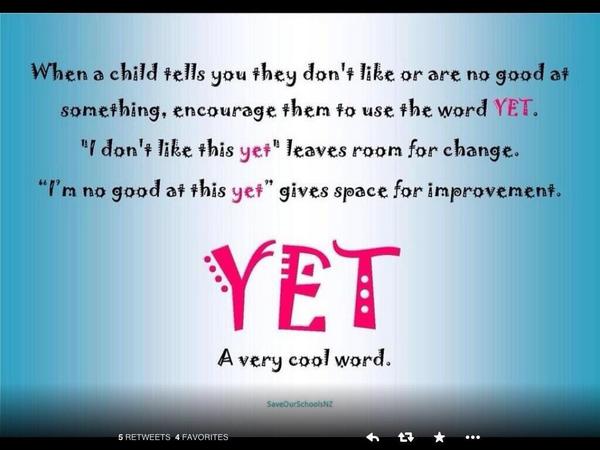
Let's face it...nobody likes to see their children struggling.  But if everything is easy and can be obtained without effort then you have to ask, "Is my child really learning anything?"  Real learning comes from a little struggle from time to time.  Just because your child doesn't "get it" the first time doesn't mean they will never get it.  They just haven't gotten it yet.  If you tell them the answer or do the work for them, they will get the right answer, but they haven't learned anything.  Remember, the goal of school is learning.  Instead of telling them the answer, ask questions.  "What do you know?"  "What don't you know?"  "What do you need to know?"  "What questions should you ask the teacher?"  We want students to learn how to deal with struggle; we want them to problem solve when the problem is difficult.

       School means a lot of things to a lot of people.  Clubs, sports, friends, activities, requirements, homework, pens, paper, teachers,....  It can be hard to remember that it is all about learning.  As the parent, you can help your child to focus on the important parts of school.

       Have a great school year!

Saturday, June 18, 2016

Preparing Our Students for College and/or Careers


       "College and Career" has become the new buzzword in American high schools.  We want to prepare students to be ready for the social and academic demands of college; and--for students who go to college and don't go to college--we want to prepare our students for the demands of being in a working environment.  This has become a rallying cry for our P-12 school system because of so many surveysstudies (also see this study) and articles that have touted how unsuccessful our schools have been at accomplishing this goal.

       Certainly many recent high school graduates (and their parents) can speak from personal experience.  They completed high school and received their diploma, but they couldn't do the same in college.  Among students that began college in 2007, less than 40% completed their Bachelor's degree by 2011.  Even if you give them another two years the college graduation rate is still very low--59.4% (source).  Employment rates for high school graduates may (certainly) be affected by general conditions of employment in society, however employers often have serious concerns about the readiness that recent high school (and college) graduates have for the workplace.  So what should be done to better prepare students for college and careers?

       First let's define the problem that is faced by our public schools.  In a (very) broad sense, we need to be everything for everyone.  We need to prepare the rich kids and the poor kids, the learning disabled and the academic superstars, the sports kids and the theatre kids and the band kids.  And we need to prepare them for community college, for 4-year colleges, for selective and ivy-league colleges, as well as for certification in cosmetology and welding and mechanics.  Additionally, we want them to be able to express themselves in writing, verbally, and online.  We want them to know that it is important to be on-time, to be polite, to be a learner (for jobs and for college), to be wise with money and credit, to make good decisions.

       Hence, our public schools are tasks to develop rules and policies and requirements for everyone even though everyone isn't following the same path after high school.  So we have to find a balance between what's necessary for most or all students with what's probably really, really helpful for some of the students.  For instance, mathematics is important, but should we require all students to take and pass (and know) Algebra 2?  Financial Literacy is important, but do middle school students need to learn about home mortgages?  Finding the right balance can be tough.


       The other issue is that too many students (and parents) view high school as just a list of requirements to complete.  The idea of "learning" is too far removed from the idea of "getting-a-grade".  How do we help students to see the value of what they are learning in the midst of a system that constantly "rates" students with grades?  Too many people feel that school is merely another one of life's competitions in which there are few winners.  How does this prepare students for their life after high school.  Therefore, our P-12 schools are also tasked with helping students to appreciate the learning and to increase their understanding of their abilities to learn.

       Some of this can be done with requirements from school districts and from state education agencies.  But, it seems to me, that some of this requires a societal view of school as preparing students for after school.  We need parents to support this view; we need television to support this view; we need law-makers to support this view.  College and career readiness is a big job and it requires a big response from all of us.

Monday, May 2, 2016

It's OK To Struggle When You're Learning Something New

       Years ago I knew of a little boy whom I never heard speak a word until he was nearly ten years old.  It wasn't that he couldn't talk; his disability was more serious than that...he was born with two older siblings and a mother who wanted the world to view her son as "Always Correct".  To ensure this perception, whenever anyone asked him a question, she would answer the question.  The older siblings did the same thing--but not for the same reason.  They just thought of him as a child that didn't talk much.  Clearly my nephew got the message (at a very early age) that other people would do things for him--even speak for him.  There was no reason to speak or even to think very much.  Of course, his mother loved him and she wanted the best for her son.  She didn't like to see him struggle to learn how to do things and didn't like to see him cry, so she did just about everything for him.

       Sometimes teachers are like this mother.  We want the best for our students and we want them to succeed.  So, sometimes we give them hints to nudge them toward the right answer; we compliment them for minor things (like repeating what we say); and we never want to suggest that they might be wrong about something.  Teachers are caring people and it makes sense that we want the best for our students.  But allowing students to have a false sense of achievement is not a caring thing to do.  And if this sort of (false) encouragement continues for a whole school year, and then the next year, and then the next year, we end up teaching students that learning is just memorizing stuff and repeating what the teacher says, and following directions.  That's not learning.

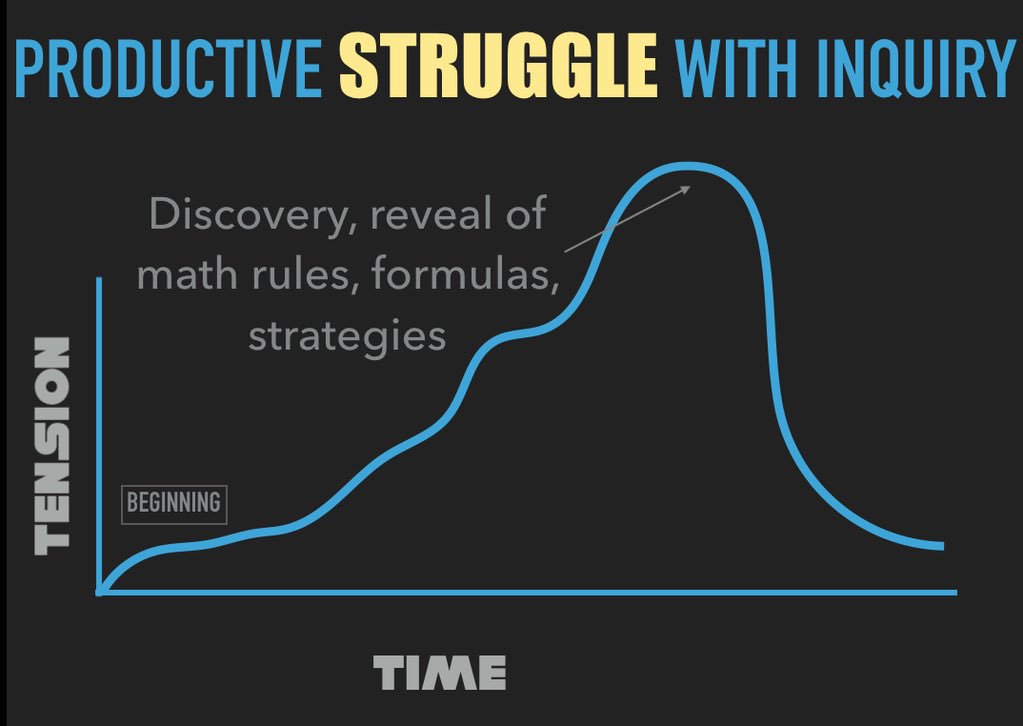
       Learning anything that is worth learning requires a certain amount of struggle.  No one expects you to learn something complex the first time you hear it.  You have to think about it, and practice with it, and make some mistakes, and learn from the mistakes, and make more mistakes, and then (maybe) you can claim success at learning.  It's OK to struggle and it's OK to allow your children to struggle.  We want students to know that learning is full of challenges and effort is required to overcome these challenges.  We want students to believe that they can do anything if they have the will to work at it until it is done.

       This is a difficult message for most parents to hear.  A lot of people have a fixed mindset about their children's abilities.  This means that they believe that their children are capable of doing some things and incapable of doing other things--and no amount of effort will change that.  This mindset leads to statements such as, "It's OK if you're not good at math because I was never good at math and some people just can't do math."  (Feel free to substitute other words in place of the word "math".)  This is a terrible message for students.  Instead, the message should be that hard work pays off and struggle leads to learning.


Monday, April 18, 2016

Why Do You Remember Your SAT Score?

       What's your social security number?  What is your phone number?  How tall are you?  When were you born?  What did you get on your SATs?  Huh??  Why is your SAT score is a number that you memorize every bit as much as your phone number?  I can't find any survey data that says the percentage of adults who recall their SAT score (from among adults who have taken the SAT), but my own anecdotal evidence suggests that it is very high.  I dare say that a far majority--maybe more than 75%--of adults who have taken the SAT more than 20 years ago can still recall their score today.

       Why?

        Why is this number, this score--which has no power whatsoever in lives of people in their 30s and 40s--so ingrained in our memories?  It's just a number that (years ago) described our ability to do high school mathematics and our knowledge of grammar, vocabulary, and reading comprehension.  It won't get us a raise or a promotion twenty-plus years later.  There's no college admission counselor to impress when you're in your late 30s.   We're certainly not going to get any reward or trophy or recognition of any kind.

       So why is your SAT score so important to you that you remember it for your whole life?  Why?  I have a theory....  At the time we took the SAT, everyone around us made a big deal about it.  It was billed as the most important test we will ever take.  They said, "Your life depends on it."  (Or something to that effect.)  It was like training for the Olympics.  The test date was on our mind for weeks before.  We thought and thought and thought about it.  We worried about it.  It was a sort of a milestone in our young lives; like getting our driver's license.  We might have taken it more than once because someone said that that was a good idea.  It was an accomplishment akin to graduating from high school or running a mile in six minutes or going out on your first date.

       I think that taking the SATs was billed as such a huge event in our lives, that most of us figured it was important enough to remember our scores.  But, I fear, that it also produced a generation of people that valued test scores over actual learning.  Today in education, we are trying to change this thinking.

       Today educators value frequent formative assessment over the results of unit tests and final exams.  We value multiple data points over the "one big test".  We value a combination of conceptual understanding and procedural knowledge over the mere regurgitation of facts.  Learning and the measurement of learning has come a long way.  Some colleges don't even use the SAT as a consideration for admission.  Others use it as one of many factors for making the admission decision.

       Aside from the college admission process, your SAT score really isn't very important in your life.  Americans are competitive people.  We like to win.  We don't want people to pass us on the highway; we don't want to lose a promotion to someone else; we don't want our lawn to look worse than our neighbor's lawn.  We have to stop competing for everything.  Your SAT score does not define who you are.  You won't "win" or "lose" anything because of your SAT score; especially twenty-plus years after you take the SAT.

       There are lots of experiences that most adults would gladly like to forget about their high school experiences.  Your SAT score should be one of them.


Thursday, April 14, 2016

Education that REALLY Prepares Our Students

 
       This week I've had the great fortune of attending the National Council of Teachers of Mathematics (NCTM) Annual Meeting.  Many subject areas hold these types of large, national conferences to help teachers and supervisors and school board members and principals to grow professionally and help students to achieve.

       I attended one particular session that discussed the need for our schools to examine the needs of the world that we live in and to make appropriate changes to the education that we provide to our students--the adults and workforce of the next generation.  The speaker was Diane Briars; President of NCTM.  She referenced the book Education for Life and Work (2012) that discussed the sort of competencies that will increase in the near future.  These include:


  • non-routine analytic skills
  • non-routine interactive skills
  • thinking
  • reasoning
  • expressing information to others
  • interpreting information and responding appropriately

       Math teachers know that we teach reasoning and problem solving and analytic thinking.  But we currently teach these skills under the guise of Algebra and Geometry courses.  Is there a better way?  Would it be better to teach these skills within a context rather than strictly in the abstract?  And what about the actual teaching strategies that are employed when presenting such content to students?  Ms. Briars cited a study from 2014 that stated students learn better in active learning classrooms than they do in the traditional lecture-type classrooms.  Active-learning classrooms would use strategies such as: (i) Occasional group problem solving, (ii) Tutorials completed during class, (iii) Use of personal response systems, and (iv) Increased emphasis on student discourse including student-to-student discourse and teacher-to-student discourse.

       Finally, in the report titled, A Common Vision , the Mathematical Association of America (MAA) states that the status quo of teaching mathematics to our undergraduate students is no longer acceptable given that so many students struggle to complete the first one or two mathematics classes offered to them.  We need to see cooperation between the P-12 system and the collegiate system to create courses and course pathways that help students to learn the skills they need to learn to be successful in the world they will inherit.  One possible solution is to offer math courses that are not based on Algebra or Calculus--considering that the content learned in these classes is not necessary for the majors that some of our students seek.  For instance, Journalism may not need to know Calculus, but they will need to know statistics and how to interpret data.  

       From time to time, great institutions need to examine their work in light of the goals that they seek to achieve.  Education is one of those great institutions.  Such change should not be rare but (indeed) should be ongoing.  We no longer live in the 1920s or the 1960s or even in the 2000s.  We have an obligation to prepare our students for their world.  


Friday, April 8, 2016

Encouraging a Growth Mindset for your Students

       Growth Mindset is an understanding that you can learn and achieve anything if you are willing to work and practice and study and try.  A student's ability to learn is not predetermined from birth.


       This is an important concept for teachers who seem to always have some students who believe that they are not born with the skills necessary to learn.  A common saying among some students is, "I don't have a math brain.", meaning, "I don't have the ability to learn math regardless of the extent of my efforts."  We know now that this is not true.  But teachers are often faced with the prospects of needing to convince some of their students that this is not true.
       This chart is filled with suggestions for helping students to view their perceived obstacles in a different way.  Part of a teacher's job is to motivate their students to do their best everyday.  The more that we can convince students and then demonstrated to students that effort leads to (at least some level of) success, the more we are able to create a learning atmosphere in which students believe that they can learn.

       Growth Mindset is for weak and strong students alike.  We also have students who have been successful in the traditional school setting who don't have a growth mindset.  These students may have been praised for their "smarts" and they may be afraid to try something new for fear of not succeeding.  This limits their ability to grow.  Hence, encouraging a growth mindset is for all students and not just for a few.  Our best teachers have always been encouraging a growth mindset.  We have all had teachers who were able to convince us to try and to work hard in the belief that we would eventually succeed.  We need to see this occurring much more often in our classrooms.


Thursday, March 31, 2016

We Do Something Important Every Day

       Education is important business.

       Once in a while, a student needs to be somewhere else in the school during the time that she should be in my classroom.  Club meetings, picture day, sporting events, ... lots of activity going on in a typical high school.  So this mature and responsible student comes to me a day or two before and asks, "Are we doing anything important tomorrow?"

       My answer is always the same:  We do something important Every Day.  Bell-to-bell learning; every minute, every day; valuable instructional time....  Call it what you will, the stuff that goes on in the classroom--in every classroom--is valuable and important.

       Sometimes it is hard to see the importance of something we do everyday.  It becomes commonplace; and without an engaging teacher it can become boring.  The best learning occurs when the teacher understands the importance of every minute and communicates this to the students via thoughtful, engaging lessons.

       Education is important; everyday, every minute.

Monday, December 28, 2015

Top Five Posts of 2015

       As I finish my second full year of blogging, I'd like to take a look back at 2015 and the five posts that got the biggest response from my readers.  But first I'd like to thank some of the many fellow bloggers that I've read and (sometimes) responded to over this year.  These professionals have caused me to pause and think about the various issues in public education that (perhaps) need to be changed; or that need to at least be debated.  I've also read many, many inspiring stories about teachers who work very hard--with little recognition--to help their students to succeed.

       Thank you to Alice Keeler, Starr Sackstein, Justin Tarte, Annie Murphy Paul, and Daisy Dyer Duerr.  I used to think that these were Super-Hero People who had some special gift or ability in the area of education.  But I've come to understand that they are just regular people like you and me who are eager to share their thoughts and ideas with the rest of us.  I, for one, am extremely grateful to include them among my professional learning community.  (And so are tens of thousands of other educators who follow these folks!)  I am continually inspired by your words; you keep me going and keep me writing.  Thank you.

------------------------------------------------------------------------------------

       Here are my top five posts from 2015:

#5) Open Letter to Teachers

       This was the second (and most popular) of a three-part series of Open Letters to the three most important stakeholders in our educational system: Students, Teachers, and Parents.  I wrote this "letter" to teachers on the eve of the 2015 - 2016 school year.  It was published on August 19th.  In it, I talked about how excited teachers are when a new school year begins--something, I bet, a lot of students don't realize.  I wrote about the tough job of teaching and I applauded the men and women who accept this responsibility.    Sometimes being a teacher involves difficult conversations with students about the need to continually struggle to learn something that isn't easy at first. Teachers shape the minds that shape the future of our country.  Teachers' influence over student achievement is well documented.  We always need great teachers.

#4) Learning vs. The Appearance of Learning

       Published on March 28th, this is an issue in which I feel very deeply.  The issue of the best way to measure learning and the problem (at times) of students appearing to be learning well (i.e. - getting good grades) but its only an appearance and it isn't real learning.
       I feel that P-12 education is the time when we have to be honest with students and their parents.  We don't want students to believe that they are achieving at a high level only to learn later in life (perhaps while sitting in a college class) that the grades they earned in high school did not represent their true ability.  The job of schools is to help students to learn.  We need to use multiple measures to get a true picture of their level of learning.  "Getting-a-good-grade" is not the job of schools.

#3) We Should Value Good Thinking More Than We Value Good Memorizing

       This post, from May 29th, quotes from Dr. Jo Boaler and Cathy Seeley.  In it, I talk about how our students'  thinking should be rewarded more than their ability to memorize math facts.  Sometimes elementary children who are very good at memorizing their multiplication facts (and recited them quickly) are viewed as being more able than students who cannot do this.  But we really don't students who can merely memorize facts.  What we really want is students who can think and reason and build on known facts to gain further knowledge.  Sometimes students memorize facts without knowing why the facts are true.  Later in their P-12 education they struggle because of this lack of understanding.  The goal isn't speed; the goal is learning.


#2)  No More Worksheets

       I began this post (from April 3rd) with a simple question:

Does you your child's mathematics teacher assign a lot of worksheets for homework and classwork?

If the answer is YES - Not a very effective teacher.
If the answer is NO - Likely to be a more effective teachers.


       Of course, this is an exaggeration, but the point is that this staple of P-12 education (the worksheet) should be a thing of the past.  They are boring; they are very un-engaging; and they de-emphasize thinking over mere "following steps".  They represent the opposite of what we want to see in our classrooms today.  Students should be spending class time reasoning and thinking and debating; they should be sharing ideas and thoughts.  They should hear from other students.  By the response I got from my readers, I'm thinking that this idea is not as radical as it may sound to some.

#1)  Growth Mindset Teachers

       This post had the most views of any post I've written since I started blogging more than two years ago (142 posts).  I talked about the idea of Growth Mindsets as created by Carol Dweck.  Specifically I talked about teachers who have the mindset that says anyone can learn.  These teachers help their students to understand that learning is always possible; productive struggle is a good thing; and their past negative learning experiences does not predict their future learning.


       Thank you to everyone who have shared this journey of learning and thinking with me in 2015.  The best of us are always trying to improve and to learn more.  Continue on and find your way to be the best educator you can be.

       All the best!

Peter Cincotta


Thursday, December 24, 2015

A Passion to Make Education Better

       I often say to my children, "It takes less time to do the thing I'm asking you to do than it takes to argue about it."  Am I allowed to say this to adults who are critical of public education?

       Of course, I don't mind if people disagree with decisions made about their child's school or school district.  But mere negative comments don't usually help to make our schools better.  If everyone who disagreed with a school-level decision, instead, were to offer a possible solution, or make an effort to understand the reasons behind the decision, or step up to make things better we could accomplish a lot.  We can help to improve attitudes about public schools AND we can help to improve our schools.

       We want people to be passionate about their local schools and we want people to be partners with their schools.  Education is important.  It's more important than sports; it's more important than grades; it's more important than social status.  Education helps everyone: students, businesses, society.  The effort to improve schools has to be a group effort.

       Be passionate about education.  We need you.


Tuesday, November 17, 2015

It's Time for Our Schools to Leave the 20th Century

       You know the old joke about Rip Van Winkle and schools?  He falls asleep for a hundred years and upon waking up he sees everything he used to know has changed dramatically.  The houses look so different.  The clothes that people wear are very different.  And the cars...wow.  Then he finds a school and walks inside.  He goes into a classroom and he is comforted to see that schools and classrooms haven't changed a bit.

       We educators don't think this is very funny.

       In fact, it is embarrassing for us carry out the important work of education today in the same way that we did this work 50 or 30 or even 20 years ago.  Doing so ignores the research about learning that has been done over the past few decades.  It ignores the research about how the brain reacts to the stimuli that occurs in classrooms.

       For instance, we know that most students can't learn to the best of their ability strictly by sitting in class for a whole class period and listening to the teacher talking (and taking notes).  We know that students are more engaged when they have the opportunity to participate verbally and when they have a chance to get up out of their seat and participate physically in some way.  We have technology that we didn't have (even 20) years ago that can be tapped to help our students to prepare for the information world that they will enter after high school.

        We are not preparing our students by merely teaching them to read, write, and do arithmetic.  These things are important, but they are not enough.  Memorizing facts long enough to get a good test grade will not prepare our children for the world that they will inherit.  Our schools have the responsibility to mirror the society that our students will experience.

       Twentieth Century schooling is not what our students need.  Most of them have never even lived in the 20th century.  I believe that our current education leaders understand this need for our schools to change.  Part of the responsibility of our public schools is to explain this need for change to our parents and to our communities.  Staying the same is easy; change is hard.  Schools often face opposition from communities who tend to say that "The old way was good enough for me and it's good enough for our kids."  We need to make the case against this sort of thinking.

       Someone needs to speak for our students and for their futures.


Public Schools and Choice

       Is it true that public school kids and their public school parents don't have choices?  I'm sure that I will expose my igno...

Teach100 blog