Showing posts with label improving. Show all posts

Tuesday, February 21, 2017

Great Teachers are Constantly Improving

       The best teachers are constantly improving.  "Good enough" isn't good enough for them.  The world is changing and teachers need to change as well.  The traditional classroom that your parents had when they were in school should not be the classroom of today.

       Here is a short list of characteristics of teachers that work to be their best for their students:


  • The student is the center of the learning experience; not the teacher.
  • We want students to demonstrate what they know and are able to do.  It's not enough for students to merely sit and listen and take notes.
  • Learning new tech resources for use as instructional tools in the classroom and as learning tools for students.
  • Less paper and more use of digital resources
  • Using Twitter to connect with other educators and to learn with other educators.
  • Learning about and implementing student engagement strategies in the classroom.
       The need to improve is necessary because students learn differently.  Teaching in a single style may be OK for some students, but it is not sufficient to reach all of our students.  When students struggle to learn, teachers need to use different strategies to help them.  We often joke that repeating the same information SLOWER and LOUDER is not an effective strategy for students who didn't "get it" the first time.  Part of the journey toward being an effective teacher is learning about your students and discovering better ways to help them to learn.


       Teachers learn from a variety of sources.  Over 50% of teachers earn a Master's degree at some point in their teaching career.  Teachers take online courses, teachers read journals.  But most of all, teachers talk with other teachers--online and in person--to learn from their experiences and improve their skills.  Teachers who strive to improve are better teachers for their students.


Friday, December 2, 2016

Changing Math Attitudes

       I'm borrowing the title of a Facebook group to use as the title for this post.  The group called Changing Math Attitudes is composed of math teachers and other educators and (I suppose) other folks that seek to share experiences and expertise in the effort of helping students (and adults) to see mathematics as something beautiful, sensible, and doable by everyone.

       The first step in improving abilities in anything is to believe that you can do it.  We want students to understand that mathematics is not a secret code to which only a privileged few have access.  There is no "math brain".  Everyone can understand mathematics and it will take a group effort by many people in many circumstances to effectively change the view of mathematics that so many people hold.  This is the view that says "I'm not good at math."  (And so many people freely say this out loud when they would never say that they can't read or that they are bad at Science or History.

       I especially enjoy reading the posts from this group because they are generally politically agnostic.  It isn't a group that is pushing a political agenda one way or the other.  And this makes sense too because the "I'm bad at math." attitude is not coming from one group of people who members of any single political persuasion.  All sorts of people hold this view and so we are talking to all people when we say that we want to change attitudes about mathematics.

       Any math teacher will tell you that most of the students in their classes that struggle to understand the math would do so much better if they held the view that effort would lead to success; if they believed that getting the wrong answer doesn't mean that you are "dumb" but instead means that you've had a learning experience that can lead to better understanding.  If students can escape the Fixed Mindset that says "No amount of effort will lead to success.", then we know that we can help them to get to a point of better understanding.

       Attitude is everything.  Attitude determines the effort that students will put forth.  Attitude allows for a second try and a third try and a fourth try; or attitude gives permission to not try at all.  Attitude is the force that is stronger than caring adults.  Attitude shapes our views and ultimately shapes our destiny.  When our attitude tells us to give it a try, we are on our way to a world of opportunities.


Monday, October 17, 2016

High School Graduation Rates Continue to Rise

       In the 2014 - 2015 school year, the high school graduation rate rose to 83.2% according to the National Center for Education Statistics.  This is modern day, national success story.  Twenty years ago, the national high school graduation rate was only 71% and it only rose a couple of percentage points from the 1998 - 1999 school year to the 2005 - 2006 school year (to 73%).  In the past ten years this important statistic has risen ten percentage points.  This is an amazing accomplishment!

       Our educational system is big.  17,000 school districts; 100,000 schools; 50 million students; and 3 million teachers.  This accomplishment isn't due to the effort of just a couple of school districts; or even just a couple of states.  This incredible increase says that we as a country have made it a priority to do everything we can to see to it that students graduate.  We understand that the world that our students will inherit requires an educated mind if we want these future adults to succeed.  We have heard this message and we believe it and we have taken steps in every school to make this happen.

       Even among our nation's poor students the high school graduation rate has risen to 76.1% -- which is a higher percentage than the graduation rate of the whole population of students in 1999.  Imagine the better life that will exist for these students in their future -- all because their parents and teachers and schools wouldn't allow them to drop out.

       So often we hear only bad news about our public schools.  We only hear about students who don't succeed and schools that don't have certain programs and teachers that don't have the tools they need.  We should celebrate the great successes we've had (such as the highest graduation rate ever) because they tell us that we are headed in the right direction.  They tell us that our efforts have paid off.  They tell us that we have achieved great success.  In the entire history of American Education we have never had a graduation rate this high.  This is something that all of us can be proud of because all of us have had a hand in helping this to happen.

       So thank a teacher, keep pushing your child to do well in school, and recognize that our nation's schools are working hard everyday to improve the lives of our students; your children.


Saturday, October 1, 2016

Good Enough Isn't Good Enough

       Schools, educators, teachers...they are never satisfied.  We are the ultimate Olympic athletes when it comes to our desire to constantly improve.  In education, "Good Enough" is never good enough.

       While it is often true--though not in all schools--that most students do fine; most students learn to read pretty well, most students move on to the next grade, most students graduate.  There are always some students that don't or that struggle to reach these accomplishments.  And even for those that do succeed, What is our standard for success?  Is it a passing grade?  Is it to barely exceed the minimum?  Is it to be merely good enough?

       The best teachers are constantly striving to find ways to reach all of their students.  The students that do what they are told and are able to "succeed" in school without much effort should be pushed to do more.  The students who always excel academically should be pushed to do more.  And the students that struggle to meet the minimum requirements should be given the help they need to do better.  All students can do better; all teachers can improve; all schools can strive for better results.

       The goal of school is learning.  But students approach this goal from many different viewpoints.  Some strive to be "Number 1"; some do their best everyday and accept that they may be stronger in some areas than in other areas; some students struggle in math but are good at reading; some students seem to struggle in all academic subjects but are talented in the arts.  And some students have been beaten down so often by their schooling experience that they have given up on trying.  All of these people come together in the typical public school and it is the job of the educators to more all of them forward.

       It is hard to have one policy or one standard that applies to everyone when "everyone" is so different.  Maybe the goal shouldn't be to reach a standard as much as it should be to improve based on whatever your starting point is.  If you come to 7th grade able to run a mile in 9 minutes and 36 seconds, maybe you should strive to end 7th grade with a time of 9 minutes flat or 8:30.  Similarly, if you begin 7th grade with a reading ability that is considered "average", may you should strive to end the school year above average in reading.  And if you are a teacher who always struggled to help those students who always want to sit in the back of the classroom and never participate, maybe you want to have the goal to encourage them to answer questions and to offer their ideas at least twice in every class.

       The goal isn't to be Number 1; the goal isn't to "win".  School is not a competition.  The goal is always to improve regardless of your starting point.  Nobody should accept "Good Enough" as good enough.

Thursday, July 21, 2016

Everyone Can "Do" Math


       I've got great news...Everyone can do math!

       The bad news is that everyone doesn't believe this.  In fact, lots of people don't believe this.  How many times have you or someone you know said, "I'm not good at math." or "I'm not a 'math person'." or "I don't have a math brain."?  You never hear people say this about Science or Social Studies; it's only about math.  And the reason people say this is (probably) because of the way they learned math in school.

       Math has always been taught as a bunch of rules to follow, a lot to senseless things to memorize, and a whole lot of procedures to do.  Nobody ever taught you why these procedures make sense or why these rules are in place.  They just said something like "You have to know it."  (This is akin to the parent who says to his or her child, "Because I say so.")  Not a very good reason and certainly not a compelling reason for learning and understanding.

       And to make matters worse, we now have generations of people (parents and grandparents) who believe that this is the way math is supposed to be taught.  We have parents saying to their children, "I know it's hard and I know it doesn't make sense, but this is just the way it is and you have to do it."  This is a terrible message for students to receive.  It says to students that even their parents think that math is weird and confusing and doesn't make sense.  It reinforces the message that says "You will probably not understand this."  So a lot of students accept this message and basically say, "Fine.  I'm never going to 'get it', so I'm not going to try anymore."

       It doesn't have to be this way.  Our mathematics classrooms can be filled with positive messages that tell students that math is about creativity and making connections.  Messages that tell students that it is OK to make mistakes in math class because that is how you learn.  And messages that explain that you don't have to be first to get the correct answer.  In fact the best math students are slow in thinking and reasoning and understanding.

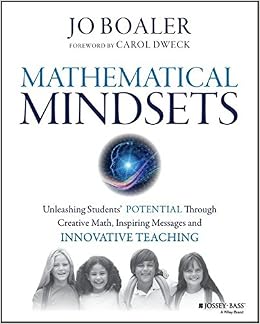
       Everything in this post comes from Dr. Jo Boaler and from the website that she created called YouCubed.  She has spent her professional career trying to understand how students learn and how teachers teach.  Her ideas and suggestions can lead to a new world of mathematics teaching and mathematics learning.  All of this is based on research and not from one person's point of view or experience.


       Understanding math is important and we need public school teachers to teach for understanding; we need parents to encourage understanding in math class; and we need students to believe that they can learn mathematics as easily as any other subject.


Wednesday, June 15, 2016

Is Your Child Advanced in Mathematics?

       It seems that, more than in other subjects, the placement of students in advanced mathematics is often a contentious issue. Elementary schools have different policies about placing students in classes that teach math at grade levels that are above the student's current grade.  Middle schools often offer high school mathematics classes, but some stop at Algebra 1 and some go beyond Algebra 1.

       The ability of a school or school system to determine a student's math ability (or "advanced" math ability) can be hard to do with great accuracy--especially when we are trying to make this determination with eight and nine year old children.  It's not enough that they are getting good grades in their math work; math is more than mere calculation.  And higher-level math is all about reasoning and thinking and understanding.  The kid that is good at memorizing, isn't always good at (say) the abstraction that comes with manipulating variables and graphing a line.


      Yet, I think that (too often) we get a false impression of a student's math abilities from merely looking at their elementary grades on the report card.  Sometime students are placed in advanced classes and at some point in middle school they start to struggle because they were pushed to learn higher and higher levels of math too fast.  On the other hand, there are certainly students who are highly able in mathematics and they should be encouraged to take more challenging classes that are commensurate with their abilities. So goes the dilemma of trying to identify the truly highly-able students from those that only appear to be highly-able.

       One method that helps is using multiple data points.  When students breeze through their multiplication tables and get "A's" on their report cards, but do poorly on standardize tests or on unit tests, this should be a cause for concern.  Maybe this student is good at memorizing facts and procedures and not good at understanding concepts.  This student is successful at procedural assignments (such as long division with whole numbers), but may struggle with more abstract assignments (such as a math task with multiple answers).

       Of course, we know that it is OK for students to struggle as they learn new concepts (see previous blog post), but many students view this struggle as a sign that they aren't good at math; or a sign that the teacher is doing something wrong.  We don't want students to struggle because they have been inappropriately placed.  Truly able students (and Growth Mindset students) don't mind the struggle because they enjoy the journey toward learning.  Also they understand that it is OK if they don't get it the first time.  Continual effort will eventually pay off.  Students who never tried hard to do well in math and then are placed in an advanced math class and then are upset when they don't get it the first time...these may be the students that we are pushing too quickly.

       Is your child advanced in mathematics?  How do you know?

Saturday, June 11, 2016

Reflecting on the School Year


       Did I do all I could to help my students to learn?
       Did I improve as an educator this year?
       Did I encourage my quietest students to participate?
       Did I emphasize "learning" over "getting-a-good-grade"?
       Did I communicate my expectations clearly?
       Did I establish good relationships with my students?
       Did I call on every students everyday?
       Did I help my reluctant learners to do their best?
       Did I work with parents to help my struggling learners?
       Did I push my highly-able students to do better?
       Did I model a growth mindset for my students?
       Did I provide appropriate and timely feedback?
       Did I demand the best from all of my students?
       Did I engage my students in their learning?
       Did I collaborate with my colleagues?
       Did I try something new in the classroom this year?
       Did I share my knowledge with other teachers?


       Teaching is an imperfect profession.  We get better every year; but we always have room to improve.  We connect with our students, but there are always some students that we can't reach.  We learn new strategies to address different learners, but we struggle to succeed with everyone.  Since we work with people (students) and not robots, every year is different--every day is different.  What worked last year doesn't work this year.  The lesson we spent two hours preparing usually leads to good student understanding, but not always and not with every student.

       The need to reflect on our practice and to improve every year is necessary.  Students change, principals change, resources change, the world changes.  We can't do the same thing for ten or twenty years.  We have to change too.  And when our results are less than we desire, we can't expect better results unless we change.  I often hear people say that there is no manual for being a good parent; the same is true for teachers.  But there are lots of books and courses and journals and EdCamps and conferences and colleagues for teachers to turn to get ideas and suggestions.  Experience helps; and our best teachers are those people who consistently seek to improve--those that reflect on their successes and failures of the past and yearn to improve.


Sunday, May 8, 2016

EdCamp

       EdCamp is sweeping the nation!  Have you heard about EdCamp? Check out this quick (1 minute) video:


       EdCamp is like a huge faculty room with teachers from all over your school district (or state) coming to one place to talk about whatever education topic they want to talk about; and to do so with other teachers who are interested in sharing ideas and hearing from others on the same topic.

       I often tell our new teachers that an important way to grow and to improve professionally is to talk with and hear from other teachers.  Everyone has ideas; everyone has something to contribute.  Different teachers have different experiences; different teachers hear about and use different resources.  One teacher uses Desmos (for example) to demonstrate attributes of graphs and equations; another teacher uses PearDeck to gather quick formative information from students (and to enhance student engagement); a third teachers uses TenMarks to determine the level of understanding her Algebra 1 have of a particular standard.  (And so on.)  The teachers using these resources may feel like they don't have anything special to share, but these resources that they use everyday might be completing new to someone else.  Everyone gets better at what they do when they hear from other teachers.

       EdCamp brings together teachers to talk about teaching.  And the teachers that come to EdCamp are the teachers that want to share their knowledge and want to hear from others.  Contact your state education office or your district's Office of Professional Learning.  See if there is an EdCamp being planned near you.  Or host your own EdCamp.

       Better teachers make better students; and EdCamp makes teachers better.


Sunday, November 8, 2015

Improving Education is Harder than Going to the Moon

       I often hear people say, "We have been able to send men to the moon.  Why can't we improve education?"  The implication, of course, is that the effort to send people to the moon is certainly more difficult than educating children.  So if we could do that, why can't we accomplish this--much easier--task?

       I would contend that improving education for all students is much more difficult than--the extremely complex of task of--sending people to the moon because (even today) educators are dealing with many more "unknowns" than NASA had in 1969.

       I doubt that anyone at Mission Control watched the Apollo capsule heading toward the moon thinking, "I'd say that we have a 20% chance of missing the moon by a hundred thousand miles."  They knew how far away the moon was; they knew the amount of force needed to break out of the earth's atmosphere; they knew how much food the astronauts needed.  It was certainly a complex task.  Mistakes were surely made and some things certainly went wrong.  But the Apollo 11 team that dealt with the physics of sending people to the moon were dealing with plenty of known quantities.

       In contrast, improving education involves our--still evolving--knowledge of how students learn.  Brain research is currently taking place and reporting new findings every year.  We have to contend with understanding the best way to motivate students and the best way to teach students.  And, of course, students aren't robots with the same abilities and the same limitations.  We have students from rich and poor families with different views of the benefits of education.  We have students from different home-life situations in which some are very supportive and some lack any sort of structure.

       It would make more sense to compare the effort to improve learning with the effort to cure cancer.  Over the years and decades, both of these fields have experienced progressed, but neither of these fields have been able to claim a complete victory.  Our understanding of cancer cells has certainly improved from 100 and 50 and even ten years ago, but we don't know enough to know how to stop their growth throughout the body.  Similarly, our understanding of how students learn has improved, but we are yet to find a school model--or even an education model--that best addresses the needs of all of our students.

       Improving education is a complex problem.  We see small improvements from time to time; and we see isolated pockets of (what appear to be) great success from time to time.  But we still have more to learn before this problem can be solved.  We have to continue to build on the successes of the past (and present) to reach the day when all students will receive the full education that they deserve and all students will reach their full potential.


Sunday, October 25, 2015

Teachers that Promote a Growth Mindset

       Every teacher has had "the phone call" with parents in which the teacher says,  Your child has the ability, she just needs to apply herself.  And then the teacher and parent (typically) talk about school rules involving turing work in on time and not talking in class.  Essentially, we are saying to the child, We're the adults.  These are the rules.  If you don't follow the rules, then you will get a bad grade.  (Of course, if the student was concerned about her grade, we wouldn't have this discussion in the first place.)

       There are a lot of "old school" problems with that phone conversation.

  1. The conversation emphasizes following rules and getting grades, and there is very little talk about actual learning.
  2. The first part of the famous teacher line is, Your child has the ability....  If the child already has the ability to do the work, then the solution to the problem should concentrate on why the child isn't doing what she is already capable of doing.
       We know that (as adults) there are lots of things that we have the ability to do and yet we don't do them--or we delay doing them for as long as possible.  Mowing the grass, doing the dishes, admitting we're wrong about something.  We have the ability to do all of these things, but we need some sort of motivation to actually take the time to do them.  Students are the same way.  The old adult (or teacher) response of "I'm the adult and I say so." may force children to do something, but it certainly doesn't motivate them to do their best.

       Growth Mindset theory tells us that when students believe that effort will lead to result, they are more likely to try new things and are less worried about making mistakes because they believe that these setbacks are just part of the process of learning new things.  I've recently been introduced to the website Mindset Kit.  This site is dedicated to helping teachers, parents, and students to understand what Growth Mindset is and how to help students to develop good, healthy Growth Mindsets.

       One simple strategy that every teacher can do is called Praise the Process.  When a student is doing some classwork, or offers an answer or an idea in class, the teacher response by praising the thinking that went into the student's effort rather responding to the correctness or the incorrectness of the student's work or response.  This simple strategy helps the student to know that their effort is important towards that eventual goal of learning the skill or concept.
  
       Mindset Kit has excellent resources for parents.  Teachers can refer parents to this site for parents who ask, "How can I help my child to do her best?"  There is a brief quiz on different statements of praise that parents can say to their children that will promote a Growth Mindset.  And there are other typical daily activities in which a parent's reaction will help their children to understand (for instance) that making mistakes is great for helping your brain to learn.

       Our best teachers already know how to encourage their students to do their best everyday--even when they don't want to.  It's the same as when a parent tries to distract their child away from something that is bothering him and towards something that he would like.  Growth Mindset strategies help teachers to do this while also helping their students to see the value in effort.

       Here's another quote I hear from parents all of the time, "I can't believe my child is doing so well in (insert course subject here) class in school.  He has never done well in that class before."  You can bet that this child has a teacher that knows how to motivate students.  Her class is interesting and students are engaged in the adventure of learning.  

       After all, they already have the ability.


Sunday, September 20, 2015

We Are a Community of Learners

       Teaching students is not like like building a model airplane.  We don't have distinct steps to follow that will lead to a completed project in the end.  Students learn differently; they come to school with different experiences and different abilities.  Good teaching requires an understanding of the learners in each classroom and daily lesson plans that are designed to help those learners.

       Good teachers understand the difficulty of reaching each individual student and they seek out the best strategies from experts in the field of education and from the teacher across the hall.  We (educators) are a community of learners.  We have to be.  We can't learn everything from experience and we can't figure out everything on our know.  We can't be experts in child psychology and special education and mathematics and English Language Learners and student engagement and formative assessment and ....  We need each other to be the best teachers we can be for our students.

       After more than 25 years in education, I am still learning and improving by listening and reading and following other educators just like me who have something great to share.  Here is my short list of excellent sources of information for educators who strive to make a difference with their students and who seek to improve their abilities every year:
  1. Annie Murphy Paul - The Brilliant Blog
    1. Her recent writings on how to using testing as a learning tool (aka - formative assessments) are informative and eye-opening to those who only see testing as an end-of-unit assessment.  She has also recently released an e-course that will show parents, teachers, and school leaders how to implement testing strategies as opportunities for student learning and growth.
  2. Robert Marzano - Marzano Research
    1. Great professional development information for teachers and for whole schools on topics ranging from Student Engagement to Assessment and Grading to Instructional Strategies to Teacher Effectiveness.  Don't let the "research" part scare you; Marzano provides effective tools and ideas that are simple to understand and to implement.
  3. Doug Lemov - Teach Like a Champion
    1. Excellent tips that any teacher can use to improve student learning and student motivation.
  4. Starr Sackstein - Changing the World, One Mind at a Time
    1. Great ideas and thoughts from a National Board Certified Teacher
    2. Lots of great recent blog posts about emphasizing learning and de-emphasizing grading

       And teachers don't have to go online to find excellent educators to collaborate with; look to your administrators, and district and state-level leaders.  Find ways to collaborate with teachers in other school buildings in your school district.  There is great value in learning from other professions.  I would say that it is a necessary element for teachers who strive to improve year after year.

     We are a community of learners.

Saturday, July 4, 2015

Educational Testing Should be Compared to a Health Check-up

       There's a lot of talk about testing in schools these days.

       Should we test students?  Is there too much testing?  What should be on the tests?  Are the tests too easy?  Are the tests too hard?  Do tests measure student ability?  Are high-stakes tests fair?  Standardized tests, the new SAT tests, college-readiness tests, ...and so on and so on.


     On a purely surface level, some students (and parents) do not like the big, end-of-course tests or the big standardized tests because they don't score well on these tests.  And that bad score leads to other negative and uncomfortable issues:
  • students feel bad
  • students feel not smart
  • course grade is negatively affected
  • looks bad on high school transcripts
  • negative affect on grade point average (G.P.A.)
  • negative affect on class rank
This opposition to this sort of testing has nothing to do with learning or the student's (or the parent's) feeling toward the test representing the quality of learning that took place during the course.  This opposition is purely about how the "after-effects" of the test will effect the student's stature, ranking, or reputation in some way.

       On a much different level, some people are concerned about the ability of the "big test" to accurately measure a student's academic ability in a particular subject area.  Alfie Kohn stated his many concerns about standardized testing in his 2000 article titled The case against standardized testing: raising the scores, ruining the schools.  In it, he offers a history of the origins of current-day standardized testing and lays out some of the problems with our current system.  On the other side of the debate, is the book Defending Standardized Testing (2005) edited by Richard Phelps.  This book examines testing via multiple points of view such as: research on standardized testing, misconceptions about large-scale testing, high-stakes nature of some assessments, and the issue of the growing testing industry.

       I view educational testing in the same way I view going to the doctor for a health checkup.  The two extremes are too extreme.  Never seeing a doctor is bad because you might never know if you are developing a serious health issue until its too late.  And seeing a doctor for a full physical checkup everyday is not necessary because your health isn't going to change on a day-to-day basis.  But seeing a doctor (perhaps annually) and following his/her advice is necessary for good health.

       Educational testing is necessary because there has to be some sort of measure of academic ability so that we can fairly compare a student's ability with other students.  If students never take advantage of standardized testing they could go through 12 years of formal schooling believing that all is well only to enter college and to discover that they are unprepared for college-level work.  Educational testing should not be used to rate schools as if they were in some sort of horse race.  They should be used to measure true learning--which is the purpose of schooling in the first place.  They should be used to provide students, parents, and teachers with good information on what students know and understand and what they don't.

       We don't have competitions with other people on who has the lowest cholesterol level or the highest pulse...We shouldn't have competitions on who gets the highest grade on standardized tests.  They should be used for individual results.


Tuesday, June 23, 2015

Why Do You Teach?

       The school year ended four days ago and I am thinking about welcoming my teachers to the next school year.  (Wow.  That was a short summer vacation.)

       Every year in our school district the teachers return to school one week before the students return.  On one of the days of that first-week-back, all of the secondary teachers in the district meet in their subject areas for a full day of professional development before the school year begins.  This is a time to learn about new resources, to network with other teachers in other schools, and to energize teachers to get excited about the new school year.

       We know that an effective teaching strategy for student understanding is to ask a lot of questions that encourage students to think about what they are learning.  If students can explain what they are doing and why they are doing it, they must understand it pretty well.  It also reinforces the idea that we want students to understand underlining concepts and not just to get-the-right-answer.

       In that vein, I am going to ask our teachers some questions in an effort to encourage them to think about what they do and why they do it.  These question will challenge the teachers to consider different possibilities.  They will be questions that defy simple answers.

       I'm in the beginning stages of preparing this presentation and I am certainly open to suggestions.  Feel free share (in the comment section below) other questions that you feel would be good questions for teachers in the beginning of the school year.

Questions:
(1) Why do you teach?
(2) What are your goals this year?
(3) What will you do differently this year?
(4) How will you make a difference?
(5) What do you want to learn this year?
(6) Why is mathematics difficult for some of your students?
(7) How will you help students who don't ask questions?
(8) How will you engage your students in their learning this year?
(9) How do you help your students to value "learning" over "getting-grades"?
(10) Why do you teach?

       We ask (or should be asking) our students difficult questions every day.  As such, we need to ask ourselves difficult questions.  Teaching students who are willing and able and ready to learn is easy.  But trying to reach the unwilling, the struggling, and the distracted student takes time and effort and expertise.

       Why do you teach?


Wednesday, June 17, 2015

How Do You Define "Winning"?

       Expectations play a large part in our perceptions of just about everything.  If you go shopping and expect to pay $75. for good pair of running shoes and find out that they only cost $50. you're happy because it was less than you expected.  If, instead, they cost $125. you're not happy because it was more than you expected.  But what if your expectations were not reasonable?  What if the average cost of good running shoes is $135.?  Compared to this average, it seems like a pretty good deal to get a good pair of running shoes for $125.

       How do you define "winning" when it comes to the education of your child?  What are your expectations?  To what do you compare your child's progress?  Some people look at the comparison of their child's test scores with other students in the class.  In high school, some people look at their child's class rank (which is a comparison of your child with other students in his/her grade).  Other people might look strictly at letter grades.  Are these legitimate measures of comparison?  What if your child always earns the top score in his/her class, but the class is below average when compared to the achieve of all students in the school?  Is your child really "winning" if everyone that he/she is surpassing is below average?

       This competitive nature of ours is misplaced if the goal is to win (or to appear to win) without any concern towards actual learning.  This is why education has standards.  Standards tell us--grade-by-grade--how we are doing compared to where we should be (academically speaking).  When these standards lead to a college-ready status, they tell us that our children are on the path towards being ready for the rigors of college-level work when they are still in middle and high school.


       This comparison is important because too many of our students are graduating from high school being told that they are "winners" because of some lesser standard that they've achieved only to find out that they are not prepared for college.  Less than 50% of students who enter college ever earn a college degree.  If our high school graduation rate was this low, there would be a national outcry from every corner of the country.  But, for some reason, at the college level, this figure is considered acceptable.  Why?

       Our high schools have to be willing to give our students (and their parents) the hard truth about their academic ability.  We should help them as much as we can and we should be compasionate when we give them this news.  But we have to make it clear exactly where they stand when compared to the standards.

       High standards are not an insurmountable barrier.  Most students rise to the challenge when they are pushed to think harder and do more.  If "winning" is important to us, then let's win for real.  Let's push our students to reach their potentials.  They can do it with our help.


Thursday, June 11, 2015

Congratulations to All First Year Teachers!

June, 2015

Dear First Year Teacher,

       Congratulations on the completion of your first year of teaching.  You did it!

       After making the decision to be a teacher 
  • and finishing your degree 
  • and navigating the job market 
  • and landing a teaching job
you have reached the point in the school year where you can look back and say, "I did it.  I've completed my first year of teaching."

       You probably learned some things that you didn't expect to learn--and that's a good thing.  (Learning is always a good thing.) For instance, you might have learned that some students didn't retain the learning they had previous years.  This might have caused you to consider different teaching strategies to reach these students and to help them to learn this year's content.  Secondly, you might have learned that you understand your content so much better now that you have taught it--compared to when you just had to learn it as a student yourself.  This might have caused you to consider that your students (too) may learn well be "doing" or by "teaching" (or explaining) what they know with other students.  Lasting, you might have learned that great lessons may take a lot of time to prepare and not-so-great lessons can be prepared quickly--and you have to find a balance between the physical time you have and the your desire to keep your students motivated to do their best.

       Mostly, I hope you've learned that teaching isn't the sort of profession in which people start out knowing it all.  Teaching is the sort of profession in which people get better at it the longer they do it.  I hope you asked your colleagues a lot of questions this year.  That shows that you are interested in growing and improving as a teacher.  (You may have noticed that the teacher across the hall from you--who has been teaching for ten years--also asks a lot of questions because she wants to continue to improve every year.)  Using different resources, using electronic resources, using different teaching strategies...it's a lot to learn in a signal year.  Every year you will hear about new and cool stuff that you can use in your classroom.  So find the thing that's right for you, and do that extra one or two new things next year.  But don't worry about not doing it all; or not doing what that great teacher down the hall is doing.

       Learning about teaching is a big part of teaching.  There is no "one way" to be a great teacher.  (That's why no one has given you the Book of Directions of Teaching.)  This is what makes teaching hard--that non-educators don't realize.  But it is also what makes teaching a true profession in which professionals such as yourself need to get together to make the best decisions for your students.

       Enjoy your time off this summer.  But also spend some time reflecting on this past year.  What was great that you want to repeat next year?  What didn't work that you want to improve upon next year?  What is the cool digital tool that you heard about and never had time to learn about and that you may want to use next year?  Look for webinars to attend; find people and chats on Twitter that will broaden your horizons; read a book about teaching or teaching strategies that may be specific to your area of teaching.

       The best teachers are always learning and always improving.

       Be a better teacher, and the next year, and the next year.  And (again) congratulations on the completion of your first year of teaching.  You did it!  See you next year!


Thursday, June 4, 2015

Comparison to the Standard

     
            Recently I saw my doctor to check my cholesterol level.  This is something that I don’t worry about enough and (hence) know little about.  As my doctor went through the various numbers for my LDL, HDL, triglycerides, and glucose I became very confused because I didn’t know which numbers were “good” and which were “bad”.  I asked him, “Is 90 high?”  His response was intended to be helpful but instead I found it to be completely useless.  He said, “It’s better then most men your age.”

            Now I realize that we live in America and competition is at the heart of many of our activities, but everything in life is not a competition.  Why should I care if my cholesterol is better than “most men my age”?  I’m not going to win a prize for having better cholesterol than the next guy.  I happen to know that two-thirds of Americans are overweight.  What would it matter if my doctor said that my weight was better than “most men my age”?  I was hoping my doctor would give me a range of numbers that some team of professional cholesterol doctors had determined was reasonable.  I was hoping that my doctor would tell me the standard for cholesterol.

            We do the same thing in our schools.  We want (for instance) all students to be proficient in reading and mathematics.  But the only thing that many educators seem to care about is whether or not we are doing better than school X or district Y.  I think it makes people feel good to be able to say that they are better than some other school down the road.  But the truth is, the only comparison that matters is the comparison to the standard. 

If (for instance) we want all students to read on grade level by third grade, than that is the only comparison that should be made.  For example, let’s say that last year 63% of the 3rd graders in our school read on grade level and this year 69% of our 3rd graders read on grade level.  We are approaching the standard.  That’s it.  We could say we are succeeding in approaching our standard or we could say we have not succeeded because we have not yet reached our standard.  But there is no good reason to compare our results with other schools as a measure of our school’s success.

When we allow a school to compare its students’ proficiency rate with that of another school, we create an illusion of progress and a false sense of pride.  


You can always find some school somewhere that is doing worse than your school.  But that may only mean that your school sucks less than that other school.  Student achievement isn’t a soccer game.  We don’t “win” just because we got a higher “score” than someone else.  If there is any winning at all, it comes when education professionals set high standards and students meet (or approach) those standards.  That is the only comparison that matters. 


As for me, I need to start eating less and exercising more.  If there is a standard for cholesterol, I really, really want to reach it!


Sunday, May 24, 2015

Parents Like Their Children's Schools More Than They Like Education in America--Huh???


Question #1:  How satisfied are you with the quality of education of our your oldest child?
Question #2:  How satisfied are you with the quality of K-12 education that students receive in the United States today?

       How would you answer these two questions?  Gallup has asked these questions to Americans for years and the answers are always the same; paradoxical, but the same:

Answer #1: I like my child's school.  I think he/she is getting a good education.
Answer #2: I don't like education in America as much as I like the education in my child's school.

       What???  How can this be?  How is it that most parents are satisfied with their child's education, but not (generally) satisfied with the nation's schools?

       One possible reason is that parents live in the community that their child's school is located and they like their community.  Another reason could be that parents know their child's teachers; they've met them, talked to them, maybe are neighbors with them.  Their child's school is a place that they've visited many times and that they know pretty well.

       On the other hand, the quality of our nation's schools is heavily influenced by newspaper and media reports--which is generally negative.  (This is one of the reasons that I write this blog.)  Unfortunately, positive stories about public schools and American education are not told nearly as much as negative stories.

       Still, if so many people are happy with their child's school, then how can these same people be so negative about public schools in general?  Does this fall into the same category of, "Drivers around her are crazy, but I'm a good driver."?

       Our schools aren't perfect, and we certainly have challenges that need to be addressed.  I believe that these challenges can be better addressed when we have the support of the public that we serve.  Indeed we need all our collective "best thinking" to solve our most entrenched problems--such as the education of our poorest students.

       So cheer up American.  Maybe things aren't as bad you think--or should I say "As bad as you read in the press".


Monday, May 11, 2015

How Much Assessment is Too Much Assessment?


       So, here is how education is supposed to work...


  1. The teacher teaches something.
  2. The student learns it.
  3. The teacher verifies that it has been learned.

Step #3 (above) is a very important step.  In the art of teaching, the actual "teaching" part is (indeed) only a part of what we do.  The far more important part is ensuring that learning is taking place.  If students aren't learning anything, then (one might say) we are not really teaching.  (Maybe we are just "presenting".)

       Sometimes we think that learning has taken place when it hasn't taken place.  Students nod their heads and smile and don't seem to have any questions; and it "looks like" they are understanding.  But unless our teachers are also psychics and are able to actually know what their students are thinking; some form of assessment is necessary for teachers and students (and parents) to verify that the "learning" really happened.  (After all, the goal of education isn't to get grades; the goal is to learn.)

       Outside of education, when people think about "assessment", they usually think about tests such as "Chapter Tests" and "Final Exams".  But educators know that there are many, many different ways to assess student understanding.  In fact, our best teachers incorporate some form of assessment into every lesson that they plan everyday.  This makes sense because how can a teacher know how or when to move on to the next topic unless they know how well their students understood the last topic?

       Assessment should be a part of every lesson.  It can take many varied forms.  Here is a list of ways to assess student understanding in the classroom from David Wees:
  • 3 Things
    • List 3 things that a fellow student might misunderstand about the topic
  • Venn Diagram
    • Have students compare and contrast a topic using a Venn diagram
  • Write it down
    • Have students write down an explanation of what they understand.
  • My Favorite No
    • Students complete a math problem and write their solution on an index card.  The teacher selects his/her favorite wrong answer and analyzes it with the class.


  • Doodle It
    • Have students draw what they understand rather then writing it.
  • Chalkboard Splash
    • Numerous students respond to a prompt/question on the chalkboard or whiteboard at the same time
  • and 50 more to found here

       These many and varied forms of assessment could be graded or not graded.  But all of these assessments have the purpose of providing the teacher (and student) information about how well the students are learning.  Instead of assessment "of" learning, these include assessment "for" learning.

       So, How much assessment is too much assessment?  Assessment should take place frequently.  Some sort of assessment should occur with every lesson taught.  And we do this, the traditional, formal, summative assessments (like chapter tests) won't be such a big deal.


Monday, May 4, 2015

Attitude Trumps Ability

       Remember when you left for school as a child and your mother said, "Do your best"?  It turns out, that was pretty good advice.


       Most students who don't succeed in their school subjects have plenty of ability but instead lack the desire to do their best.  Maybe they believe that they don't have the natural, genetic, brainpower to succeed (read Mindsets by Carol Dweck).  Maybe they have problems at home that make their schoolwork seem very unimportant.  Maybe they have a fear of failure.  I contend that most of the time, it isn't ability that is holding them back.

     Here is the most common teacher phone call to parents:

Teacher: Hello Ms. Thompson.
Parent: Hello Ms. Salero.  Is there a problem with my son, Donald, in your class?
Teacher: Donald has lots of ability; he just needs to put in the effort.

       Every teacher knows that their job is two-fold:

       (1) Teach
       (2) Encourage students to learn  


If learning isn't taking place, the best teachers with the best lesson plans won't make any difference in the lives of their students.  Hence, teachers spend a lot of time thinking and experimenting with the best ways to motivate students to do their best.

       When parents ask, "What can I do at home to help my child?", the best answer is to encourage your child to do their best everyday.

       Students need to understand that learning takes time and learning is hard and learning requires struggle.  But a lack of understanding after the first try does not mean that you are unable to learn.  In fact, it's the struggle that helps your brain to make more connections and to retain what you are learning.  Stanford educator, Jo Boaler, talks about this all of the time (see video).  Students need to understand the value in making mistakes--it isn't an excuse to give up.  In fact, mistakes are excellent learning opportunities.


       Some students are anxious to learn and don't mind making mistakes.  But others are so focused on "getting-the-right-answer" and "winning" that they are quick to give up when they don't understand something the first time.  We need students to understand the value of productive struggle.

       Keep trying; keep struggling; keep making mistakes; and keep learning.


Wednesday, April 1, 2015

Learning, Smoking, and The Long Arc of Change

       When I think about the huge job of improving education outcomes among our students (especially our poor students) in America, I think about the amazing turn-around in behavior about smoking over my lifetime.

       It is nothing short of a modern-day miracle that smoking has declined so dramatically in the United States over the past 50 years.  In 1965, 42.4% of U.S. adults were smokers.  By 2003, that number was cut in half and in 2013 we were down to 17.8%.  And, of course, our population has risen quite a bit over this timeframe from 194 million people in 1965 to over 320 million people today.

       No one in the United States in 1965 would have ever believed that Americans would give up their love for smoking so dramatically.  Even with today's relatively low rates of smoking, nearly 70% of current smokers want to stop smoking.  It is nothing short of amazing the way this addictive behavior has changed in the United States in just a couple of generations.

       I believe that our public schools can look at this incredible event, this long arc of changed behavior, and that we can use it as a lesson for tackling the equally difficult task of improving the educational outcomes of our students.  We can examine the efforts that took place (and continue to take place) that convinced people that smoking is bad for you; and (perhaps) we can undertake similar efforts in our public schools.

       First of all, there was a national effort to inform the public of the dangers of smoking.  This began with the first surgeon general's report that provided proof that smoking was bad for your health.  Of course, there were lots of people of that didn't believe the contents of this report.  I'm sure there were people who pointed to relatives and friends who lived well into old age and smoked their whole life--and, therefore, refused to believe that smoking was bad for your health.  But more and more information came out from public and private sources about the dangerous health risks of smoking and eventually it became very hard for people to believe that smoking wouldn't harm their health.  As smokers died from lung cancer and other diseases, people began to link these deaths to their habit of smoking.  This gave people a personal connection to the ill effects of smoking and it convinced them to never smoke or to quit smoking.  As they grew up and had children of their own, this knowledge of the evils of smoking was passed on to the next generation.  And so, what started as a national effort from government sources, slowly became a combined effort of government and private resources that worked together to bring down the rates of smoking in America.


       I believe that a similar combined effort is underway in our public schools today.  We have a government that believes in the value of education and is dedicated in improving the education of our citizens.  We also have many private efforts underway that are striving to do the same.  We also have segments of our population that don't believe that education is important.  As with the smoking example, they point to friends and relatives that quit school in eighth grade and grew up perfectly fine.  But (as with the smoking example), we also have generations of parents that have regrets of not doing better and trying harder when they were in high school.  They look at their peers who went on to college or some sort of vocational training and now have higher-paying jobs.

       I believe that we can change the behavior of Americans toward the value of education--and all of the hard work that this entails--over the next generation.  I believe that we can see a country with higher high school graduation rates and higher college graduation rates.  And when this happens, we will reap the benefits of a more educated society.  We will see less crime, less people on welfare, less obesity, and a strong economy.  And I believe that this will happen within the lifetimes of our current high school students.

       We can do it.  We have done it in other areas of our society and we can do in education too.  We must do better and we will.


Public Schools and Choice

       Is it true that public school kids and their public school parents don't have choices?  I'm sure that I will expose my igno...

Teach100 blog