Showing posts with label dropout rates. Show all posts

Monday, March 27, 2017

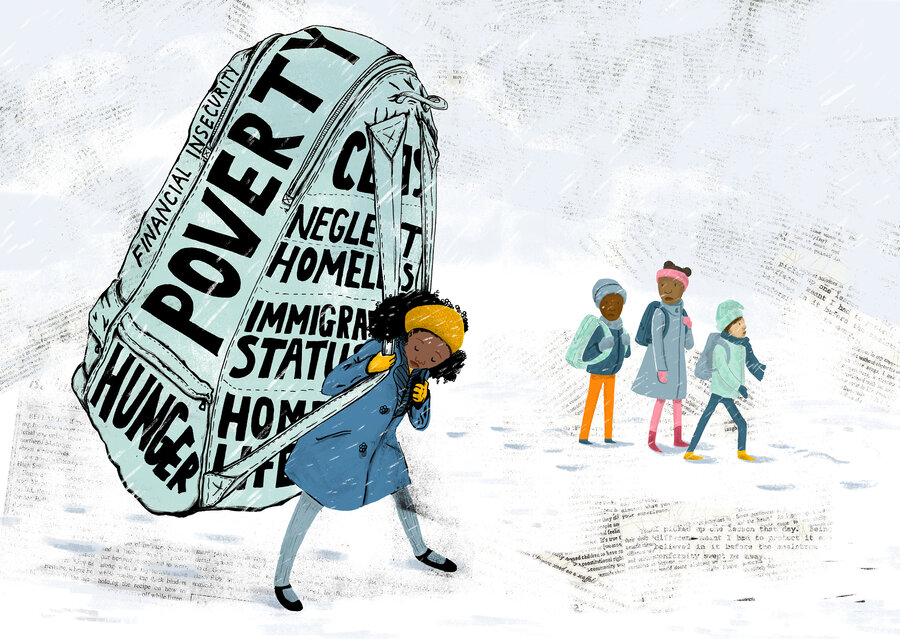
Achievement of Poor Students is the Educational Challenge of Our Time

       The data is overwhelming:

  • 10.7 million school-aged children living in poverty (source)
  • Over 50% of school-aged children are eligible for Free and Reduce Price Meals (source)
and the results are terrible:
  • Children living in poverty miss more days of schools than children who do not live in poverty.
  • Dropout rates are higher among student from low-income families.
  • 40% of children living in poverty are not prepared for primary schooling.
  • Less than 30% of students from the bottom quarter of income go to college; and less than half of them finish college. (source)
       The academic achievement of poor students has been a challenge that our nation has seen for decades.  Back in the time when earning a high school diploma was less necessary for acquiring a good job, our failure to adequately help poor students was less of an issue.  The penalty for not succeeding in school, while present, was not so severe.  Low-skilled jobs, manufacturing jobs, and service jobs were relatively plentiful and attaining a middle class life-style, while still somewhat difficult, was more possible.  

       Today, high school graduation (and the hard and soft skills that we want our students to gain in high school) is much more of a necessity than ever before.  Technology has lowered the number of low-skilled jobs and "Career and College Readiness" has become so much more than a slogan.


       The statistics are well known.  Student from families in which the parents have college degrees usually do well in school.  Students from families in which the parents didn't finish high school usually do poorly in school.  We are faced with the daunting challenge of overcoming this generational force that seems to keep pulling our most vulnerable students down.  Since "learning" is not something that can be forced on a person, our schools need to find a way to convince poor students (and their families) that schooling and education are important.  Knowledge is power.  Academics leads to more opportunities.  

       This is especially true as students move to middle and high school.  The subject content is more difficult; the reading level is higher; and the consequences of better achievement that are recorded and stored in student records are asked for from colleges and universities later on.  It's hard to do hard things--even for bright students.  The issue isn't the level of intelligence.  The issue is the level of motivation that encourages students to carry on even when the work gets harder.

       No one wants to fail.  Poor students are burdened with many hardships that come with a lack of money: less books at home; less technology at home; poor or no healthcare that leads to sick students getting sicker rather than getting better; less food and/or less healthy food.  We need to understand these challenges that are part of the daily experience of our poor students.

       This has been a problem in education for a long time.  There are pockets of success around the country, but we are far from declaring victory over this problem.  Of all the issues facing education, the issue of educating our poor students looms high above the rest in my opinion.  When this issue is properly addressed and we begin to see improved results, we can truly say that we have given our best to our students and to our society.



Saturday, April 4, 2015

We Want Students To FINISH College

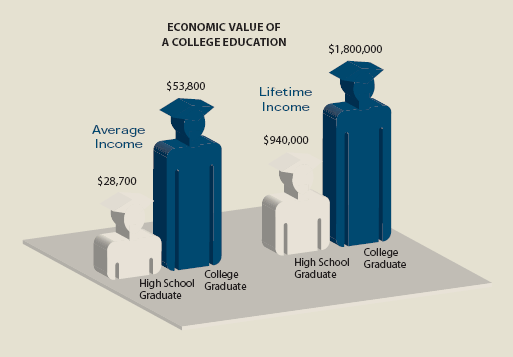
       The importance of a college education is well established.  People understand that a college education will increase the likelihood of entering into a satisfying profession and earning a higher income.  Indeed, college enrollment has risen significantly over the past 15 years.  In 2011, 21 million people attended U.S. colleges compared to only 15.9 million in 2001.

       We have won the battle of convincing students of the value of going to college.  But our goal isn't really for more students to "go" to college; our goal should really be for more students to "graduate" from college.  On that metric we are still far from claiming victory.


       Rates vary depending on the source of the information, but overall it is fair to say that merely getting accepted to college is absolutely not a guarantee of graduating from college.  In fact, many colleges have such a terrible graduation rate among students that have been attending for four years that they prefer to publicize their SIX YEAR graduation rate rather than their four year graduation rate.  According to the Chronicle of Higher Education, the six-year graduation rate means the percentage of students who are able to complete a four-year program within six years [!] .  Even this extra time only raises the overall college graduation rate to around 50%.


       Can you imagine the outcry from the public, from our government, and from our students if the high school graduation rate was only 50%???  Yet, this fact is not widely known by the public.  Little more than half of our students that begin college actually finish college.  And if you look at the data by race, the news is even worse.

       Of course there are many reasons for why students drop out of college.  A Harvard Study cites the following reasons:
- not being prepared for the rigors of academic work
- inability to cope with the competing demands of study, family, and work
- cost


       Our public schools are in a constant battle with students (and sometimes with parents) over the dueling pressures of Learning versus Getting Good Grades.  Some students care little about actual learning and only want to do what is necessary to earn a good grade.  While their teachers are pushing them to learn, to understand, and to use the learning they've acquired to learn more.  I believe that a major reason for the low college graduation rate is students who do enough in high school to get accepted to college, but don't enough (in high school) to gain the knowledge and the discipline they need to succeed in college.

       We must do better on this front.  We must continue to stress the importance of true learning and true understanding of P-12 content.  We have to lessen the importance of grades and increase the importance of real learning.  In the end, it's not that we want students to attend college; what we really want is for students to graduate from college.


Friday, March 6, 2015

Are the new PARCC and Smarter Balanced Tests Too Difficult?

       Public schools across the country are now using the new PARCC and Smarter Balanced assessments in Mathematics and English/Language Arts in grades 3 to high school.  Aside from the political commentary about these tests, some teachers have concerns that they are too difficult for their students.  Along with this concern comes concerns about hurting students' self-esteem, battling parents' perceptions of their children's abilities, and aligning earned course grades with earned PARCC and Smarter Balanced scores.

       I have heard and read comments that say that these tests are good for students who are very strong academically, but that they are inappropriate for students who are average or below average.  Sometimes parents have commented on sample problems and have stated that they are too hard for the students.

       The standards that these tests are written to are aligned to world-class education standards.  I realize that "world-class" is a buzz word, but I agree that these standards (and associated tests) represent an uptick with regard to rigor compared to those that they are replacing.  We know that too many of our students get good grades in elementary and middle school and then struggle with subjects in high school.  Or, they do fine (in terms of course grades) even through high school, but then they do poorly on the SAT or ACT.  We also know that many students graduate from high school, go to college, and do not graduate from college. (see college graduation rates)

       Hence, public schools are faced with this problem of students who appear to be learning and doing well in school, but then struggle with learning later.  We addressed this problem by incorporating tougher standards and putting in place assessments to see if the students are attaining these tougher standards.  In my opinion, this needs to happen; this must happen.  Nobody wants to see their own child struggling.    But we have to realize that this is already happening:


  • poor SAT/ACT scores
  • low AP scores
  • high percentages of students taking remedial math and english courses in college
  • students dropping out of college before earning a degree
       Until now, we have always been able to say "my kid gets good grades in school, so none of these other things matter to me".  But we have been fooling ourselves.  

       If we want students to be successful, we have to raise the standards (as we've done) and we have to insist on continually high standards throughout P-12 education.  This must happen.  Better education leads to better lives for our future adults--which leads to a better society for all of us.

       The tests are not too difficult.  We must, must, must insist on high standards, and we must do everything we can to help our students to achieve these higher standards.  I believe that our public schools will do exactly this in the years to come.  We will meet this challenge and we will raise student achievement and we will help to produce a society of educated people who are not afraid to face challenges, find solution, and succeed.


Thursday, February 26, 2015

Everyone Should Go to Community College

       The Community College system in the United States is simply the perfect college option for many of our high school graduates in my opinion.  


       Here are some of my reasons for this statement:

  1. Close to home.
  2. Less expensive.
  3. Small classes.
       Let's start with my first reason: Close to home.  I went to a college that had the initials TSC.  (This college has since been renamed.)  Among the students at this college, we referred to "TSC" as meaning "The Suitcase College" because just about everyone went home on the weekends.  I remember thinking at the time that high school students are always complaining about "living under the rules of their parents".  They want to be on their own; they want their freedom.  And, so, I thought that these people were hypocrites when, given the opportunity, would rush back home at every chance they got to do so.

       Of course, it probably isn't fair to categorize young people this way.  It is more likely that they rushed back home to be with their friends.  It is also likely that they really didn't hate their parents as much as they said.  According to the Higher Education Research Institute (and referenced here), 53% of college students attend a school within 100 miles of their home and 90% within 500 miles.  This tells me that most students want to attend college close (or relatively close) to their home.  Surely lower in-state tuition is part of the reason, but I think another reason is that newly graduated high school students are not completely ready to break all ties with their hometown by attending a college that is very far away.

       Community colleges provide the college experience with college courses and college teachers while still remaining close (sometimes very close) to home.  Students don't have to adjust to a new environment--perhaps with new foods and new expressions and maybe new fashions and (perhaps) a new climate--in addition to the (sometimes shocking) new experience of college-level course work.  Change is hard and a lot of change at once can be too hard for some students to endure.  The closeness of community colleges allows students to be close to friends and family and familiar settings, while they adjust to some aspects of college life.

       Reason number two: Less Expensive.  Full discloser; I am the cheapest cheapskate you will ever meet.  If I see something for free, I take two.  So my views of cost are probably skewed when compared to those of normal people.  However, I would think that lots of middle-class, working class, and (certainly) poor people are interested in finding good deals wherever they can be found.  And when you are talking about cost, Community Colleges are a very good deal.


       Tuition costs at community colleges are not merely "less" than those of public and private four-year schools; they are dramatically less--50% less; maybe even 75% less.  And students take the same courses and earn the same credit that they would at the much more expensive four-year schools.  To put a dollar figure to it, according to the College Board (reference found here)  the average cost of tuition and fees at a two-year school is only $3,131 which is just over one-third (60+% savings) of the cost for a year at a four-year institution.

       And here is a sobering statistic that we don't like to talk about, but when it comes to cost this is important.  Only slightly more than 50% of students who enter college eventually earn a degree.  Most people know someone who began college and then left college after one semester or after one year.  Imagine paying $25,000. or $35,000. and then your child drops out of college.  Isn't it better to risk only $3,131 to see if your child is college-ready?  For thirty thousand dollars you could have bought your child a car and rent for a year--during which time he/she could have been looking for job.
       Check out this recent study on the issue of college dropouts.

       Finally my third reason: Small classes.

       I have to be honest here; I'm not completely sure that community colleges can promise small classes or smaller classes that at four-year colleges.  I did find this reference and this one that mention community colleges having smaller classes.  But, to be fair, these references don't cite research.  I know that people often talk about large lecture halls at big, four-year colleges.  If it is true, then the "large lecture hall" is (yet) another major transition that students need to make when they begin college.  Most high schools keep classes to 30 students or less; maybe 35 or 40 would be the biggest class that any high school student would typically experience.  


       Smaller classes don't make students smarter, but they do open the possibility that the teacher would have better relationships with his/her students.  When students and teachers get to know each other, than students tend to do better in classes.  This is the factor that helps small class sizes to lead to better academic performance by students.

       The transition to college is a major life transition for 17 and 18 year old people.  Many new things are happening all at once.  A typical student might be able to handle some of these changes, but still struggle to handle all of these changes.

       Community Colleges help students to manage these multiple changes by being close to home, having much lower costs, and having small classes (similar to high school classes).  They also have all sorts of academic supports to help students to succeed.  Community Colleges are a great deal.  I think everyone interested in earning a BA or MA should consider Community College as a starting point.


Thursday, November 13, 2014

We Must Do Better - Part 2

       This post is part two of a three-part series titled We Must Do Better.

       I love public schools; and there is a lot to cheer about when it comes to the ability of public schools to prepare students for their futures.  But there are three major areas in which public schools must improve if we want to see ourselves as providing a world-class education to our nation's children.

       1) We must raise the achievement of poor children.

       2) We must increase graduation rates.

       3) We must provide continuous, high-quality professional development to our teachers.

       It isn't that there aren't other areas that can and should improve in our public schools.  But improvement in these three areas are absolutely critical if we truly want our school system to be exceptional and of the highest quality for all of our students.

----------------------------------------------------------------------------------------------------------------

We Must Do Better

Part 2 - Increasing Graduation Rates

       Part 1 of this series was about the need to increase achievement among poor students.  I am going to begin this part by looking at the differences in high school graduation rates between poor students and non-poor students.  Take a look at this graphic from the organization America's Promise Alliance:


       This graphic shows that (in 2012) low-income students had a graduation rate below 80 percent in 41 states while non-low income students had a graduation rate below 80 percent in only 7 states.  As a nation, our graduation rate in 2012 was 81 percent.  (source: National Center for Education Statistics - The Condition of Education)  

       Our national graduation rate has been rising since the 1995 - 1996 school year when it was 71%. We are moving in the right direction as a nation, but we still have a long way to go.  Allowing 1 of every 5 students to leave school without a diploma has real and serious consequences.  These include:
  • Higher unemployment rates
  • Lower pay compared to people with high school diplomas
  • Greater need for public assistance
  • Greater chance of incarceration
  • Less effective parenting skills
(sources: here and here and here)

       Public schools clearly have many responsibilities.  We must do everything we possibly can to get more students to graduate from high school--especially poor students.  In decades past, completing high school was arguably less important than it is today.  However, in today's world and in the world that our students will inherit, people without a high school diploma have a greatly enhanced risk of lifelong struggles to avoid poverty and to experience a middle-class lifestyle.

     As a graduate student, I questioned the difference between students who dropout of high school and students who graduate in the bottom 10% of their class.  I hypothesized that such students who barely graduate were no better off than students who didn't graduate.  Using data from the National Center for Education Statistics, I discovered that weak high school graduates were still better off than high school dropouts.  That's right; even students who struggle to pass all of their courses in high school and eventually graduate are better off than people who never earn a high school diploma.  Why?  I think it is because there is something within these weak students that says, "This (schoolwork) is hard, and everyday I come to school I know that I am going to struggle.  But I am going to continue to come and to work and to finish high school."  I believe that students who (perhaps) hate school and always struggle academically AND still graduate have had a life experience that they carry with them in their futures struggles.

       This message of the importance of graduating from high school is logical and sensible to everyone working in education and probably to just about everyone outside of education.  But despite our best efforts, this message is not getting through to 19% of our youth.  And it is hitting particular groups of students worse than others.  Once again, according to the National Center for Education Statistics (see top of page 13):

Group                  Graduation Rate (2012)
Amer. Indian/
Alaskan Native                68%

Hispanic                           76%

Black                                68%

Poor students              well below the national average (see America's Promise)

     These focus areas will help to improve graduation rates among our most vulnerable groups of students:

  1. Adress chronic absenteeism
  2. Improve middle schools
  3. Re-engage youth who have left school
  4. Provide more and better adult and peer supports
       We must do better at raising the high school graduation rates of our students.  It is important to our nation; it is important to every young man and woman in our high schools.


Saturday, October 4, 2014

Lower Dropout Rates

     According to a recent article from the Pew Research Center (see article here), the U.S. high school dropout rate dropped to 7% last year.  It has been going down since 2000 when the national dropout rate was 12%.  Educators know that earning a high school diploma may not be a ticket to live-long success.  But without one, you are pretty much guaranteed to experience many struggles in your life--not the least of which would be trying to build a middle-class life for you and your family.


     Hispanic and Black dropout rates have significantly declined since 1993.  Hispanic student (today) comprise 25% of our nation's public school students.  In 1993 their dropout rate was 33%.  Today it is down to 14%--and it has been steadily declining since 1998 despite a 50% rise in the population of young Hispanics in our country.  The dropout rate for Blacks has declined from 16% in 1993 to 8% today.  Black youth represent 16% of our public school students.

     Public schools do everything they can to keep students in school and to encourage completion of their high school diploma.  We encourage students to become involved in school teams and school clubs.  Students who are involved in school are less likely to dropout.  (I have to be honest, I can't find data on that last statement.  But I've heard it from many sources over the years and it makes sense--to me--to be true.)

     We also know that when students can connect with an adult in the school, they are more likely to stay in school and to finish high school.  Once again, relationships is the key.

     This is a major win for our public schools and even more of a win for our students--and for our country.  An educated society leads to less people in jail; less people on welfare; more people working; more taxes being paid; and so on, and so on, and so on.  It all begins with education.  Lowering the dropout rate is very, very good news.

     The next hurdle to clear is raising the college graduation rate--which is well below 50%.  But that's a topic for another post.


Public Schools and Choice

       Is it true that public school kids and their public school parents don't have choices?  I'm sure that I will expose my igno...

Teach100 blog