Showing posts with label people. Show all posts

Wednesday, December 23, 2015

Teachers That Inspire Students

       Who is your hero?

       Who do you look up to?

       This is a very common essay question for students at all levels.  The list of people who fill the pages of these essays is long: parents, athletes, friends, teachers, grandparents, historical figures, authors, poets, leaders,....  The world is full of inspiring people.  It is easy to think of such a person and maybe difficult to think of only one such person.

       These people make us believe that we can do anything.  They help us to overcome obstacles, to work harder, and to be better people.  They ask for very little in return--usually nothing.  They come to mind during the times in our lives when we think that we can't go on or we can't achieve.  They are our own, personnel superheroes.

       Most people can think of a teacher who has inspired them.  Usually a teacher who demanded high performance and worked hard to help you to achieve.  Our favorite teacher(s) were the people who believed we can do more than we believed we ourselves could do.

       Teachers that inspire students to do their best are the teachers that every parents wants their children to have.  They make learning adventurous, exciting, and thrilling.  They give their students the tools to tackle difficult problems and the self confidence to keep trying when they don't "get it" the first time.

       Be the teacher that inspires your students.


Saturday, September 5, 2015

The Pros and Cons of Standardized Testing

Warning:  If you are 100% against standardized testing or 100% in favor of standardized testing, you shouldn't read this blog post.  I'm going to some things that you will agree with, but you will be so blinded in anger over the things I say that you disagree with that you will never see the agreement parts.  Besides, you have already determined your thinking on this matter so there is no point for you to hear the opinions of others.

------------------------------------------------------------------------------------------------------------------

       Alright, maybe that warning was a little harsh.  I apologize.  In truth, I'd like to believe that the people who are on the extreme sides of this issue are a very small minority.  Most people have their views regarding standardized testing, and I would guess that most people fall somewhere in the middle of the issue.  I'm one of those people.

       In an ideal world, the students will come to school and do their best everyday to learn--and testing wouldn't be necessary.  The reason it wouldn't be necessary (in this ideal world) is because teachers would constantly gain an understanding of each student's level of learning through formative assessment practices; and students would ask questions about the things they didn't understand and keep working on these things until they got it.  The motivation would be the attainment of knowledge.

       To be fair, some students and teachers and whole schools work hard to (at least) approach this ideal world of education; but for the rest of us, we are still somewhere on our journey toward this world.  We are striving to emphasize learning over "getting-a-grade"; but we still need effective ways to measure learning--and testing is part of this process; and standardized testing is part of this process.

Some Pros of Standardized Testing

       In my view the "standardized" part of standardized testing is a pro.  Every student takes the same test regardless of the factors that influenced their learning (such as their teacher, the curriculum, the standards, the state they live in, etc.).  Think about the SAT test: colleges know that every student is taking the same test, so SAT scores can be compared to each other regardless of where in the country the test was taken.

       Also, the next generation of standardized tests (think PARCC and Smarter Balanced tests) are written to determine a measure of learning based on understanding content more than based on memorizing formulas and procedures.   This means that it will be harder for students to guess the right answers on these tests.  It also means that results will be based on true learning and understanding rather than on a student's ability to take a test.

Some Cons of Standardized Testing

       It may be a challenge to teach all of the content that is covered in a standardized test prior to the administration of the test.  Standardized tests typically have specific testing windows or a specific testing date on which to give the test.  Since different school districts start and end on different dates during the year and have different days off due to holidays and other reasons, it might be hard to structure a course outline that completely covers all of the material that will be assessed on a standardized test.  This occurs (sometimes) for Advanced Placement tests.  These AP tests usually have a particular May date for their administration and many school districts finish their school years in June.

       Some might argue that a "con" to standardized testing is that it might assess something that we don't teach or don't want to teach in the course.    I believe that there is general agreement of what needs to be taught in each grade and that this is less of an issue than some would have you believe.

       To me the biggest down side to standardize testing is that it gives the message to students (and parents) that the goal of school is getting a good grade on a (standardized) test rather than having the goal of learning.  Sometimes standardized test results are treated with great importance with newspaper articles and school-wide celebrations.  And sometimes these results are given too much importance when making course selection decisions for the next couple of school years.  As I said before, schools should emphasize learning and should de-emphasize "getting a grade".  A standardized test score should be just one piece of data that is used in conjunction with many other data points to make big decisions about a student's ability.


Thursday, June 4, 2015

Comparison to the Standard

     
            Recently I saw my doctor to check my cholesterol level.  This is something that I don’t worry about enough and (hence) know little about.  As my doctor went through the various numbers for my LDL, HDL, triglycerides, and glucose I became very confused because I didn’t know which numbers were “good” and which were “bad”.  I asked him, “Is 90 high?”  His response was intended to be helpful but instead I found it to be completely useless.  He said, “It’s better then most men your age.”

            Now I realize that we live in America and competition is at the heart of many of our activities, but everything in life is not a competition.  Why should I care if my cholesterol is better than “most men my age”?  I’m not going to win a prize for having better cholesterol than the next guy.  I happen to know that two-thirds of Americans are overweight.  What would it matter if my doctor said that my weight was better than “most men my age”?  I was hoping my doctor would give me a range of numbers that some team of professional cholesterol doctors had determined was reasonable.  I was hoping that my doctor would tell me the standard for cholesterol.

            We do the same thing in our schools.  We want (for instance) all students to be proficient in reading and mathematics.  But the only thing that many educators seem to care about is whether or not we are doing better than school X or district Y.  I think it makes people feel good to be able to say that they are better than some other school down the road.  But the truth is, the only comparison that matters is the comparison to the standard. 

If (for instance) we want all students to read on grade level by third grade, than that is the only comparison that should be made.  For example, let’s say that last year 63% of the 3rd graders in our school read on grade level and this year 69% of our 3rd graders read on grade level.  We are approaching the standard.  That’s it.  We could say we are succeeding in approaching our standard or we could say we have not succeeded because we have not yet reached our standard.  But there is no good reason to compare our results with other schools as a measure of our school’s success.

When we allow a school to compare its students’ proficiency rate with that of another school, we create an illusion of progress and a false sense of pride.  


You can always find some school somewhere that is doing worse than your school.  But that may only mean that your school sucks less than that other school.  Student achievement isn’t a soccer game.  We don’t “win” just because we got a higher “score” than someone else.  If there is any winning at all, it comes when education professionals set high standards and students meet (or approach) those standards.  That is the only comparison that matters. 


As for me, I need to start eating less and exercising more.  If there is a standard for cholesterol, I really, really want to reach it!


Wednesday, May 20, 2015

Graduation and Austin Cincotta


       A recent report from America's Promise Alliance on high school graduation rates reports that the United States High School Graduation Rate rose to 81.4% in 2013.  This represents a steady increase over the two prior years--a promising trend toward the (albeit, lofty) goal of a 90% high school graduation rate by 2020.  Ninety percent?? Maybe.   By 2020??  Not likely.

       About 3.3 million students are expected to graduate from high school this year according to the National Center for Educational Statistics. When we talk about millions of high school graduates and their collective prospects in the working world and the college world, it's easy to look at broad trends and predict likely outcomes.  But when we look at individuals, we move to the realm of real people with real concerns, real emotions, and real dreams for the their future.

       One of this year's high school graduates is my son, Austin Cincotta.  He was born in the waning years of the 20th century and grew up in the early years of the digital age.  He never used a rotary phone and he never changed a TV channel by turning a dial on the television.  He's loves his family, is a good friend, has been a boy scout since first grade, plays multiple instruments, and is interested in robotics and motion pictures.  He is excited about graduating from high school and moving on to the next phase of life.

       As for me, I am very excited for him and for the types of experiences that he will have over the next few years.  He will experience the freedoms and responsibilities of college while he thinks about his future endeavors.  He will be frustrated by meeting requirements that don't seem to have a direct link to his interests, and he will thrive in the areas that do.  He will have support from family and friends and (hopefully) from his school and his teachers.

     Our P-12 system along with family and community has done its best to prepare my son for his life after high school.  There will be ups and downs.  Ultimately his ability to make decisions, to meet goals, and achieve are up to him.  Still, I have the following hopes:


  • I hope he is willing to ask questions when he doesn't understand something and he needs to understand it
  • I hope he chooses right over wrong, even when right isn't comfortable
  • I hope he understands the value of hard work and sees (or "imagines" if he can't see it) the benefits on the other side of hard work
  • I hope he takes some chances that may be based on good criteria, but who's endpoint cannot always be known at the beginning.
  • I hope he loves what he does
       When he was little, people always told me that I couldn't protect him from all of life's dangers.  I still can't.  I can try, but I can't do it all of the time.  It is his time to face the joys and dangers of life.

       Ladies and gentleman of the world, I present my son, Austin Cincotta--quite possibly the most precious and special high school graduate this year!

       Be nice to him.  He's still learning.


Saturday, March 7, 2015

Blood Donors and Students: Doing the Right Thing

       I've been a blood donor since I was 18 years old.

       Over the years, I've grown more and more impressed with the blood donation system in the United States and Canada via the America's Blood Centers and the American Red Cross.  They have a difficult and (yet) very important job.

       Here is the difficult part:

       Imagine if you had the job of trying to convince people to volentarily have a needle stuck in their arm?  They would also have to answer a lot of personal questions about their past travels--especially if it included travel to certain countries--and questions about their possible drug use and even their sex lives and sex partners.  As compensation for going through this ordeal, donors would receive a hearty "Thank You", a bottle of water, a snack, and occasionally a free T-shirt.  No money; no raise; no notoriety.  In fact, friends and neighbors would probably question your reasons for doing such a thing if you were a blood donor.  And if all of this wasn't tough enough, only 38% of the U.S. population is eligible to give blood (source) because of various health and risk factors.

       Here is the important part:

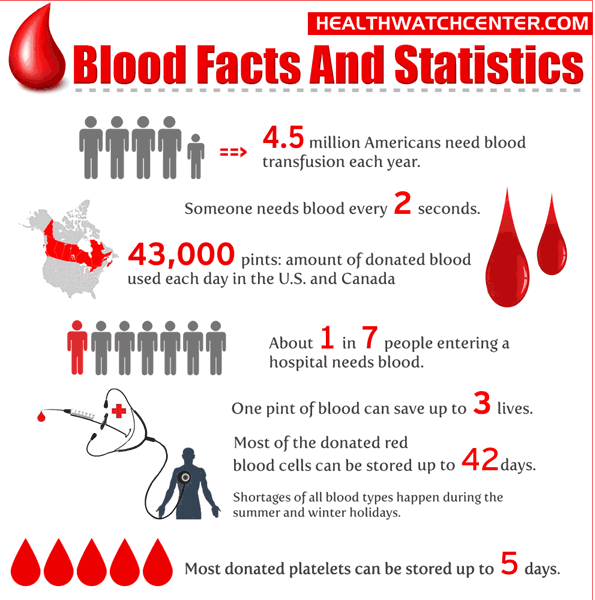
       Blood can not be manufactured.  The only way hospitals and medical centers can get blood is from people donating blood.  Blood is needed everyday for accident victims, people with Sickle cell disease, and people with cancer (source).  Over 15 million blood units are needed in the U.S. and Canada every year.  To make matters even more dire, blood can only be stored for up to 42 days (see chart).

       Hence, maintaining an adequate blood supply is difficult to do, and very important to be done.  It is so important that is worth the effort of many people throughout the country to continually seek to find more and better methods of encouraging people to donate blood and to improve the blood donation process.

       When I look at our public schools and their mission, I see many parallels to the efforts for encouraging more blood donors.  Our public schools (also) have a difficult and important job to do.  We accept students into our schools with many and varied backgrounds.  Some are poor and ill-equipped to find success in the academics of traditional schooling; some are new to our country and are trying to learn English while also trying to learn math, science, and social studies.  Some schools have few needed supplies and some classrooms have large numbers of students.  Some teachers are very well prepared to educate their students and some are not as well prepared to do this job.


       Yet, few would argue that the need for an educated public is important.  It is important for the individual and it is important for the society at large.  Hence, it is worth the struggle and the effort to continually search for ways to successfully educate all of our students.

       This belief in the importance of education is certainly shared by educators; but we often find it difficult to convince some students and their parents.  Like blood donors, we don't offer our students money or prizes for obtaining a good education.  Instead, we offer them hope for a better future.  We do our best to help our students to see the value in learning.


       Education is (indeed) the art of selling students (and parents and communities) the future value of learning.  It isn't the grades or the GPA or the credits earned.  It isn't "doing what you're told because, 'I say so'".  Learning is it's own reward.  Learning is the right thing to do because it helps you and everyone around you to be an educated person.

Monday, April 21, 2014

Everyone has Experiences with Education

     One of the strongest assets of public education is The Public.

     Everyone is free to voice their opinions regarding public education in general as well as public education as it relates to their own school (or their child's school).  Everyone has had experiences with education and everyone has their opinions regarding what should happen within the school walls during the school day.  The strength of a public school is its ability to respond to the needs of the public in its mission to educate and prepare students for their future.

      Of course, this can be a messy process at times; and everyone isn't going to get everything they want all of the time.  As society changes and as America changes and as the world changes, our public schools must also continue to change.  Sometimes changes don't lend themselves to simple "right" or "wrong" solutions.  Sometimes people prefer the comfort of "staying the same" rather than the uncertainty of change as we prepare for the future.

     Still, we are stronger when we listen to varying points of view and consider varying options.  Schools know that it is important to have a partnership with parents.  We know that students do better academically when their parents are involved in their education.  It is unfortunate that (so often) the newspapers only talk about the struggles between school systems and the public.  It much more common for schools to seek positive relationships with their parents and even to encourage more parental participation in school issues and events.

     The public makes our schools great.  As a teacher, I would occasionally receive advice from a parent regarding my teaching.  Sometimes I was offended and sometimes I was appreciative.  But (probably) all times, it affected my teaching in some way.   I would think about what they said and compare it to what I knew about teaching; and I would (perhaps in a small way) change what I did for the better.  The same thing happens to principals and other school leaders.  We take in the advice and opinions of many and it shapes our thinking--perhaps, it even shapes our actions.

     I wonder if it is the case that most people never comment about educational matters; and only the people who are really angry and only the people who are really happy tend to be the people who speak up.  That can be dangerous because the people on the extremes (often) do not represent the opinions of the many.  So the next time you receive an email or phone call from your child's teacher (or superintendent) asking for your opinion, please take a few minutes to share what you think.

     We're listening.  After all, you are the "public" of our public education!


Wednesday, April 16, 2014

Lots of Helpful People

     In the one-room school house, there was a teacher and that was it.  It was probably a very caring teacher who (maybe) knew her students and their families very well.  But it was one person and that was it.

     Today, our public schools have librarians and nurses and school counselors and aides and assistant principals, and (maybe) math specialists and reading specialists and special education teachers.  We know that students need good teachers, but they also may have other needs that can be addressed by other professionals.  We want our students to be good learners, but also want them to be healthy, happy members of society.

     And these people are here to help the parents as well as helping the students.  Our public schools take on a lot of responsibilities in an effort to help our students to be the best that they can be.  It is a big job to educate children and it takes a lot of people to do the job right.

     So, in addition to thanking your teacher, be sure to thank the other people in the schools that come to work everyday to make the school experience positive and to help your child in every aspect of their growth and development.

     What's so good about public schools in America?  Lots of helpful people!

Public Schools and Choice

       Is it true that public school kids and their public school parents don't have choices?  I'm sure that I will expose my igno...

Teach100 blog