Showing posts with label questions. Show all posts

Sunday, October 30, 2016

When Students are Thinking, Students are Learning


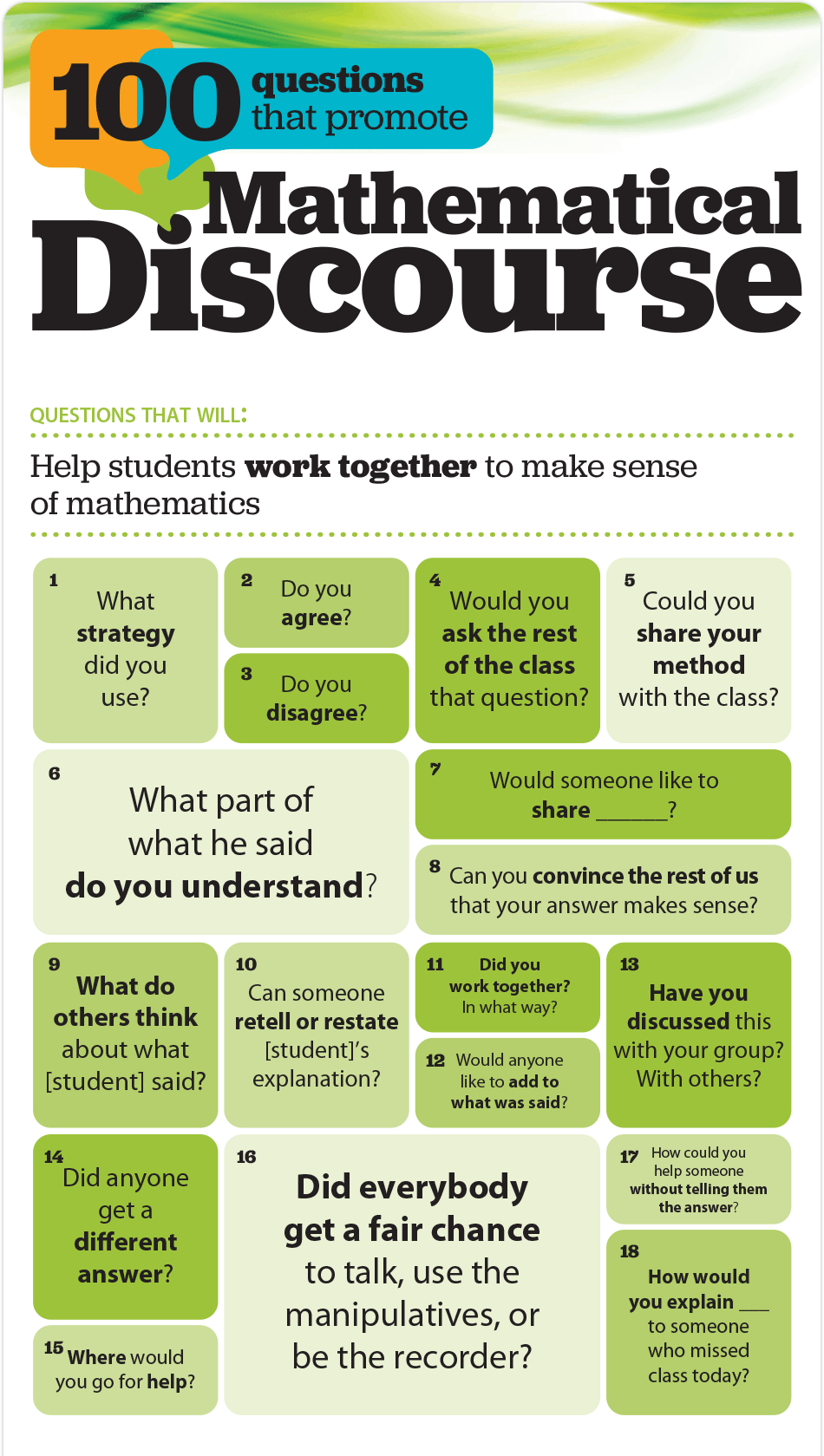
       I was recently introduced to a fantastic list of 100 questions that teachers can ask in mathematics class that will encourage students to think and reason and share their thoughts with each other.  A portion of these 100 questions are in the graphics in this post.  The rest can be found here.

       The questions are separated into categories that help students to:
  1. Work together to make sense of mathematics.
  2. Rely more on themselves to determine if something is mathematically correct.
  3. To reason mathematically.
  4. Evaluate their own processes and engage in productive peer interaction.
  5. Gain a better understanding with problem comprehension.
  6. Learn to conjecture, invent, and solve problems.
  7. Learn to connect mathematics, its ideas, and its applications.
  8. Persevere.
  9. Focus on the mathematics from activities.
       Every parent that has ever received the unimaginative response of "Fine." to the question, "How was school today." understands the frustration of trying encourage a dialogue with young people who are either unable or unwilling to do so.  Teachers face this dilemma every day.  Except, for teachers, their are tasked with making sure that the students are actually learning the content that they are teaching.  Teachers don't have the luxury of dismissing an uninformed, mono-syllabic response.  Hence teachers do their best to use strategies that will encourage students to share their thinking.  These questions help teachers to achieve this goal.

       Here is a sampling of some of these great, discourse-encouraging questions:

How would you explain _________ to someone who missed class today?

How did you reach that conclusion?

Can you think of a case where that wouldn't work?

Could you reword that in simpler terms?

How is your solution method the same as or different from (student)'s method?

How does this relate to ____________ ?


       These questions help students to understand that mathematics is not just a bunch of rules that lead to a single number answer.  We want students who are able to understand the reasoning behind the rules.  We want students to think and reason and discuss and struggle and fail and try again.  We want students to have strategies for finding solutions beyond just asking the teacher.  We want students to learn from each other, to recall past lessons, and to know how to check their own work.

       These questions are a great resource to our teachers.  When students are thinking, students are learning.


Tuesday, August 30, 2016

A Tale of Two Classrooms -- Kids Question

 This is the fourth in a ten-part series based on the poster: A Tale of Two Classrooms.


---------------------------------------------------------------

Kids Question

       The typical, tradition classroom has the teacher doing most of the talking.  The teacher asks questions, the teacher gives information (verbally), the teacher decides if the answers are correct or incorrect.  And the students do very little talking.  In the traditional classroom, student talk is for answering the teacher's questions and that's about it.

       But in the Learning Classroom, students do a lot of talking.  They ask questions.  They offer solutions and ideas.  They consider alternatives, shortcuts, more efficient pathways to learning.  There are lots of great benefits to student talk in the classroom.   Here's a list of ten such benefits:

  1. Participation adds interest
  2. Participation engages students
  3. Participation provides the teacher feedback
  4. Participation provides the students feedback
  5. Participation can be used to promote preparation
  6. Participation can be used to control what’s happening in class
  7. Participation can be used to balance who’s contributing in class and how much
  8. Participation encourages dialogue among and between students
  9. Participation can be used to develop important speaking skills
  10. Participation gives students the opportunity to practice using the language of the discipline

       We want students to ask questions because real learning requires more than just memorizing what the teacher says.  It requires thinking and reasoning and trying and failing and trying again.  Real learning encounters road blocks from time to time and students to ask questions about how to navigate around these obstacles.   When students ask questions that are engaged in learning and they learn better and more deeply when they are engaged.


Thursday, August 25, 2016

A Tale of Two Classrooms - Teacher as Learner

       This is the second in a ten-part series based on the poster: A Tale of Two Classrooms.


---------------------------------------------------------------

Teacher as Learner

       Every teacher will tell you that they have learned so much more about the subject and content that they teach once they began teaching.  People have this belief that teachers know everything their is to know about their content.  While teachers may be considered "experts" about the content that they teach, it is probably impossible to actually know everything about a particular content.

       We now know that our best teachers are the people who are continually learning about there subject(s).  More importantly, our best teachers are continually learning about the best way to help their (many and diverse) students to learn.  The science of how students learn is a growing industry.  Brain science and cognitive science is constantly informing education about how students think and learn and retain information.  Teachers who do their best to continually grow and improve are spending time learning about the best ways to reach their students.  Teaching strategies, engaging activities, better communication with students, and encouraging more student discourse all fall into the category of improving the classroom atmosphere for better learning.

       A learning teacher is also a person who asks good questions of him- or herself as well as of their students.  A learning teacher doesn't mind if a student asks a question that they cannot answer right away.  It is not seen as a weakness, but instead as a learning opportunity for the teacher.  (And isn't it great to have students in your class that ask such deep, and high-level questions?)  A learning teacher models for students that learning is ongoing; it never ends.  Even this adult in the room who has been teaching for ten years is still learning.

       A learning teacher invites questions and ideas and suggestions.  A teacher that knows everything and spends the entire class time reciting information discourages participation because students assume that he/she will tell them what they need to know; so there is no reason to explore or think or question.

       I want my children to have teachers that are constantly learning because I want my children to become adults who are constantly learning.


Friday, May 20, 2016

Is There Too Much Testing?

       Testing.  


       The very word conjures up emotions in students and parents and school officials alike.  Within the educational community, this word conjures up other words like: measuring, accountability, fairness, purpose, practice, instructional time, online, paper/pencil, formative, and summative.  Your connection to these feelings and issues probably shapes your views about testing in our public schools.  Part of what makes this such a big issue is that there are no simple "right" and "wrong" solutions.  It is a complex problem that requires thought and discussion among many stakeholders.


       The goal of schooling is learning.  There may be other benefits such as socializing, joining a club or team, earning a diploma; but the goal is learning.  Our ability to measure learning has grown significantly over the past twenty years as educators come to understand the value of frequent formative assessments in combination with teaching strategies that engage students.  In the past, the school classroom was a very dictatorial place:  Teacher in the front doing most of the talking; students sitting in rows listening to the teacher and taking notes; test or quiz every Friday.  This system worked fine for the student who was able to learn by listening, but if you needed to ask questions, or clear up any confusion with the content prior to the test you probably struggled to learn in this environment.  And if you weren't able to concentrate on the teacher's words for two or three hours, you might have missed your first and only chance to get that precious information from the teacher.


       Today we know that learning requires doing and talking and questioning in addition to listening (and note taking).  We also know that we want to get a sense of the learning that is taking place on a daily basis and not just once a week or whenever the "Big Test" occurs.  This "measuring of daily learning" is what we call Formative Assessment.  It could be a game, a series of verbal questions from the teacher, an activity during class, a exit ticket (or exit pass),  Anything that gives the teacher and the student information as to their level of understanding the content or the objective for the day.  Usually when we argue about "Testing", this isn't the sort of testing that we are arguing about.

       The discussion over testing usually centers around what educators call summative tests.  These are chapter or unit tests, final exams, end-of-course tests, and major state tests.  These tests might be required to graduate from high school; or they may command a large portion of a final grade in a course; or they may be used to determine if you are ready for college (or if you will be accepted to college).  These are the tests whose results have some sort of consequence.

       A common issue that arises is a student who appears to be learning very well based on class grades and report card grades, but then this same student demonstrates a lower level of learning on one of these big tests.  I think that I worry when there is a public outcry over testing because of this scenario.  I feel that rather than arguing against giving the test, we should question why the discrepancy happened in the first place.  Clearly a student who fails an end-of-course test and earns an "A" or a "B" as a course grade cannot (both) be very knowledgeable about this content AND be very weak with this material.  Something is going on.  Perhaps both the course grade and the test are not true reflections of the student's ability.  Perhaps it is somewhere in the middle of these two extremes.

       Since the goal of school is learning, there should be accurate and valid methods for determining the extent of this learning.  It isn't enough for a student to come to school everyday and do what he's told to do and then walk out of school without some measure his learning.  Getting grades isn't enough.  What does it benefit a child to get good grades in school and not be able to read or do math at an acceptable level when he leaves school?  This is one of the reasons for instituting summative and state testing in the first place.  Also far too many students begin college but never finish college.  If more people took the results of these big tests seriously, they might be less in a rush to go to college until their abilities were more in-line with college-level expectations.


       Is there too much testing?  Why are you asking this question?  If it is because you don't like to see your child getting poor results on this test, than you should question the discrepancy between the course grades and the big test.  If it is because the results are not used for any useful purpose, then you should discuss this with you child's teacher or school.  Everything done in public schools should have a purpose; this includes testing.


Wednesday, April 27, 2016

Future Schools: It's All About the Learning

       In the future, our middle and high schools won't use grades and grading--at least not the way we think of grades and grading today.  Parents will brag about what their children are learning.  As the school year ends, students will reflect on what they learned--rather than on the grades they got.  Colleges will identify qualified applicants based on what they have learned in their P-12 schools.


      Students will move at their own pace; some will finish high school when they are 16 and some finish when they are 21--and both are perfectly acceptable.  There will be an appreciation for the value of education throughout our society; and all students will feel valued in their schools.  Teachers will teach classes and help individuals; sometimes face-to-face and sometimes online.  "Sit-and-get" lecture will be replaced with active learning that includes students working and learning together--actually talking with each other during school.  Questions will be asked and problems will be solved everyday.  Students will view effort and struggle as value and necessary elements of the learning process.

       Computers and tablets will be viewed as tools for learning and for gaining information.  Students will find the data and facts that they need to make conclusions and to discover new things; to prove theorems and to create stories and art; to publish, to communicate with their learning team, and to keep lists of further areas of inquiry.

       Some students are already enjoying this school experience; for others it probably sounds like a fantasy.  I believe that current elementary school students will see pieces of this future school before they graduate and their children will see this school system as normal.  Our society can not accept an outdated system to prepare our students for their futures.  Change is not a luxury; it is a necessity.  It's not about being #1 in the world; it's about doing what's right for the next generation.


Friday, August 21, 2015

11 Serious Questions for Teachers


       Yesterday I welcomed our 200+ secondary mathematics teachers to the 2015 - 2016 school year.  We do this every school year and it is always an exciting day.  We get to see people we haven't seen since last June; middle school teachers get to network with their high school colleagues.  The first day of school is getting closer and closer.

       This year I welcomed them with 11 serious questions about teaching.  Since this week is filled with the details of preparing those first lessons, decorating the classroom, preparing class resources, and learning about any new school policies and procedures, teachers don't usually get the chance to sit down for 30 minutes and reflect on why they do what they do.

       Here are the questions I asked them.  Read each one and take 30 seconds to reflect on your answer to the question.

  1. Why do you teach?
  2. What is your goal this year?
  3. Will you make a difference?
  4. What will you do differently this year?
  5. How do you view challenges?
  6. Where is the line between impossible and very difficult?
  7. Do your students have a Growth or Fixed Mindset?
  8. How do you know when they "get it"?
  9. Do student's term grades reflect their ability?
  10. How do you move your students from procedural to conceptual understanding?
  11. Why do you teach?
       Teachers have a job to do.  It is a difficult, complex job.  And the need to grow and to improve in the job is necessary because it isn't the sort of job in which a person knows everything they need to know when they graduate from college.  Teachers face new challenges every year and their ability to find solutions to those challenges is generally what separates good teachers from great teachers.

       Here is a movie clip I shared with the teachers in which FDR struggles to stand up straight and then boldly says, "Don't tell me, 'It can't be done.'"

       Why do you teach?


Public Schools and Choice

       Is it true that public school kids and their public school parents don't have choices?  I'm sure that I will expose my igno...

Teach100 blog