Showing posts with label classrooms. Show all posts

Friday, February 3, 2017

Learning and Thinking - (getting the right answer isn't good enough anymore)


       Learning and thinking have always been closely linked.  But sometimes, in our schools, we only achieve the appearance of learning--often accompanied by very little thinking.  This problem has been recognized by educators for a long time.  In recent years, however, we have been addressing this issue on various fronts.

       Let me begin by explaining what I mean by the term Appearance of Learning.  This is when students get good grades, but their actual learning is very low.  The grade to the students and to their parents makes it appear as if they have learned a lot, but the attainment of those grades may have been based partly on non-academic measures such as good behavior or mere compliance with rules such as turning in homework on time.  This is a problem because when students move on to more complicated coursework that requires previous knowledge, they struggle due to never actually learning the earlier content in the first place.

     Over the past few years, there has been a stronger attempt to balance the need for teaching skills (such as solving an equation) with the need for teaching conceptual understanding (such as using an equation to solve a problem).  This sort of "teaching" is different from when our students' parents were in school--a time in which just-getting-the-answer might have seemed good enough.  Today we know that this isn't good enough.  Students going to college and students going to work need skills and knowledge beyond merely doing what they are told to do.  Today's world demands more from our citizens.


       Our schools recognize this need and we are trying to make changes to address this challenge.  It's hard to change a system of 100,000 schools, 50,000,000 students, and 3,000,000 teachers.  But (indeed) this change is already happening.  What we used to call a "computer room" is now just about any classroom in the building.  Classrooms with students sitting in nice, neat, straight rows that discouraged collaboration among students have been replaced with classrooms with tables or desks arranged in groups to encourage students to work together and ask questions of each other and learn together.  Grades for non-academic behaviors (mentioned above) are strongly discouraged so that a student's grade can more accurately reflect his/her ability in the content.  Finally, student engagement strategies and growth mindset strategies are constantly being discussed and implemented.  These reflect our knowledge of the best way that students learn.  No longer do we expect everyone to learn strictly by listening to the teacher and taking notes.

       Indeed, the change to an educational system that requires more from our high school graduates is well underway.  The past is in the past and we're not going back.  Those that choose not to change risk creating a generation that is ill prepared for the challenges that they will face.  Learning, thinking, reasoning, and problem solving will be more and more integrated into our schools.

       You're welcome.


Saturday, January 7, 2017

Teachers Seeking Innovative Learning Strategies

       If students aren't learning, then the teacher isn't succeeding.

       This is a harsh statement.  Clearly there are lots of reasons that prevent students from learning.  Some of these reasons can be due to teacher actions in the classroom and some are outside the control of the teacher.  But the main goal of school is learning.  If the student isn't learning, than we haven't met this main goal.

       Of course, not all students learn in the same way.  When a teachers presents a lesson--be it via lecture, or a game, or discovery learning, or through the use of a task, or some combination of these methods--some students will "get it" and some will not.  And so our best teachers are constantly looking for different ways (different teaching strategies) to help students to learn.  This (indeed) is the part of teaching that very, very complex.  Trying to understand the best way to help students to learn--every student in every class--is the struggle of every teacher.

       Alas, the world of education is full of ideas to help us.  Some of these ideas fall into the category good suggestions that any teacher should use, such as:

  • Scaffolding - breaking up the learning into smaller chucks and allowing students the time to learn one-piece-at-a-time in the effort to get them to learn the whole idea or standard.
  • Graphic Organizers - providing students with different ways to organize information so that "many ideas or facts" are easier to see and to understand.
  • Multisensory - presenting new information in multiple ways that help the students brain to store the information in multiple ways.  For instance, verbally explaining something while also writing the information on a whiteboard or computer screen, while also (perhaps) providing a manipulative or foldable for the student to hold and work with tactilely.  
Other ideas are more specific as to the sort of instructional style that may take place in a classroom.  A typical example of this would Direct Instruction or Lecture.  This is very typical in classrooms in the United States; particularly in our high schools.  Adults in their 70's and 80's probably received instruction in this manner when they were in high school and their grandchildren and great-grandchildren likely receive their high school instruction in this same mode.  Some people refer to this sort of instruction as Traditional classroom instruction--and it clearly is not effective for all students.

       More teachers are using a Discovery Learning approach to classroom instruction at least some of the time in their classes.  This approach allows students to build on past learnings by completing tasks and problems that require them to do so.  Students may work individually or in small groups of three or four while the teacher responds to students' questions and encourages students to think about other solutions.  This approach is common in some countries but is much less used in the United States.   

       I am part of a couple of math groups on Facebook and I posed the question, "Is Direct Instruction Necessary?"  I went on to ask if Discovery Learning could be the sole or major teaching strategy in a high school math class.  Of course the responses that I received were various and wide ranging, but I did learn a lot more about individuals and groups of teachers who use this approach with some success.  

       When teachers are continuously searching for more and better ways to reach their students, everyone wins: students, teachers, schools, society.


Tuesday, October 11, 2016

Why Can't High School Classrooms Be More Like Elementary Classrooms?

       Every level of schooling from elementary school to high school has its challenges.  Among them are teaching to the academic and age level of the students.  No one wants second graders to read high school level novels and it wouldn't be appropriate to take 15 minutes of class time to explain to high school students how to use scissors.

       However, when teachers create a learning environment in their classrooms there are some aspects of learning that are true for both elementary and high school students.  One of these is the idea that when students are engaged in their learning, they tend to do better.  There are plenty of reasons why this makes sense, and they apply to little kids as well as teenagers (and adults).

       In elementary school, while it may be true that the children are more excited about learning and school just because little kids are generally happy and willing to do what they are told to do; it is also true that their teachers work hard to make the learning engaging.  Look at this list of aspects of an elementary classroom, and consider which (if any) could not also be aspects of a high school classroom:

  • motivating posters on the walls
  • opportunities for students to be out of their seats often
  • opportunities for students to talk with each other during a lesson
  • working in whole groups
  • working in small groups
  • working individually
  • using educational technology
  • students given choices (perhaps about what to read or where to sit or how to solve a problem)
  • calling on every student every day
  • classwork that is challenging ("too easy" is boring and "too hard" can lead to disinterest)

       The things that make elementary classrooms fun and interesting can be replicated in our high schools.  High school students like to learn.  They also like to receive a gold star and a smiley face every once in a while.  They like to get out of their seats during a class activity and they like to ask questions of their peers to help them to understand a new concept.  High school students like motivational posters on the walls and they like to use educational technology.  All of these things keep high school students engaged in the learning process, even when the learning is difficult.

       There should be more similarities between our elementary and our high school classes when it comes to engaging students to learn.

Sunday, October 9, 2016

Breaking News: High School Is Not Supposed to be Boring

       Too many parents have this idea that says, "If it was good enough when I was in high school, than it's good enough for my kids."  Of course, they hated it when they were in high school.  But for some reason, they are "OK" with the same boring classes and senseless assignments for their own children.

       I'm talking about high school classes with:

  • students sitting in rows
  • teacher always standing in the front of the room
  • worksheets, worksheets, worksheets
  • very little (or none) students discussing, asking questions, or working together
  • homework on stuff they already know how to do
  • no use of educational technology
       I've seen high school classrooms with multiple students who have their heads on their desks and the teacher seems to be "OK" with this.  Too many classes in which the teacher asks the class something like, "Do you understand?" and one student says "Yes" and the teacher assumes that everyone in the class understands.  And the students know that this is going to happen and they don't want to say out loud that they don't get it.  I've actually heard parents say to their children, "School is supposed to be boring.  That's just the way it is."  They believe this and (now) their children believe this.

       I've got breaking news for all of the parents and students who believe that school is supposed to be boring.

It does not have to be this way.


       Think about your favorite teacher in high school.  Or think about your child's favorite teacher in high school.  What makes this teacher so special?  Why does this teacher stand out among all of the high school teachers you've ever had?  Was he or she boring?  Do they appear to not care if you passed or failed?  Of course not.  We've got lots of high school teachers who work hard every day to engage their students in the learning.  They believe that it is their responsibility to ensure that all students are learning; and they understand that students cannot learn solely by sitting and listening.  

       Learning requires doing, talking, listening, questioning, arguing (at times), trying and failing and trying again.  Students need to get out of their seats during class from time to time (or everyday)--especially in high school classes that last 80 or 90 minutes.  High school students should work in small groups without the teacher for part of the class.  They do it in elementary school and middle school; so they can do it in high school too.  We have teachers who understand this very well and they establish a true learning environment in their classrooms.  Students know that these teachers really care about their learning and they make an effort to encourage the learning everyday.


       High school isn't supposed to be boring.  Learning rarely happens in the context of "boring".  Compliance may happen; memorization may happen; even decent grades may happen.  But learning won't happen.  And if learning isn't happening, then what's the point of school?

Sunday, September 18, 2016

The Case Against Worksheets

The Case Against Worksheets

       The "worksheet" has been a staple of the P-12 educational experience for students for the past 30 to 40 years--maybe longer.  The advent of the mimeograph machine and then the photocopier made the duplicating of massive amount of worksheets easy, cheap, and increasing common.  Today there are multiple websites with pre-made worksheets for math, reading, geography, science, and just about any other school subject.  Some teachers love using worksheets.  Some use a worksheet everyday or nearly everyday.  In middle and high school math classes, students sitting in rows in the classroom and independently completing 20 or more math problems on a worksheet is an iconic image that many parents remember as a child and still expect to happen to their children today.

       The problem with the massive use of worksheets in today's classrooms is that they represent the opposite of everything we now know about how students learn best and what we hope to accomplish in our schools.  Math worksheets in particular go against many of the tenets of good learning and good teaching.  Here is my short list of why worksheets are a poor choice for today's classrooms:

  1. Worksheets are boring.
  2. Worksheets discourage students from working and learning together.
  3. Worksheets are often very low on the rigor scale.

Boring

       I often say to my teachers that it isn't our job to entertain students, but it is part of our responsibility to motivate students to do their best.  The old days of the teachers who basically use the "Because I say so" theory of teaching is over.  Students may do what they are told, but they won't like it.  So the next question is, "Why do we care if the students 'like it' or not."  And the answer is student engagement.  The Glossary of Education Reform says the following about students engagement:

...the concept of "students engagement" is predicated on the belief that learning improves when students are inquisitive, interested, or inspired, and that learning tends to suffer when students are bored, dispassionate, disaffected, or otherwise "disengaged."

       Simply put, there is no educational reason for a student to complete 20 (basically) identical math problems.  If they know how to do solve the problem, then completing about three should provide sufficient evidence that they can do it.  If they don't know how to solve the problem, then they won't be able to solve 20 problems.  Or, they will make the same mistake 20 times and be very upset to discover this mistake the next day when the class goes over the answers.

Students Working Together

       When there are 30 students sitting in class and learning something new, most won't fully understand everything there is to know about the new learning right away.  Some will try to link the new learning to past learning; some will try to memorize the steps or the procedures; some will just take notes and not really understand anything right away.  When the teacher assigns classwork that is meant to be done independently, students have a lot of questions.  Some will ask their questions, but most won't because they don't want the teacher to think that they don't get it; or they don't want their classroom peers to think that they are stupid.  Some students won't even know what questions to ask.

       However, when students are encouraged to work in groups of (say) two to four students AND when they are encouraged to ask each other questions, they are much more likely to ask their question(s) and to help each other.  Each person in the group may understand a different piece of the new learning and together they can help each other.  Additionally, we know that when students can explain what they are doing, they understand the concepts much better than when they merely answer questions or solve problems independently.


Rigor

       Although not always the case, worksheets tend to emphasize low-level, procedural skills such as following steps to solve a problem, or defining a word, or finding a fact from a reading passage.  While we want students to have these skills, I question the need to constantly repeat this (worksheet) activity for the purpose of helping students to gain these skills.  In today's classrooms, we want to emphasize thinking and reasoning and problem solving.  We want students to recognize particular situations that require particular skills or procedures.
  • What formula do I need for this problem?
  • What further information do I need to determine before I move forward?
  • I'm not sure what to do, but I'll try this first and see what happens and progress based on this "first try" experience.
       In the math world, we now use activities called Math Tasks.  (For some great examples, see youcubed, nrich, (also here), and MARS.)  Math tasks cover the same content as worksheets, but they require more than merely asking students to repeat what they heard a few minutes ago when the initial lesson was taught.  Good math tasks begin with some basic information and slowly increase the level of rigor as the tasks goes on.  Students spend the same amount of time in class on a math task as they would on a worksheet, but instead of doing the same thing over and over (20 or more times), they are pushed to think about the new learning in new ways.

       This sort of rigor is better suited for students to work in groups than to work individually.  Group work is more amenable to higher-level problem solving that requires input and ideas from multiple people.  The group members can discuss and debate the different solution methods and (hence) they can gain a stronger understanding of concept or standard being discussed.


        I could go on...

       Worksheets, at their worst, are used to keep students busy during precious class time.  In fact, many students refer to worksheets as "busy work".  Even the students know that (sometimes) teachers are just using worksheets to fill time in the class.  And this is time that could be better spent with student-to-student discourse or whole-class discourse at much higher levels than the simple worksheet could ever achieve.  Worksheets do not promote learning beyond simple recall and following procedures.

       Worksheets are "old school".  Worksheets do not prepare our students for their future.  Worksheets should be (very) infrequently used in today's classrooms if we truly intend to prepare our students for life after high school.


Thursday, September 15, 2016

A Tale of Two Classrooms -- Rules unnecessary

This is the tenth in a ten-part series based on the poster: A Tale of Two Classrooms.


---------------------------------------------------------------

Rules unnecessary

       Rules govern behavior.  Hence, rules are only necessary when behavior needs to be governed.

       When my child began high school, he was presented with ten school rules.  One of these rules was:
Every student must provide their name when asked to do so by an adult.

This was many years ago, but I still remember it because it seemed like such a strange rule.  I thought, "What student wouldn't give their name when an adult asked for it?"  But I assumed that this was a problem in the school and the school decided that this was sufficiently important of a problem to make the list of top ten school rules [!].  Despite this (disturbing) fact, I can certainly envision a high school that does not have this rule because this sort of behavior occurs so rarely that it doesn't make sense to include it in the official school rules.

       On the other hand, schools certainly have a number of rules that are very necessary because some behaviors may disrupt the learning process, cause harm to students or adults, or are considered unacceptable in a school setting.  These are generally rules that some students and/or adults might not follow if there were no such rules in place.

       Now imagine a classroom in which such rules were not necessary.  Students respect each other; students do their best to learn everyday; students help each other; and adults and students work together to think, reason, debate, create, and learn.  This sort of classroom would have less of a need for strict rules because there is already an understanding of purpose and acceptable behavior.  

       And this really isn't some sort of utopian view of the world.  All of us have had a class in school that we really liked.  Maybe we liked the teacher or the subject or the other students in the class or all three of these attributes.  In this class there was very little behavior that required a recitation of the school rules to address.  When someone did something unacceptable, a peer or leader would speak to that person--or the person would notice the fault on their own--and the problem was over.  More importantly, everyone in the classroom is focused on doing their best and helping each other and making the best use of their class time.


       When school is focused on the needs of the learner and the students understand their purpose and responsibilities, the rules become unnecessary.  This is the classroom that I want to be part of; this is the classroom that I want to lead.  This is the classroom where I can truly learn.


Monday, September 12, 2016

A Tale of Two Classrooms -- One Size Fits Each

This is the ninth in a ten-part series based on the poster: A Tale of Two Classrooms.


---------------------------------------------------------------

One Size Fits EACH

       School is for learning.

       But students learn in different ways.  Some are quick to answer teacher questions, but slow to see connections between yesterday's lesson and today's lesson.  Other students take time to digest new content and (perhaps) need some quiet time to reflect on notes and classwork before they are ready to ask questions about the new learning.  Some students are eager to be pushed beyond their limits and they don't mind if they have to struggle a little bit to understand.  They like the challenge.  Other students feel like they are not smart if they don't "get it" right away.  They don't like to study (or don't know how to study) and they want to understand the new content right away with relatively no effort.


       When possible, we want the learning, the content, and the level of rigor to fit each student.  When this happens you never have students who are bored because they "get it" faster than everyone else; and you never have students who are frustrated because the class moves too fast for them.  Everyone is learning at their speed and at their level.

       This sounds impossible.  In practice, however, teachers accomplish this feat by teaching one lesson to the whole class, and then separating the class into three or four groups that receive slightly different classwork assignments that meet the students' level of ability.  This can also be accomplished by employing online tools that can provide additional instruction or support to students as they complete an assignment.  Or they can provide a high level of rigor to students who seek a challenge.
       This certainly requires an experienced and well trained teacher.  And it takes some effort and trial and error to find the best way to reach all students all of the time.  But it can be done and it certainly has great benefits for students.


Thursday, September 8, 2016

A Tale of Two Classrooms -- Create

This is the eighth in a ten-part series based on the poster: A Tale of Two Classrooms.


---------------------------------------------------------------

Create

       Should school be a place where students (only) do what they are told to do?  Or, should school be a place the encourages and even requires students to think and hypothesize and create?

       When educators get together to talk about the factors that go into determining a course grade, we sometimes refer to some of these factors as "compliance" grades.  These are things such as: completing homework, completing classwork, following the school or classroom rules, and behaving properly.  While these are certainly going to be a part of the school experience for students, is it appropriate that a student's grade should be based on these "compliance" factors?

       Learning doesn't occur when teachers tell students exactly what to do and what to say.  Learning occurs when students are reminded of past lessons followed by additional information (or "content") and then students are given the task to put these two experiences together to make sense of them.  Learning is demonstrated when students can explain their thinking either orally or in writing (preferably both ways), when students ask questions about the new content, and/or when students take in the new content and find ways to use it to create something new.  The learning process may involve some level of compliance, but compliance alone isn't learning.

       In today's classroom, we want students to struggle with questions that can't be answered with a single word or in a very brief period of time.  We want students to go back to their notes, or the book, or the online resource to recall something they were taught yesterday or last week and to use that information to connect to what they are being asked to understand today.  We want students to understand this process for making connections and extending beyond what the teacher says.  We want students to imagine bigger, to think bigger, and to create bigger.

       The classroom isn't just a place to follow rules.  The classroom should be a place of thinking and talking and reasoning and arguing and offering solutions.  The classroom should be a place of "new" everyday.


Tuesday, September 6, 2016

A Tale of Two Classrooms -- Solve Problems

This is the seventh in a ten-part series based on the poster: A Tale of Two Classrooms.


---------------------------------------------------------------

Solve Problems

       School used to be:

  • Read the book
  • Memorize the facts
  • Recite what you've memorized
over and over and over again.  

       What are the capitals of the states in the United States?
       What year did World War 1 begin?
       What is the formula for finding the area of a triangle?

       Today's learners need so much more than mere memorization skills.  They need to know how to use these facts to make predictions, to see connections, and to find solutions.  The classrooms we need today require students to think and reason and discuss and hypothesize.  We need students who can be presented with a problem and know the tools they need to address the issues involved in the problem; and to find a way to solve the problem.

       Problem solving prepares students for the real world they will encounter beyond high school; be it college or career or relationships or buying a car or choosing a route to a destination.  We need problem solvers.  And the classroom is the ideal place to practice problem solving skills.  It isn't enough to have students who are only good at memorizing procedures or memorizes mere facts.  Anyone can find facts with the click of a mouse today.  Schools have to push students to do more.

       As with any other skill, problem solving takes practice.  Students need to hear from other students in addition to hearing from a teacher.  They need to be presented with problems that are (perhaps) a little bit beyond their reach, yet close enough to their abilities so that they can have ideas on where to begin.  Classroom need to have an atmosphere that respects effort and ideas so that students are free to offer their suggestions.  And we need to understand that problem solving is a slow process.  The quickest answer isn't always the correct answer.  Taking time to think is important.

       We need more and better problem solvers.


Thursday, September 1, 2016

A Tale of Two Classrooms -- Kids Think

This is the fifth in a ten-part series based on the poster: A Tale of Two Classrooms.


---------------------------------------------------------------

Kids Think

       It seems crazy to suggest that classrooms in the 21st century should emphasize more student thinking and to imply that this wasn't always the case.  But if you think about the traditional classroom--the sort of classroom that many adults sat in when they were in school--you see a teacher standing in the front of the room and asking a lot of low-level, "recall" -type questions.

       "It's not positive, it's........?"
       "The capital of the United States is........?"
       " The largest planet is........?"

       A student could walk into the classroom after the lesson was taught and still be able to answer these questions.  These are simple, one answer, "just the facts" questions.  They don't require students to think.  Sometimes they don't even require students to memorize anything because the answer to these sorts of questions may be in the book or paper that is lying on the student's desk at the time the question is asked.  I've been in classrooms (today) when a teacher would ask a question and then point to the answer on the screen or the whiteboard and all the student had to do is read the word that the teacher pointed to.  This doesn't require thinking.  Even worse, low-level questions don't promote learning.

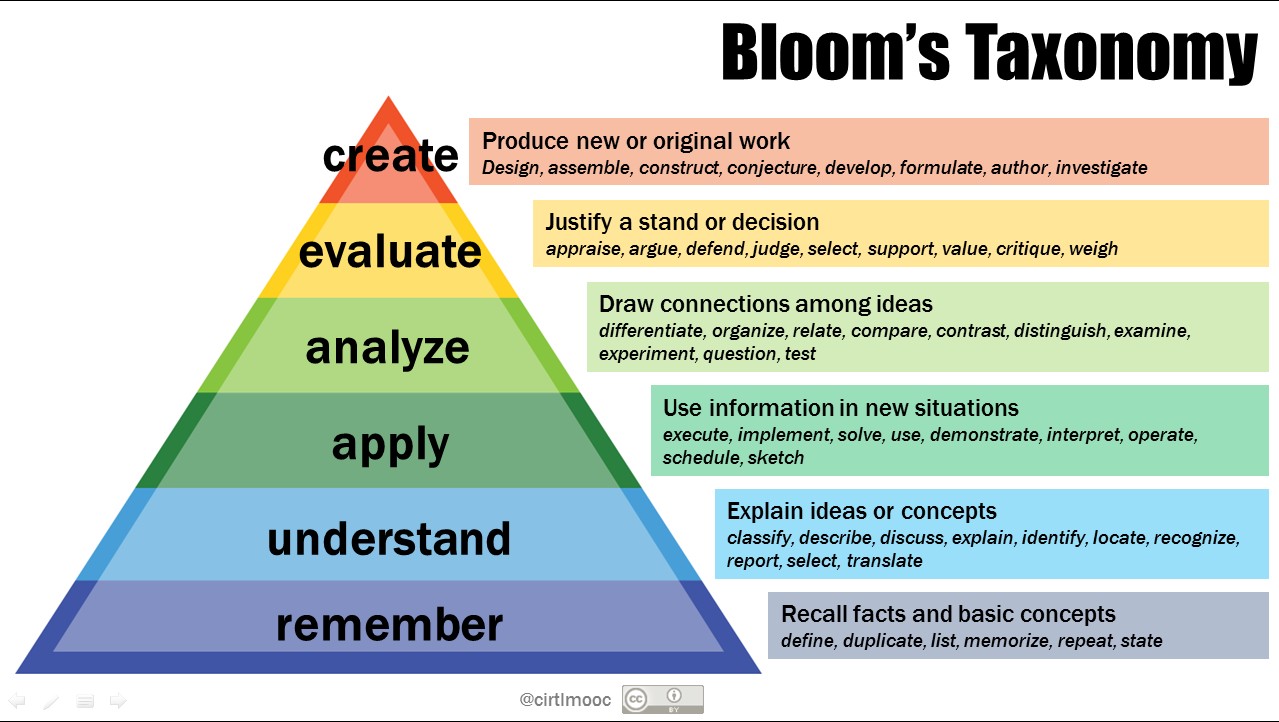
         In today's world, we need students who can analyze, evaluate, and create.  These skills are on the highest level of the revision of Bloom's Taxonomy.  These are the thinking skills.  These are the skills that enable students to compare and contrast pieces of information and to draw conclusions.  They help students to learn how to devise solutions to problems and how to come up with ideas and suggestions.  These are the skills that teach students how to learn.

       And thinking isn't supposed to be easy.  Academic thinking takes practice; it takes time; and it helps to have a supportive teacher.  The students with the first answer (the "fastest" answer) may not have the only answer.  Thinking also grows the brain by creating more connection among synapses.  Thinking adds content to students' long-term memory--which is good because more information in our long-term memory allows for more thinking--or more "space" in our short-term memory.  This is the place where we hold on to new information.

       A classroom that allows for a lot of student thinking must also allow for ideas and suggestions to flow without an immediate response from the teacher.  We want students to share their thoughts and ideas and to hear those of their peers without worry about being right or wrong all of the time.  Thinking is hard work; and school is the perfect place to cultivate this life skill.

Tuesday, August 30, 2016

A Tale of Two Classrooms -- Kids Question

 This is the fourth in a ten-part series based on the poster: A Tale of Two Classrooms.


---------------------------------------------------------------

Kids Question

       The typical, tradition classroom has the teacher doing most of the talking.  The teacher asks questions, the teacher gives information (verbally), the teacher decides if the answers are correct or incorrect.  And the students do very little talking.  In the traditional classroom, student talk is for answering the teacher's questions and that's about it.

       But in the Learning Classroom, students do a lot of talking.  They ask questions.  They offer solutions and ideas.  They consider alternatives, shortcuts, more efficient pathways to learning.  There are lots of great benefits to student talk in the classroom.   Here's a list of ten such benefits:

  1. Participation adds interest
  2. Participation engages students
  3. Participation provides the teacher feedback
  4. Participation provides the students feedback
  5. Participation can be used to promote preparation
  6. Participation can be used to control what’s happening in class
  7. Participation can be used to balance who’s contributing in class and how much
  8. Participation encourages dialogue among and between students
  9. Participation can be used to develop important speaking skills
  10. Participation gives students the opportunity to practice using the language of the discipline

       We want students to ask questions because real learning requires more than just memorizing what the teacher says.  It requires thinking and reasoning and trying and failing and trying again.  Real learning encounters road blocks from time to time and students to ask questions about how to navigate around these obstacles.   When students ask questions that are engaged in learning and they learn better and more deeply when they are engaged.


Friday, August 26, 2016

A Tale of Two Classrooms -- Mistakes = Learning

 This is the third in a ten-part series based on the poster: A Tale of Two Classrooms.


---------------------------------------------------------------

Mistakes = Learning

       So here's a situation that happens everyday.  A teacher is teaching something new.  He or she asks a question and nobody responds.  Or maybe you're an adult and you go to a meeting of some sort and the presenter asks a question and nobody responds.  Why does this happen?  Why is this so common?

       Just like adults, students don't want to give the wrong the answer.  They don't want to offer a suggestion or an idea or a possible answer for fear that they may be wrong.  Wrong answers are viewed in a very negative way.  Wrong answers are bad.  Wrong answers are frowned upon.  So rather than risk embarrassment and possibly a scolding of some sort from the teacher, students (and adults) prefer to stay silent.

       Now imagine being in a class in which mistakes are viewed as great opportunities for learning.  When a students asks a question or offers a solution or an idea, it doesn't matter if he/she is right or wrong.  Instead, the comment is considered part of the classroom discourse.  It enables others students to hear different ideas and they can respond to these ideas.  In fact, we now know that mistakes help our brains to grow and help all of us to learn (no matter our age).

       When you are learning something new, you're not expected to know it right away.  Most new learning takes time and effort and mistakes and correcting mistakes and then more mistakes before you really understand it well--perhaps especially when learning math and science concepts.  It's not only "OK" to make mistakes, it should be expected (and respected) to make mistakes when you are learning something new.

       We want our students to be in classes in which mistakes are viewed as a nature part of the learning process.


Thursday, August 25, 2016

A Tale of Two Classrooms - Teacher as Learner

       This is the second in a ten-part series based on the poster: A Tale of Two Classrooms.


---------------------------------------------------------------

Teacher as Learner

       Every teacher will tell you that they have learned so much more about the subject and content that they teach once they began teaching.  People have this belief that teachers know everything their is to know about their content.  While teachers may be considered "experts" about the content that they teach, it is probably impossible to actually know everything about a particular content.

       We now know that our best teachers are the people who are continually learning about there subject(s).  More importantly, our best teachers are continually learning about the best way to help their (many and diverse) students to learn.  The science of how students learn is a growing industry.  Brain science and cognitive science is constantly informing education about how students think and learn and retain information.  Teachers who do their best to continually grow and improve are spending time learning about the best ways to reach their students.  Teaching strategies, engaging activities, better communication with students, and encouraging more student discourse all fall into the category of improving the classroom atmosphere for better learning.

       A learning teacher is also a person who asks good questions of him- or herself as well as of their students.  A learning teacher doesn't mind if a student asks a question that they cannot answer right away.  It is not seen as a weakness, but instead as a learning opportunity for the teacher.  (And isn't it great to have students in your class that ask such deep, and high-level questions?)  A learning teacher models for students that learning is ongoing; it never ends.  Even this adult in the room who has been teaching for ten years is still learning.

       A learning teacher invites questions and ideas and suggestions.  A teacher that knows everything and spends the entire class time reciting information discourages participation because students assume that he/she will tell them what they need to know; so there is no reason to explore or think or question.

       I want my children to have teachers that are constantly learning because I want my children to become adults who are constantly learning.


Wednesday, August 24, 2016

A Tale of Two Classrooms


       I saw this great graphic on Twitter today.


       Classroom A is the old, traditional classroom; and Classroom B is the way we (educators) want classrooms to be today.

       Of course, what I call "old" and "traditional", a lot of people would call "normal" and "expected".  It is the way school was when they were kids and it is perfectly OK with them now.  But today we know that that old system just didn't work for a lot of students--and it's not working for even more students today.

       If our goal is Learning, than we simply must conduct our classrooms in a way that facilitates learning.  We can't expect students to just sit and listen and learn everything.  We know now that that is not effective for most students.  I could write a blog post on everyone line in the Classroom B...maybe I will!


Thursday, March 31, 2016

We Do Something Important Every Day

       Education is important business.

       Once in a while, a student needs to be somewhere else in the school during the time that she should be in my classroom.  Club meetings, picture day, sporting events, ... lots of activity going on in a typical high school.  So this mature and responsible student comes to me a day or two before and asks, "Are we doing anything important tomorrow?"

       My answer is always the same:  We do something important Every Day.  Bell-to-bell learning; every minute, every day; valuable instructional time....  Call it what you will, the stuff that goes on in the classroom--in every classroom--is valuable and important.

       Sometimes it is hard to see the importance of something we do everyday.  It becomes commonplace; and without an engaging teacher it can become boring.  The best learning occurs when the teacher understands the importance of every minute and communicates this to the students via thoughtful, engaging lessons.

       Education is important; everyday, every minute.

Tuesday, November 17, 2015

It's Time for Our Schools to Leave the 20th Century

       You know the old joke about Rip Van Winkle and schools?  He falls asleep for a hundred years and upon waking up he sees everything he used to know has changed dramatically.  The houses look so different.  The clothes that people wear are very different.  And the cars...wow.  Then he finds a school and walks inside.  He goes into a classroom and he is comforted to see that schools and classrooms haven't changed a bit.

       We educators don't think this is very funny.

       In fact, it is embarrassing for us carry out the important work of education today in the same way that we did this work 50 or 30 or even 20 years ago.  Doing so ignores the research about learning that has been done over the past few decades.  It ignores the research about how the brain reacts to the stimuli that occurs in classrooms.

       For instance, we know that most students can't learn to the best of their ability strictly by sitting in class for a whole class period and listening to the teacher talking (and taking notes).  We know that students are more engaged when they have the opportunity to participate verbally and when they have a chance to get up out of their seat and participate physically in some way.  We have technology that we didn't have (even 20) years ago that can be tapped to help our students to prepare for the information world that they will enter after high school.

        We are not preparing our students by merely teaching them to read, write, and do arithmetic.  These things are important, but they are not enough.  Memorizing facts long enough to get a good test grade will not prepare our children for the world that they will inherit.  Our schools have the responsibility to mirror the society that our students will experience.

       Twentieth Century schooling is not what our students need.  Most of them have never even lived in the 20th century.  I believe that our current education leaders understand this need for our schools to change.  Part of the responsibility of our public schools is to explain this need for change to our parents and to our communities.  Staying the same is easy; change is hard.  Schools often face opposition from communities who tend to say that "The old way was good enough for me and it's good enough for our kids."  We need to make the case against this sort of thinking.

       Someone needs to speak for our students and for their futures.


Saturday, October 17, 2015

Learning is a Social Activity

       Learning is a social activity.

       A quick search of respected sources such as General Psychology, Psychology Today (article by Dr. Matthew J. Edlund, and one of my favorite education writers Annie Murphy Paul will help all of us to understand that the best learning requires active participation by the learner.  (View an excellent talk by Dr. Paul here.) The old days of "sit and get", don't-talk-in-class, teacher-in-the-front-of-the-room-doing-all-of-the-talking have been shown to be effective for an incredibly small percentage of our students.


     The problem is that most of our current teachers grew up in a school setting in which less student talk was the norm.  The teacher was the sole source of knowledge in the classroom and the students were discouraged from sharing their thoughts and ideas with each other.  Hence, many current classrooms engage in this same classroom structure that existed 20 and 40 and 60 years ago.  "It was good enough for me, and so it will be good enough for my students" as the thinking goes.

       This is a problem because the old model of presenting information to students and basically asking them to memorize it isn't enough for the workforce of today--and it isn't completely necessary in the age of the internet.  We are able to obtain facts very easily now.  The challenge to our teachers is to help our students to use that information to make connections to other information; to build things; to create things; and to solve problems.

       This requires our teachers to have a knowledge of how students learn and to use that knowledge to create lessons that incorporate the strategies that are most effective in helping our students to learn.
       This also requires teachers to be comfortable with students talking to each other in class; students getting out of their seats to share information and ideas with other students; and students making mistakes (and learning from these mistakes) during class time.  Some teachers struggle with this "active learning" approach because of the fear that such a classroom atmosphere would be difficult to manage.  Such an environment in the classroom requires planning and structure and good communication between the teacher and the students.  Students need to understand the objectives of the activities and they need to be accountable for doing their part.  Yet, this is the classroom that most students will tell you that they want.  And they want it because they struggle with learning through a strict sit-and-listen-and-take-notes sort of classroom.

       Learning is a social activity no matter where the learning takes place.  Adults who learn via asking questions and reading information and watching others and making mistakes and asking more questions, etc.; should not expect students to learn any differently.

       And if students aren't learning, then what's the point of school?


Saturday, July 4, 2015

Educational Testing Should be Compared to a Health Check-up

       There's a lot of talk about testing in schools these days.

       Should we test students?  Is there too much testing?  What should be on the tests?  Are the tests too easy?  Are the tests too hard?  Do tests measure student ability?  Are high-stakes tests fair?  Standardized tests, the new SAT tests, college-readiness tests, ...and so on and so on.


     On a purely surface level, some students (and parents) do not like the big, end-of-course tests or the big standardized tests because they don't score well on these tests.  And that bad score leads to other negative and uncomfortable issues:
  • students feel bad
  • students feel not smart
  • course grade is negatively affected
  • looks bad on high school transcripts
  • negative affect on grade point average (G.P.A.)
  • negative affect on class rank
This opposition to this sort of testing has nothing to do with learning or the student's (or the parent's) feeling toward the test representing the quality of learning that took place during the course.  This opposition is purely about how the "after-effects" of the test will effect the student's stature, ranking, or reputation in some way.

       On a much different level, some people are concerned about the ability of the "big test" to accurately measure a student's academic ability in a particular subject area.  Alfie Kohn stated his many concerns about standardized testing in his 2000 article titled The case against standardized testing: raising the scores, ruining the schools.  In it, he offers a history of the origins of current-day standardized testing and lays out some of the problems with our current system.  On the other side of the debate, is the book Defending Standardized Testing (2005) edited by Richard Phelps.  This book examines testing via multiple points of view such as: research on standardized testing, misconceptions about large-scale testing, high-stakes nature of some assessments, and the issue of the growing testing industry.

       I view educational testing in the same way I view going to the doctor for a health checkup.  The two extremes are too extreme.  Never seeing a doctor is bad because you might never know if you are developing a serious health issue until its too late.  And seeing a doctor for a full physical checkup everyday is not necessary because your health isn't going to change on a day-to-day basis.  But seeing a doctor (perhaps annually) and following his/her advice is necessary for good health.

       Educational testing is necessary because there has to be some sort of measure of academic ability so that we can fairly compare a student's ability with other students.  If students never take advantage of standardized testing they could go through 12 years of formal schooling believing that all is well only to enter college and to discover that they are unprepared for college-level work.  Educational testing should not be used to rate schools as if they were in some sort of horse race.  They should be used to measure true learning--which is the purpose of schooling in the first place.  They should be used to provide students, parents, and teachers with good information on what students know and understand and what they don't.

       We don't have competitions with other people on who has the lowest cholesterol level or the highest pulse...We shouldn't have competitions on who gets the highest grade on standardized tests.  They should be used for individual results.


Public Schools and Choice

       Is it true that public school kids and their public school parents don't have choices?  I'm sure that I will expose my igno...

Teach100 blog