Showing posts with label poverty. Show all posts

Monday, March 27, 2017

Achievement of Poor Students is the Educational Challenge of Our Time

       The data is overwhelming:

  • 10.7 million school-aged children living in poverty (source)
  • Over 50% of school-aged children are eligible for Free and Reduce Price Meals (source)
and the results are terrible:
  • Children living in poverty miss more days of schools than children who do not live in poverty.
  • Dropout rates are higher among student from low-income families.
  • 40% of children living in poverty are not prepared for primary schooling.
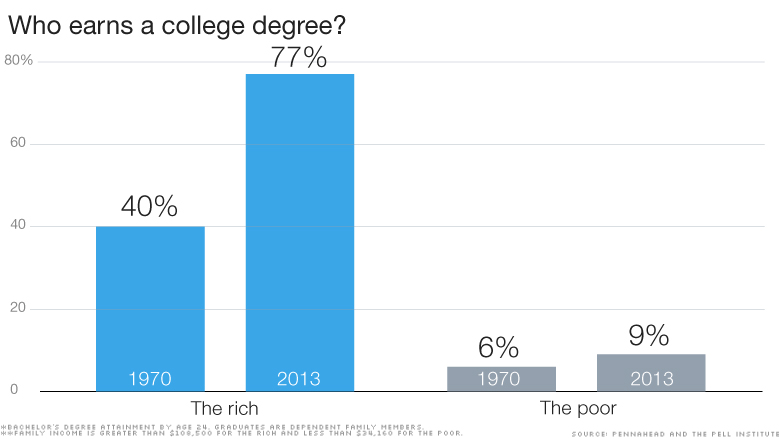
  • Less than 30% of students from the bottom quarter of income go to college; and less than half of them finish college. (source)
       The academic achievement of poor students has been a challenge that our nation has seen for decades.  Back in the time when earning a high school diploma was less necessary for acquiring a good job, our failure to adequately help poor students was less of an issue.  The penalty for not succeeding in school, while present, was not so severe.  Low-skilled jobs, manufacturing jobs, and service jobs were relatively plentiful and attaining a middle class life-style, while still somewhat difficult, was more possible.  

       Today, high school graduation (and the hard and soft skills that we want our students to gain in high school) is much more of a necessity than ever before.  Technology has lowered the number of low-skilled jobs and "Career and College Readiness" has become so much more than a slogan.


       The statistics are well known.  Student from families in which the parents have college degrees usually do well in school.  Students from families in which the parents didn't finish high school usually do poorly in school.  We are faced with the daunting challenge of overcoming this generational force that seems to keep pulling our most vulnerable students down.  Since "learning" is not something that can be forced on a person, our schools need to find a way to convince poor students (and their families) that schooling and education are important.  Knowledge is power.  Academics leads to more opportunities.  

       This is especially true as students move to middle and high school.  The subject content is more difficult; the reading level is higher; and the consequences of better achievement that are recorded and stored in student records are asked for from colleges and universities later on.  It's hard to do hard things--even for bright students.  The issue isn't the level of intelligence.  The issue is the level of motivation that encourages students to carry on even when the work gets harder.

       No one wants to fail.  Poor students are burdened with many hardships that come with a lack of money: less books at home; less technology at home; poor or no healthcare that leads to sick students getting sicker rather than getting better; less food and/or less healthy food.  We need to understand these challenges that are part of the daily experience of our poor students.

       This has been a problem in education for a long time.  There are pockets of success around the country, but we are far from declaring victory over this problem.  Of all the issues facing education, the issue of educating our poor students looms high above the rest in my opinion.  When this issue is properly addressed and we begin to see improved results, we can truly say that we have given our best to our students and to our society.


Tuesday, April 21, 2015

The Challenge of Educating Poor Students - Part 3

       American Public Schools face many and varied challenges.  Funding, equity, and public support to name a few.  On the top of this list of challenges, I would include: The Achievement of Poor Students.

       It is easy to understand the underpinnings of this problem, and yet it is extremely complex to succeed in overcoming this problem.  The problem stems from two indisputable facts:

  1. Poor students consistently demonstrate lower achievement than their non-poor peers.
  2. The proportion of poor students in our nation's public schools is over 50% and is growing.


       I will examine this challenge from three perspectives:

  1. Poor students who have succeeded in our schools
  2. Understanding the special and different needs of poor students 
  3. Expert advice on successfully educating poor students
--------------------------------------------------------------------------------------------------

The Challenge of Educating Poor Students - Part 2

Expert Advise on Successfully Educating Poor Students

       Despite the great difficulties that our public schools have had in turning the tide of student achievement among our poor students, we actually have a lot of knowledge about best practices and effective strategies for achieving this goal.  People like Paul Gorski, Eric Jensen, and others have done extensive research on this subject.

       However, a mere listing of effective strategies severely undermines the great difficulty that is faced by teachers to engage in these strategies on a daily basis.  As with any long-term problem, we need a long-term solution--and that requires effective and ongoing training.  We mustn't assume that this is somehow "common knowledge" for all teachers.  It isn't.

       The first step is recognizing that we have this problem.  Our accountability measures over the past 15 years (in the United States) has helped in this respect.  Where, in the past, the low achievement of our poor students was often "hidden" in the aggregate data of the "whole school"; since about 2003, our public schools have been required to report the achievement of poor students separately.  This practice has shone a light on the serious under-achievement of our poor students.  While I am not convinced that the general public is aware of this problem, it is fair to say that more people know about it today than was the case in the recent past.

       So until we develop a national strategy for increasing the achievement of poor students in America, here are strategies that every teacher can do:

  1. Good Relationships:  As with any students, when teachers and students get to know each other and enjoy a positive relationship with each other, achievement generally is pretty good.  For poor students it is important that they feel welcome in school and in each classroom.  Even if the student may have a negative attitude toward the subject of the class, he/she does not have to have a negative attitude toward the teacher of the class.  Get to know your students; ask them about their day; talk about things other than the subject matter before and after class time.  Students want to make their teachers proud.  Students will try harder to do their best if they know that their teachers cares about them as a person.

2.  Basic Materials: Paper, pencils, pens, rulers, textbooks, etc. should be available to all students all the time.  While we want students to be responsible to have these items with them at all times, it is not necessary to stop the flow of the classroom just to give a lecture about bringing a pencil to school everyday.  Most teachers have a system of allowing students to borrow pencils.  It's not a big deal.  But when a student is scolded for such minor things, it adds to their negative attitude toward school.

3.  High Expectations: We want all of our students to succeed and we want all of our students to do their best.  However, sometimes in our (well-meaning) efforts to achieve these goals, we set tiny, minor expectations for our students and then we guide them every step of the way and then we (unnecessarily) praise them for basically doing what they were told to do.  I think teachers do this because they either do not think that their students can achieve at high levels, or they don't know how to help them to get to those high levels.  This, indeed, is the hard part of teaching and (indeed) is the very root of our difficulty in raising the achievement of poor students.  Teachers need to identify those best practices--within their subject area or grade level--that is the most effective with poor students.  We have to raise expectations and allow students to struggle sometimes in their journey toward learning.  Merely doing the minimum is not going to help our poor students.


       The education of our nation's poor students can no longer be pushed aside as a difficult problem that effects a few.  It is now a major problem that effects a majority of our students.  And it has long-term ramifications for them and our society as a whole.  We must do better.

       We must do better.


Saturday, April 18, 2015

The Challenge of Educating Poor Students - Part 2

       American Public Schools face many and varied challenges.  Funding, equity, and public support to name a few.  On the top of this list of challenges, I would include: The Achievement of Poor Students.

       It is easy to understand the underpinnings of this problem, and yet it is extremely complex to succeed in overcoming this problem.  The problem stems from two indisputable facts:

  1. Poor students consistently demonstrate lower achievement than their non-poor peers.
  2. The proportion of poor students in our nation's public schools is over 50% and is growing.


       I will examine this challenge from three perspectives:

  1. Poor students who have succeeded in our schools
  2. Understanding the special and different needs of poor students 
  3. Expert advice on successfully educating poor students
--------------------------------------------------------------------------------------------------

The Challenge of Educating Poor Students - Part 2

Understanding the Special and Different Needs of Poor Students


       People who grow up in a middle class (or higher) home environment may take for granted simple life experiences that poor students and their families never experience.  Well-meaning teachers may have never experienced living in a poor environment and working with poor people until their first year in the classroom.  Particularly since school teachers must have a college degree and it is rare for poor people to earn a college degree, teachers are generally from a middle class (or higher) background.  

       Here is a short list of challenges for most poor students:

1) Regular, quality medical care
       
       Middle class families generally have a regular doctor for their children.  When children are sick, they go to the doctor and they get better in a couple of days.  When poor students get sick, they don't have access to a doctor or to medicine; this makes them sicker.  When they are too sick to come to school, they generally miss more school days because it takes them longer to get better.  And if they come to school when they are sick, it is harder for them to concentrate on their school work.       

      A lack of medical care leads to other issues that are more prevalent among the poor such as untreated ear infections and hearing loss issues, greater exposure to lead, and a higher incidence of asthma (source).  All of these health issue contribute to higher absenteeism and lower engagement with class lessons at school.

2) Small vocabulary when they start school

       Students from poor households hear and use considerably less words than students from middle class households.  This puts poor students at an academic disadvantage from their first day of kindergarten.  Students who are less able to use words to express their feelings and to explain their thinking because frustrated and soon shy away from activities that involve reading because they don't want to appear less able than their peers.


      Opportunities to increase each students' personal vocabulary must be of primary importance for poor students.  We know from multiple studies that students who are not reading on grade level (or above) by third grade have a reduced chance of graduating from high school. (source)  This is a significant risk factor for poor students.  In 2013, the overall national high school graduation rate was 81.4%  but the rate for poor students was only 73.3%.

3) Fixed vs. Growth Mindset

       Stanford psychologist, Carol Dweck, and her book Mindset has taken the education world by storm over the past few years.  And so it should.  She has proved that students who believe that they are not smart will refuse to try to succeed.  This is the belief of the "Fixed" mindset; the one that says, "I have a fixed capacity for learning and no matter how hard I try I won't get any smarter."  In fact, nobody has a brain that isn't capable of learning more.

       But poor students are more likely to believe in the Fixed Mindset because they are less likely to see the many opportunities that will be offered to them in the future beyond high school and college graduation.  Poor students need to be praised for their effort and teachers need to point out when their thinking has led to a great solution to a problem.  Students with Fixed Mindsets believe that they just got lucky whenever they get a good test grade.  They need to understand that it is their effort and their learning that led to that good test grade.


       Teachers at every level (elementary, middle, and high school) can help poor students to succeed.  But we have to understand the deficiencies that they bring to school and we cannot label every lack of effort as "laziness".  Some poor students do succeed; they are the lucky ones.  They probably had great teachers and caring parents or caring authority figures at home.  Overcoming these deficiencies is a very difficult job for our public schools; but understanding the problem is certainly the first step.

       All teachers should receive some training in the education of poor students.


Wednesday, April 15, 2015

The Challenge of Educating Poor Students - Part 1

       American Public Schools face many and varied challenges.  Funding, equity, and public support to name a few.  On the top of this list of challenges, I would include: The Achievement of Poor Students.

       It is easy to understand the underpinnings of this problem, and yet it is extremely complex to succeed in overcoming this problem.  The problem stems from two indisputable facts:

  1. Poor students consistently demonstrate lower achievement than their non-poor peers.
  2. The proportion of poor students in our nation's public schools is over 50% and is growing.


       I will examine this challenge from three perspectives:

  1. Poor students who have succeeded in our schools
  2. Understanding the special and different needs of poor students 
  3. Expert advice on successfully educating poor students
--------------------------------------------------------------------------------------------------

The Challenge of Educating Poor Students - Part 1

Poor students who have succeeded in our schools

       Every public school can point to a student who comes from a poor family and (yet) defies the odds and does well in school academically.   Or...Can they?  Unless you know the student's background, it might be hard to find these students in your school.

       The outward signs of poverty are relatively easy to see:  dirty clothes or the same clothes day after day; same, single pair of shoes everyday; no extra school supplies.  And then there is the attitude--opposition behavior, attention disorders, excessive absenteeism.  Taken alone, these are not necessarily signs of students from poor homes, but taken together there can be assumptions of the student's home lives based on these visible factors.

       Unfortunately, it is so common for poor students to have low academic achievement that when we have a poor student who succeeds in the academics of school we (often) don't see that child as being from a poor background.  So what is it that propels a poor student to achieve where his/her peers don't?  And what can we learn from poor students that succeed that can help us to raise the achievement of other poor students?

Vocabulary Acquisition


       According to a study from 1995, from the age of 7 months to the age of 3 years, 90% of the words used by children were words used by the children's parent (or primary caregivers).  Parents with higher educations used more words than parents with less education AND higher educated parents talked to their babies and toddlers more than less educated parents.  This creates an "Achievement Gap" among very young children before they even begin Pre-kindergarten.

       But poor students who succeed in school often come to school with a good vocabulary because they were blessed with parents and/or caregivers that shared with them the (totally free) gift of words when they were very young.  Babies and toddlers can learn words from parents reading books to them; but they also learn from simple talking and singing.  So families that cannot provide a lot of children's books to their children can still provide the precious gift of words by simply talking to their children every day.

Grit

       The story of Karvel Anderson is the best definition of grit that you will ever find.  Karvel's story is one of a child who grew up with many challenges but never anything that made him give up on life.  He says that adversity was good for him because he always wanted to prove that he can do anything.

       Most students from poor backgrounds succumb to the narrative that they will never succeed because it seems like the world is against them.  Every where they turn, some one is taking away an opportunity or refusing them something.  Grit is a personality trait in which a person strives to achieve goals regardless of the obstacles that may stand in the way.

A Supportive Adult

       Poor student who succeed usually have an adult in their life that is there to encourage them when times are tough.  It might be a parent, but it also might be a teacher, a grandmother, a school counselor, or a coach.  While some students seems to have the ability to overcome just about any situation, most poor students need someone to guide and help them through the toughest times.


       As schools and teachers look to increase the achievement of poor students, I believe that we have to understand that the world they live in can seem very different than our world.  We need to understand how their lack of resources and supports is a great hindrance to their academic success.  And we have to find a way to fill in the supports that they are lacking so that we can help them to value education and to be successful in school.


Monday, April 13, 2015

I Shouldn't Be Here - Again

In preparation for my three-part series on the urgent need to improve the achievement of poor students in America's public schools, I am re-printing a blog post that I wrote in January 2014.

---------------------------------------------------------------------------

I Shouldn't Be Here

     I am enjoying my 26th year working in education this year.  In that time I've been a middle and high school mathematics teacher, a high school mathematics chairperson and a district teacher specialist.  I've worked in the research and accountability office and I am now a supervisor of secondary mathematics--overseeing the mathematics program for 20,000+ students in my school district.  Still, had things worked out the way they were "supposed" to, I should have never done any of this.

     You see, I grew up in a lower-middle income family--which is an overtly nice and formal way to put it.  I have a brother and two sisters.  I was among the first generation to benefit from the Free and Reduced Meals program; a benefit I received from elementary to high school.

       When I was in 10th grade in 1980 the National Center for Educational Statistics (NCES) did a national survey of students from my class.  They followed up with us ten years later and this is what they found:  Only about 5% of the students in my economic family situation graduated from college.  (Good news: NCES did the same study with the 10th graders from 2002 and found that 14.5% of the low-income students from that class ended up with a college degree by 2012.  That's better than 5%, but still much too low.)

     So, had I followed the path that most of my peers did, I should have never went to college; and I certainly should have never graduated from college.  Which means, no teaching job, no promotions, and certainly no Master's degree later on.  Hence, I shouldn't be here.

     The reasons I AM here are many.  One of the biggest is simply public education.  My K-12 teachers never told me I couldn't go to college; they never told me I couldn't do whatever I wanted to do.

       I also had the good fortune of two wonderful parents who struggled to raise four children and to make ends meet while generally keeping a positive attitude.  I often say that "If we were poor, I never knew it."  Still, the ability of my parents to pay a greatly reduced price for lunch for four children was an incredible benefit to my family.  Who knows how much less my parents would have been forced to provide for us had this not been an option?

       And so, with help from my teachers in our (free) public school, and encouragement from home, I was able to attend college, graduate from college, and enjoy the occupational benefits of a college education--as is the case of my three siblings as well.

       Still, I always felt like I was one of the (extremely few) lucky ones.

Wednesday, April 8, 2015

Poverty Should Not be a Barrier to Education


       The Statue of Liberty quote (written by Emma Lazarus) says it well:

Give me your tired, your poor, 
Your huddled masses yearning to breathe free, 
The wretched refuse of your teeming shore. 
Send these, the homeless, tempest-tossed, to me: 
I lift my lamp beside the golden door.

       At the turn of the 20th century, the golden door was the gateway to America for many people from Europe and other far-off lands.  Today, (I contend) this golden door is our nation's public schools.  We accept all students and we teach all students.  But when we look at the achievement of our students, we see two distinct groups:  poor students (who now make up a majority of our public school students) and non-poor students.

       I just read a great article in the April 2015 issue of District Administration (by Tim Goral) that talks about confronting the crisis of educating low-income students in our public schools.  I'm calling it a "crisis" because of the following two facts:

  1. Low-income students make up half of the population of public school students in the United States.
  2. Low-income students struggle to maintain acceptable academic results.
These two facts are largely undisputed among educators and education researchers.  Taken together they express the most major issue facing our public schools today and (perhaps) our society in the future.  While our students from middle and upper-income families tend to show good achievement throughout their  P-12 schooling experience, the growing numbers of students from poor families continue to demonstrate bleak achievement results.  This is evident on the NAEP results as well as just about any state-level results (and local results).

       I believe that this is the "Sputnik" event of our time.  However, I fear that while this is a well-known problem among educators, it is not a well-know problem for people outside of education--particularly middle and upper-income people outside of education.  We need change on a national level; a national effort.  We need advocates throughout the country to make the general public aware of this problem.


       I believe that our nation's schools have the people and the tools to turn around this "rising tide of mediocrity that threatens our very future as a nation and a people."  (quoted from A Nation at Risk)  This is a difficult and complicated problem that we must solve.

       And I am certain that we will solve this problem.


Thursday, November 13, 2014

We Must Do Better - Part 2

       This post is part two of a three-part series titled We Must Do Better.

       I love public schools; and there is a lot to cheer about when it comes to the ability of public schools to prepare students for their futures.  But there are three major areas in which public schools must improve if we want to see ourselves as providing a world-class education to our nation's children.

       1) We must raise the achievement of poor children.

       2) We must increase graduation rates.

       3) We must provide continuous, high-quality professional development to our teachers.

       It isn't that there aren't other areas that can and should improve in our public schools.  But improvement in these three areas are absolutely critical if we truly want our school system to be exceptional and of the highest quality for all of our students.

----------------------------------------------------------------------------------------------------------------

We Must Do Better

Part 2 - Increasing Graduation Rates

       Part 1 of this series was about the need to increase achievement among poor students.  I am going to begin this part by looking at the differences in high school graduation rates between poor students and non-poor students.  Take a look at this graphic from the organization America's Promise Alliance:


       This graphic shows that (in 2012) low-income students had a graduation rate below 80 percent in 41 states while non-low income students had a graduation rate below 80 percent in only 7 states.  As a nation, our graduation rate in 2012 was 81 percent.  (source: National Center for Education Statistics - The Condition of Education)  

       Our national graduation rate has been rising since the 1995 - 1996 school year when it was 71%. We are moving in the right direction as a nation, but we still have a long way to go.  Allowing 1 of every 5 students to leave school without a diploma has real and serious consequences.  These include:
  • Higher unemployment rates
  • Lower pay compared to people with high school diplomas
  • Greater need for public assistance
  • Greater chance of incarceration
  • Less effective parenting skills
(sources: here and here and here)

       Public schools clearly have many responsibilities.  We must do everything we possibly can to get more students to graduate from high school--especially poor students.  In decades past, completing high school was arguably less important than it is today.  However, in today's world and in the world that our students will inherit, people without a high school diploma have a greatly enhanced risk of lifelong struggles to avoid poverty and to experience a middle-class lifestyle.

     As a graduate student, I questioned the difference between students who dropout of high school and students who graduate in the bottom 10% of their class.  I hypothesized that such students who barely graduate were no better off than students who didn't graduate.  Using data from the National Center for Education Statistics, I discovered that weak high school graduates were still better off than high school dropouts.  That's right; even students who struggle to pass all of their courses in high school and eventually graduate are better off than people who never earn a high school diploma.  Why?  I think it is because there is something within these weak students that says, "This (schoolwork) is hard, and everyday I come to school I know that I am going to struggle.  But I am going to continue to come and to work and to finish high school."  I believe that students who (perhaps) hate school and always struggle academically AND still graduate have had a life experience that they carry with them in their futures struggles.

       This message of the importance of graduating from high school is logical and sensible to everyone working in education and probably to just about everyone outside of education.  But despite our best efforts, this message is not getting through to 19% of our youth.  And it is hitting particular groups of students worse than others.  Once again, according to the National Center for Education Statistics (see top of page 13):

Group                  Graduation Rate (2012)
Amer. Indian/
Alaskan Native                68%

Hispanic                           76%

Black                                68%

Poor students              well below the national average (see America's Promise)

     These focus areas will help to improve graduation rates among our most vulnerable groups of students:

  1. Adress chronic absenteeism
  2. Improve middle schools
  3. Re-engage youth who have left school
  4. Provide more and better adult and peer supports
       We must do better at raising the high school graduation rates of our students.  It is important to our nation; it is important to every young man and woman in our high schools.


Monday, November 10, 2014

We Must Do Better - Part 1

       This post starts a three-part series titled We Must Do Better.  I love public schools; and there is a lot to cheer about when it comes to the ability of public schools to prepare students for their futures.  But there are three major areas in which public schools must improve if we want to see ourselves as providing a world-class education to our nation's children.

       1) We must raise the achievement of poor children.

       2) We must increase graduation rates.

       3) We must provide continuous, high-quality professional development to our teachers.

       It isn't that there aren't other areas that can and should improve in our public schools.  But improvement in these three areas are absolutely critical if we truly want our school system to be exceptional and of the highest quality for all of our students.

--------------------------------------------------------------------------------------------------------------------------

We Must Do Better

Part 1 - Achievement of Poor Children

       It's easy to find data and information on the topic of Low Achievement Among Poor Students.  (see JensenHoneydosomething.org)  Few professional educators and very few education researchers disagree about the effects of poverty on a child's education.  And children living in poverty in the U.S. will soon become the majority of our public school students.

       The list of obstacles for children living in poverty is long and difficult to overcome.  (Which is why school system continue to struggle to solve this problem.)  Here's the short list:
  • higher absenteeism
    • when poor kids get sick, they tend not to go to the doctor; then they get sicker and it takes longer for them to get well
  • higher dropout rates
    • poor kids need to work to make money for the family
    • poor kids see school as "not for them"
  • academically behind from the start
    • poor kids tend to have parents that didn't go to college or didn't finish high school
    • poor kids have less books in their home and parents read to them less than their non-poor peers
    • poor kids also tend to actually hear less words prior to entering school which adds to their academic shortcomings
  • less than 30% of students in the bottom quarter of incomes enroll in college and less than 50% of them graduate.
(source for all of these bullet points is here)

       In the past decade, public schools have shone a light on the academic achievement of poor students--which is a good start.  We cannot address a problem unless we recognize it as a problem.  But the next step--improving the achievement of poor students--is still a struggle for most schools and school systems.

       The Educational Testing Service (ETS) Center for Research on Human Capital and Education put out a report in July 2013 that laid out seven strategies that education policymakers can address that would have an effect on the problem of increasing achievement among poor children.  There strategies are:

  1. Increasing awareness of the incidence of poverty and its consequences 
  2. Equitably and adequately funding our schools
  3. Broadening access to high-quality preschool education
  4. Reducing segregation and isolation
  5. Adopting effective school practices
  6. Recognizing the importance of a high-quality teacher workforce
  7. Improving the measurement of poverty

       These strategies require a national response. This is something that can happen in America.  I know this because it has happened before.  Civil Rights for African Americans; Women's Right to Vote; Reduction of the Prevalence of Smokers; wearing seat belts.  All of these things were (at one time in America) considered impossible dreams.  Yet a national effort that lasted decades led to each of them becoming a reality.

       We can do the same thing with the education of children living in poverty.  We can and we must.  We have a moral responsibility to help our most vulnerable citizens.  We must do better than we are doing now.  For us as a country; and for every individual citizen.  We can begin to see the reduction of this problem in our lifetime; and the elimination of this problem in our children's lifetimes.  

       This is a huge problem that can be fixed.

       We must do better.


Public Schools and Choice

       Is it true that public school kids and their public school parents don't have choices?  I'm sure that I will expose my igno...

Teach100 blog