Showing posts with label middle school. Show all posts

Saturday, March 4, 2017

Three Simple Steps to School Success

       Every parent wants their child to do well in school.  When kids are in elementary school, parental influence and assistance is usually plentiful.  Parents generally understand the content well enough to help their children during homework time.  And elementary children are more likely to do as they're told to do, and to respect the authority of adults in the school.  They generally want to please their parents and their teachers.  When elementary students struggle academically, public schools provide lots of help and assistance in a caring and nurturing way.

       As children move on to middle school and then to high school some of those attributes that helped students to be successful in elementary school tend to lessen.  The school work is more rigorous, children are more concerned with pleasing their friends, and parents who may feel that their children should be more responsible for their school work may take a step back when it comes to reminding them of due dates.  Also, parents may find that they can no longer help their children with homework due to the level of the content.

       Still, all students can do well in school and here are five simple steps that can help:

1.  Do your best


       I know this sounds trite and cliche, but I'm going to define "doing your best" in a way that may sound different from what most would think.  It doesn't mean getting an "A" or even necessarily striving for an "A" all of the time.  In fact, "doing your best" has little to do with the way your child's school assesses students.  Instead, it has everything to do with your child looking into the mirror at the end of the unit or a marking period or the school year and being able to say that he/she did everything they could to be successful.  Sometimes students really, honestly don't have time to everything that are asked to do.  Sometimes they ask for help and stay up late to study and take on the responsibility for their learning and end up with a "C".  That's OK.  But if the child feels that he/she didn't do their best, then this is the time for self-reflection about what can be done differently the next time.  Everyone (including adults) fall short of doing their best sometimes.  Striving to do better is part of what we want students to learn in school.

2.   Adult support outside of school

       Middle and high school students are not too old to need support from a caring adult outside of the school building.  Students today have lots of distractions and when given the choice between school work and social media it can be hard to plan time for both unless someone is there to help.  In 2006 there was a study of high school dropouts.  Many high school dropouts in this study said that they would have tried harder if someone insisted that they try harder.

"Nearly 7 in 10 respondents (69 percent) said they were not motivated or inspired to work hard, 80 percent did one hour or less of homework each day in high school, two-thirds would have worked harder if more was demanded of them (higher academic standards and more studying and homework), ..."

3.  Get involved

       Students that are involved clubs and sports and other school activities discover that "school" is more than a place with teachers and homework.  Involvement in activities helps students to connect with other students who have similar interests and these connections can be positive in and out of the classroom.


       School success should not be all about grades.  We want students to graduate with lots of skills that can be hard to measure with the standard "grade".  These include:  communication skills, computer and technological literary, adaptability, research skills, problem solving skills, strong work ethic, and conflict resolution skills--to name a few.

       Our public schools along with home support help our students to succeed.


Wednesday, January 4, 2017

Three Cheers for Middle School!


       When I interview future mathematics teachers, some embarrassingly say to me, "I actually prefer to teach at the middle school level."  Then they go on to say that their parents and friends think that they are crazy to be a middle school teacher.  This is because so many people have this image of middle-school-aged children as being wild and out of control all of the time.  I hear this so often; sometimes in silly way and sometimes in a very serious way.  As a longtime educator I can tell you that this image is untrue and unfair to young teenagers.

       Middle school is great!  The excitement and energy of the students is part of the reason that middle schools are so great.  Our best middle school teachers understand how to use that energy to engage students and to foster learning.  When middle school students are respected and appropriately challenged academically, they rise to the occasion and show their best everyday.  Middle schools are the places where you have classes with tall girls and short boys; shy kids and talkative kids.  Middle school students are fun and interesting to get to know.  They are excited to leave their elementary school and they are anxious to go to high school.

       We want and we need teachers who understand the middle school child; understand how they think and how they learn.  Teachers who are excited to teach everyday and to help their students to discover their ability to solve problems and to ask difficult questions.  We need teachers to encourage our middle school students to read and to understand more difficult text; including non-fiction text.  Middle school is often the place in which students first encounter difficulty with their academics, so we need teachers who are excited to help these students to preserve through these difficult times and to find ways to succeed.

       I know many middle school teachers who love their job.  These teachers understand the "line" between allowing students to express themselves while keeping the class of students in control.  Middle school students understand the need for structure and appreciate teachers who insist on this structure.  Middle school can be the best years of a student's school career when they have great teachers and leaders who care about them.

       Middle school is a great place to be.  Everyone should appreciate the excitement and energy of our nation's middle schools.


Wednesday, September 21, 2016

My Favorite Teacher

       My favorite teacher wasn't supposed to be my favorite teacher.

       I heard he was tough.  I heard he makes you write a lot.  I heard there was a lot of reading in his class.  One person said he was mean.

       He was my 7th grade English teacher.  I was 12 years old.  When I got my class schedule for the year, I started to ask friends if they knew any of my teachers.  The comments about this teacher (it seemed) were all bad.  Of course, at 12 years old, when I said things such as, "Everyone says he's a mean teacher.", what I really meant was, "The extremely small number of 13 year old boys (3) that I spoke with about this said he was mean."

       But they were my friends and I believed them, so when the first day of school came I was worried about this teacher and this class.  His class was third period and up to that point in the day, everything had gone pretty well.  I entered his class with a more than a little concern.

       He let us sit anywhere we wanted to sit.  He gave each of us a number and then told us to sit at the desk that had that number.  So all of us got up out of our seats (after just two minutes in the class) and moved to a different seat.  After that, he had each of us "meet" the two people who were sitting next to us.  Then we went around the room and each student said something about one of the students sitting next to us.  Then he told us about himself.  But instead of saying how many years he was a teacher and how much he loved English (which is the sort of introduction that most teachers give) he told us that he had three sisters, he weighed 265 pounds, and he liked to go bow hunting for deer.

       I actually remember more about that first class, but the point is his class was all about relationships.  He wanted to get to know us and he wanted us to get to know each other.  Everyday as students walked into his class he would ask us specific questions about things we were interested in and some students would ask him about things that he was interested in.  Our class involved a lot of discussions and he always linked these discussions to something the someone (or many of us) were interested in.  He never made a big deal about grades.  He never put anyone down for getting a bad grade or even for failing to complete an assignment on time.  If students earned a "D" or an "F" (and some did) he didn't get mad at them.  In fact, one student in particular who failed his class seemed to have a great relationship with him.


       We did do a lot of writing and we did do a lot of reading.  It was an ENGLISH class [!].  That's what you do in an English class.  My friends' opinions of what determined "a lot" probably meant that they didn't want to do any writing and reading.  Another thing that he often did was to not accept the first answer or idea that a student put forth.  He wanted many ideas; or he wanted us to be able to expand on our ideas.  The goal in his class was learning.  It wasn't "answering questions".  We didn't earn "points" for cleaning the chalkboard or for not using all of our bathroom passes.  We only earned grades for good writing and good thinking (participation).  This was probably the part my friends referred to as "being mean", since they were generally pretty good at "earning" good grades while learning very little.  Those techniques probably didn't work in his class.

       I didn't refer to this person as "My favorite teacher" until years later--after high school.  And the reason he was my favorite was because he didn't belittle us.  He pushed us to do our best.  Some were more ready for that "push" than others, but all of us knew that we couldn't just slide by and earn a high grade in his class without producing something of quality.

       My favorite teacher wasn't a popular teacher; he wasn't a coach of a sports team; he made us laugh from time to time, but he wasn't known as a "fun" teacher.  He probably didn't care about being liked.  He was firm and fair.  He spoke to his students in pretty much the same way he spoke to our parents.  He knew what he was doing and he had a reason for everything he asked us to do.

Sunday, August 14, 2016

Parent's Role in Improving Student Achievement

       If you have a child in elementary, middle, or high school, then your main concern is helping your child to do well in school.  You have a person or persons in your household that is a member of the most important cliental in the educational community--the students.  And as a parent, you have influence over your children.  Your attitudes and actions toward school matter.

       We need your help!

       So here is my short list of the three top things that parents can do to help their children to do well in school.


  1. Healthy relationships all around.  
Help your child to make friends with classmates and to get to know the teacher or teachers.  You (the parent) should try to get to know your child's teacher(s) too.  Communication is the key to all healthy relationships.  So try to discover the best way to contact the teacher.  Make sure that your child knows that you have a relationship with the teacher and a way to make contact on an as-needed basis.  This shows that you care about your child's education.  

   2.  Emphasize "learning" over "getting-a-good-grade".

The point of school is learning, not getting a good grade.  There are lots of ways to get good grades without learning much.  We want students to learn how to learn; to read; to study; to try and fail and try again; and ask for help.  Your child's grade should reflect his or her ability; but sometimes it just reflects his or her ability to do what they're told.  Remember that the goal of school is learning.  It's the "Do you best." philosophy (that your parents probably said to you).

    3. Don't help your children too much.

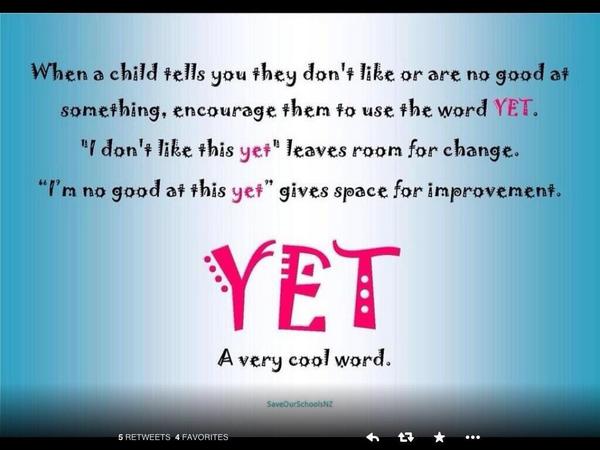
Let's face it...nobody likes to see their children struggling.  But if everything is easy and can be obtained without effort then you have to ask, "Is my child really learning anything?"  Real learning comes from a little struggle from time to time.  Just because your child doesn't "get it" the first time doesn't mean they will never get it.  They just haven't gotten it yet.  If you tell them the answer or do the work for them, they will get the right answer, but they haven't learned anything.  Remember, the goal of school is learning.  Instead of telling them the answer, ask questions.  "What do you know?"  "What don't you know?"  "What do you need to know?"  "What questions should you ask the teacher?"  We want students to learn how to deal with struggle; we want them to problem solve when the problem is difficult.

       School means a lot of things to a lot of people.  Clubs, sports, friends, activities, requirements, homework, pens, paper, teachers,....  It can be hard to remember that it is all about learning.  As the parent, you can help your child to focus on the important parts of school.

       Have a great school year!

Thursday, May 15, 2014

The Middle School Principal Everyone Wants to Have

  The following was written by my daughter's middle school principal in the school's newsletter:

       I’m not sure when it happened exactly, but recently I realized I’ve reached a point in
my life when I find myself looking backward as often as I find myself looking ahead. When
you’re young, life is all about making plans and dreaming of the future, but the past is starting
to comprise a bigger and bigger chunk of the years I’ve been allotted. One of the benefits of
getting older, is the years tend to give one perspective. Recently, I found a tidbit attributed to
an “Author Unknown” that makes the point:

       Someone asked me the other day, if I had my life to live over, would I change anything?
“No,” I answered, but then I began to think . . .

       If I had my life to live over, I would have talked less and listened more. I would have taken the time to listen to my grandfather ramble about his youth. I would have never insisted that the car windows be rolled up on a summer’s day because I didn’t want to mess up my hair. I would have sat on the lawn with my children and not worried about
grass stains.

       I would have gone to bed when sick instead of pretending the earth would go into a holding pattern if I weren’t there for a day. Instead of wishing away my nine months of pregnancy, I’d have cherished every moment and realized that the wonderment growing
inside me was my only chance in life to assist God in a miracle. When my child kissed me impetuously, I would never had said, “Later – now go get washed up for dinner.” There would have been more “I love you”. . . more “I’m sorry”. . . but mostly, given another shot at life, I would seize every minute. . . to look at life and really see it. . . to live it. . . and never give it back.

       Look, I’m not a philosopher, and believe me, there’s a lot I don’t know, but the older I get, the
more I realize just how important our children are – both yours and mine. Most of the parents of East Middle’s students are now quite a bit younger than me, and my advice to you is to cherish your children while they’re young. Plan for the future, but take time to live in the now.

       And as far as their education goes, we’re in this together. We all have a responsibility to ensure every child gets what he or she needs to be successful in life, and that’s a responsibility I and everyone else here at East Middle School takes very seriously. Sometimes it’s hard to find the right balance between being supportive and being enabling. There’s a fine line between the two, and the truth is, that line needs to be drawn at different places for every
student - sometimes in different places on different days for the same student. Knowing how best to help a student is a complicated thing. Each has his or her own personality and unique life story. Home lives are different; learning styles vary; sometimes kids have great support structures; sometime they have none. On any given day, there are students going through a life crisis – some very real; some perceived – and on the best of days, middle school is a confusing time for students, who often are simply trying to figure out who they are and what they’re all about.

       Sometimes the right thing to do is to push them harder and to hold them strictly accountable for their poor choices. Other times, the right thing to do is to push them a little less and to cut them a break.

       As educators, we don’t always have all the right answers, but I can tell you, we are far more likely to make the correct decisions when we have the support of a child’s parents, and I am constantly amazed at the level of support we receive from our parents. I hope you all know how much you kids mean to us. We may not
always make the right decisions, but it’s not because we don’t care, and the debates we sometimes have are simply a matter of trying to figure out what the right thing to do is given the current set of circumstances. These are never easy decisions, and all we can do is our very best for each child. That’s true for educators as well as parents. 
 
       So, I guess to bring this letter full circle, as my life progresses and I look more and more back over the years, it becomes increasingly important to me that I make a difference in the lives of all my students, and I try awfully hard to enjoy every minute I spend with them. I want to “seize every minute. . . to look at life and really see it. . .to live it. . . and never give it back.” 
 
       Thanks for sharing your children with us! 
 
       Here’s to a fabulous finish to another school year!! 

Public Schools and Choice

       Is it true that public school kids and their public school parents don't have choices?  I'm sure that I will expose my igno...

Teach100 blog