Showing posts with label high school. Show all posts

Monday, April 3, 2017

We Protect Our Students - but we can do better


       I just finished watching the Netflix show titled 13 Reasons Why.  It is about a high school girl that commits suicide and her life in high school during the two years prior to killing herself.  It made me think of all of the efforts and policies and hours spent on keeping students safe in our schools.  We practice fire drills and code-red drills; we encourage students to talk with an adult when they see something or hear something dangerous; and we all make an effort to have good, healthy relationships with as many students as we can.

       Still, despite these efforts we are constantly faced with the reality of high school students riding into their first attempts of adult life without training wheels.  Adults can be warm and friendly and approachable, but they are still adults.  It is too easy for teenagers to view the adults in their life as completely unable to understand the issues that they face.  We can do better.

       In 2014, 1668 teenagers (13 to 18 years old) killed themselves--about 7 out of every 100,000.  We can do better.  Recognizing the warning signs for committing suicide can help to prevent a person from going through with it.  Friends matters; words matters.  One person's suicide effects many people around them.  And it can always be prevented when we work together to identify potential victims and take action.

       School is a great place for most of our students.  Friends, sports, clubs, etc.  It can be a place of solace for students who come from a difficult home life.  But it can also be a terrible place of name-calling, and social-media-humiliation, and bullying.  We want everyone to feel welcome and safe in our schools.  Most students and parents would agree that our schools are safe places.  But we can do better.

       We have to work together; we have to be a society that looks out for each other.  See something, say something.  In the same way that police need the assistance of the public to solve crimes, schools need the eyes and ears of every student.  We want to help; we want you to feel welcome and wanted and special.  We want everyone to feel that their school is a place where they belong.

       Help us.  Do your part.  We can do better.


Sunday, March 5, 2017

How much Parental Involvement is 'Just Right'?

       Parents are an important part of the educational process.  But some parental involvement is too little and some is too much.  What is the "sweet spot" of parental involvement; What would you consider to be (as Goldilocks would say) "just right" when it comes to parental involvement?

       No one would dispute the value of a strong connection between the home and the school when it comes to better outcomes for education.  We (educators) want parents to be involved.  We want parents to celebrate with us the academic successes of their children, and we want parents to support and to assist us when struggles and obstacles occur along the way.  As teachers, what do you consider to the right amount of parental support?  Is it possible to have too much involvement from the home? What do you consider to be too little support?  As a parent, how do you approach your involvement in your child's education?  Do you leave it all to the schools and the teachers?  Do you check on homework and that's it?  Are you comfortable talking to your child's teacher?

       How much parental involvement falls into the "Just Right" category?  This question may have a different answer for elementary teachers than for high school teachers.  Parents with more education may feel different than parents with less education.  Parents of younger children may answer this question differently than parents of older children.

       As a high school teacher, whenever we had parent-teacher conferences, the parents of students with high grades often came and the parents of students with low grades usually didn't come.  I also saw many parents who (themselves) had a college education and few parents who never went to college.  As a school we would often discuss the issue of finding ways to involve parents and finding ways to invite parents to different school events.  Whenever I reached out to a parent (due to both positive and negative events that occurred with their child in my classroom), I always found a parent who was willing to help and who was appreciative of the contact.

       On the other hand, I've also experienced parents who wanted weekly updates (phone calls or emails); parents who would constantly contact me and other teachers about the smallest issues that occurred in the school relative to their child.  Sometimes these folks were very anti-public-school and they were anxious to share their alternate opinion about what was happening and what (instead) should be the job of the schools.  But most of the time these parents were supportive of the school and certainly supportive of their child--but I worried that the child (in high school) was not given the opportunity to make even the smallest decision on his own about his education.  Still, I felt that more parental involvement was better than no parental involvement and it wasn't my place as a teacher to tell a parent how to help their child.


       What does your school do to encourage more parental involvement?  What can a school do to encourage overly involved parents to allow their children to take more ownership of their education? How much parental involvement is 'just right'?  Is too much involvement a nice problem to have?  

Saturday, March 4, 2017

Three Simple Steps to School Success

       Every parent wants their child to do well in school.  When kids are in elementary school, parental influence and assistance is usually plentiful.  Parents generally understand the content well enough to help their children during homework time.  And elementary children are more likely to do as they're told to do, and to respect the authority of adults in the school.  They generally want to please their parents and their teachers.  When elementary students struggle academically, public schools provide lots of help and assistance in a caring and nurturing way.

       As children move on to middle school and then to high school some of those attributes that helped students to be successful in elementary school tend to lessen.  The school work is more rigorous, children are more concerned with pleasing their friends, and parents who may feel that their children should be more responsible for their school work may take a step back when it comes to reminding them of due dates.  Also, parents may find that they can no longer help their children with homework due to the level of the content.

       Still, all students can do well in school and here are five simple steps that can help:

1.  Do your best


       I know this sounds trite and cliche, but I'm going to define "doing your best" in a way that may sound different from what most would think.  It doesn't mean getting an "A" or even necessarily striving for an "A" all of the time.  In fact, "doing your best" has little to do with the way your child's school assesses students.  Instead, it has everything to do with your child looking into the mirror at the end of the unit or a marking period or the school year and being able to say that he/she did everything they could to be successful.  Sometimes students really, honestly don't have time to everything that are asked to do.  Sometimes they ask for help and stay up late to study and take on the responsibility for their learning and end up with a "C".  That's OK.  But if the child feels that he/she didn't do their best, then this is the time for self-reflection about what can be done differently the next time.  Everyone (including adults) fall short of doing their best sometimes.  Striving to do better is part of what we want students to learn in school.

2.   Adult support outside of school

       Middle and high school students are not too old to need support from a caring adult outside of the school building.  Students today have lots of distractions and when given the choice between school work and social media it can be hard to plan time for both unless someone is there to help.  In 2006 there was a study of high school dropouts.  Many high school dropouts in this study said that they would have tried harder if someone insisted that they try harder.

"Nearly 7 in 10 respondents (69 percent) said they were not motivated or inspired to work hard, 80 percent did one hour or less of homework each day in high school, two-thirds would have worked harder if more was demanded of them (higher academic standards and more studying and homework), ..."

3.  Get involved

       Students that are involved clubs and sports and other school activities discover that "school" is more than a place with teachers and homework.  Involvement in activities helps students to connect with other students who have similar interests and these connections can be positive in and out of the classroom.


       School success should not be all about grades.  We want students to graduate with lots of skills that can be hard to measure with the standard "grade".  These include:  communication skills, computer and technological literary, adaptability, research skills, problem solving skills, strong work ethic, and conflict resolution skills--to name a few.

       Our public schools along with home support help our students to succeed.


Tuesday, December 27, 2016

College Not For All

       I'm going to start by saying that I went to college, my wife went to college, my siblings went to college, I want my children to go to college, and everyone I work with went to college.  I'm a big fan of "going to college".  College provides specialized knowledge in a specific field of study; often by people who are experts in that field.  There is a benefit to going to college, but since this post is about "not going to college", I'll just say that the benefits of college are well documented.


       So why am I (a lifelong educator) writing about not going to college?  Because public school desire to teach ALL students.  All students are welcome in our public schools.  We take all students.  We don't have some sort of litmus test that permits some students to enter our public schools and denies others t enter; we take everyone.  And in doing so, we have an obligation to teach all students.  This means that we teach the students who are college-bound as well as those that are not.  This leads to the dilemma of all public schools: Are we preparing students for college?  Are we preparing them for the world of work?  Or, Are we doing both?  (And if the answer is the latter, then How do we do that?)

       We know that all students won't go to college.  (source)  We also know that some will go to college and won't finish college. (sourceHere is a slideshow of 25 jobs that don't require a college degree--although nearly all (or actually all) of these jobs require some sort of education and/or training beyond high school.  So the question remains, How do prepare the college-bound students and the non-college-bound students at the same time?

       The simple answer is that this is a complex problem.  It is a problem that (in my opinion) requires multiple options and pathways for high school students.  It is a problem that does not lend itself to one-size-fits-all solutions.

       It is fair to say that all public schools recognize this need to prepare students for their lives beyond high school--whatever they may be.  But it is also fair to say that some requirements are aimed (more) at the college-bound students than at the non-college-bound students.

       My solution views these two subgroups of students as much more alike then different in terms of the skills and knowledge that they need for both college and work.  Clearly, reading and basic mathematics understanding is needed.  By "reading", I include understanding the context of what is being read; and I include reading and understanding non-fiction and technical manuals.  Our civilized world requires reading.  Medical reports, insurance papers, legal documents such as wills and mortgages all require a level of reading in which people can read and understand.  By "basic mathematics", I include understanding and calculating things such as sales tax and interest income.  People should be able to gain information from a chart, graph, or table of numbers.  People need to know what a percent means and what fractions mean.  Calculators can do the calculations, but people need to do the "understanding".  Beyond reading and mathematics, I believe that a good understanding of other typical high school subjects is needed to help people gain an understanding of the world and the people around them.  These include science, history, art, some computer skills, health, and knowing a foreign language--which is extremely common outside of the United States.

       Beyond these academics, I believe that the rules and regulations that take place in a high school and in the classroom should instill in our students a sense of right and wrong as well as a sense of how to exist as an adult in society.  When my daughter was in kindergarten, her teacher told us that everything they do has a purpose.  What may look like "fun" or "downtime" to the non-kindergarten-teacher observer, has a purpose.  Similarly, everything in high school should have a purpose.  Whether you are going to college or work, you need to be on time, you need to be polite, you need to listen.  You need to learn from others and you need to be able to work with others.  You need to know that sometimes you'll get some help to do things and sometimes you have to do things on your own.  You need to be responsible and you need to take on responsibilities.

       It seems to me that when employers complain about young people in the workplace, it isn't so much that they lack reading and mathematics skills--although I hear this as well.  It is more that they lack the ability to accept responsibilities, to understand written and verbal directions, and to follow through on important tasks.  These skills are needed for the college students also.

       College isn't for everyone.  But public schools and their graduation requirements and daily rules and regulations are for everyone.  Learning is a lifelong skill.  It doesn't stop on graduation day.  We want all students to succeed regardless of the path they take after college.


Tuesday, November 8, 2016

Always Looking Toward the Future

       School is about learning.

       Although we "do" a lot of things in school: sitting, listening, following rules, writing, reading, playing sports, eating lunch, seeing our friends, joining clubs; the primary goal of school is learning.  If we're not learning, we're wasting time and we're losing an opportunity.  If we're not learning, we're planting the seeds of lifelong struggles to support ourselves and our families; we're risking our dreams.

       This is why schools are always looking toward the future.  Elementary teachers are preparing their students to be successful in middle school.  Middle school teachers are preparing their students to be successful in high school.  And high school teachers are preparing their students to be successful in college or in a career.  There is always a "next step"; another mountain to climb; another goal to achieve.  Schools understand this and teachers understand this.

       Pre-K to grade 12 contain a lot of "steps".

  • 14 years of school
  • 2,520 school days
  • 16,380 hours of school
  • homework, classwork, books, notes, pencils, laptops, studying
Just as children physically grow a little bit each day, they should also learn a little bit each day.  In the end, the actual ability to learn will be their most valuable asset.  In the end, we want all of our students to continually look toward their future.


Monday, October 24, 2016

The Time Has Come to Question Everything We Do in Education

Why is the school day six-and-a-half hours?

Why is the school year from September to June?

Why do have to use Carnegie Units in high school?

Why are grades so important?

Why does every class have to have a textbook?

Why do I have to use a pencil in math class?

Why does high school start so early in the day?

Why do schools compare themselves to each other?

Why do I have to memorize things that are easily found online?

Why does the teacher do most of the talking in class?

Why do we rank students in high school?

Why do we brag about high grades and not about high learning?

Why do have student desks and chairs?

Why do all of the chairs face in the same direction?

Why is there 14 years of schooling from Pre-K to high school graduation?

Why?


       Cars change; buildings change; clothes change; planes change: people change; the world changes.  Why don't schools change?  

       Why?

Friday, October 21, 2016

The Struggle for Change in Our Schools


       This sign hung at the Gillette Stadium in Foxborough, Massachusetts this week during the annual MassCUE conference.  "MassCUE" stands for the Massachusetts Computer Using Educators.  The conference was also sponsored by the M.A.S.S. (that is, the Massachusetts Association of School Superintendents).  The sign begs the question, Why is it that schools (education) is not changing if everything around the schools are changing?  I think I know the answer...

       The sign reminds us that the world is changing.  Indeed it is.  The changes that have occurred in the world have been driven by market forces such as efficiencies in manufacturing.  They have been driven by technology such as computers and cell phones and the capacity of these technologies (and others) to accomplish tasks much faster and easier.  The sign says the workforce is changing.  One big factor is the lower demand for low-skill jobs.  Less workers are needed to do a job that took more workers a few decades ago.  This (again) is largely due to the creation of machines and equipment that have been built to do jobs faster and better than human workers ever could.


       The sign says that technology is changing.  Few would need any strong justification to argue this point.  Computer chips are constantly being made to be smaller and faster.  (Although this scenario may come to an end soon.)  Computers are smaller and more powerful.  And the applications of this great processing speed appear to be endless.  Finally, the sign suggests that students are changing.  Different clothes, different music, and (once again) technology available at every turn.  Of course, these "different" students are also living in this "different" world; so of course since they are living a different experience than their parents, it makes sense that students of today are different from students of 20 or 40 years ago.

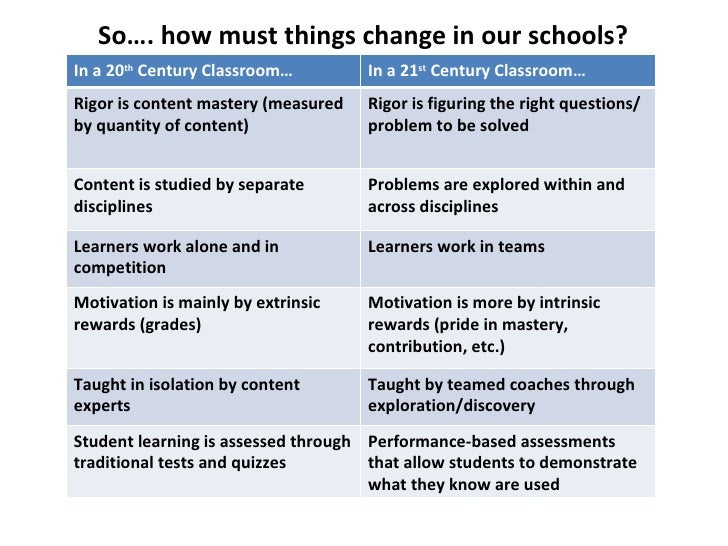
       So why are we surrounded by change and yet we are stuck with relatively little change in our schools?  By "little change", I mean high school classes of about 30 students with one teacher doing most of the talking.  Course requirements nearly the same for all students, even though we have students with different needs and different abilities.  The school day has basically the same start and stop time as 50 years ago.  The school year is basically the same as 50 years ago.  (And not because of farming needs 100 years ago.)  I would argue that the changes to the world, the workforce, technology, and students occurred as a sort of evolution.  No one person or group of people orchestrated these changes.  They happened as a natural phenomenon of humans living on earth and trying to better their situation.  As a species, we are always looking for ways to improve our life and our surroundings.  So we develop better tables and better chairs and better cars and better watches and so on.  Each generation is a little better than the one before it for all of these things.  But a change in schools requires that we conscientiously do something.

       School change requires a community that wants the schools to change.  Someone has to propose the change (or changes).  Someone has to agree.  Then someone has to convince the school board.  And so on and so on.  In the end, while educators may see the need for change in our schools (and not all educators see this change), non-educators often don't see the need for this change.  The common expression is, "This is the way school was when I was a kid.  It was good enough for me, so it will be good enough for you."  The general public is weary of major changes.  Change is disruptive and unsettling.  It is uncomfortable.  People (as a group) don't generally want things to change.  They may accept changes that are forced upon them (such as a new cable company because the old one merged with the new one), but when given the choice it seems that most would vote against change.  This is why (in my opinion) schools are so slow to change.


       As an educator, it is frustrating because I sometimes wonder if we are preparing our students for anything more than higher-level coursework.  Are they learning the skills they need to succeed in the workforce of the 21st century?  Are they able to cope with the world that they will inherit?  Is a high GPA enough?  How do we help the public to embrace the sort of change that will benefit their children?

       Can we allow our schools to change?


Monday, October 17, 2016

High School Graduation Rates Continue to Rise

       In the 2014 - 2015 school year, the high school graduation rate rose to 83.2% according to the National Center for Education Statistics.  This is modern day, national success story.  Twenty years ago, the national high school graduation rate was only 71% and it only rose a couple of percentage points from the 1998 - 1999 school year to the 2005 - 2006 school year (to 73%).  In the past ten years this important statistic has risen ten percentage points.  This is an amazing accomplishment!

       Our educational system is big.  17,000 school districts; 100,000 schools; 50 million students; and 3 million teachers.  This accomplishment isn't due to the effort of just a couple of school districts; or even just a couple of states.  This incredible increase says that we as a country have made it a priority to do everything we can to see to it that students graduate.  We understand that the world that our students will inherit requires an educated mind if we want these future adults to succeed.  We have heard this message and we believe it and we have taken steps in every school to make this happen.

       Even among our nation's poor students the high school graduation rate has risen to 76.1% -- which is a higher percentage than the graduation rate of the whole population of students in 1999.  Imagine the better life that will exist for these students in their future -- all because their parents and teachers and schools wouldn't allow them to drop out.

       So often we hear only bad news about our public schools.  We only hear about students who don't succeed and schools that don't have certain programs and teachers that don't have the tools they need.  We should celebrate the great successes we've had (such as the highest graduation rate ever) because they tell us that we are headed in the right direction.  They tell us that our efforts have paid off.  They tell us that we have achieved great success.  In the entire history of American Education we have never had a graduation rate this high.  This is something that all of us can be proud of because all of us have had a hand in helping this to happen.

       So thank a teacher, keep pushing your child to do well in school, and recognize that our nation's schools are working hard everyday to improve the lives of our students; your children.


Tuesday, October 11, 2016

Why Can't High School Classrooms Be More Like Elementary Classrooms?

       Every level of schooling from elementary school to high school has its challenges.  Among them are teaching to the academic and age level of the students.  No one wants second graders to read high school level novels and it wouldn't be appropriate to take 15 minutes of class time to explain to high school students how to use scissors.

       However, when teachers create a learning environment in their classrooms there are some aspects of learning that are true for both elementary and high school students.  One of these is the idea that when students are engaged in their learning, they tend to do better.  There are plenty of reasons why this makes sense, and they apply to little kids as well as teenagers (and adults).

       In elementary school, while it may be true that the children are more excited about learning and school just because little kids are generally happy and willing to do what they are told to do; it is also true that their teachers work hard to make the learning engaging.  Look at this list of aspects of an elementary classroom, and consider which (if any) could not also be aspects of a high school classroom:

  • motivating posters on the walls
  • opportunities for students to be out of their seats often
  • opportunities for students to talk with each other during a lesson
  • working in whole groups
  • working in small groups
  • working individually
  • using educational technology
  • students given choices (perhaps about what to read or where to sit or how to solve a problem)
  • calling on every student every day
  • classwork that is challenging ("too easy" is boring and "too hard" can lead to disinterest)

       The things that make elementary classrooms fun and interesting can be replicated in our high schools.  High school students like to learn.  They also like to receive a gold star and a smiley face every once in a while.  They like to get out of their seats during a class activity and they like to ask questions of their peers to help them to understand a new concept.  High school students like motivational posters on the walls and they like to use educational technology.  All of these things keep high school students engaged in the learning process, even when the learning is difficult.

       There should be more similarities between our elementary and our high school classes when it comes to engaging students to learn.

Sunday, October 9, 2016

Breaking News: High School Is Not Supposed to be Boring

       Too many parents have this idea that says, "If it was good enough when I was in high school, than it's good enough for my kids."  Of course, they hated it when they were in high school.  But for some reason, they are "OK" with the same boring classes and senseless assignments for their own children.

       I'm talking about high school classes with:

  • students sitting in rows
  • teacher always standing in the front of the room
  • worksheets, worksheets, worksheets
  • very little (or none) students discussing, asking questions, or working together
  • homework on stuff they already know how to do
  • no use of educational technology
       I've seen high school classrooms with multiple students who have their heads on their desks and the teacher seems to be "OK" with this.  Too many classes in which the teacher asks the class something like, "Do you understand?" and one student says "Yes" and the teacher assumes that everyone in the class understands.  And the students know that this is going to happen and they don't want to say out loud that they don't get it.  I've actually heard parents say to their children, "School is supposed to be boring.  That's just the way it is."  They believe this and (now) their children believe this.

       I've got breaking news for all of the parents and students who believe that school is supposed to be boring.

It does not have to be this way.


       Think about your favorite teacher in high school.  Or think about your child's favorite teacher in high school.  What makes this teacher so special?  Why does this teacher stand out among all of the high school teachers you've ever had?  Was he or she boring?  Do they appear to not care if you passed or failed?  Of course not.  We've got lots of high school teachers who work hard every day to engage their students in the learning.  They believe that it is their responsibility to ensure that all students are learning; and they understand that students cannot learn solely by sitting and listening.  

       Learning requires doing, talking, listening, questioning, arguing (at times), trying and failing and trying again.  Students need to get out of their seats during class from time to time (or everyday)--especially in high school classes that last 80 or 90 minutes.  High school students should work in small groups without the teacher for part of the class.  They do it in elementary school and middle school; so they can do it in high school too.  We have teachers who understand this very well and they establish a true learning environment in their classrooms.  Students know that these teachers really care about their learning and they make an effort to encourage the learning everyday.


       High school isn't supposed to be boring.  Learning rarely happens in the context of "boring".  Compliance may happen; memorization may happen; even decent grades may happen.  But learning won't happen.  And if learning isn't happening, then what's the point of school?

Sunday, August 14, 2016

Parent's Role in Improving Student Achievement

       If you have a child in elementary, middle, or high school, then your main concern is helping your child to do well in school.  You have a person or persons in your household that is a member of the most important cliental in the educational community--the students.  And as a parent, you have influence over your children.  Your attitudes and actions toward school matter.

       We need your help!

       So here is my short list of the three top things that parents can do to help their children to do well in school.


  1. Healthy relationships all around.  
Help your child to make friends with classmates and to get to know the teacher or teachers.  You (the parent) should try to get to know your child's teacher(s) too.  Communication is the key to all healthy relationships.  So try to discover the best way to contact the teacher.  Make sure that your child knows that you have a relationship with the teacher and a way to make contact on an as-needed basis.  This shows that you care about your child's education.  

   2.  Emphasize "learning" over "getting-a-good-grade".

The point of school is learning, not getting a good grade.  There are lots of ways to get good grades without learning much.  We want students to learn how to learn; to read; to study; to try and fail and try again; and ask for help.  Your child's grade should reflect his or her ability; but sometimes it just reflects his or her ability to do what they're told.  Remember that the goal of school is learning.  It's the "Do you best." philosophy (that your parents probably said to you).

    3. Don't help your children too much.

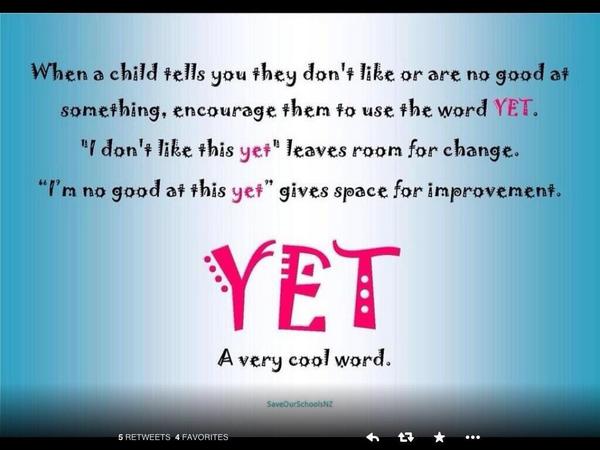
Let's face it...nobody likes to see their children struggling.  But if everything is easy and can be obtained without effort then you have to ask, "Is my child really learning anything?"  Real learning comes from a little struggle from time to time.  Just because your child doesn't "get it" the first time doesn't mean they will never get it.  They just haven't gotten it yet.  If you tell them the answer or do the work for them, they will get the right answer, but they haven't learned anything.  Remember, the goal of school is learning.  Instead of telling them the answer, ask questions.  "What do you know?"  "What don't you know?"  "What do you need to know?"  "What questions should you ask the teacher?"  We want students to learn how to deal with struggle; we want them to problem solve when the problem is difficult.

       School means a lot of things to a lot of people.  Clubs, sports, friends, activities, requirements, homework, pens, paper, teachers,....  It can be hard to remember that it is all about learning.  As the parent, you can help your child to focus on the important parts of school.

       Have a great school year!

Saturday, July 9, 2016

Creating a Better High School - Part 3

       This is the third in a three-part series that will look at the structures in place in our current high schools that don't make sense or are not needed anymore.  I want to think about the best way that students learn and create a high school that will serve these learners.  I also want to think about the true purpose of high schools in our time.  My goal isn't to imagine a "High School of the Future", but instead to consider what can realistically be done today.  As always, I encourage my readers to add their thoughts and ideas.  Together we can create the high school that our students want and need today.

Create a Better High School

Part 1 - Current school structures that aren't necessary anymore.
Part 2 - How students learn and how schools can react to these learners.
Part 3 - The purpose of high school

-----------------------------------------------------------------------------------------------------------------

The Purpose of High School

       This could be a short post because all I really want to say is that the purpose of high school is "Learning".  That's it.

       Indeed, the purpose of schooling in general is learning.  However sometimes it seems that the purpose of high schools is "getting-a-good-grade".  This can be stated in many ways:
  • Getting a grade
  • Doing what your told
  • Compliance
  • Grade Point Average (GPA)
  • Test scores
But this is not the intention of high school.  The purpose of high school is learning.  We want students to learn.  In fact its more than that...We want students to learn how to learn.  Our current system is all about doing stuff to get a good grade.  Learning might take place; and we (as educators) certainly want learning to take place.  But many students are stuck in the rut that says, "I just have to do what I'm told to get the grade; to get the credit."  For many students, "Learning" comes in second or third place (if rated at all) in their list of priorities.

       So how do we create a better high school that emphasizes "Learning" over "getting-a-good-grade"?  We know that when students are interested and excited about what they are doing, they are more likely to try their best and more likely explore, to ask questions, and engage in the effort to complete the task.  Therefore, we need high school to include more project-based tasks.  We also need students to engage in tasks in small groups so that they have the chance to debate ideas with fellow students and allow their peers to evaluate their ideas and suggestions.

       I believe that we (also) need high school to include instructional techniques that encourage a growth mindset in our high school students.  Part of the reason that students sometimes show such a small amount of motivation is because they believe that no amount of effort will enable them to learn.  We want students to understand the value of effort.  Growth mindset teaching helps students to understand this.  But growth mindset is not well understood by our current teachers.
       Our better high school will evaluate learning in different ways.  Rubrics, peer evaluation, presentations, portfolios.  We already use a lot of these methods.  This is not futuristic; this is today.

       We have to separate the "Learning" of high school from the "Grading" of high school.


Wednesday, July 6, 2016

Creating a Better High School - Part 2

       This is the second in a three-part series that will look at the structures in place in our current high schools that don't make sense or are not needed anymore.  I want to think about the best way that students learn and create a high school that will serve these learners.  I also want to think about the true purpose of high schools in our time.  My goal isn't to imagine a "High School of the Future", but instead to consider what can realistically be done today.  As always, I encourage my readers to add their thoughts and ideas.  Together we can create the high school that our students want and need today.

Create a Better High School

Part 1 - Current school structures that aren't necessary anymore.
Part 2 - How students learn and how schools can react to these learners.
Part 3 - The purpose of high school

-----------------------------------------------------------------------------------------------------------------

How students learn and how schools can react to these learners

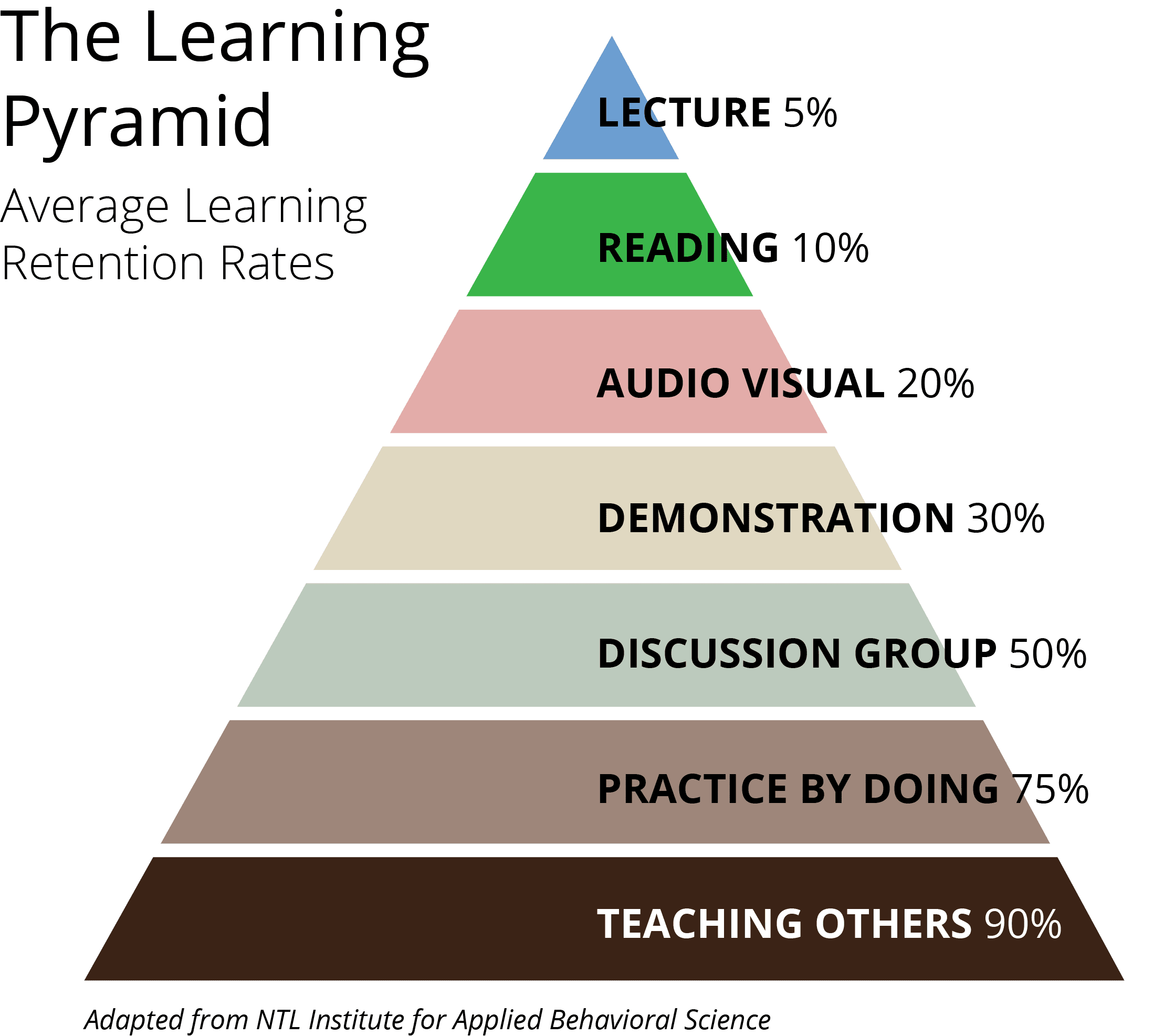
        When I think about creating a new high school, I'm really thinking about all of the traditional structures of our current high schools that don't respond to the way students learn.  The typical high school class still consists of a teacher in the front of the room who does most of the talking while students sit in rows facing the front of the room and take notes.  Students generally only talk to answer a question; to which the teacher confirms or denies its correctness.  This sort of learning (generally) falls in the "Lecture" category which is the least effective strategy for helping students to learn.

       The organization Jobs for the Future has recently published a series of papers titled Students at the Center.  In this series, they list four principles of student-centered learning.  These are:
  • Learning is personalized
  • Learning is competency based
  • Learning takes place anytime, anywhere
  • Students exert ownership over their learning
These four principals lead to deeper learning which is the sort of learning that gets students exited about what they are learning and encourages retention of their learning.  Deeper learning prepares students for both college and careers because it teaches them how to solve problems, how to work with other people, and how to think critically.

       The "changes" needed in our current high schools are changes that respond to these four principles and respond to the best ways that students learn.  This will require changes for teachers as well as changes in the expectations for schools from our parents.  Part of the struggle of changing high schools is that every adult has had the same basic schooling experience.  We are comfortable with it.  Teachers teach the way they were taught--they didn't devise these structures, they just mimic from their high school teachers and the only changes are additions of what they thought their teachers should have done and subtractions of what they thought their teachers did wrong.

       We need our high schools to be the places in which students are still learning to write and read and do math and understand history and make and appreciate art and learn about physical fitness.  But all of this has to be done in a way that encourages learning as opposed to encouraging "getting-a-good-grade" and encouraging competition with other students.  Students need to actually solve problems, to work with each other, to talk and learn how to argue their point.  The college-bound students should be able to master the beginnings of Physics and Calculus; but should also be to experience the work of the field they aspire to enter.  They should be able to more than just what they are told to do.  They should be thinkers and reasoners and creators and doers.  The career-bound students should master the art of expressing themselves in written and oral forms; they (too) should experience the workplace before leaving high school.  They should know how to build on the basic skills of any job and seek ways to make it better.

       We want students to learn; we want them to learn how to learn; and we want them to learn in abundance.  Because learning doesn't stop when you receive your high school diploma.


Sunday, July 3, 2016

Creating a Better High School - Part 1

       This is the first in a three-part series that will look at the structures in place in our current high schools that don't make sense or are not needed anymore.  I want to think about the best way that students learn and create a high school that will serve these learners.  I also want to think about the true purpose of high schools in our time.  My goal isn't to imagine a "High School of the Future", but instead to consider what can realistically be done today.  As always, I encourage my readers to add their thoughts and ideas.  Together we can create the high school that our students want and need today.

Create a Better High School

Part 1 - Current school structures that aren't necessary anymore.
Part 2 - How students learn and how schools can react to these learners.
Part 3 - The purpose of high school

-----------------------------------------------------------------------------------------------------------------

Current School Structures that Aren't Necessary Anymore

       There's this "joke" about schools that educators don't find funny at all.  The joke says that Rip Van Winkle sleeps for 100 years.  When he wakes up, he walks around town and notices everything is different.  The grocery store, the cars, the roads, the clothes people wear,...everything.  Then he comes to a school and walks in and sees a classroom and he smiles and says, "Finally, something that looks familiar to me."  (Don't laugh.  Not funny.)

       People like "familiar".  People tend to resist change.  But do you really want a doctor who only uses medical knowledge from 1920?  Do you want an ice box instead of a refrigerator?  Do you want a rotary phone instead of a smart phone?  Why do we welcome these changes and resist changes to our schools?  

       Mr. Van Winkle recognized the student desks in neat rows and the teacher's desk in the front of the room.  He recognized the chalkboard on the front wall.  If he happened to visit while school was in session, he would see all students arrive at school at the same time and leave at the same time.  He might have recognized the students moving from class to class every 45 minutes; carrying textbooks and pencils and notebooks.  During classes, he might have recognized the teacher verbally teaching--doing most or all of the talking--while the students took notes and listened to the teacher.  If he stayed for a few days or a few weeks, he might see the teacher giving written tests and returning assignments with grades on them.  He would see report cards.

       I want to think about basic school structures and think about if they are still the best way to conduct a high school in the 21st century.  Here's my short list:

  • Why does high school have to start at 7:30am?
  • Why do all classrooms have a "front"?
  • Why do teachers do most of the talking?
  • Why are desks in rows and pointing in the same direction?
  • Why do we use individual students desks?
  • Why do we use grades to measure knowledge?
  • Why do all students learn the same thing at the same time?
  • Why do textbooks constitute the "primary source" of content?
  • Why four years?
       Do these structures produce the results we want?  Do these structures "work" for most of our students?  It's not that I don't like structure.  We have a lot of students and a lot of instruction in a lot of content areas to provide to them.  Structure of some sort is probably necessary.  But does it have to be these structures--the same basic structures that we've had in high schools for a hundred years?  Is there a better way to use the tools of education that we have today to help our students of today to prepare for their futures of tomorrow?

       Most or all of the items on my list are not part of SOME high schools (or some classes in some high schools) today.  So this isn't a futuristic view of what high schools could be--these things are happening today in some small way in many of our high schools.  But should these structures change for all of our high schools?  And what will be the new structures for high schools?


Wednesday, April 27, 2016

Future Schools: It's All About the Learning

       In the future, our middle and high schools won't use grades and grading--at least not the way we think of grades and grading today.  Parents will brag about what their children are learning.  As the school year ends, students will reflect on what they learned--rather than on the grades they got.  Colleges will identify qualified applicants based on what they have learned in their P-12 schools.


      Students will move at their own pace; some will finish high school when they are 16 and some finish when they are 21--and both are perfectly acceptable.  There will be an appreciation for the value of education throughout our society; and all students will feel valued in their schools.  Teachers will teach classes and help individuals; sometimes face-to-face and sometimes online.  "Sit-and-get" lecture will be replaced with active learning that includes students working and learning together--actually talking with each other during school.  Questions will be asked and problems will be solved everyday.  Students will view effort and struggle as value and necessary elements of the learning process.

       Computers and tablets will be viewed as tools for learning and for gaining information.  Students will find the data and facts that they need to make conclusions and to discover new things; to prove theorems and to create stories and art; to publish, to communicate with their learning team, and to keep lists of further areas of inquiry.

       Some students are already enjoying this school experience; for others it probably sounds like a fantasy.  I believe that current elementary school students will see pieces of this future school before they graduate and their children will see this school system as normal.  Our society can not accept an outdated system to prepare our students for their futures.  Change is not a luxury; it is a necessity.  It's not about being #1 in the world; it's about doing what's right for the next generation.


Wednesday, January 20, 2016

Higher Rates of Women in Engineering


       Are we doing enough to encourage girls to pursue careers in Engineering?

       It isn't enough (anymore) to say that there are more women in Engineering today then there were 10 and 20 and 30 years ago.  The numbers of women in Engineering in these past years was so low that (one would hope) those numbers have gone up.  But recently, the percentage of females earning bachelor degrees in engineering has stubbornly remained only steady.

       Lots of data suggest that the number of female engineers should be increasing.  More high school women are taking Statistics, Calculus, and Physics.  More women than men have been enrolled in college since 1978.  Women have been earning more college degrees than men since 1981.  And the prospects for jobs in engineering is growing.  
       Opportunities abound; so if you're a middle or high school teacher or principal, or you're a parent of girl, be sure they get the message that they can do anything.  Don't feed the stereotype that says men are engineers.  Help them to be proud of their abilities and to pursue their dreams.  

       We need more women to be engineers.


Monday, June 8, 2015

How Much Help is the Right Amount of Help for High School Students?

       Parents and teachers want school-age children to be responsible--at least, "responsible" given their age.  But what is the right amount of responsibility for a high school student--or for a new college student?  How much "help" do 16 year olds (or 18 year olds, or 20 year olds) need to navigate the rigors of high school courses, college courses, and college life?

       Some high school students seem to breeze through high school with very little guidance from adults while others struggle--same for college.  These students make some teachers say, "See!  They can do it, so anyone of you can do it."  But is this just a "sink or swim" mentality?  Does this viewpoint help students learn responsibility, or does it prevent them from succeeding.

       On the other end of the spectrum, some say that we help student too much in high school and (so) they aren't prepared for the independence of college courses.  (Is it true that college teachers don't help their students?  I hope not.)  High schools help students to remember deadlines and they offer after-school help.  Is that "too much" help?  What is the proper balance of teaching responsibility and helping students to successfully navigate courses and school programs?

       I believe that their is value in allowing students to make mistakes and to learn from those mistakes.  I also believe that we should not be so extreme in our "caring" at the high school level that we (as teachers) do too much for students to the point that they only doing-what-they-are-told and are not learning anything.  But should we allow them to fail a course if they know the content but struggle to meet deadlines?

       Should we really expect 14 year old 9th graders to hear a long, long, long list of directions and rules on the first day of school and then penalize them for not following rule # 56 on the 23rd day of school?  Should we have to remind 11th graders of the term paper deadline everyday for three weeks?  How much help is the right amount of help?

       I think my main concern is for students who capable of learning what they need to learn at a satisfactory level (or higher), but they struggle with skills such as organization, planning ahead, learning school procedures (such as college course sequences), and meeting deadlines.  I know that these skills are important and (certainly) we want these future employees to have these skills.  But is high school and college the right place for penalizing teenagers and young adults who are still developing these skills?  I am particularly concerned about students who drop out of high school or college due to a lack of organization and not due to a lack of academic ability.

       As public schools, we should do everything we can to help our students to succeed.  But how much "help" is too much help, and how much "help" is too little help?


Wednesday, April 15, 2015

The Challenge of Educating Poor Students - Part 1

       American Public Schools face many and varied challenges.  Funding, equity, and public support to name a few.  On the top of this list of challenges, I would include: The Achievement of Poor Students.

       It is easy to understand the underpinnings of this problem, and yet it is extremely complex to succeed in overcoming this problem.  The problem stems from two indisputable facts:

  1. Poor students consistently demonstrate lower achievement than their non-poor peers.
  2. The proportion of poor students in our nation's public schools is over 50% and is growing.


       I will examine this challenge from three perspectives:

  1. Poor students who have succeeded in our schools
  2. Understanding the special and different needs of poor students 
  3. Expert advice on successfully educating poor students
--------------------------------------------------------------------------------------------------

The Challenge of Educating Poor Students - Part 1

Poor students who have succeeded in our schools

       Every public school can point to a student who comes from a poor family and (yet) defies the odds and does well in school academically.   Or...Can they?  Unless you know the student's background, it might be hard to find these students in your school.

       The outward signs of poverty are relatively easy to see:  dirty clothes or the same clothes day after day; same, single pair of shoes everyday; no extra school supplies.  And then there is the attitude--opposition behavior, attention disorders, excessive absenteeism.  Taken alone, these are not necessarily signs of students from poor homes, but taken together there can be assumptions of the student's home lives based on these visible factors.

       Unfortunately, it is so common for poor students to have low academic achievement that when we have a poor student who succeeds in the academics of school we (often) don't see that child as being from a poor background.  So what is it that propels a poor student to achieve where his/her peers don't?  And what can we learn from poor students that succeed that can help us to raise the achievement of other poor students?

Vocabulary Acquisition


       According to a study from 1995, from the age of 7 months to the age of 3 years, 90% of the words used by children were words used by the children's parent (or primary caregivers).  Parents with higher educations used more words than parents with less education AND higher educated parents talked to their babies and toddlers more than less educated parents.  This creates an "Achievement Gap" among very young children before they even begin Pre-kindergarten.

       But poor students who succeed in school often come to school with a good vocabulary because they were blessed with parents and/or caregivers that shared with them the (totally free) gift of words when they were very young.  Babies and toddlers can learn words from parents reading books to them; but they also learn from simple talking and singing.  So families that cannot provide a lot of children's books to their children can still provide the precious gift of words by simply talking to their children every day.

Grit

       The story of Karvel Anderson is the best definition of grit that you will ever find.  Karvel's story is one of a child who grew up with many challenges but never anything that made him give up on life.  He says that adversity was good for him because he always wanted to prove that he can do anything.

       Most students from poor backgrounds succumb to the narrative that they will never succeed because it seems like the world is against them.  Every where they turn, some one is taking away an opportunity or refusing them something.  Grit is a personality trait in which a person strives to achieve goals regardless of the obstacles that may stand in the way.

A Supportive Adult

       Poor student who succeed usually have an adult in their life that is there to encourage them when times are tough.  It might be a parent, but it also might be a teacher, a grandmother, a school counselor, or a coach.  While some students seems to have the ability to overcome just about any situation, most poor students need someone to guide and help them through the toughest times.


       As schools and teachers look to increase the achievement of poor students, I believe that we have to understand that the world they live in can seem very different than our world.  We need to understand how their lack of resources and supports is a great hindrance to their academic success.  And we have to find a way to fill in the supports that they are lacking so that we can help them to value education and to be successful in school.


Public Schools and Choice

       Is it true that public school kids and their public school parents don't have choices?  I'm sure that I will expose my igno...

Teach100 blog