Monday, December 28, 2015

Top Five Posts of 2015

       As I finish my second full year of blogging, I'd like to take a look back at 2015 and the five posts that got the biggest response from my readers.  But first I'd like to thank some of the many fellow bloggers that I've read and (sometimes) responded to over this year.  These professionals have caused me to pause and think about the various issues in public education that (perhaps) need to be changed; or that need to at least be debated.  I've also read many, many inspiring stories about teachers who work very hard--with little recognition--to help their students to succeed.

       Thank you to Alice Keeler, Starr Sackstein, Justin Tarte, Annie Murphy Paul, and Daisy Dyer Duerr.  I used to think that these were Super-Hero People who had some special gift or ability in the area of education.  But I've come to understand that they are just regular people like you and me who are eager to share their thoughts and ideas with the rest of us.  I, for one, am extremely grateful to include them among my professional learning community.  (And so are tens of thousands of other educators who follow these folks!)  I am continually inspired by your words; you keep me going and keep me writing.  Thank you.

------------------------------------------------------------------------------------

       Here are my top five posts from 2015:

#5) Open Letter to Teachers

       This was the second (and most popular) of a three-part series of Open Letters to the three most important stakeholders in our educational system: Students, Teachers, and Parents.  I wrote this "letter" to teachers on the eve of the 2015 - 2016 school year.  It was published on August 19th.  In it, I talked about how excited teachers are when a new school year begins--something, I bet, a lot of students don't realize.  I wrote about the tough job of teaching and I applauded the men and women who accept this responsibility.    Sometimes being a teacher involves difficult conversations with students about the need to continually struggle to learn something that isn't easy at first. Teachers shape the minds that shape the future of our country.  Teachers' influence over student achievement is well documented.  We always need great teachers.

#4) Learning vs. The Appearance of Learning

       Published on March 28th, this is an issue in which I feel very deeply.  The issue of the best way to measure learning and the problem (at times) of students appearing to be learning well (i.e. - getting good grades) but its only an appearance and it isn't real learning.
       I feel that P-12 education is the time when we have to be honest with students and their parents.  We don't want students to believe that they are achieving at a high level only to learn later in life (perhaps while sitting in a college class) that the grades they earned in high school did not represent their true ability.  The job of schools is to help students to learn.  We need to use multiple measures to get a true picture of their level of learning.  "Getting-a-good-grade" is not the job of schools.

#3) We Should Value Good Thinking More Than We Value Good Memorizing

       This post, from May 29th, quotes from Dr. Jo Boaler and Cathy Seeley.  In it, I talk about how our students'  thinking should be rewarded more than their ability to memorize math facts.  Sometimes elementary children who are very good at memorizing their multiplication facts (and recited them quickly) are viewed as being more able than students who cannot do this.  But we really don't students who can merely memorize facts.  What we really want is students who can think and reason and build on known facts to gain further knowledge.  Sometimes students memorize facts without knowing why the facts are true.  Later in their P-12 education they struggle because of this lack of understanding.  The goal isn't speed; the goal is learning.


#2)  No More Worksheets

       I began this post (from April 3rd) with a simple question:

Does you your child's mathematics teacher assign a lot of worksheets for homework and classwork?

If the answer is YES - Not a very effective teacher.
If the answer is NO - Likely to be a more effective teachers.


       Of course, this is an exaggeration, but the point is that this staple of P-12 education (the worksheet) should be a thing of the past.  They are boring; they are very un-engaging; and they de-emphasize thinking over mere "following steps".  They represent the opposite of what we want to see in our classrooms today.  Students should be spending class time reasoning and thinking and debating; they should be sharing ideas and thoughts.  They should hear from other students.  By the response I got from my readers, I'm thinking that this idea is not as radical as it may sound to some.

#1)  Growth Mindset Teachers

       This post had the most views of any post I've written since I started blogging more than two years ago (142 posts).  I talked about the idea of Growth Mindsets as created by Carol Dweck.  Specifically I talked about teachers who have the mindset that says anyone can learn.  These teachers help their students to understand that learning is always possible; productive struggle is a good thing; and their past negative learning experiences does not predict their future learning.


       Thank you to everyone who have shared this journey of learning and thinking with me in 2015.  The best of us are always trying to improve and to learn more.  Continue on and find your way to be the best educator you can be.

       All the best!

Peter Cincotta


Saturday, December 26, 2015

Students Remember the Fun Stuff

       I remember my Algebra 1 teacher taking off his shoes and socks in class one day.  He did it to demonstrate the need to do certain things in a proper order--otherwise, it just doesn't work.  The Algebra lesson probably had something to do with Order of Operations, but the real lesson was to complete each step in a process in the correct order.

       That lesson happened over 30 years ago and I still remember it because it was a little silly; a little goofy.  It wasn't a lecture; it wasn't a worksheet; it wasn't the normal classroom.  It was strange and odd and that it probably why I remember it.  As an educator (now), I think I also remember this event in class because it showed me that my teacher was willing to be a little silly to make a point.  He didn't have to be the Big Formal Authority in the classroom at every second of the class.  He was allowed to have some fun with his class--and still be a great teacher.

       I often tell teachers that it is not our job to entertain.  But it is part of our responsibility to motivate students to do their best.  Students don't think in educational terms such as "student engagement", "participatory learning", and "stations".  Most students just this fun.  It's not a show; it's not entertainment.  "Fun" to students is when the math class or the English class involves the students in the learning.  Its when students are not forced to stay seated for the whole period; to listen and not talk for the whole period; to take notes and learn on their own for the whole period.


      What students call "fun", teachers call "good teaching".  You don't have to be an entertainer to be a good, engaging teacher.  Chances are most teachers are already excited about the content that they teach.  The job is to convey that excitement to your students.  Involve them in the learning.  Allow for time out of their seats; time to talk and argue with other students; time to think and create and share their thoughts and ideas.

       Students don't just "like" the class better when they are involved, they actually "learn" better.  And isn't that the whole point of school in the first place?

Thursday, December 24, 2015

A Passion to Make Education Better

       I often say to my children, "It takes less time to do the thing I'm asking you to do than it takes to argue about it."  Am I allowed to say this to adults who are critical of public education?

       Of course, I don't mind if people disagree with decisions made about their child's school or school district.  But mere negative comments don't usually help to make our schools better.  If everyone who disagreed with a school-level decision, instead, were to offer a possible solution, or make an effort to understand the reasons behind the decision, or step up to make things better we could accomplish a lot.  We can help to improve attitudes about public schools AND we can help to improve our schools.

       We want people to be passionate about their local schools and we want people to be partners with their schools.  Education is important.  It's more important than sports; it's more important than grades; it's more important than social status.  Education helps everyone: students, businesses, society.  The effort to improve schools has to be a group effort.

       Be passionate about education.  We need you.


Wednesday, December 23, 2015

Teachers That Inspire Students

       Who is your hero?

       Who do you look up to?

       This is a very common essay question for students at all levels.  The list of people who fill the pages of these essays is long: parents, athletes, friends, teachers, grandparents, historical figures, authors, poets, leaders,....  The world is full of inspiring people.  It is easy to think of such a person and maybe difficult to think of only one such person.

       These people make us believe that we can do anything.  They help us to overcome obstacles, to work harder, and to be better people.  They ask for very little in return--usually nothing.  They come to mind during the times in our lives when we think that we can't go on or we can't achieve.  They are our own, personnel superheroes.

       Most people can think of a teacher who has inspired them.  Usually a teacher who demanded high performance and worked hard to help you to achieve.  Our favorite teacher(s) were the people who believed we can do more than we believed we ourselves could do.

       Teachers that inspire students to do their best are the teachers that every parents wants their children to have.  They make learning adventurous, exciting, and thrilling.  They give their students the tools to tackle difficult problems and the self confidence to keep trying when they don't "get it" the first time.

       Be the teacher that inspires your students.


Friday, December 4, 2015

Soft Skills Education

       Our public schools' biggest offering is opportunity.  Students learn from qualified professionals and from a long list of course offerings--probably the longest at the high school level.  But we are not just teaching our students the R's, we are preparing them for the adult world.  This means that we are also tasked with teaching our students the so-called "soft skills".  Here is a short list of some of these skills:

  • Listening 
  • Presentation Skills 
  • Giving Feedback 
  • Decision Making 
  • Inspiring 
  • Persuasion 
  •  Interpersonal Relationships 
  • Dealing with Difficult People 
  • Conflict Resolution 
  • Self Confidence 
  • Resilience 
  • Assertiveness 
  • Friendliness 
  • Empathy 
  • Problem Solving 
  • Critical Thinking 
  • Organization 
  • Planning 
  • Scheduling 
  • Time Management
       Employers tell us that high school and college graduates who have these soft skills are much more likely to be successful employees than those who don't.  Students aren't "graded" on these skills in school, however many of these skills are incorporated into classrooms as rules of behavior (friendliness, conflict resolution, planning), suggested steps in completing assignments (decision making, resilience, organization), and learning strategies (problem solving, critical thinking, giving feedback).

       Students who are successful and confident usually possess these skills at a high level.  Students who are only concerned with the "book work" of school may possess the knowledge needed for their future, but they may also struggle with relationships with their co-workers.  This "soft-skills" education is an important part of our school system.  The ability of our students to get along with other students and to organize their thoughts, ideas, and lives is all a part of growing up and being responsible.  


       And everyone gets to receive this education for free in our public schools.  


Friday, November 27, 2015

Tinkering Around the Edges Isn't Sufficient for Significant Improvement in Our Schools

       There's a joke among some educators that says if a child doesn't understand the lesson, then we will just say it again slower and louder.

       It's not a funny joke.  In fact its really sort of a put down to teachers who struggle to help students to learn.  If the teacher presented the lesson in the best way she knows how, then she may not know of another way to present the lesson and (so) when a students doesn't get it, she just repeats the same thing (sometimes slower and louder).  This usually doesn't help the student to learn any better than the first time, but it does lead to frustration for both the student and the teacher.

       These situations are far too common in our nation's classrooms today.  Improving these situations is haphazard at best.  Sometimes some students try harder; sometimes some teachers try different strategies.  But most of the time, instructional change is small (or absent) and academic results remain the same.

       Still, this doesn't happen from a lack of trying.  Plenty of teachers (most teachers) try very hard to learn more and to improve every year.  They read books; they attend conferences; they take classes; they join Professional Learning Communities (PLCs) within their school or school system or online.

       Change is hard, and improving academic results for student groups that have historically struggled in the traditional school system is a complex problem.  It isn't the sort of problem that can be solved by tinkering around the edges; and by not causing some level of discomfort for people who insist that everything is fine the way it is now.

       I believe that we have the knowledge and the research to know what must be done to improve education outcomes for the students that we aren't reaching today.  These strategies and policies are available for everyone to see.  A short list of books from a variety of sources provides the answers we seek.  Here are some of them:

  1.  The Results Fieldbook: Practical Strategies from Dramatically Improved Schools, by Mike Schmoker
  2.  Whatever It Takes: How Professional Learning Communities Respond When Kids Don't Learn, by Richard DuFour
  3.  School Leadership that Works: From Research to Results, by Robert Marzano
  4.  Teacher Leadership that Strengthens Professional Practice, by Charlotte Danielson
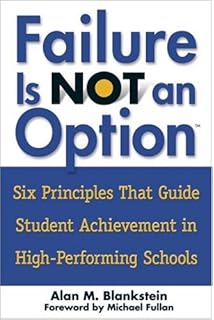
  5.  Failure is Not an Option: Six Principles that Guide Student Achievement in High-Performing Schools, by Alan Blankstein

       However, I also believe that the change we need involves the hard work of constant improvement.  It requires schools to dig deep into the standards and objectives that are taught everyday and to ask questions such as, 
  • What is the best way to teach this objective to students?
  • What strategies should we use?
  • What activities are best?
  • How do we reach a classful of students with different learning styles?
  • How do we assess student understanding?
  • How do we assess the success of the decisions we made for this lesson?
       This is complex work and it requires effective collaboration among teachers--no one should have to do this on their own.  If we are successful, it will take a generation to complete this transformation of our schools.  During that time, we will have to contend with a lot of resistance from educators and non-educators alike.  However, this is an effort that is worth the years of hard work.  This is an effort that today's teachers can look back on and be proud to say, "I was there when the hard work was done."

       Tinkering around the edges isn't enough anymore.  It's time to do what we tell our students to do--Work hard and you will see the rewards in your future.

Tuesday, November 17, 2015

It's Time for Our Schools to Leave the 20th Century

       You know the old joke about Rip Van Winkle and schools?  He falls asleep for a hundred years and upon waking up he sees everything he used to know has changed dramatically.  The houses look so different.  The clothes that people wear are very different.  And the cars...wow.  Then he finds a school and walks inside.  He goes into a classroom and he is comforted to see that schools and classrooms haven't changed a bit.

       We educators don't think this is very funny.

       In fact, it is embarrassing for us carry out the important work of education today in the same way that we did this work 50 or 30 or even 20 years ago.  Doing so ignores the research about learning that has been done over the past few decades.  It ignores the research about how the brain reacts to the stimuli that occurs in classrooms.

       For instance, we know that most students can't learn to the best of their ability strictly by sitting in class for a whole class period and listening to the teacher talking (and taking notes).  We know that students are more engaged when they have the opportunity to participate verbally and when they have a chance to get up out of their seat and participate physically in some way.  We have technology that we didn't have (even 20) years ago that can be tapped to help our students to prepare for the information world that they will enter after high school.

        We are not preparing our students by merely teaching them to read, write, and do arithmetic.  These things are important, but they are not enough.  Memorizing facts long enough to get a good test grade will not prepare our children for the world that they will inherit.  Our schools have the responsibility to mirror the society that our students will experience.

       Twentieth Century schooling is not what our students need.  Most of them have never even lived in the 20th century.  I believe that our current education leaders understand this need for our schools to change.  Part of the responsibility of our public schools is to explain this need for change to our parents and to our communities.  Staying the same is easy; change is hard.  Schools often face opposition from communities who tend to say that "The old way was good enough for me and it's good enough for our kids."  We need to make the case against this sort of thinking.

       Someone needs to speak for our students and for their futures.


Public Schools and Choice

       Is it true that public school kids and their public school parents don't have choices?  I'm sure that I will expose my igno...

Teach100 blog