Wednesday, July 29, 2015

The Grading Monster

       This is a story of a idea that grew up and got bigger and eventually took over a population.  The idea was to use grades to classify a student's ability.  This idea has grown into the the current Grading Monster that we have today.

       The origins of this idea, attributed to William Farish, seemed innocent enough--find a way for teachers to teach more students.  But what it did, instead, was to separate the important student-teacher relationship that had symbolized teaching for most of the 10,000 years prior.

     It would be fair to say that grades have overtaken the main purpose of schooling--which is to learn.  Of course this is not true for all students, but when students complain about academic performance, their complaint is much more commonly about their grade than about the learning that did or did not take place.

       Parents tell their children to get good grades rather than to learn a lot.  And when grades are low, discussions about how grades are determined and how these grades will affect course placement and/or college acceptance are the paramount concern over and above the concern that students are learning well enough.  More often than then not, the concern over learning is never brought up when grades are low.


       Dr. Justin Tarte talks about grades a lot in his blog Life of an Educator by Dr. Justin Tarte.  He points out many pitfalls that our educational system has fallen into when it comes to grades and grading.  Starr Sackstein is another blogging star of mine who has discussed grades and grading recently.  Clearly the effects of The Grading Monster are well known by educators and maybe, just maybe, we will begin to see this monster lose her strangle hold on our educational system.
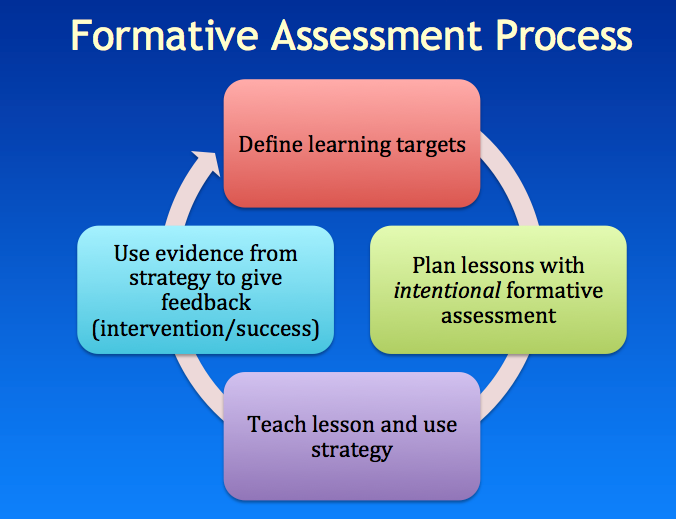
       My thoughts on defeating this monster include the more common use of true formative assessments in our classrooms.  My definition of "formative assessments" is assessments and activities that provide to students and parents (and teachers) information on how well the students are learning.  Notice that I included the "activities" in this definition--as formative assessments don't have to be tests and quizzes.  In fact, I would advocate that most of the time formative assessments are not tests or quizzes.

       If we can emphasize the idea of learning and of measuring learning and de-emphasize the idea of getting-good-grades, we can defeat The Grading Monster and win back our schools for their true purpose--learning.


Monday, July 20, 2015

Building the Academic Strength of Our Weakest Students

       School is about learning.  And most students do fine when it comes to learning what they need to learn in school.  For most students, its not a matter of passing or failing; its more a matter of learning very well or not learning so well.  But for some of our students, keeping up-to-speed in their reading, writing, and mathematics skills as they go through their middle and high school years is difficult.  As a public school system, a lot of effort is focused on helping these students to improve their skills.  This is an important mandate in every public school.

       We know from research that students who are below grade level in reading by the end of third grade often struggle with their reading skills throughout the rest of their P-12 schooling experience.  (link to study)  They are also more likely to leave school without a high school diploma.  Difficulties in learning mathematics have been similarly well documented.  Students with weak math skills also struggle in high school mathematics and are less likely to graduate from college (see here; go to chapter 3 on page 45).  It is because of these known consequences that schools make every effort to raise the skills, abilities, and understandings of students who are weak in reading, writing, and mathematics.

       At the heart of this effort is the struggle of understanding how these students think and how they learn.  Clearly, the "usual way" of teaching and learning is not working; and so schools look to other resources and teaching strategies to reach these students.  Understanding the best ways to motivate students to do their best in school (especially when they have experienced only failure in the past) is an important task for schools and teachers.  One excellent resource is the book Mindsets by Carol Dweck.  In it Dr. Dweck explains the psychology of how people perceive their abilities to learn.

       There is no shortage of intervention programs that are available to schools (at a cost) for the purpose of helping students to regain "grade-level" status.  Schools invest in these programs and train their teachers.  Some students show excellent improvement while others do not.  It is a constant challenge to find the best way to help our weakest students.  But it is a challenge that our public schools eagerly accept every day.

       Learning is for everyone and everyone can learn.  Building the skills of our weakest students is an important responsibility of our public schools--one that we take very seriously.

Thursday, July 16, 2015

Make Math Meaningful: Math Tasks

       The days of the boring worksheets in math class and the word problems about the train leaving New York are over.

       Well...actually, they're not over.  But they should be over.

       We already know that most students (and adults) do not learn new things very well just by listening to someone explaining it; after which the teacher often says something like, "Does anyone have any questions?"  This is when the students want to say, "How can we have any questions about this?  You just taught it to us one minute ago.  (And then they get a worksheet.)

       This is passive learning.  This learning promotes adherence to procedures and getting-the-right-answer over true learning and understanding.  Some students do fine and some students do not; and it is simply not acceptable to engage in teaching strategies that don't help all of our students.

       Math classes should be places where students are actively engaged in their learning.  Students are presented with a problem or a task and they work in groups to brainstorm ideas based on the objectives that they have been recently learning.  The final answer can be reached via multiple solution methods and (most importantly) the students are using and learning mathematics simultaneously.  Finally, students are able to explain what they are doing (teaching others) which is a way for students to demonstrate their understanding.

       Math Tasks are written to be activities that students can do in small groups in their math classrooms under the direction and supervision of their math teacher.  Math Tasks are meant to take the place of the old 20-problem-worksheets during class time.  Instead of students working quietly and independently, they are working together with other students: learning from each other and sharing their ideas.

       There are many online resources that have wonderful math tasks.  Some of my favorites are:

  • Illustrative Mathematics
    • Go to Content Standards, then chose a Grade, then chose a Domain, then chose a cluster, then chose a standard and you'll see a list of Math Tasks.
  • Mathematics Assessment Project (MAP)
    • Click on Tasks and see a list of middle school and high school Math Tasks.
  • Inside Mathematics
    • Click on Performance Assessment Tasks and chose a grade or course to see a list of Math Tasks
      Math Tasks model the way math is done in the real world.  That's where you are presented with a problem and you have to decide which resources to use to find a path to the answer.  There is more than one way to get the answer and sometimes there is more than one possible answer.  Math Tasks help our students to understand mathematics.


Saturday, July 4, 2015

Educational Testing Should be Compared to a Health Check-up

       There's a lot of talk about testing in schools these days.

       Should we test students?  Is there too much testing?  What should be on the tests?  Are the tests too easy?  Are the tests too hard?  Do tests measure student ability?  Are high-stakes tests fair?  Standardized tests, the new SAT tests, college-readiness tests, ...and so on and so on.


     On a purely surface level, some students (and parents) do not like the big, end-of-course tests or the big standardized tests because they don't score well on these tests.  And that bad score leads to other negative and uncomfortable issues:
  • students feel bad
  • students feel not smart
  • course grade is negatively affected
  • looks bad on high school transcripts
  • negative affect on grade point average (G.P.A.)
  • negative affect on class rank
This opposition to this sort of testing has nothing to do with learning or the student's (or the parent's) feeling toward the test representing the quality of learning that took place during the course.  This opposition is purely about how the "after-effects" of the test will effect the student's stature, ranking, or reputation in some way.

       On a much different level, some people are concerned about the ability of the "big test" to accurately measure a student's academic ability in a particular subject area.  Alfie Kohn stated his many concerns about standardized testing in his 2000 article titled The case against standardized testing: raising the scores, ruining the schools.  In it, he offers a history of the origins of current-day standardized testing and lays out some of the problems with our current system.  On the other side of the debate, is the book Defending Standardized Testing (2005) edited by Richard Phelps.  This book examines testing via multiple points of view such as: research on standardized testing, misconceptions about large-scale testing, high-stakes nature of some assessments, and the issue of the growing testing industry.

       I view educational testing in the same way I view going to the doctor for a health checkup.  The two extremes are too extreme.  Never seeing a doctor is bad because you might never know if you are developing a serious health issue until its too late.  And seeing a doctor for a full physical checkup everyday is not necessary because your health isn't going to change on a day-to-day basis.  But seeing a doctor (perhaps annually) and following his/her advice is necessary for good health.

       Educational testing is necessary because there has to be some sort of measure of academic ability so that we can fairly compare a student's ability with other students.  If students never take advantage of standardized testing they could go through 12 years of formal schooling believing that all is well only to enter college and to discover that they are unprepared for college-level work.  Educational testing should not be used to rate schools as if they were in some sort of horse race.  They should be used to measure true learning--which is the purpose of schooling in the first place.  They should be used to provide students, parents, and teachers with good information on what students know and understand and what they don't.

       We don't have competitions with other people on who has the lowest cholesterol level or the highest pulse...We shouldn't have competitions on who gets the highest grade on standardized tests.  They should be used for individual results.


Saturday, June 27, 2015

Somebody Has To Tell Them

       Nobody likes to hear bad news.  And nobody wants to be the person to give the bad news.


       In our public schools, we (sometimes) have the following problem...a student is not achieving at an acceptable level.  He tries to do well; he does some things well; but overall his achievement is too low for his grade or age level.  Public schools have lots of ways of helping students to raise their level of achievement and (indeed) it is our job and moral responsibility to do so.

       The problem is that someone has to tell the student and his parents that he is achieving below grade level.  That is a hard conversation to have.  No teacher wants to tell their students' parents this news.  No parent wants to hear this news.  But someone has to do it because we don't want to allow students to go through school thinking that they are doing fine (academically) when, in fact, they are below grade level.

       Sometimes we try to give this news through grades on report cards or via standardized testing grades, but the message doesn't always get through.  Sometimes students get a few good grades on minor assignments and parents "hang on" to those grades and seem to ignore the poor grades on the more major assignments.

       And so, sometimes students go through elementary and middle school thinking that they are doing fine and then they get to high school and struggle with their academic course work.  Even worse, sometimes these struggling students even go through high school with no one in authority ever telling them that they are below grade level.  These are the students that go on to college and (only) then are finally told that they do not have the ability that they thought they had--no one ever told them.

       Our job is to help students to learn.  Part of that job is telling students how well they are learning.  We don't help our students by letting them think that all is fine when it isn't.  Someone will tell them at some point, so it might as well be sooner rather than later.  It doesn't have to be an argumentative conversation.  Teachers and schools will help students to do better--that's our job.

       One way to communicate this message is to have a grading policy that rewards high academic achievement and discourages mere compliance with school and classroom rules.  While we certainly want students to behave in school, what we really want is for students to learn in school.  Teachers who have high expectations for their students and are very clear about those expectations tend to have students who reach those expectations.

       It's OK to tell students that they have not achieved the goal yet.  It doesn't mean that they will never get there, but it does tell them that where they are (academically) is not acceptable and they have to do more, try more, and achieve more.

       Somebody has to tell them.  Be brave and be the one who cares the most about your students.  Be clear about your expectations and tell students when they have and haven't met these expectations.


Tuesday, June 23, 2015

Why Do You Teach?

       The school year ended four days ago and I am thinking about welcoming my teachers to the next school year.  (Wow.  That was a short summer vacation.)

       Every year in our school district the teachers return to school one week before the students return.  On one of the days of that first-week-back, all of the secondary teachers in the district meet in their subject areas for a full day of professional development before the school year begins.  This is a time to learn about new resources, to network with other teachers in other schools, and to energize teachers to get excited about the new school year.

       We know that an effective teaching strategy for student understanding is to ask a lot of questions that encourage students to think about what they are learning.  If students can explain what they are doing and why they are doing it, they must understand it pretty well.  It also reinforces the idea that we want students to understand underlining concepts and not just to get-the-right-answer.

       In that vein, I am going to ask our teachers some questions in an effort to encourage them to think about what they do and why they do it.  These question will challenge the teachers to consider different possibilities.  They will be questions that defy simple answers.

       I'm in the beginning stages of preparing this presentation and I am certainly open to suggestions.  Feel free share (in the comment section below) other questions that you feel would be good questions for teachers in the beginning of the school year.

Questions:
(1) Why do you teach?
(2) What are your goals this year?
(3) What will you do differently this year?
(4) How will you make a difference?
(5) What do you want to learn this year?
(6) Why is mathematics difficult for some of your students?
(7) How will you help students who don't ask questions?
(8) How will you engage your students in their learning this year?
(9) How do you help your students to value "learning" over "getting-grades"?
(10) Why do you teach?

       We ask (or should be asking) our students difficult questions every day.  As such, we need to ask ourselves difficult questions.  Teaching students who are willing and able and ready to learn is easy.  But trying to reach the unwilling, the struggling, and the distracted student takes time and effort and expertise.

       Why do you teach?


Friday, June 19, 2015

Summertime Learning


      Summertime may offer a break from formal schooling, but learning can take place in all sorts of formal and informal ways throughout the summer.  Many school districts offer summer programs that are part academic and part recreational.  Boy Scout and Girl Scout summer camps offer lots of learning opportunities that involve working with groups of people as well as individual projects.  Of course many libraries offer summer reading programs for children of all ages.


       Family trips during the summer offer children the opportunity to learn about different places and different people and (perhaps) different foods and different climates.  There are also many online programs that help students to sharpen their math skills such as TenMarks and Discovery Education.

       Learning takes place in all sorts of settings and in all times of the year.  Summertime can provide time for families and for children to explore interests and build on abilities.

       What will you learn this summer?

Public Schools and Choice

       Is it true that public school kids and their public school parents don't have choices?  I'm sure that I will expose my igno...

Teach100 blog