Wednesday, July 23, 2014

Getting Technology, Learning Technology, Using Technology

     I am so excited about the upcoming school year!

     For the first time ever, all of our school buildings will be wireless enabled.  This is the first step in our efforts to build a 1-to-1 learning environment for all of our students.  This is such an exciting time to be in education.  We have had a couple of schools pilot a Bring-Your-Own-Device (BYOD) system and we have learned from their experiences.

     In less than a month, I will meet with 250 teachers in a wireless-enable high school auditorium.  I can't wait.  During this meeting we will use Google Hangout to hear from four different companies that offer four great products for use in the classroom.  Some parts of these products are free to all teachers for use in the classroom and some have a fee.  All of these products have embraced the 21st century learning model of encouraging students to discover information and to ask more questions about what they see and learn.
   
     None of the four presenters will be physically present in the auditorium.  This is how we learn in the 21st century.  One presenter will be 3000 miles and three time zones away from us.  The four companies presenting on this day will be: DesmosTen MarksDiscovery Education, and Learn Zillion.  The teachers in the auditorium will bring their own devices and will be able to access the website of each company as the presenter is talking.

     It will be a great learning experience for our teachers and an excellent example of the possibilities that (now) exist in our classrooms as the 1-to-1 learning environment begins.

     At 50 years old, I am constantly learning about different websites and various learning products that provide resources to students and teachers.  The P-12 education landscape is (indeed) changing to mirror the lives of our students.  We must change to keep up with the changes that are happening all around us.

     So get ready to bring your device to school.  It is lighter than a textbook and infinitely more valuable as a learning tool.


Wednesday, July 16, 2014

The Best Teachers are Lifelong Learners

   
     Every teacher has this experience.

     It usually occurs during the first year of teaching.  I hear them saying it all the time.  "I never knew this (content) so well until I had to teach it."  "I understand this content so much better now--as a teacher--than I ever did as a student."

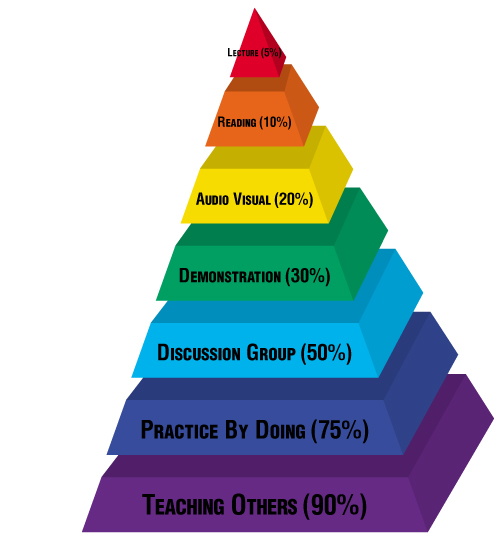
   There is actually a lot of research behind this idea that "doing" and "teaching" helps students (and adults) to learn, understand, and retain information.  And it makes sense too.  

     As much as (some) teachers would prefer that their students learn merely by listening, the data suggests that very few students (and adults) learn solely by listen.  The best learning occurs when students can combine what they've heard with what they see and what they are asked to do.  Learning comes from struggling with concepts, asking questions, discovering answers, discussing ideas with other learners.  The best learning comes from "doing".

     If this is true for adults, then it is true for students too.  An active classroom is a learning classroom.  Teachers that are able to create an atmosphere in which students are willing to ask questions and pose ideas tend to have better student outcomes that those that can't (or won't).

     From a teacher's perspective, the best teachers are constantly learning new things about their subjects.  This is the deep understanding that comes from building on previous understandings.  Teachers aren't finished learning when they complete their college degree requirements.  Teachers continue to learn and to improve.  

     Teachers are lifelong learners!

Tuesday, July 15, 2014

Meeting the Needs of All Students

     One thing that I have always been proud of about public schools is our desire and efforts to meet the needs of all students.  This seems like a natural thing for schools to do; but when we say "All", we mean "All".  While most students fall in the average category, some students are very strong academically and some struggle a lot with academics.  Public schools strive to help all of these students wherever they may fall on this spectrum.

     Probably the most difficult part of achieving this goal is reaching the students on the extremes.  For students who have severe learning disabilities, public schools have personnel trained in Special Education who work with teachers to help our weakest students to achieve.  Improvements in the education of our weakest students have been great over the past generation; and these improvements continue.

     For students who are significantly strong academically (able to understand work that is two and three--or more--grade levels above their current grade level) public schools look to make special arrangements.  This can be done via online courses, grade acceleration, and help from outside organizations.  Keeping these students challenged year after year is a challenge for our schools.  But we do our best to make it happen.

     As always, a good working relationship between parents and schools is the key to great outcomes for students.


Saturday, July 5, 2014

Learning During Summer Vacation


     In addition to relaxing and enjoying time with family, summertime is a time for teachers to take courses to persue masters degrees, to take part in curriculum development, to read books about teaching and learning, and to prepare for the next school year.

     As a math supervisor, summertime is always a busy time for me as I prepare to roll-out updated curricula and new resources in addition to planning leadership development and professional development for all of our secondary mathematics teachers.  My school district is also on the ground floor of developing a 1-to-1 learning environment and I want to help my teachers and leaders to successfully progress to this new teaching and learning model.

   Additionally this summer, my wife's bookclub is reading The One World School House written by an ex-hedgefund manager turned educator by the name of Salman Khan.  The bookclub invited me to read the book and to join in on the monthly meeting where they will discuss the book.  Considering that education is one of the extremely few subjects that I am comfortable talking about with other people...How could I say no?

     Furthermore, our superintendent is also leading a book study on the book Outliers by Malcome Gladwell.  This book is about successful people who might not have seemed to have success in their future when they were young.  Gladwell suggests that family various situations as we grow can help to shape the future of any child.  Our futures are not predetermined.

     And so, I look forward to entering the new school year with new knowledge about students and learning.  Pretty good for a guy in his fifties!


Tuesday, July 1, 2014

Everyone is an Expert

     Sometimes it seems as though everyone is an expert at education.  And it makes sense because everyone went to school at some point in their lives (or they are currently in school).  Education is often in the news.  Politicians debate about education and comedians joke about education and business leaders laud the value of education.  So it makes sense that there is a lot of knowledge about education out there.

     It would be fair to say that (from time to time) the diverse knowledge about education in a community can sometimes lead to disagreements.  But on the whole, I believe that hearing different points of view leads to better decisions for our schools and for our students.

     Parents often cite their own experiences in school.  Some are positive and some are negative.  Often we want to keep the things that we felt worked well and change the things that we felt didn't work very well.

     I've always felt that it is incumbent on public schools to explain their decisions to the public.  In doing so, it helps to educate the public about the issues that our public schools face today.

     And every public school wants to have a good relationship with their students' parents.  Parent involvement leads to better academic results for children and it strengthens our schools.

     I think that the hard part is to hear from as many parents as possible.  Often, it is the parents that are the most happy or the most angry that tend to speak up and be heard.  Schools want to gain the expertise of all of our parents.

     So don't be afraid to speak with your child's teacher or principal.  There want to hear from you.

Friday, June 27, 2014

Teach100 Education Blogs


     The TEACH100 list of education blogs is a treasure trove information, ideas, resources, and people in the world of education.  Blogs from established companies like The Washington Post and Discovery Education can be found.  But mostly there are blogs from regular teachers, principals, and other educators who want to share what they do and what they have learned with others.

     If you want to learn about technology in the classroom, this is the place to go!  There are lots of blogs about technology.  Check out: iLearn TechnologyTechnology Enhanced LearningDitch That TextbookCommon Core and Ed TechTechnology Made Easy in Education, and so much more.

     There are lots of blogs about teaching mathematics.  Some of my favorites are: I Speak MathMath NinjaMaths InsiderMagical Maths, and Math Coach Blog.  And (again) lots of other great blogs about teaching mathematics.

     In fact, there are blogs on just about every subject and issue related to education that you can think of.  Here is a small sample of the many topics that are covered in this list of blogs:


If you are looking for just about anything that has anything to do with education, TEACH100 is the place to find it.

     And, by the way, TEACH100 has far more than one hundred blogs.  They add to their list of blogs often.  As of June 2014, they are up to 692 blogs.  (In fact, this blog is among the list of the education blogs in TEACH100.)

     Are you looking for a little summer reading (or "Summer Personal Professional Development"), TEACH100 is a great place to go.  It is all about the educator and the act of education.  

     Enjoy!

Monday, June 16, 2014

Concerns about Summer Learning Loss

     It is summertime and students have a ten-week vacation from school.  Should I be worried?
     Well, I think the answer is "Yes" and "No".

     On the "Yes"-side, there does appear to be evidence that students lose some level of knowledge during the summer article.  But, on the "No" side, it looks like this loss may be exaggerated another article.  Also, the "loss" appears to occur more often among poor kids than among middle-class kids (see graphic below).


    Also on the "No" side, there are 50 million students in P-12 education in the United States and a good majority of them seem to do OK year to year.  So, if there is a summer loss, Is this something that we should worry about?  I think that we all want the best for our children and we all want our children to do their best at all times.  We want them to remember what they have learned; we want them to grow physically and academically.  We don't want them to struggle.  If your child is required to do a lot of reading during the school year and then he/she does no reading during the summer, it makes sense that some loss of ability is going to occur.

     No parent would ever allow their child to go without vegetables for ten weeks during the summer.  So don't allow your child to go without exercising and reading and doing math and thinking and creating and discovering and learning during the summer either.  It's not that we are afraid that they will get a bad grade in September.  It is that we want our children to grow all of the time.  That includes academic growth.

     During the summer, the parents are the teachers and the home is the school.  Keep learning!

     For ideas to keep up your skills in mathematics during the summer, check out our Summer Math site.

Public Schools and Choice

       Is it true that public school kids and their public school parents don't have choices?  I'm sure that I will expose my igno...

Teach100 blog