Saturday, March 7, 2015

Blood Donors and Students: Doing the Right Thing

       I've been a blood donor since I was 18 years old.

       Over the years, I've grown more and more impressed with the blood donation system in the United States and Canada via the America's Blood Centers and the American Red Cross.  They have a difficult and (yet) very important job.

       Here is the difficult part:

       Imagine if you had the job of trying to convince people to volentarily have a needle stuck in their arm?  They would also have to answer a lot of personal questions about their past travels--especially if it included travel to certain countries--and questions about their possible drug use and even their sex lives and sex partners.  As compensation for going through this ordeal, donors would receive a hearty "Thank You", a bottle of water, a snack, and occasionally a free T-shirt.  No money; no raise; no notoriety.  In fact, friends and neighbors would probably question your reasons for doing such a thing if you were a blood donor.  And if all of this wasn't tough enough, only 38% of the U.S. population is eligible to give blood (source) because of various health and risk factors.

       Here is the important part:
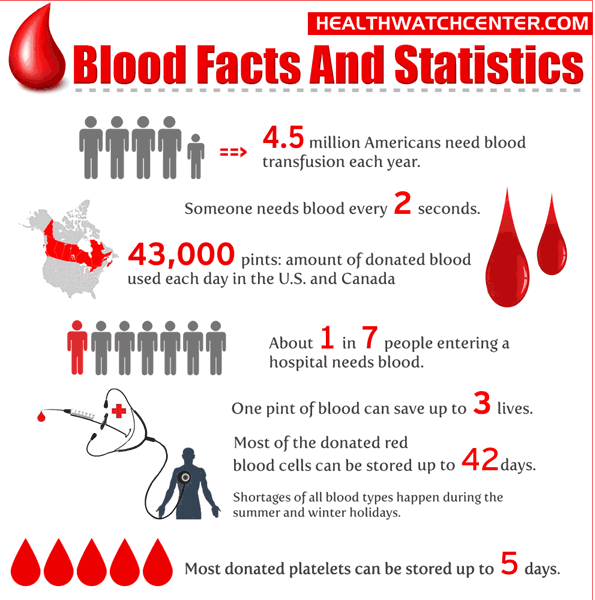
       Blood can not be manufactured.  The only way hospitals and medical centers can get blood is from people donating blood.  Blood is needed everyday for accident victims, people with Sickle cell disease, and people with cancer (source).  Over 15 million blood units are needed in the U.S. and Canada every year.  To make matters even more dire, blood can only be stored for up to 42 days (see chart).

       Hence, maintaining an adequate blood supply is difficult to do, and very important to be done.  It is so important that is worth the effort of many people throughout the country to continually seek to find more and better methods of encouraging people to donate blood and to improve the blood donation process.

       When I look at our public schools and their mission, I see many parallels to the efforts for encouraging more blood donors.  Our public schools (also) have a difficult and important job to do.  We accept students into our schools with many and varied backgrounds.  Some are poor and ill-equipped to find success in the academics of traditional schooling; some are new to our country and are trying to learn English while also trying to learn math, science, and social studies.  Some schools have few needed supplies and some classrooms have large numbers of students.  Some teachers are very well prepared to educate their students and some are not as well prepared to do this job.


       Yet, few would argue that the need for an educated public is important.  It is important for the individual and it is important for the society at large.  Hence, it is worth the struggle and the effort to continually search for ways to successfully educate all of our students.

       This belief in the importance of education is certainly shared by educators; but we often find it difficult to convince some students and their parents.  Like blood donors, we don't offer our students money or prizes for obtaining a good education.  Instead, we offer them hope for a better future.  We do our best to help our students to see the value in learning.


       Education is (indeed) the art of selling students (and parents and communities) the future value of learning.  It isn't the grades or the GPA or the credits earned.  It isn't "doing what you're told because, 'I say so'".  Learning is it's own reward.  Learning is the right thing to do because it helps you and everyone around you to be an educated person.

Friday, March 6, 2015

Are the new PARCC and Smarter Balanced Tests Too Difficult?

       Public schools across the country are now using the new PARCC and Smarter Balanced assessments in Mathematics and English/Language Arts in grades 3 to high school.  Aside from the political commentary about these tests, some teachers have concerns that they are too difficult for their students.  Along with this concern comes concerns about hurting students' self-esteem, battling parents' perceptions of their children's abilities, and aligning earned course grades with earned PARCC and Smarter Balanced scores.

       I have heard and read comments that say that these tests are good for students who are very strong academically, but that they are inappropriate for students who are average or below average.  Sometimes parents have commented on sample problems and have stated that they are too hard for the students.

       The standards that these tests are written to are aligned to world-class education standards.  I realize that "world-class" is a buzz word, but I agree that these standards (and associated tests) represent an uptick with regard to rigor compared to those that they are replacing.  We know that too many of our students get good grades in elementary and middle school and then struggle with subjects in high school.  Or, they do fine (in terms of course grades) even through high school, but then they do poorly on the SAT or ACT.  We also know that many students graduate from high school, go to college, and do not graduate from college. (see college graduation rates)

       Hence, public schools are faced with this problem of students who appear to be learning and doing well in school, but then struggle with learning later.  We addressed this problem by incorporating tougher standards and putting in place assessments to see if the students are attaining these tougher standards.  In my opinion, this needs to happen; this must happen.  Nobody wants to see their own child struggling.    But we have to realize that this is already happening:


  • poor SAT/ACT scores
  • low AP scores
  • high percentages of students taking remedial math and english courses in college
  • students dropping out of college before earning a degree
       Until now, we have always been able to say "my kid gets good grades in school, so none of these other things matter to me".  But we have been fooling ourselves.  

       If we want students to be successful, we have to raise the standards (as we've done) and we have to insist on continually high standards throughout P-12 education.  This must happen.  Better education leads to better lives for our future adults--which leads to a better society for all of us.

       The tests are not too difficult.  We must, must, must insist on high standards, and we must do everything we can to help our students to achieve these higher standards.  I believe that our public schools will do exactly this in the years to come.  We will meet this challenge and we will raise student achievement and we will help to produce a society of educated people who are not afraid to face challenges, find solution, and succeed.


Thursday, February 26, 2015

Everyone Should Go to Community College

       The Community College system in the United States is simply the perfect college option for many of our high school graduates in my opinion.  


       Here are some of my reasons for this statement:

  1. Close to home.
  2. Less expensive.
  3. Small classes.
       Let's start with my first reason: Close to home.  I went to a college that had the initials TSC.  (This college has since been renamed.)  Among the students at this college, we referred to "TSC" as meaning "The Suitcase College" because just about everyone went home on the weekends.  I remember thinking at the time that high school students are always complaining about "living under the rules of their parents".  They want to be on their own; they want their freedom.  And, so, I thought that these people were hypocrites when, given the opportunity, would rush back home at every chance they got to do so.

       Of course, it probably isn't fair to categorize young people this way.  It is more likely that they rushed back home to be with their friends.  It is also likely that they really didn't hate their parents as much as they said.  According to the Higher Education Research Institute (and referenced here), 53% of college students attend a school within 100 miles of their home and 90% within 500 miles.  This tells me that most students want to attend college close (or relatively close) to their home.  Surely lower in-state tuition is part of the reason, but I think another reason is that newly graduated high school students are not completely ready to break all ties with their hometown by attending a college that is very far away.

       Community colleges provide the college experience with college courses and college teachers while still remaining close (sometimes very close) to home.  Students don't have to adjust to a new environment--perhaps with new foods and new expressions and maybe new fashions and (perhaps) a new climate--in addition to the (sometimes shocking) new experience of college-level course work.  Change is hard and a lot of change at once can be too hard for some students to endure.  The closeness of community colleges allows students to be close to friends and family and familiar settings, while they adjust to some aspects of college life.

       Reason number two: Less Expensive.  Full discloser; I am the cheapest cheapskate you will ever meet.  If I see something for free, I take two.  So my views of cost are probably skewed when compared to those of normal people.  However, I would think that lots of middle-class, working class, and (certainly) poor people are interested in finding good deals wherever they can be found.  And when you are talking about cost, Community Colleges are a very good deal.


       Tuition costs at community colleges are not merely "less" than those of public and private four-year schools; they are dramatically less--50% less; maybe even 75% less.  And students take the same courses and earn the same credit that they would at the much more expensive four-year schools.  To put a dollar figure to it, according to the College Board (reference found here)  the average cost of tuition and fees at a two-year school is only $3,131 which is just over one-third (60+% savings) of the cost for a year at a four-year institution.

       And here is a sobering statistic that we don't like to talk about, but when it comes to cost this is important.  Only slightly more than 50% of students who enter college eventually earn a degree.  Most people know someone who began college and then left college after one semester or after one year.  Imagine paying $25,000. or $35,000. and then your child drops out of college.  Isn't it better to risk only $3,131 to see if your child is college-ready?  For thirty thousand dollars you could have bought your child a car and rent for a year--during which time he/she could have been looking for job.
       Check out this recent study on the issue of college dropouts.

       Finally my third reason: Small classes.

       I have to be honest here; I'm not completely sure that community colleges can promise small classes or smaller classes that at four-year colleges.  I did find this reference and this one that mention community colleges having smaller classes.  But, to be fair, these references don't cite research.  I know that people often talk about large lecture halls at big, four-year colleges.  If it is true, then the "large lecture hall" is (yet) another major transition that students need to make when they begin college.  Most high schools keep classes to 30 students or less; maybe 35 or 40 would be the biggest class that any high school student would typically experience.  


       Smaller classes don't make students smarter, but they do open the possibility that the teacher would have better relationships with his/her students.  When students and teachers get to know each other, than students tend to do better in classes.  This is the factor that helps small class sizes to lead to better academic performance by students.

       The transition to college is a major life transition for 17 and 18 year old people.  Many new things are happening all at once.  A typical student might be able to handle some of these changes, but still struggle to handle all of these changes.

       Community Colleges help students to manage these multiple changes by being close to home, having much lower costs, and having small classes (similar to high school classes).  They also have all sorts of academic supports to help students to succeed.  Community Colleges are a great deal.  I think everyone interested in earning a BA or MA should consider Community College as a starting point.


Tuesday, February 24, 2015

Good Teachers are Great Learners

       I think everyone has had the experience of teaching something to someone.

       Parents teach their children to walk or to ride a bike or to drive.  Friends teach their friends about cool stuff they find online or cool stuff they read about.  Colleagues teach their co-workers trade skills on the job.

       Sometimes, as a teacher, we are very attentive to the way our learner is "catching on" to what we are trying to show them.  Sometimes, as a teacher, we just go through the steps and explanations with no regard whatsoever as to whether or not the learner is following us.  And sometimes, as the teacher, we get very upset when the learner does "learn" what we just taught them.

       "I just said that."  "Weren't you listening?"  How is possible for them to not understand when I did such a good job of explaining it?

       Teacher know that "teaching" is only half of their job--maybe even less than half.  Their main job is to ensure that students are learning.  Lots of people are very knowledgeable about something; but that doesn't mean that they are good teachers.

       Teachers excel at understanding their students and (to the best of their ability) at understanding how their students are thinking and what it is that is keeping their students from fully understanding the objectives of the lesson.  Good teachers are great learners.  They discover common errors that their students make and use that understanding to help their students to understand.

       Good teachers learn about their students through questioning, discussions in class, notes on classwork, email messages or other electronic resources, meetings with parents, and sometimes facial expressions.  Teachers who care about student learning do whatever they need to do to help their students to learn.

       This is one reason why experienced teachers tend to have more success with student achievement than less experienced teachers.  This sort of learning and understanding of students comes almost exclusively from experience.  It is hard to gain this professional ability strictly from a teacher preparatory program.  Teachers that continually strive to get to know their students and to learn how they think build an ability to anticipate problems in learning and to act on these anticipated problems as part of their lesson planning.

       Teaching is a difficult job.  Students are different and student backgrounds are different; and student abilities are different.  Good teachers strive to understand these differences and to find ways to overcome these differences to help all of their students to learn.

Saturday, February 21, 2015

What is the Best Way to Measure Academic Ability?

       One student is smart.  Another gets good grades.  Another is in the 90th percentile.  A fourth student gets a good SAT score.  Yet another graduated in the top 25% of her class.  And a different student scored a 4 on her AP test.

       What does all of this mean?  What is the best way to measure how well students are actually learning?  How do we know which are the students that are really learning and understanding and able to use the knowledge in different situations; and which students are dutifully doing what they are told to do and completing assignments and earning good grades not learning a thing?

       I think our educational system struggles with this question very often.  We want to learn--it is the main focus of schools to teach students and to help them to learn.  When I say "learn", I mean "real, actual learning".  Not memorizing and forgetting.  Not memorizing long enough to pass the test.  I mean learning; understanding; able to teach it to others; able to use the knowledge at a later time; able to build on the knowledge learned to learn more, higher-level material.  How do we measure a student's ability to actually learn?  How do we know who is really getting it and who only appears to be really getting it?

       Parents see their children's grades.  And (I think) parents make a determination of their children's abilities based on the grades that they get in school.  That is certainly understandable.  We don't expect all parents to be experts in education and we certainly don't expect all parents to be experts in measuring academic ability.  And if the grades (the test grades and homework grades and classwork grades and course grades) accurately reflect their children's abilities, then it is OK to use these grades to gain a sense of academic ability.


       But what do you do when your child gets great grades in class and lousy grades on the final exam, or the SAT, or the PARCC or Smarter Balanced test, or the college entrance exam?  What does it mean when we have students who do great in middle and high school and then cannot handle the academics in college?  Once again, What is the best way to measure academic ability?  Everyone likes to brag about their smart children; and everyone wants their children "to do well" in school.  But at some point we need to have a way to tell if their apparent ability (academically speaking) is actual ability.

       Large-scale testing is one way to measure actual academic ability.  State-level tests, SAT and ACT, PARCC, Smarter Balanced, and NAEP (National Assessment of Educational Progress) tests are all large-scale tests that attempt to do this.  The SAT is a good predictor of a students' ability to do well in their first year of college.  The new PARCC and Smarter Balanced tests are supposed to measure student abilities compared to standards that are taught over the previous school year.  NAEP is a national test given to a sampling of students in every state and in many subject areas to get a sense of our nation's students academic abilities.

       I believe that we want to use multiple data points to determine students' academic abilities.  If a students have good school grades and terrible large-scale testing grades, I believe that we should question why this is the case.  We shouldn't dismiss the low grades and not important; we should question why there is a lack of consistency in the grades.  Similarly, when students get high homework and classwork grades and low quiz and test grades, we should question this.  Sure, it may be that they are nervous when taking a quiz or test; but it also may be that they don't know the content and that is why their quiz and test grades are low.


       I think that it is difficult to use a single measure to determine a student's academic ability.  If you have a mechanic who has been fixing cars for (say) ten years and you asked her to take a test on fixing cars and then to go through a field test in which she actually fixed cars and then to write an essay on fixing cars, you would expect that she would earn similar scores.  This would be provide multiple pieces of evidence that she knows what she needs to know to do her job.  I think the same is true for students and academic subjects.  If a student is sufficiently knowledgeable in (say) Geometry, I would expect her to demonstrate this knowledge via verbal explanations, written exams, performance tasks, and large-scale testing.  And I would expect all of these measures to show a similar level of understanding.

       Our nation's schools have a responsibility to teach so that our students are truly learning.  We cannot accept the mere appearance of learning; we have to do the hard work of ensuring actual, true learning.  And we need to continue to develop and revised the best and most effective ways to measure that this "true learning" is actually taking place.


Thursday, February 19, 2015

Should Teacher Tenure take Five Years?

       Anyone who has ever gone through the process of becoming a doctor understands the many and varied phases that are required to attain the title of "doctor".  This process involves undergraduate work (four years), medical school (four years), residency program (three to seven years depending on the medical speciality), and perhaps a fellowship (one to three years) if the individual is pursuing a subspecialty.  American Medical Association

       The purpose for the residency and fellowship portions of this process is so that these people who have completed the course work of medicine can have experience in the actual process of treating people and making decisions about the healthcare of patients--under the supervision of experienced medical professionals.  No one wants their loved one to undergo heart surgery from a doctor who has only read a book on how to complete a heart surgical process [!].

     Teachers go through a similar process on their journey to becoming teachers:  Four years of undergraduate work that included a semester or more of student teaching--actual planning and then teaching of actual students under the supervision of an experienced teacher.  Then they go through two or three years of teaching as an untenured teacher.  During this period of time they are gaining experience as they are also observed and evaluated by their administrators.  Hopefully they work for a school or school system that also provides professional development during these first couple of years.

       But how many years does it take for a person to become sufficiently knowledgeable about the mechanics and the art of teaching before they can be considered for tenure?  Is two years enough time?  Should it be three years?  Five years?  Across the 50 United States, the time frame between first hire and tenure varies from about 1 to 5 years source.

       Teaching is a difficult job.  It takes a while to learn effective strategies for reaching students and helping them to learn and understand and reason and think.  A typical class of 30 students has students with multiple ability levels and multiple levels of motivation.  Teaching is only half of the job; the far more important half in ensuring that students are learning.  And that takes skill, ability, and experience.  I'm not talking about earning good grades--lots of students earn decent grades and walk out of class without actually learning too much.

       So, how long should teachers be in the "learning" and "gaining experience" mode before we officially endow on them the title of "tenured teacher"?

Tuesday, February 3, 2015

Thinking about Thinking


       There has been a lot of talk recently about the need for schools to teach students how to think.  Actually, the need to build thinking skills has always been a big part of schooling, but our changing world seems to have added to the value of thinking skills.

     So this leads to the obvious question, How do you teach students how to think?  How do teachers create a learning environment in their classrooms that encourage students to think and to reason and to build on past knowledge?

       It is clear that there are times in a typical student's day when they are merely doing what they are told to do.  "Copy the notes,"  "Read this passage."  "Answer the questions."  Very little thinking is needed to complete these tasks.  Quite possibly, no thinking is needed to complete some of these tasks.

       So, once again, How do you teach students to think?  Or maybe I should ask, How do teachers encourage students to think?  One way to do this is to present students with problems to be solved.  We may suggest certain tools to solve the problem, but we do not tell them how to solve the problem.  The "problem" could be lots of things.  Here is a short list of problems to consider:

  1. x+27=51
  2. Run a mile in at least 30 seconds less time than you did at the beginning of the school year.
  3. Learn to drive a car.
  4. What can you do at your school to encourage students to be more friendly with each other?"


       The first "problem" could require thinking or it could require very little or no thinking.  If a tells a students to "subtract 27 from both sides of the equation", the student only needs to do-what-he's-told.  No thinking required.  If, instead, the teacher asks the question, "What number added to 27 is 51?", the student needs to do some thinking.  Of course we want the students to get the right answer, but the more important skill that we (eventually) want is for the student to know how to get the right answer.  We want to know what the student did to get the right answer--or the wrong answer.  We want the student to understand what is being asked and to devise a path to a solution.  (Lots of thinking!)

     The second "problem" is a physical problem.  Let's say that this student ran as fast as she could the first time she ran the mile, and now she is asked to run the same mile in at least 30 seconds less (later in the school year).  Let's also assume that this student has the desire to solve this problem.  She has to think, How can this be done?  What can I possibly do to run faster than my fastest running speed?

       The third problem requires a lot of procedural knowledge and a lot of rules to know.  Before students learn to drive, they often have a great deal of experience riding in a vehicle and (perhaps) observing someone driving.  This is knowledge that can help them when they are learning to drive.  They also (probably) have to learn things that they could not learn via mere observation.  Driving requires a lot of decision making which requires thinking.  Eventually experience with driving lessens the need for most of these thinking opportunities.  But in the beginning, driving requires a lot of thinking.  Considering that so many young people are able to acquire a driver's license, it must be true that even difficult problems that require a lot of thinking can be accomplished when we are sufficiently motivated to accomplish them.

     Finally the last "problem" is a social problem that is not (usually) solved through the learning of simple and procedural steps.  Indeed, this is the sort of problem that tests our abilities to think.  There is certainly more than one answer to this problem, yet these multiple answers may be very difficult to discover.

       Who knows how many difficult problems our students will face during high school, after high school, and well into their adult years?  The ability to think and to reason is a necessary asset in our lives.  Thinking can be taught and thinking can be practiced in our schools.  But thinking must be encouraged.  We cannot allow our students to go through the entire school day--everyday--and never ask them a difficult question that requires thinking.  We cannot allow them to spend all day in school merely doing-what-they-are-told.

       Students need opportunities to struggle with a problem in a classroom learning environment that provides encouragement.  The joy of thinking through a difficult problem and finding a possible solution is an experience that we want our students to have on a regular basis.  Thinking requires practice.


Public Schools and Choice

       Is it true that public school kids and their public school parents don't have choices?  I'm sure that I will expose my igno...

Teach100 blog