Tuesday, September 30, 2014

Change What You Do (or else improvement will never happen)


     It seems we are constantly hearing and reading statistics that say American students are not achieving very well.  We rank low in reading and mathematics compared to other industrialized countries.  A quarter of our children never graduate from high school and the graduation numbers are even worse in college.  Our poor children and learning disabled children and minority children have lower rates of achievement than our white and economically advantaged children.

     All of this is true.  And we don't like it; and we want it to change.  We want all students to be successful; we want all students to graduate from high school; we want all students to be grow to be capable, responsible adults.  But this is a difficult problem--as is evidenced from the years and years of data with very little improvement on these fronts.

     Something has to change.  We cannot keep teaching the same way we have always taught and expect different results.  Teachers give their best everyday.  It isn't a matter of "not trying" or "not doing our best".  We have to do things differently.

     If I knew the solution(s) to this problem, I would tell you.  The best I can do is offer my ideas:

     (1)  We need to instruct students in a way that they respond to; we need to know what they "get" and what they don't get--so we can help them.
     (2)  We need to use more technology in a more effective way.
     (3)  We need to be more concerned about learning and less concerned about grades.
     (4)  We need to use valuable classtime for addressing student questions and much, much less classtime forcing students to complete worksheets.  (If they already know how to do the work, why force them to show us again and again and again.  If they don't know how to do the work, why force them to do ten problems that they can't do.)
     (5)  We need to increase student engagement every minute of every class.  There should be less teacher-talk and more student-talk.

     What are your five best ideas for changing teaching?  If you could do anything in your classroom to help students to learn better, what would you do?  We have to do something different if we want different (and better) results.

Monday, September 29, 2014

Faculty Lounge of the 21st Century

     I am taking a MOOC (That is a: Massive Open Online Course) on Coaching Digital Learning (check it out here).  Recently they held a twitter chat and I said that the PLN's--Personal Learning Networks--are like the faculty lounge for the 21st century (see tweet here).  This tweet got a lot of retweets and favorites; a lot of people seemed to agree with this comment.


     I know that a lot of educators are on Twitter and I've heard (read) many say that they learn a lot from others on Twitter.  But, it is not just Twitter.  I believe that professional learning today and in the future will come from sources outside of our schools and school districts.  And many of these sources will be regular teachers with full class loads who also happen to be very well connected.  These are the teachers who tweet and blog and write books and speak at conferences and are always very willing to share their experiences.

     Back in August (2014) I planned a Professional Development session on digit learning and all of the speakers came to us via Google Hangout.  From the comfort of their own homes or offices, four companies spoke and interacted with 250 teachers.  We could see them and they could see us.  We spoke to them and they spoke to us.  But it was done without them having to board a plane and come to our school district.

     I am going to do it again in December as I plan a meeting with all of the Mathematics Supervisors in Maryland.  This time the topic is Using Technology in the Classroom.  The speakers will be influential people that I have discovered via their tweets and blogs.

     This is how we learn in the 21st century.

Sunday, August 24, 2014

Three Wishes for Education

     As I begin my 27th year in education, I would like to look ahead and think about the three biggest things that I would like to see in education in the United States.  These things may happen before I retire (still a long way off), they may happen before I die (hopefully a longer way off [!] ); but I hope they happen.  So rub the lamp; here are my three wishes.

#1) Poor students learn just as much and just as well as rich students

     We are constantly bombarded with data that shows poor students having lower achievement than their richer peers.  We (in education) know why this happens.  It's not just that they lack money for adequate, nourishing food.  Students from poor families come to school in kindergarten already behind their richer peers.  They have less books in their home.  They have a higher percentage of parents who didn't finish high school and/or never went to college.  They live in more dangerous neighborhoods compared to rich kids.  They don't always have a space at home to study or to do homework.  They don't always have an adult in the home who can help with homework.  When they get sick, they don't go to the doctor as much or as quickly as richer kids; so they get sicker and they miss more school.

     The list goes on and on.  And it's all true.  Poor students have many, many disadvantages when it comes to schooling and learning.  Add to this list that all of their teachers went to college, graduated from college, and probably (most of their teachers) were never poor--since the percentage of poor students going to and completing college (still) remainings embarrassingly low for Americans.  So many of their teachers have little or no experience at what it's like to be grow up in a poor household.

     And so, for all of these reasons (and more) poor students in America have lower achievement than rich students.  I feel that America's public schools have a moral responsibility to these children to see to it that they get a great education and that they succeed in education.  It is our responsibility to prepare these students for the world that they will inherit.  It is our responsibility to see to it that each and every poor student does not continue the cycle of poverty but ends poverty for themselves and for their children.

     It is my number one wish that our public schools do a better job with our most vulnerable students.  In fact, we must do better.

#2 Learning is more important than getting grades

     It probably isn't fair to say this, but a lot of the time I feel that so many of our students are more concerned about getting grades than they are about learning.  I hope that isn't true for the majority of our students, but it certainly seems to be true for many of our students.  We created a monster when it comes to grading and it is out of control.

     Students stay up late and worry endlessly not about whether or not they will learn something, but instead, whether or not they will get this or that grade.  It has led us to a system where many students are great at (what I call) "playing school".  They do what they're told, they read the book, they turn in their homework, they take the test, they get the grade.  And one week later they couldn't tell you anything they learned from that unit of study.

     This is a major reason why so many students begin college and so few finish college.  Heck, this is a major reason why so many students do great in (say) Algebra 1 and do lousy in Algebra 2.

     We have to do a better job and emphasizing the learning and de-emphasizing the grading.  Students need to be rewarded for actually learning.  When they do, they will feel a great sense of accomplishment and will celebrate the learning--and care less about the grading.

     We don't give grades when children learn to ride a bike or play the piano or do a magic trick or hit a baseball.  Yet children find great enjoyment in doing these things--all without grades.  My second wish is for students to find enjoyment in learning--in conquering a difficult subject or a difficult learning task--and succeeding.

#3 All students graduate from high school


     The high school graduation rate in the United States is around 75%.  (Note: In our colleges, the graduation rate is even lower.)  This is a serious problem for our nation and is certainly a serious problem for the people who don't have a high school diploma.  The statistics for people without a high school diploma are awful.  Higher rates of unemployment; lower wages; higher percentages on welfare; poorer health; and (worst of all) a much higher chance that their children will not graduate from high school.

     There have been studies that tell us that many high school dropouts leave school for non-academic reasons.  They don't feel a connection to the school or they don't  feel as if any of the adults care about whether they stay in school or leave.

     We have to take a hard look at what we can do in our schools to keep students in school and to help them to graduate.  I know that this is being done in a lot of places--this isn't (unfortunately) a new problem.  But our economy in the United States is not kind to people who don't have a high school diploma.  This is a problem that can be solved and it will improve the lives of millions of young adults as well as improving the communities all over our country.

     These are my three wishes for education in the United States.  What are your three wishes?  Let me know.  Leave a comment or use the Twitter hashtag #ThreeWishesForEducation.


Saturday, August 2, 2014

Hot Dogs and High Jump

     Take a look at this data from the Famous Nathan's Hot Dog Eating Contest:


Year               Winning Amount
1990                           16
1991                          21.5
1992                           19
1993                           17
1994                           20
1995                          19.5
1996                           22
1997                          24.5
1998                           19
1999                           20
2000                           25
2001                           50
2002                          50.5
2003                           44
2004                          53.5
2005                           49
2006                           54
2007                           66
2008                           59
2009                           68

     Look at the amount of hot dogs eaten by the winners in the 1990's.  Now look at the winning data from the 2000's.  Specifically, look at the difference in the winning numbers from 2000 to 2001.  Yipes!  What happened???  Is this data correct???  The number of hot dogs eaten jumped (tremendously) from 25 in 2000 to 50 in 2001.  How is that possible?

     The answer is Takeru Kobayashi from Japan.  He "changed the game" when it came to hot dog eating contests.  Not being from the United States, Kobayashi didn't have any preconceived notions about the way to eat a hot dog.  He knew that this contest was all about eating as fast as you can.  So he devised a new way to eat a hot dog in this contest.

     Kobayashi took the hot dog out of the bun, broke it in half, and ate the two halves together.  He just put both of the halves in his mouth at the same time.  Then he took the bun, squished it into a ball (with one hand), dunked it in water, and shoved it in his mouth--in one bite.  All together, it took him about ten seconds to eat one hot dog and bun.

     Kobayashi found a different way to eat hot dogs that no one had ever thought of before.  Up until his first appearance at the hot dog eating contest, everyone ate their hot dogs the same way and the winning amount only grew very slowly from year to year.

     The same thing happened in the world of high jumping.  For decades high jump competitors used a high jumping style called the Western Roll (or Straddle).  But in the 1968 Olympics, an American High Jumper named Dick Fosbury used a different technique.  He jumped with his back to the crossbar and went over the bar with his head first and his feet last.

     Once again, no one had ever seen this before and few people had ever tried this technique.  Within a short amount of years however, all world-class high jumper would use this technique (known as the Fosbury Flop).  It is considered far superior to the Western Roll.  Our current high jump world records would never have been achieved using the old technique.

     Dick Fosbury realized that the human limits of high jumping were quickly being reached with the Western Roll technique and he decided to look at high jumping in a completely different way.

Wednesday, July 23, 2014

Getting Technology, Learning Technology, Using Technology

     I am so excited about the upcoming school year!

     For the first time ever, all of our school buildings will be wireless enabled.  This is the first step in our efforts to build a 1-to-1 learning environment for all of our students.  This is such an exciting time to be in education.  We have had a couple of schools pilot a Bring-Your-Own-Device (BYOD) system and we have learned from their experiences.

     In less than a month, I will meet with 250 teachers in a wireless-enable high school auditorium.  I can't wait.  During this meeting we will use Google Hangout to hear from four different companies that offer four great products for use in the classroom.  Some parts of these products are free to all teachers for use in the classroom and some have a fee.  All of these products have embraced the 21st century learning model of encouraging students to discover information and to ask more questions about what they see and learn.
   
     None of the four presenters will be physically present in the auditorium.  This is how we learn in the 21st century.  One presenter will be 3000 miles and three time zones away from us.  The four companies presenting on this day will be: DesmosTen MarksDiscovery Education, and Learn Zillion.  The teachers in the auditorium will bring their own devices and will be able to access the website of each company as the presenter is talking.

     It will be a great learning experience for our teachers and an excellent example of the possibilities that (now) exist in our classrooms as the 1-to-1 learning environment begins.

     At 50 years old, I am constantly learning about different websites and various learning products that provide resources to students and teachers.  The P-12 education landscape is (indeed) changing to mirror the lives of our students.  We must change to keep up with the changes that are happening all around us.

     So get ready to bring your device to school.  It is lighter than a textbook and infinitely more valuable as a learning tool.


Wednesday, July 16, 2014

The Best Teachers are Lifelong Learners

   
     Every teacher has this experience.

     It usually occurs during the first year of teaching.  I hear them saying it all the time.  "I never knew this (content) so well until I had to teach it."  "I understand this content so much better now--as a teacher--than I ever did as a student."

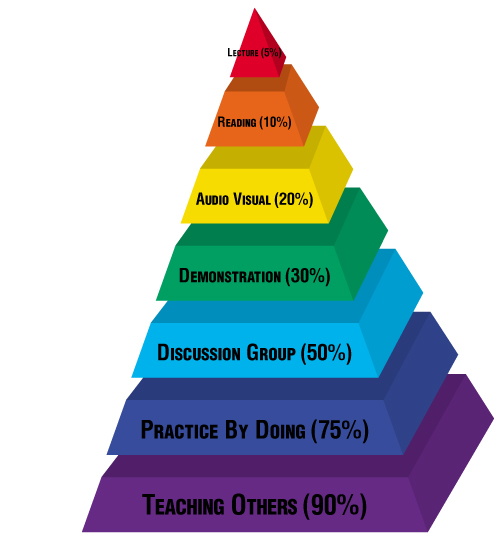
   There is actually a lot of research behind this idea that "doing" and "teaching" helps students (and adults) to learn, understand, and retain information.  And it makes sense too.  

     As much as (some) teachers would prefer that their students learn merely by listening, the data suggests that very few students (and adults) learn solely by listen.  The best learning occurs when students can combine what they've heard with what they see and what they are asked to do.  Learning comes from struggling with concepts, asking questions, discovering answers, discussing ideas with other learners.  The best learning comes from "doing".

     If this is true for adults, then it is true for students too.  An active classroom is a learning classroom.  Teachers that are able to create an atmosphere in which students are willing to ask questions and pose ideas tend to have better student outcomes that those that can't (or won't).

     From a teacher's perspective, the best teachers are constantly learning new things about their subjects.  This is the deep understanding that comes from building on previous understandings.  Teachers aren't finished learning when they complete their college degree requirements.  Teachers continue to learn and to improve.  

     Teachers are lifelong learners!

Tuesday, July 15, 2014

Meeting the Needs of All Students

     One thing that I have always been proud of about public schools is our desire and efforts to meet the needs of all students.  This seems like a natural thing for schools to do; but when we say "All", we mean "All".  While most students fall in the average category, some students are very strong academically and some struggle a lot with academics.  Public schools strive to help all of these students wherever they may fall on this spectrum.

     Probably the most difficult part of achieving this goal is reaching the students on the extremes.  For students who have severe learning disabilities, public schools have personnel trained in Special Education who work with teachers to help our weakest students to achieve.  Improvements in the education of our weakest students have been great over the past generation; and these improvements continue.

     For students who are significantly strong academically (able to understand work that is two and three--or more--grade levels above their current grade level) public schools look to make special arrangements.  This can be done via online courses, grade acceleration, and help from outside organizations.  Keeping these students challenged year after year is a challenge for our schools.  But we do our best to make it happen.

     As always, a good working relationship between parents and schools is the key to great outcomes for students.


Public Schools and Choice

       Is it true that public school kids and their public school parents don't have choices?  I'm sure that I will expose my igno...

Teach100 blog